Three medical billing trends are having the most immediate operational impact in 2026. AI-powered claim scrubbing and denial prediction becoming standard in billing departments of all sizes, electronic prior authorization reaching meaningful interoperability across major payers, and value-based payment arrangements tying a growing share of reimbursement to quality metrics rather than visit volume. Each trend […]

Articles posted by Alex J. Lau
How to Get Credentialed with Medicaid: State Requirements, MCO Enrollment, Timelines

Medicaid credentialing happens in two layers, state enrollment and managed care plan credentialing, and in most states you need both before you can treat Medicaid members. There is no single federal application, which is why guides that treat it like Medicare send so many providers to the wrong place first. This guide explains who you […]
MedicaidGroup NPI or Individual NPI: Which Fits Your Practice?

The National Provider Identifier (NPI) is a unique 10-digit number assigned by CMS to identify healthcare providers on claims. There are two types, Type 1 NPI and Type 2 NPI. A Type 1 NPI belongs to an individual provider. A physician, nurse practitioner, physical therapist, or any licensed professional who delivers patient care. A Type […]
Billing Mistakes, CMS-1500, Group NPI, Individual NPI, Provider NPIThe Most Common Reasons for Credentialing Denials

The most common reasons for credentialing denials are worth knowing before you submit another application. Getting credentialed with insurance companies should be straightforward, but for many healthcare providers, it turns into a months-long headache. You’ve spent years earning your medical degree, completing residencies, and building your practice. Yet somehow, filling out insurance forms becomes one […]
CAQH, Credentialing Denials, DEA Registrations, Hospital Privileges, Malpractice History, NCQAA Guide to Provider Credentialing with PacificSource

Provider credentialing is a fundamental quality assurance process in healthcare, so patients receive care from qualified medical professionals. For healthcare providers seeking to join PacificSource’s network, mastering the credentialing process opens doors to serving one of the Pacific Northwest’s most established health insurance organizations. PacificSource operates as a not-for-profit health insurer serving Oregon, Washington, Idaho, […]
How 2026 E/M and Telehealth Rules are Changing

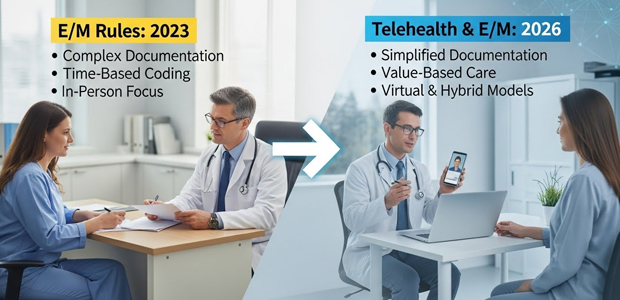
The 2026 CMS rules for Evaluation and Management services and telehealth introduce changes that affect how providers document visits, select E/M code levels, and bill for remote care. The changes are not cosmetic adjustments to existing guidelines, they modify how medical decision-making components are weighted, clarify time-based coding for total encounter time, and establish which […]
E/MHow to Choose and Prepare Professional and Peer References for Credentialing

Professional and peer references are the part of a credentialing file you don’t control, unlike most of the paperwork. Other clinicians write them on their own schedule, and under the NAMSS best-practice standards, chasing a source that doesn’t respond falls back on you as the applicant. The file stays incomplete until the last one arrives. […]
Credentialing Applications, Credentialing Delays, Credentialing References, Peer Reference, Professional ReferenceOut-of-Network Billing: How to Appeal Low Payments and Recover Fair Reimbursement

Out-of-network billing operates without a contracted rate, which means the provider sets their charges and the payer determines what they consider an appropriate payment, and those two numbers are rarely the same. Payers use methodologies like “usual and customary” rates, “allowed amounts,” and geographic database benchmarks to calculate payments that frequently fall well below the […]
EOB, OON, Out of Network, Out-of-Network ProviderPhysician Credentialing Checklist: Every Document You Need, When to Start Gathering It

A physician credentialing application requires documents from every stage of a provider’s career. The medical school transcripts, residency completion certificates, state licenses, DEA registration, malpractice insurance declarations, board certifications, and a gap-free work history. Gathering those documents takes longer than most providers expect. Medical schools and licensing boards that still operate on paper can take […]
Continuing Medical Education, Credentialing Checklist, Credentialing Documentation, Hospital PrivilegesCan Providers Practice with Pending Credentialing Applications? Options, Risks, and Rules

Providers can see patients while credentialing applications are pending, but the options for how they get paid, and the compliance requirements that apply, vary significantly depending on the arrangement. The three most common approaches are treating self-pay patients, working under locum tenens arrangements billed through a credentialed practice, and obtaining temporary or emergency privileges from […]
Credentialing Challenges, Credentialing Timelines, Locum Tenens, Medical CredentialingHow to Keep Your CAQH ProView Profile Current and Why It Affects Every Payer

CAQH ProView (now run by DataSpring) is a centralized database operated by the Council for Affordable Quality Healthcare that allows providers to enter their professional credentials once and authorize participating payers to access that data directly for credentialing and verification purposes. More than 1,800 healthcare organizations use it, including most major commercial payers, hospital systems, and […]
CAQH Attestation, DataSpring, Hospital PrivilegesHospital Privileging for Physicians: Types, Application Process, Renewal Requirements

Hospital privileges are facility-specific authorizations that determine what procedures and services a physician can perform within a particular hospital. A medical license establishes that a provider is qualified to practice medicine in a state. Hospital privileges establish what that provider is approved to do within a specific facility, which procedures, which patient populations, and under […]
Credentialing, Credentialing vs. Privileging, Privileging Application ProcessHealth Insurance Company Directory: Major Payers, Market Share, Credentialing Priority

This directory covers the major health insurance companies providing medical coverage in the United States, organized by market share and network reach. For healthcare providers and billing teams, knowing which payers dominate a given market, how they are structured, and what credentialing relationships they require is foundational to building a practice’s payer mix and prioritizing […]
Centene, Commercial Health Insurance, CVS Health/Aetna, Elevance Health, Humana, UnitedHealth, UnitedHealth GroupWhat Are Patient-Centered Care Models?

Patient-centered care models organize a practice around what the patient needs and wants as well as the diagnosis in front of the provider. For most practices that sounds like good bedside manner. In practice it changes how visits are scheduled, how care is coordinated after the patient leaves, and which services the practice can bill […]
Patient Satisfaction, Patient-Centric Care, Patient-Centric Care Models, Patient-Friendly, Value Based CarePayer Contract Analysis: How to Evaluate Reimbursement Rates, Payment Terms, Contract Risk

Payer contracts determine what a practice gets paid for every service it delivers, and most practices sign them without a complete analysis of their terms, reimbursement methodology, or long-term financial implications. A contract that looks reasonable based on headline reimbursement rates may be unprofitable when administrative burden, payment timelines, and claims process requirements are fully […]
Contract Negotiations, Payer Contract Analysis, Prior Authorization, Rate Evaluation, ReimbursementAmbulatory Surgery Center (ASC) Credentialing

Ambulatory surgery centers operate under a credentialing framework that differs from hospital-based credentialing in two significant ways. Firstly, ASCs focus on specific surgical specialties rather than the broad scope of services a hospital covers, which means credentialing committees must evaluate providers against specialty-specific competency standards rather than general medical qualifications. Secondly, ASCs are governed by […]
CredentialingWhy Outsource Medical Credentialing? Cost, Speed, Compliance Advantages Explained

Outsourced credentialing is the practice of contracting a specialized third-party service to manage provider credential verification, payer enrollment applications, and ongoing revalidation on behalf of a healthcare organization. The alternative, handling credentialing internally, requires dedicated staff with specific expertise in payer requirements, CAQH management, primary source verification, and license tracking across multiple states and renewal […]
Which CPT Codes are Used for Alopecia Treatment Billing?

CPT codes for alopecia treatment vary by the type of intervention performed. Intralesional corticosteroid injections use codes 11900 and 11901 depending on the number of lesions treated. Laser therapy for hair loss falls under the 96920-96922 range based on treatment area size. Hair transplant procedures use codes 15775 and 15776. Skin biopsy for diagnostic workup […]
Alopecia Treatment, Alopecia Treatment CPT CodesPayer Contract Negotiation: 3 Protective Phrases Every Healthcare Provider Needs

Payer contract negotiation is where healthcare organizations often lose reimbursement they’ve earned, even when both parties have agreed on rates. The culprits are predictable. They are hidden policy modifications, post-authorization claim denials, and contract gaps that leave new or unlisted services underpaid. According to the American Medical Association, more than 15% of commercial insurance claims […]
Healthcare Revenue Cycle Protection, Payer Contract Language, Payer Policy Change Notification, Prior Authorization Denial Prevention, Provider Contract Protection Clauses, Unlisted CPT Code ReimbursementWhat AI Can and Can’t Do in Medical Credentialing

AI in medical credentialing now handles real pieces of a provider file. It reads CVs and license copies, runs primary source checks, flags expiring documents and, with some vendors, calls payer lines to ask where an application stands. That last task used to cost a coordinator most of a morning on hold. What it still […]
CAQH, Medical Credentialing AI, Primary Source Verification, Recredentialing