
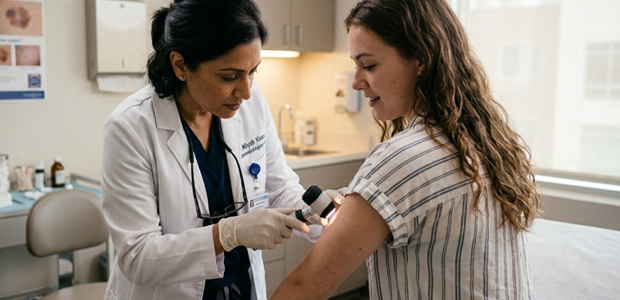
Dermatology is one of the busiest outpatient specialties in medicine, and the billing that goes along with it reflects that. On any given day, a dermatologist might perform a shave removal, excise a suspicious lesion, administer an intralesional injection, and run a full medical E/M visit, all before noon. That variety is what makes dermatology care so valuable to patients. It is also what makes dermatology billing one of the more technically demanding areas in outpatient revenue cycle management.
 The CPT codes used in dermatology span skin biopsies, lesion removals, destructions, Mohs micrographic surgery, phototherapy, patch testing, and a full range of evaluation and management visits. Each category has its own coding logic, documentation requirements, and payer rules. Add prior authorization requirements for biologic medications, the distinction between medically necessary and cosmetic procedures, and payer-specific policies on multiple lesion billing, and you get a billing environment where even small errors can add up to significant lost revenue.
This page covers how dermatology billing works across the major procedure categories, what credentialing looks like for dermatologists, where common compliance risks tend to show up, and what your practice can do to get claims right the first time.
Key Takeaways
Dermatology billing involves dozens of CPT code categories with strict documentation and measurement rules. Mohs surgery, lesion excisions, biopsies, and E/M visits all have specific coding requirements that differ by technique, size, and anatomical site. Credentialing for dermatologists runs through the American Board of Dermatology and requires primary source verification across licenses, training, and privileges. Read on for the details.
How Much Ground Does Dermatology Billing Cover?
 Most outpatient specialties pull from a fairly limited set of CPT codes. Dermatology does not work that way. A busy dermatology practice will regularly bill from the skin biopsy codes in the 11102 to 11107 range, shave removal codes from 11300 to 11313, benign lesion excision codes from 11400 to 11446, malignant lesion excision codes from 11600 to 11646, destruction codes from 17000 to 17286, Mohs surgery codes from 17311 to 17315, and evaluation and management codes from 99202 to 99215. And that list does not even include cosmetic procedures, phototherapy, allergy patch testing, or the procedure codes for intralesional injections.
Each of those code ranges comes with its own rules. Excision codes are selected based on the size of the lesion AND the surgical margins, not just the lesion alone. Biopsy codes differ based on technique. Destruction codes vary by whether the lesion is benign or malignant. Getting any of those elements wrong means billing a code that does not match the documentation, which leads to denials, underpayments, or in some cases, compliance exposure.
The real challenge for dermatology practices is that most of these distinctions live in the documentation itself. A coder can only select the right code if the chart note captures the right details. That means the billing process in dermatology starts with the physician’s documentation, not the billing department.
Lesion Excisions: Why Measurement Matters So Much
Excision coding in dermatology is based on two things. Whether the lesion is benign or malignant, and the total diameter of the excision including the margins. That second part trips up a lot of practices.
The CPT code for a lesion excision is NOT selected based on the size of the lesion alone. The correct measurement is the diameter of the excised area, which includes the lesion itself plus the surgical margins taken around it. So a benign lesion that is 0.5 cm may be excised with 0.3 cm margins on each side, making the total excised diameter 1.1 cm. That detail changes the code.
The operative note needs to document both measurements, the lesion size and the margin size, clearly enough that the coder can calculate the total excision diameter. Notes that only document the lesion size, without any mention of the margins, force a coder to either guess or default to the smallest applicable code, both of which are problems.
A few practical things worth knowing about excision billing:
- Benign vs. malignant codes are separate code sets. Benign excisions run from 11400 to 11446, and malignant excisions run from 11600 to 11646. The pathology result that comes back after the excision affects how the diagnosis is coded, but the procedure code is selected at the time of service based on the reason the procedure was performed.
- Repair codes are sometimes separately billable. When a closure requires more than simple repair, the repair code can be reported separately from the excision code. However, simple repairs are considered part of the excision and cannot be billed separately. The complexity of the closure matters.
- Multiple lesions billed in one session follow specific rules. Each excision is billed separately, and each needs its own documentation with site, size, and margin information clearly recorded.
- Location affects code selection. The code ranges break down by anatomical location, with different codes for the face, scalp, neck, hands, feet, and genitalia versus the trunk and extremities. Documentation needs to identify the site specifically.
Skin Biopsies: Technique Determines the Code
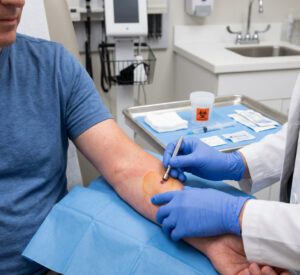 Biopsy coding in dermatology changed significantly with the 2019 CPT updates, and some practices are still not billing it correctly. The current biopsy codes are technique-based, not site-based.
CPT 11102 is a tangential biopsy (shave, scoop, or saucerize technique) for a single lesion. CPT 11103 is used for each additional lesion biopsied by the same technique. CPT 11104 is a punch biopsy for a single lesion, and 11105 covers additional punch biopsies. CPT 11106 is an incisional biopsy, and 11107 handles additional incisional biopsies in the same session.
The documentation must specifically state the technique used. A note that says “biopsy performed” without describing whether it was a shave, punch, or incisional technique does not support accurate code selection. The distinction is not just administrative; the codes carry different values and different documentation expectations.
One more thing worth noting: when a biopsy is performed at the same time as a destruction or excision of the same lesion, you cannot bill both for the same site. The biopsy is considered part of the procedure.
Mohs Micrographic Surgery Billing
Mohs surgery has its own billing logic, and it is different from almost everything else in dermatology. Each Mohs stage is billed separately, and the number of stages documented in the operative report determines the total reimbursement for the case.
CPT 17311 covers the first stage of Mohs surgery for tumors of the head, neck, hands, feet, genitalia, or any location involving muscle, bone, cartilage, or nerve. This code includes up to five tissue blocks in the first stage. CPT 17312 is used for each additional stage. For tumors on the trunk, arms, or legs, the codes are 17313 for the first stage and 17314 for additional stages. CPT 17315 is an add-on code for each additional block beyond five in any stage.
Each stage in Mohs surgery involves three components that must all be performed and documented by the same physician. Excision of the tumor layer, mapping of the tissue, frozen section preparation, and microscopic examination of the margins. The physician performing Mohs must serve as both the surgeon and the pathologist in the same encounter. That dual role is a specific requirement, not a preference, and payers audit for it.
Documentation for Mohs billing needs to include the number of stages performed, the number of blocks per stage, a map or diagram of the tissue sections, and the microscopic findings at each stage. Missing any of those components creates both a coding problem and a medical record problem.
Destruction Codes: Benign vs. Malignant and the 17000 Series
 Destruction codes in dermatology cover a wide range of techniques, including cryotherapy, laser, electrosurgery, chemical treatment, and other methods. The code selection depends on whether the lesion is benign or premalignant versus malignant, and in some cases, the number of lesions treated.
For benign lesions, CPT 17110 covers destruction of up to 14 flat warts, molluscum contagiosum, or milia in a single encounter. CPT 17111 is used when 15 or more lesions are treated. These codes are used for benign lesions and do not require documentation of lesion size.
For premalignant lesions, particularly actinic keratoses, CPT 17000 covers the first lesion, and 17003 is an add-on code for each additional lesion from the second through the fourteenth. When 15 or more premalignant lesions are treated in one session, CPT 17004 is used instead, replacing the 17000 and 17003 codes.
Malignant lesion destruction uses a different set of codes in the 17270 to 17286 range, selected by anatomical location and lesion size. These require documentation of both the site and the size of the lesion being treated.
Evaluation and Management Visits in Dermatology
E/M coding is often where dermatology practices leave the most money on the table. Dermatologists see a high volume of patients, many with medically complex skin conditions, and the documentation does not always reflect the level of service actually provided.
Since the 2021 AMA E/M guideline revisions, office visit level selection for established patients (99211 to 99215) is based on either medical decision making or total time. For new patients (99202 to 99205), the same two pathways apply. The old three-element system of history, exam, and medical decision making no longer drives level selection for outpatient visits.
Medical decision making for dermatology visits typically involves the number and nature of problems addressed, the amount and complexity of data reviewed, and the risk associated with the treatment plan. A visit for a new skin cancer diagnosis with biopsy review, staging discussion, and surgical planning can legitimately support a level 4 or 5 E/M code if the documentation reflects that work. However, many dermatologists undercode their E/M visits either from habit or from concern about audits, which results in systematic underpayment for legitimate services.
When a procedure is performed on the same day as an E/M visit, the E/M is separately billable only if it is for a distinct problem or involves decision making that goes beyond the routine preoperative evaluation for that procedure. Modifier 25 is required to bill a same-day E/M, and the documentation must support that the E/M was a separate, significant service.
Modifier Use in Dermatology Billing
Modifiers are used in dermatology billing to provide additional information about a service, identify a procedure as distinct from another, or explain why a service that looks unusual is actually correct. Using the right modifier in the right situation is what separates a paid claim from a denied one.
Here are the modifiers that come up most often in dermatology billing:
- Modifier 25 is used when an E/M visit is billed on the same day as a procedure. The documentation must clearly support that the E/M was a separate and significant service, not just a preoperative check-in for the procedure that was performed.
- Modifier 59 identifies a distinct procedural service that would normally be bundled with another code but is separately billable due to a different anatomical site or a clinically distinct circumstance. In dermatology, this comes up when biopsies or destructions are performed at multiple separate sites in the same session.
- Modifier 51 applies when multiple procedures are performed in the same session by the same provider. The primary procedure is reported without Modifier 51, and secondary procedures are reported with it. Some dermatology procedure codes are Modifier 51 exempt, meaning they retain full value even when billed alongside other procedures.
- Modifier 58 is used when a staged procedure is planned and performed during the postoperative global period of the original procedure. In dermatology, this applies when additional surgery or reconstruction is performed as a planned second step following an initial excision or Mohs case.
Medical Necessity vs. Cosmetic: The Distinction That Drives Coverage
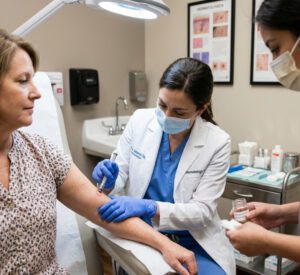 One issue that is specific to dermatology, and one that causes real headaches in billing, is the line between medically necessary procedures and cosmetic ones. Payers will not reimburse cosmetic procedures, and some procedures that a dermatologist performs for legitimate clinical reasons can look cosmetic on paper if the documentation is not written carefully.
Lesion removal is the most common example. Removing a sebaceous cyst that is infected or painful is a covered service. Removing one that is asymptomatic and only aesthetically bothersome may not be, depending on the payer and the documentation. The clinical rationale needs to be in the chart note. A note that says “patient requests removal of cyst” without any medical justification sets up a denial. A note that documents size, symptoms, and clinical reasoning supports reimbursement.
The same issue applies to scar revisions, certain skin tag removals, and a range of other procedures. The code itself does not tell the payer whether the service was medically necessary. The documentation does.
Biologics and Prior Authorization
Dermatology has become one of the leading specialties for biologic medication use, particularly for conditions like psoriasis, atopic dermatitis, hidradenitis suppurativa, and alopecia areata. Medications like dupilumab, secukinumab, ixekizumab, and others carry significant price tags, and payers manage access to them through prior authorization processes that can be time-consuming to manage.
Prior authorization for biologics in dermatology typically requires documentation of the diagnosis, prior treatment history showing that appropriate first-line or second-line therapies were tried and did not work, and clinical justification for the specific medication being requested. Approval is often condition-specific and drug-specific, meaning an approval for one biologic does not transfer to another.
When a prior authorization is denied and the medication is medically appropriate, the appeal process requires strong clinical documentation and sometimes a peer-to-peer review between the dermatologist and the payer’s medical reviewer. Practices that do not have a defined process for managing these appeals leave approvals on the table that would have been granted with better follow-through.
Dermatology Credentialing Requirements
 Credentialing for dermatologists follows the same general structure as other physician specialties but with some specifics worth paying attention to. The primary board certification pathway runs through the American Board of Dermatology (ABD), which requires completion of an accredited dermatology residency and passage of both written and clinical exams. Some dermatologists also hold subspecialty certification in dermatopathology or pediatric dermatology, and payers may have specific requirements about which certifications are needed for certain procedure types to be covered.
Primary source verification for a dermatologist covers medical school education, residency training, board certification status with the ABD, current state licensure in each state where the provider sees patients, DEA registration, malpractice history, and hospital or surgery center privileges. Each of those credentials is verified directly from the issuing institution, not just self-reported by the physician.
The NPDB (National Practitioner Data Bank) query is a required part of the process, and any adverse reports must be reviewed and addressed before credentialing is complete. Many practices underestimate how long credentialing takes, and delays in getting a new dermatologist enrolled with payers translate directly into revenue gaps during their first months with the practice.
Privileging for Mohs Surgeons
Dermatologists who perform Mohs micrographic surgery may need specific procedural privileges at surgical facilities or ambulatory surgery centers, separate from general dermatology privileges. Because Mohs surgery requires the physician to simultaneously function as surgeon and pathologist, facilities sometimes have additional requirements around laboratory setup, training documentation, or case volume thresholds.
If a Mohs surgeon does not have those specific privileges in place at a facility, claims for Mohs procedures performed there will not be supported, regardless of what payer credentials the surgeon holds. Getting ahead of this issue by starting facility privileging applications early is much better than discovering it after claims have already been submitted.
For new dermatologists joining a practice, starting hospital or surgery center privileging and payer credentialing applications at the same time rather than sequentially can cut months off the timeline before full billing activation.
Payer Contracting and Audit Risk in Dermatology
Payer contracting for dermatology is worth approaching with specialty-specific data in hand. Dermatology groups have real leverage in contracting conversations, especially when they provide the only dermatology coverage in a region, handle significant oncologic volume including Mohs surgery and melanoma management, or support hospital-affiliated dermatopathology services.
Audit risk in dermatology tends to concentrate in a few consistent areas:
- Excision upcoding based on measurement errors. Billing an excision code that reflects a larger total diameter than the documentation supports, whether from missing margin documentation or calculation errors, is one of the most common compliance findings in dermatology audits.
- Same-day E/M and procedure billing without Modifier 25. Billing an E/M visit on the same day as a procedure without the modifier, or applying the modifier when the documentation does not actually support a separate E/M service, both create problems.
- Mohs stage misrepresentation. Billing more Mohs stages than the operative documentation supports, or billing Mohs codes for procedures that do not meet the full technical requirements of Mohs surgery, are high-priority audit targets for both Medicare and commercial payers.
- Cosmetic vs. medically necessary procedure coding. Billing covered procedure codes for services that lack documented medical necessity, or applying covered diagnosis codes to procedures that were performed for cosmetic reasons, creates both denial exposure and potential compliance risk.
Medicare’s Comprehensive Error Rate Testing (CERT) program regularly flags dermatology claims, particularly for excision and Mohs surgery. Commercial payers use claims data analytics to identify outlier billing patterns within a specialty. The best protection against an audit finding is accurate coding supported by thorough documentation.
Dermatology Billing, Credentialing FAQ
What CPT codes are most commonly used in dermatology billing?
Dermatology billing pulls from a wide range of codes depending on the services provided. The most frequently used include 11102 to 11107 for biopsies, 11300 to 11313 for shave removals, 11400 to 11446 for benign excisions, 11600 to 11646 for malignant excisions, 17000 to 17004 for actinic keratosis destruction, 17311 to 17315 for Mohs surgery, and 99202 to 99215 for E/M visits. The right code within each range depends on documentation details like technique, size, site, and findings.
How is the excision code determined for a skin lesion?
The excision code is based on two things. Whether the lesion is benign or malignant, and the total diameter of the excised tissue including the surgical margins. The documentation needs to record both the lesion size and the margin width so the coder can calculate the total. Using the lesion size alone without margins typically results in undercoding.
Can a dermatologist bill an E/M visit on the same day as a procedure?
Yes, but it requires Modifier 25 and documentation that supports the E/M as a separate, significant service beyond the pre-procedural evaluation. If the only reason for the visit was to perform the procedure, the E/M is not separately billable. If the visit involved evaluation of a separate condition or decision making that went beyond the routine pre-procedure assessment, it can be billed with the modifier.
What makes Mohs surgery billing different from other dermatology procedures?
Mohs surgery is billed by the stage, not as a single procedure. Each stage requires the physician to perform the excision, prepare and map the tissue sections, and personally examine the margins under the microscope. The documentation must capture the number of stages, the number of tissue blocks per stage, and the microscopic findings at each stage. The physician serves as both surgeon and pathologist in the same encounter.
How does a practice handle prior authorizations for biologic medications?
Prior authorization for biologics requires documentation of the diagnosis, prior treatment history, and clinical justification for the specific medication. Denials can often be appealed with additional documentation or a peer-to-peer review. Practices that track authorization status, expiration dates, and appeal deadlines systematically will have better success rates than those managing it ad hoc.
What board certification do dermatologists need for payer credentialing?
Most payers require certification by the American Board of Dermatology. Some payers and facilities also have specific requirements for subspecialty procedures, such as documentation of Mohs surgery training for providers billing Mohs codes. Certifications from the ABD need to be verified directly from the board as part of the credentialing process.
What is the difference between a shave removal and an excision?
A shave removal (CPT 11300 to 11313) uses a blade to remove a lesion at or near the skin surface without a full-thickness excision. An excision (CPT 11400 to 11646) removes the lesion and a margin of surrounding tissue through the full thickness of the skin and is typically closed with sutures. The technique used determines the code, and the documentation needs to describe the technique clearly enough to support the selected code.
What is the CPT code for a shave biopsy in dermatology?
The code depends on the technique and the number of lesions. A tangential biopsy (which includes shave, scoop, and saucerize techniques) for a single lesion uses CPT 11102. Each additional lesion biopsied by the same technique in the same session uses the add-on code 11103. If the documentation does not clearly describe the technique, the coder cannot accurately select between the tangential, punch, and incisional biopsy codes.
How many Mohs stages can be billed for a single tumor?
There is no fixed cap on the number of stages that can be billed, but each stage must be documented and justified. The number of stages billed needs to match the operative record exactly. Payers look for patterns of unusually high stage counts, and outlier billing without strong documentation is a common audit flag. Each stage requires excision, mapping, and personal microscopic examination by the treating physician.
Does Medicare cover actinic keratosis treatment?
Yes, destruction of actinic keratoses is a covered Medicare service when the lesions are documented as premalignant and the treatment is medically indicated. CPT 17000 covers the first lesion, 17003 covers lesions two through fourteen, and 17004 is used when 15 or more lesions are treated in one session. The diagnosis code submitted with the claim should reflect the actinic keratosis finding.
When is cosmetic dermatology covered by insurance?
Generally speaking, cosmetic procedures are not covered by insurance. However, some procedures that could be considered cosmetic in certain contexts are covered when there is documented medical necessity. Cyst removal that is causing pain or recurrent infection, skin tag removal in areas of repeated friction or irritation, and scar revision following trauma or surgery may be covered depending on the clinical documentation and the payer’s policy. The documentation needs to explain why the procedure was medically necessary, not just aesthetically desired.
What triggers an audit in dermatology billing?
Common audit triggers include a high rate of Mohs stage billing without corresponding documentation depth, excision codes that are consistently at the top of the size ranges, same-day E/M and procedure billing without Modifier 25, billing patterns that are statistical outliers compared to similar practices in the same region, and coding for covered procedures with diagnosis codes that do not support medical necessity. Both Medicare and commercial payers use data analytics to flag unusual billing patterns before initiating a formal review.
Medwave’s Dermatology Billing and Credentialing
 Dermatology billing requires attention to detail at every step. Selecting the right excision code based on documented measurements, applying modifiers correctly when E/M visits and procedures happen on the same day, managing Mohs documentation requirements, and keeping cosmetic and covered services cleanly separated all require billers who know dermatology specifically, not just general medical billing.
At Medwave, we provide medical billing, provider credentialing, and payer contracting services to dermatology practices and dermatology groups across the country. Our billing team works directly with dermatology CPT code sets, documentation standards, and payer policies that apply to revenue cycle management. Our credentialing team manages the full physician credentialing process for dermatologists, including ABD certification verification, subspecialty documentation for Mohs surgeons, multi-state licensure tracking, and PECOS enrollment. Our payer contracting work helps dermatology practices negotiate rates and contract terms that reflect the specialty’s value, particularly for high-value services like Mohs surgery and biologic medication administration.
If your dermatology practice has not recently taken a close look at its coding patterns, modifier usage, or credentialing timelines, that review is worth doing before a denial trend or a payer audit makes it a more urgent priority.
Contact Medwave below to schedule a dermatology billing and credentialing review.