

If you want a single number that tells you how well your practice is actually getting paid, the net collection rate is it. It cuts through the noise of gross charges and list prices and gets straight to the question that matters most. Out of the money you were contractually entitled to collect, how much did you actually get?
For practices that are serious about their financial health, the net collection rate, often abbreviated as NCR, is one of the most important metrics in the entire revenue cycle. It tells you whether your billing process is working, whether your denial management is effective, and whether your team is following up on unpaid claims the way they should be. When the number is strong, things are running well. When it drops, something in the revenue cycle needs attention, and the NCR is often the first metric to show it.
Key Takeaway
Your net collection rate is the single most honest measure of billing performance your practice has. Unlike gross collection rate, it only counts revenue you were contractually entitled to collect, which means a weak NCR points directly to a process problem, not a pricing quirk. The industry benchmark is 95% or higher, with top performers hitting 98% or above. Most of the gap between where a practice is and where it should be comes down to a handful of fixable issues. Unworked denials, missed timely filing windows, inconsistent patient balance collection, and credentialing lapses that quietly kill claims. Practices that monitor NCR on a rolling 12-month basis and act on what it reveals will collect more from the same patient volume without adding a single appointment.
What’s a Net Collection Rate?
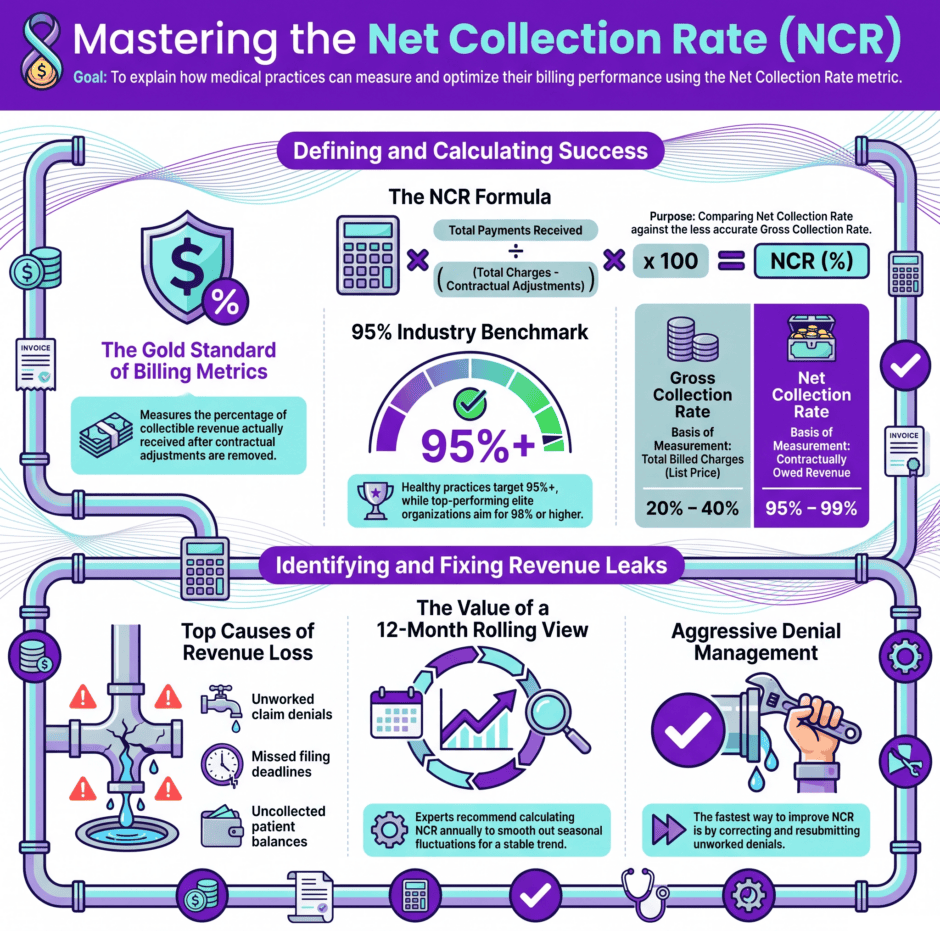
 The net collection rate is a key performance indicator in revenue cycle management that measures the percentage of collectible revenue a practice actually receives. It is not based on what you billed. It is based on what you were allowed to collect after contractual adjustments, which are the discounts your practice agreed to accept as part of your payer contracts.
That distinction is important. Gross charges are often set higher than what any payer will actually pay. The contractual adjustment is the difference between what you billed and what the payer agreed to reimburse under your contract. The net collection rate only counts revenue that was legitimately collectible, which makes it a much more honest and useful measure of billing performance than the gross collection rate.
In plain terms, a net collection rate of 96% means that for every dollar your practice was contractually owed, you collected 96 cents. The remaining four cents represents revenue that leaked out somewhere, whether through uncollected patient balances, timely filing failures, unchallenged denials, or claims that were simply never followed up on.
How to Calculate Net Collection Rate
The formula for net collection rate is straightforward:
Here is a practical example. Say your practice billed $500,000 in charges during a given period. Your contractual adjustments, the amounts you agreed to write off per your payer contracts, total $200,000. That leaves $300,000 in collectible revenue.
If you collected $285,000 of that, your net collection rate would be:
Most revenue cycle experts recommend calculating NCR on a rolling 12-month basis rather than monthly. This smooths out seasonal fluctuations and gives you a more stable picture of collection efficiency over time. The Medical Group Management Association (MGMA) specifically recommends the rolling 12-month approach for this reason.
Importantly, the net collection rate should not include amounts that were legitimately written off as bad debt or charity care adjustments in the denominator. Only include the revenue your practice was realistically in a position to collect. Including uncollectible amounts will artificially lower your NCR and give you a misleading picture of your billing team’s performance.
What’s a Good Net Collection Rate?
 Industry benchmarks for net collection rate vary slightly depending on the source, but the general consensus is clear. A rate of 95% or higher is the target for most practices, and top-performing organizations aim for 98% or above.
According to MGMA, the benchmark for net collection rate is over 95%. The American Academy of Family Physicians puts the healthy range at 95 to 99%. In practical terms, most well-run practices land somewhere between 95 and 98%, with anything below 95 percent signaling that there are revenue cycle problems worth investigating.
Practice size also plays a role. Larger groups with 20 or more providers tend to achieve NCRs of 98 to 100% because they can invest in dedicated billing teams, denial management staff, and billing technology that smaller practices often cannot afford. Solo providers and small practices typically land closer to 94 to 96%. If your NCR falls significantly below what is expected for your practice size and specialty, that gap represents real money being left uncollected.
To put that in concrete terms: if a practice has $11.5 million in collectible revenue and improves its NCR from 89% to 96%, that is roughly $805,000 in additional annual revenue, from the exact same volume of patient care, simply by collecting more of what was already owed.
Net Collection Rate vs. Gross Collection Rate
These two metrics are often confused, and the distinction matters.
The gross collection rate measures total payments received as a percentage of total billed charges, before any adjustments. Because billed charges are often set well above what payers actually pay, the gross collection rate for most practices sits somewhere between 20 and 40%, which sounds alarming but is entirely normal. It is not a reliable indicator of billing performance on its own.
The net collection rate strips out contractual adjustments and measures performance against only the revenue the practice was actually entitled to collect. This makes it a far more meaningful measure of how well your billing operations are functioning.
The gross collection rate tells you what percentage of your listed price you collected. The net collection rate tells you what percentage of what you were owed you actually received. For managing a revenue cycle, the net collection rate is the number that matters.
What Causes a Low Net Collection Rate?
 A net collection rate that falls below benchmark almost always points to one or more specific problems in the revenue cycle.
Claim denials that go unworked. Every denied claim that is not appealed or corrected and resubmitted is revenue written off by default. A strong denial management process is one of the single biggest drivers of a healthy NCR.
Timely filing failures. Most payers have strict deadlines for claim submission and appeals. Missing those windows means the claim is gone regardless of whether the service was legitimately rendered and documented.
Unpaid patient balances. As patient cost-sharing has grown through higher deductibles and copays, patient responsibility now makes up a larger share of practice revenue. Practices that do not have a structured patient collections process will see their NCR suffer for it.
Billing and coding errors. Claims submitted with incorrect codes, wrong modifiers, or missing information get denied or underpaid. Each of those outcomes pulls down the NCR.
Underpayments from payers. Sometimes a payer pays less than the contracted rate, either due to a system error or because the contract terms were applied incorrectly. If these underpayments are not identified and appealed, they quietly erode the NCR over time.
Credentialing gaps. If a provider is not properly enrolled with a payer, claims for their services will be denied. These denials are often grouped under credentialing issues but ultimately show up as revenue lost in the NCR calculation.
How to Improve Your Net Collection Rate
Improving NCR is about collecting more of what you’re already owed.
Build a real denial management process. Every denied claim should be reviewed, classified by denial reason, and either corrected and resubmitted or appealed. Practices that work their denials consistently and promptly will see a meaningful improvement in NCR relatively quickly. Denial categories should be tracked so that the root causes can be addressed, not just the individual claims.
Submit cleaner claims from the start. A higher clean claim rate, meaning the percentage of claims that get paid on the first submission without needing correction, directly supports a higher NCR. This comes down to accurate coding, complete documentation, proper modifier use, and front-end eligibility verification before claims go out.
Follow up on accounts receivable systematically. Open claims should not sit in the queue waiting for payment that may never arrive. A structured A/R follow-up process, with clear rules about when to follow up, when to appeal, and when to escalate, keeps money moving and prevents claims from aging past the point of collectability.
Improve patient collections. Patients should be informed of their financial responsibility before or at the time of service. Practices that collect copays and deductibles up front and that have clear, consistent processes for following up on outstanding patient balances will see their NCR improve as patient responsibility continues to grow as a share of total revenue.
Monitor payer payments against contracted rates. Every payment from a payer should be verified against the contracted rate in your fee schedule. Underpayments that go unidentified and unchallenged accumulate into significant revenue loss over time. Contract management and underpayment detection are underutilized tools in most practices.
Keep credentialing and enrollment current. Provider enrollment lapses and credentialing gaps generate denials that directly suppress NCR. Keeping all providers enrolled and all credentials current with every active payer is one of the most foundational things a practice can do to protect its collection rate.
How NCR Fits into the Broader Revenue Cycle Picture
The net collection rate does not operate in isolation. It is one piece of a broader set of metrics that, taken together, give you a full picture of revenue cycle health.
Four metrics worth tracking alongside NCR include:
- Days in Accounts Receivable (A/R): How long it takes your practice to collect payment after a claim is submitted. The industry benchmark is below 50 days, with top performers targeting 30 to 40 days.
- Denial Rate: The percentage of submitted claims that are denied. Industry average is 5 to 10%, but high-performing practices keep this below 5%.
- Clean Claim Rate: The percentage of claims paid on first submission without correction. Target is 98% or higher.
- Cost to Collect: Total revenue cycle costs divided by total cash collected. The industry median is around 3%.
When these metrics are tracked together and reviewed regularly, patterns become visible that no single metric would reveal on its own. A rising denial rate will eventually show up in a declining NCR. A growing A/R backlog will show up in delayed collections. Monitoring all of these together lets your team act early rather than discovering problems after months of revenue loss have already occurred.
Net Collection Rate FAQ
What is a good net collection rate for a medical practice?
Most industry sources set the benchmark at 95% or higher. Top-performing practices target 98% or above. Anything below 90% indicates significant revenue cycle problems that need to be addressed.
What is the difference between net collection rate and gross collection rate?
Gross collection rate measures total payments as a percentage of total billed charges, before any adjustments. Net collection rate measures payments as a percentage of what was contractually owed after adjustments. NCR is a more accurate reflection of billing performance because it only counts revenue the practice was realistically entitled to collect.
How often should I calculate my net collection rate?
MGMA recommends using a rolling 12-month calculation to account for seasonal variation and give you a stable, reliable trend line. Monthly snapshots can be useful for spotting short-term changes, but the 12-month rolling rate is the best benchmark to track over time.
Why is my net collection rate low if we are submitting claims on time?
Timely submission is important, but NCR is affected by many factors beyond initial submission, including denial rates, follow-up on unpaid claims, patient balance collection, underpayments from payers, and credentialing gaps. A low NCR usually means one or more of these areas is not functioning as well as it should be.
Can credentialing problems affect my net collection rate?
Yes, directly. If a provider is not properly enrolled with a payer, claims for their services will be denied. Those denials represent revenue that was earned but not collected, which reduces the NCR. Keeping all providers credentialed and enrolled with every active payer is essential to maintaining a strong collection rate.
What is the fastest way to improve net collection rate?
The fastest improvement typically comes from aggressively working existing denied claims. Many practices have months of unworked denials sitting in their system that can be resubmitted and collected with focused effort. After that, improving clean claim rates through better front-end processes and reducing A/R aging through consistent follow-up are the next highest-impact steps.
Summary: What’s Your Net Collection Rate?
 The net collection rate is one of the clearest indicators of whether a medical practice is collecting what it has earned. A strong NCR means your billing process is working, your denials are being managed, and your team is following through on outstanding claims. A weak NCR means revenue is leaking out of the practice somewhere, and the sooner you identify where, the less it will cost you.
Tracking NCR regularly, benchmarking it against your specialty and practice size, and actively working to improve the underlying processes that drive it are all essential parts of running a financially healthy practice.
Medwave provides medical billing, credentialing, and payer contracting services to healthcare practices across the United States. Whether your practice needs help improving its net collection rate, reducing claim denials, keeping providers enrolled and credentialed with all active payers, or renegotiating contracts to ensure you are being paid at market rates, our team brings the expertise and consistency to make it happen. Reach out to us today to find out how we can strengthen your revenue cycle.

Co-Founder and COO of Medwave, bringing more than 25 years of hands-on experience in healthcare revenue cycle management, payer contracting, and medical credentialing.