

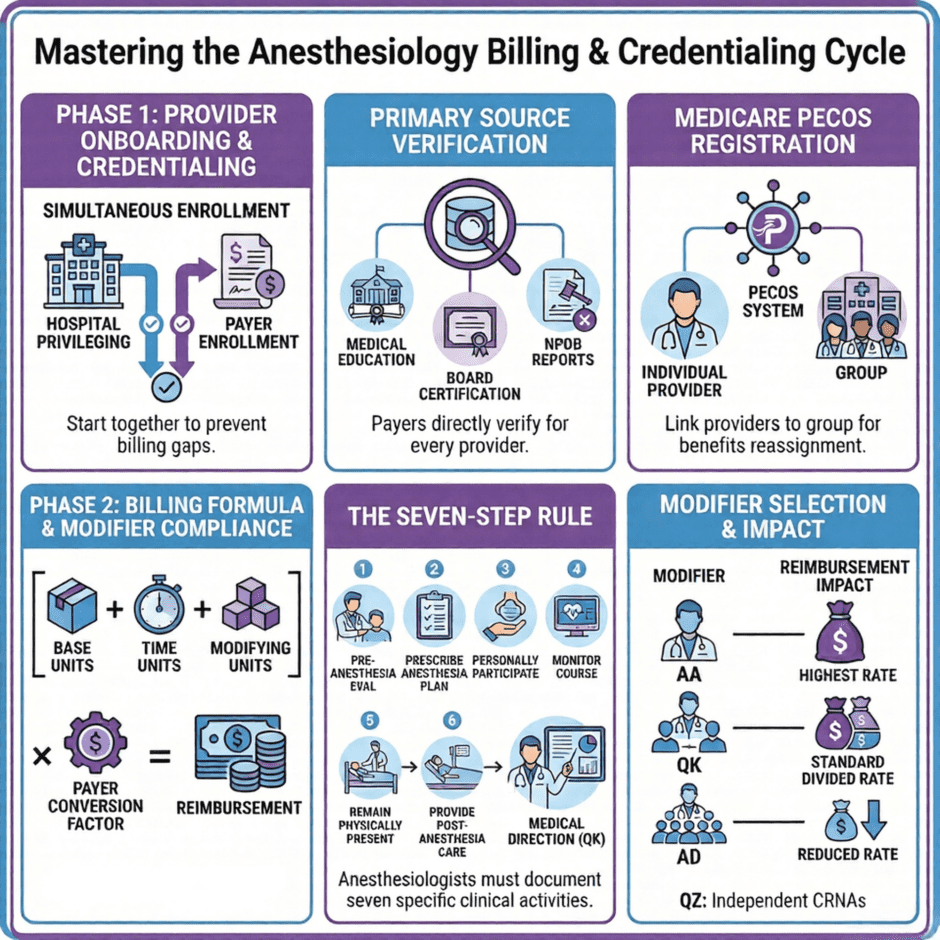
Anesthesia claims don’t pay the way other professional claims do. Instead of a fee attached to a CPT code, payment comes from a formula: base units for the procedure, plus time units for how long the provider was with the patient, multiplied by a conversion factor. The modifier on each line then decides who gets paid and how much, depending on whether an anesthesiologist worked alone, directed CRNAs, or covered more rooms than Medicare allows for direction.
Credentialing has its own timing problem. Many payers won’t enroll an anesthesia provider for a facility until hospital privileges are approved, so a new hire can go months without billing under their own NPI.
Key Takeaways
- Anesthesia payment is base units plus time units plus any modifying units, multiplied by the payer’s conversion factor.
- Medicare converts reported minutes into 15-minute units rounded to one decimal place, so the anesthesia record’s start and stop times set the time component.
- Medical direction (QK or QY) requires the anesthesiologist to meet and document seven steps on every case, or the case pays as medical supervision (AD).
- Medicare doesn’t pay qualifying circumstances codes separately, but many commercial payers do.
- Starting hospital privileging and payer enrollment together shortens the time before a new provider can bill.
How Anesthesia Reimbursement is Calculated
Every anesthesia claim runs through the same formula. Base units plus time units plus modifying units, multiplied by the conversion factor. Each piece follows its own rules, and an error in any one of them changes the payment.
Base units
 Each anesthesia CPT code from 00100 through 01999 carries a base unit value from the American Society of Anesthesiologists’ Relative Value Guide. The codes are grouped by body region, and the base value reflects how difficult and risky the anesthetic is. A lens procedure carries only a few base units, while cardiac surgery with a pump oxygenator runs above 20. Medicare publishes its own base unit file each year, and most commercial payers follow the ASA values.
The anesthesia code comes from the surgeon’s procedure through the ASA crosswalk. Choosing a code from the wrong procedure family changes the base value on every case it touches.
Time units
Anesthesia time starts when the provider begins preparing the patient for anesthesia in the operating room or an equivalent area. It ends when the provider is no longer in personal attendance and the patient can be safely placed under postoperative care. Medicare claims report time in minutes, and the contractor converts them to units by dividing by 15 and rounding to one decimal place, as described in the Medicare Claims Processing Manual. Many commercial payers use their own intervals and rounding, so the same case can produce different time units on different claims. Palmetto GBA’s calculation guide walks through a worked example.
The anesthesia record is the source for those times. A claim that bills more minutes than the record shows is an easy audit finding, and so is personally performed time that overlaps across two cases.
Conversion factor
Medicare sets its anesthesia conversion factor each year in the Physician Fee Schedule and adjusts it by locality. Commercial conversion factors are negotiated payer by payer. Every unit on every claim gets multiplied by that number, so it matters more than any other term in an anesthesia contract.
Qualifying Circumstances Codes
Four add-on codes recognize conditions that make an anesthetic riskier than its base value accounts for:
- 99100: Anesthesia for a patient of extreme age, younger than 1 year or older than 70
- 99116: Anesthesia complicated by utilization of total body hypothermia
- 99135: Anesthesia complicated by utilization of controlled hypotension
- 99140: Anesthesia complicated by emergency conditions
Medicare considers these part of the base units and doesn’t pay them separately. Many commercial payers do pay them as added units, and the record has to support the condition. Age is easy to prove, while emergency status needs a documented reason that delay would have harmed the patient. 99100 also isn’t reported with anesthesia codes that already account for age, such as the infant codes 00326, 00561, 00834, and 00836.
Anesthesia Modifiers
Anesthesia claims use pricing modifiers that tell the payer who performed the service and at what level of involvement:
- AA: Anesthesia services performed personally by the anesthesiologist
- QK: Medical direction of two, three, or four concurrent procedures by an anesthesiologist
- QY: Medical direction of one CRNA by an anesthesiologist
- QX: CRNA service with medical direction by a physician
- QZ: CRNA service without medical direction by a physician
- AD: Medical supervision by a physician of more than four concurrent procedures
Under Medicare, AA and QZ cases pay 100% of the allowance to the one provider. When an anesthesiologist directs a CRNA, each bills half: the anesthesiologist with QK or QY, the CRNA with QX. Medical supervision under AD pays the anesthesiologist on three base units, or four if they were present at induction, with no time units at all. Monitored anesthesia care adds QS, and teaching anesthesiologists working with residents add GC.
The seven medical direction requirements
For each case billed as medically directed, Medicare requires the anesthesiologist to:
- Perform a pre-anesthetic examination and evaluation
- Prescribe the anesthesia plan
- Personally participate in the most demanding parts of the plan, including induction and emergence when applicable
- Ensure that any procedures in the plan they don’t perform are performed by a qualified anesthetist
- Monitor the course of anesthesia at frequent intervals
- Remain physically present and available for immediate diagnosis and treatment of emergencies
- Provide indicated post-anesthesia care
Apart from those seven steps, the anesthesiologist can’t direct more than four concurrent cases or perform other services during that time. Medicare allows a short list of exceptions, such as handling a brief emergency in the immediate area, checking on patients in recovery, receiving the next patient entering the operating suite, and scheduling. If any step is missing from the record, Medicare treats that case as medical supervision.
CRNA Billing
 How a CRNA’s claim is coded depends on whether an anesthesiologist directed the case, not on the state alone. When an anesthesiologist meets the seven steps, the CRNA bills QX alongside the anesthesiologist’s QK or QY. When no anesthesiologist directs the case, the CRNA bills QZ and receives the full allowance. That includes cases in states that require physician supervision of CRNAs, where the operating surgeon can supervise without it counting as medical direction.
States that have opted out of Medicare’s CRNA supervision requirement remove that condition for hospitals and ambulatory surgery centers, and CRNAs there routinely bill QZ.
The most common CRNA error is a QX line on a case where the anesthesiologist’s documentation doesn’t support direction. Both providers’ lines then have to be recoded to match what the record supports, which is why direction documentation gets reviewed before the claim goes out.
Monitored Anesthesia Care
MAC bills with the same anesthesia codes and formula, adding the QS modifier. Payers look for two things in the record: a reason the case needed an anesthesia provider rather than nurse-administered moderate sedation, and a provider prepared to convert to general anesthesia if needed. Some Medicare contractors limit MAC for procedures like routine colonoscopy to patients with documented risk factors, so check the local coverage policy for the procedures your group covers. Many anesthesiologists also run interventional pain practices, which bill under a different model covered on our pain management page.
Anesthesiology Credentialing

Anesthesiologists
Payers verify board certification through the American Board of Anesthesiology, along with medical education, residency, state licensure, DEA registration, malpractice history, and hospital privileges. Each credential is confirmed with the source that issued it, and the National Practitioner Data Bank query is part of every initial credentialing and recredentialing cycle.
CRNAs
CRNA credentialing verifies NBCRNA certification and its continued professional certification cycle, nurse anesthesia program completion, the state APRN or RN license, DEA registration where the state allows CRNA prescribing, and malpractice history. In states that require physician supervision or collaboration, payers also want documentation of that arrangement.
Hospital privileges and payer enrollment
Many payers won’t enroll an anesthesia provider for services at a facility until hospital privileges are active there. When privileging takes two or three months and payer enrollment waits for it, the gap before a new provider can bill doubles. Filing both at the same time closes most of that gap, because, as we explain in why you can’t bill what you can’t credential, claims can’t go out under a provider who isn’t enrolled.
Medicare Enrollment for Anesthesia Groups
 Anesthesia groups enroll in Medicare through PECOS, with the group holding its own enrollment and each anesthesiologist and CRNA reassigning benefits to it. CRNAs enroll under their own specialty, which matters when the group bills both QX and QZ lines.
Group and individual enrollments revalidate every five years. A missed revalidation deactivates billing privileges, and claims for that provider stop paying until the enrollment is restored.
Common Anesthesia Billing Errors
- Choosing the anesthesia code from the wrong crosswalk family, which changes the base units on every case it touches
- Billing time that doesn’t match the start and stop times in the anesthesia record, or that overlaps across personally performed cases
- Billing QK or QY on a case where one of the seven direction steps isn’t documented
- Counting concurrency incorrectly, so a fifth overlapping case gets missed and every case in that window is billed as directed instead of AD
- Sending qualifying circumstances codes to Medicare, or missing them on commercial payers that pay for them
Anesthesiology Billing FAQs
How is anesthesia reimbursement calculated?
Base units for the procedure, plus time units, plus any modifying units, multiplied by the payer’s conversion factor. Medicare’s conversion factor varies by locality, and commercial payers negotiate their own.
How does Medicare count anesthesia time units?
The claim reports anesthesia time in minutes, and the Medicare contractor divides the minutes by 15 and rounds to one decimal place. A 52-minute case counts as 3.5 time units.
What are Medicare’s seven medical direction requirements?
The anesthesiologist must perform the pre-anesthetic evaluation, prescribe the plan, personally participate in the most demanding parts including induction and emergence, ensure a qualified anesthetist performs any parts they don’t, monitor at frequent intervals, remain physically present for emergencies, and provide indicated post-anesthesia care. Directing no more than four concurrent cases is a separate condition.
Does Medicare pay qualifying circumstances codes?
No. Medicare treats 99100, 99116, 99135, and 99140 as included in the base units. Many commercial payers pay them, so check each contract.
When does a CRNA bill with the QZ modifier?
Whenever no anesthesiologist medically directs the case. That applies in opt-out states and in supervision states where the operating surgeon supervises the CRNA.
How is payment split when an anesthesiologist directs a CRNA?
Medicare pays each provider 50% of the allowance for the case. The anesthesiologist bills QK or QY and the CRNA bills QX.
What modifier is used for monitored anesthesia care?
QS, added to the anesthesia code along with the provider modifier. The record has to show why an anesthesia provider was needed instead of moderate sedation.
How long does anesthesiology credentialing take?
Medwave averages 60 days for payer enrollment. Hospital privileging depends on each facility’s credentialing committee schedule, which is why both should start as soon as a provider signs.
Why Anesthesia Groups Choose Medwave for Billing & Credentialing
 Medwave handles anesthesia billing, credentialing, and payer contracting under one team. Our coders check base units against the crosswalk, time against the anesthesia record, and direction documentation against all seven steps before a claim goes out, which is how we hold a 98% clean claim rate.
On the credentialing side, we file hospital privileging and payer enrollment together for every new anesthesiologist and CRNA, with a 60-day average turnaround on payer enrollment. In contract negotiations, we work from your group’s case volume and current conversion factors with each payer.
Contact Medwave below to see how we can support your anesthesia group.