

Picture this, your highest-volume nurse practitioner has been seeing patients for months, claims have been going out on time, and then the denials start. First a few, then a flood. Your billing team works the rejections, calls the payer, digs through EOBs and eventually someone traces the whole mess back to a single checkbox that nobody ticked. Her CAQH profile went 120 days without attestation, her status flipped to inactive in ProView, and the payer has been quietly rejecting her claims ever since.
This is the ghost provider problem. The provider is real, credentialed on paper, and actively seeing patients. But as far as the payer’s adjudication system is concerned, she doesn’t exist.
Key Takeaways
An expired CAQH profile triggers a chain reaction that denies claims, freezes reimbursements, and drains your revenue cycle for months before most practices notice. The ghost provider problem is more common than it should be and almost entirely preventable. This article explains what causes it, how to calculate the real dollar cost, how to audit your practice right now, and what a sustainable fix actually looks like.
What’s A Ghost Provider in Medical Billing?
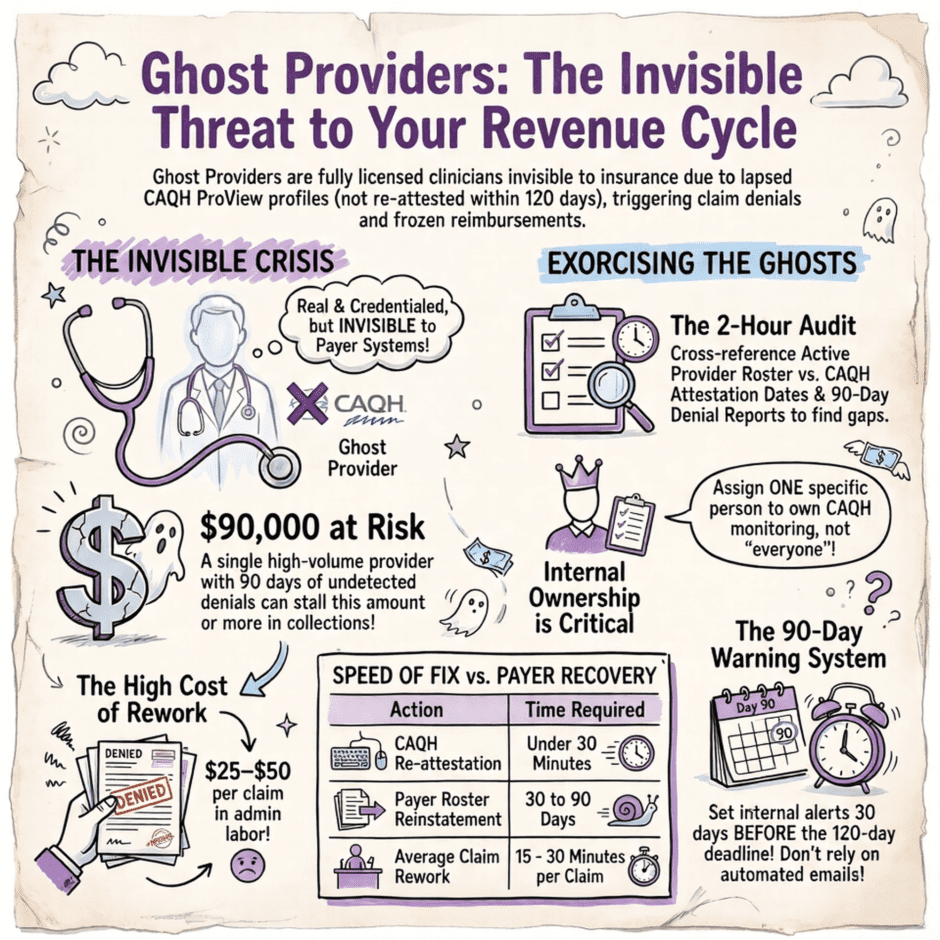
 The term ghost provider describes a clinician who exists in your credentialing records but has fallen off a payer’s active roster due to a lapsed CAQH ProView profile. They are credentialed or were. They are enrolled or were. But their status in the one database most commercial payers rely on has expired, and that gap is wide enough to swallow thousands of dollars in claims.
CAQH ProView is the central database where providers store and maintain their professional information. Such as licenses, malpractice insurance, work history, education, and more. Participating payers access that database during credentialing and recredentialing instead of requiring separate applications for each plan. It is not a one-time submission. CAQH requires providers to re-attest to the accuracy of their profile every 120 days. Miss that window, and the profile is marked as not attested. Many payers treat that status as a disqualifier during claims adjudication.
Ghost providers are not inactive providers who have left your practice. They are not locum tenens filling temporary gaps. They are full-time, fully licensed clinicians who are functionally invisible to payers because a calendar reminder was never set, an email notification went to a former employee’s inbox, or nobody in the practice knew who owned the CAQH account in the first place.
That distinction matters because the fix for a ghost provider is not a new credentialing application. It is an attestation and, depending on how long the lapse lasted, a payer reinstatement process that can take 30 to 90 days.
How a CAQH Attestation Lapse Becomes a Claim Denial
The path from an expired CAQH profile to a denied claim is not always immediate, and that delay is part of what makes the ghost provider problem so damaging. Practices often don’t know there’s a problem until a significant volume of claims has already been affected.
How Payers Check CAQH Status During Adjudication
Commercial payers that participate in CAQH ProView query the database at various points in the claims process. Some check during initial claim intake. Others verify provider status during adjudication, particularly for high-dollar claims or services flagged for pre-payment review. When the query returns an expired or unverified profile, the claim is either denied outright or flagged for manual review, which frequently results in a denial if the payer cannot confirm active credentialing status.
Medicare Advantage plans are particularly aggressive about this. So are most Blue Cross Blue Shield affiliates and Aetna. The specific behavior varies by payer and plan type, but the common thread is that an expired CAQH profile is treated as a red flag, not a minor administrative gap.
The 90-Day Blindspot
Here is where the math gets brutal. A CAQH profile can expire and start causing denials weeks before a practice’s billing team notices the pattern. Most denial workflows are reactive. Claims come back, coders work them, appeals go out. By the time someone connects a cluster of credentialing-coded denials to a specific provider’s CAQH status, that provider may have 60, 90, even 120 days of affected claims sitting in the queue.
The re-attestation itself is fast. A provider can log into CAQH ProView, verify their information, and complete attestation in under 30 minutes. But getting reinstated on a payer’s active roster is a separate process that happens on the payer’s timeline. You can fix the CAQH problem today and still be waiting on payer roster updates for the next six to eight weeks.
Which Payers are Most Aggressive about CAQH-Linked Denials
The short answer is most commercial payers, and increasingly Medicare Advantage plans. Traditional Medicare does not use CAQH ProView directly, but the majority of commercial credentialing runs through it. If your payer mix skews toward commercial insurance, which is true for most specialty practices, an expired CAQH profile is a direct threat to your reimbursement pipeline.
The Real Dollar Cost of a Ghost Provider
 The ghost provider problem is not a credentialing inconvenience. It is a revenue cycle emergency with a real dollar figure attached to it, and most practices underestimate it because they are only counting the denied claims they can see.
Start with the obvious number. A provider who generates $30,000 in monthly collections and has 90 days of claims affected by CAQH-related denials is looking at up to $90,000 in at-risk revenue. Not all of it will be denied. Not all denials will be unrecoverable. But appeals take time, and time costs money.
The Hidden Costs Beyond Denied Claims
Every denied claim that traces back to a credentialing issue requires a human being to research, recode if necessary, draft an appeal, and resubmit. Industry estimates put the average cost to rework a single denied claim at $25 to $50, depending on staff time and claim type. If a ghost provider generates 200 denied claims over a 90-day lapse period, that is $5,000 to $10,000 in rework costs before you recover a single dollar.
Then there are the claims that never get worked. Under-resourced billing teams make triage decisions every day. Older denials, small-dollar claims, and difficult appeals often get written off rather than pursued. A ghost provider situation accelerates that process. Revenue that should have been collected simply disappears.
There is also a patient attribution problem that most practices miss entirely. If a provider’s CAQH status is flagged during a payer’s directory verification process, which happens independently of claims adjudication, the provider may be temporarily removed from the payer’s online directory. Patients searching for in-network providers stop finding them. New patient referrals dry up. That loss never shows up in a denial report.
The Compounding Problem in Multi-Provider Practices
A solo practice losing one provider to a CAQH lapse is a painful but manageable problem. A group practice with 20 providers and no centralized credentialing oversight can have three or four ghost providers active at any given time without knowing it. The revenue at risk multiplies. The rework burden multiplies. And because each provider’s CAQH attestation window runs on a different 120-day clock, the lapses are staggered rather than synchronous, which means there is no single credentialing problem to diagnose. There are just persistent, unexplained denial patterns that take months to trace back to their source.
Four Reasons CAQH Profiles Go Stale in Active Practices
These are not simple CAQH application mistakes made by careless practices. They are system failures that happen in well-run organizations because nobody designed a process to prevent them.
- No designated owner for CAQH attestation. Credentialing responsibility is often split between the billing team, office manager, and the providers themselves, with no single person accountable for watching attestation deadlines. When everyone is responsible, nobody is.
- Provider turnover without a credentialing handoff. When a biller, credentialing coordinator, or office manager leaves, their login credentials and task ownership often leave with them. CAQH reminder emails keep going to their old inbox. The 120-day clock keeps ticking.
- Multi-location groups managing CAQH manually at scale. A practice with 15 providers across three locations, each on a different attestation cycle, cannot manage this by spreadsheet and good intentions. One missed reminder in a busy quarter is all it takes.
- Assuming the billing vendor covers credentialing. This is probably the most common misunderstanding in the space. Revenue cycle management companies and billing services handle claims, not credentialing. Unless your contract explicitly includes CAQH monitoring and attestation management, that function belongs to your practice, whether or not anyone inside it knows that.
How to Audit Your Practice for Ghost Providers Right Now
You do not need expensive software or a full credentialing audit to find out whether your practice has a ghost provider problem. You need about two hours, access to a few systems, and a willingness to look at the answer honestly.
Step 1: Pull Your Active Provider Roster
Start with your practice management system or EHR. Generate a list of every provider who has submitted at least one claim in the past 90 days. Include physicians, nurse practitioners, physician assistants, and any other billing providers. This is your baseline.
Step 2: Cross-Reference Attestation Dates in CAQH ProView
Log into DataSpring / CAQH ProView and check the attestation status and most recent attestation date for every provider on your list. Any provider whose last attestation was more than 90 days ago is approaching risk. Any provider whose status shows as not attested or expired is a confirmed ghost provider. Document all of them.
Step 3: Run a 90-Day Denial Lookback
Pull your denial report for the past 90 days and filter for claims denied with credentialing, eligibility, or provider-not-on-file reason codes. Cross-reference those denials against the providers you flagged in Step 2. If the overlap is significant, you have your answer. If it is minimal, you may have caught the problem before it became a billing crisis.
Step 4: Check Payer Portals for Provider Roster Discrepancies
For your top three payers by volume, log into the provider portals and verify that each of your active providers shows as participating and active. Payer directories lag behind CAQH updates, but a provider showing as inactive or missing in a payer portal is a strong signal that a roster update is overdue.
This audit should not be a one-time event. Running it quarterly is the minimum. Monthly is better for practices with high provider turnover or a large roster.
Building a System That Prevents Ghost Providers
A one-time fix is not a solution. Re-attesting a lapsed CAQH profile gets you back to baseline. It does not prevent the same problem from happening again in four months with a different provider. What practices actually need is a process, one that treats CAQH attestation as a recurring operational task rather than a credentialing project.
Build a Credentialing Calendar with 90-Day Attestation Reminders
For every provider, log their most recent CAQH attestation date and set a reminder 30 days before the next one is due. Do not wait for CAQH to send an email. Those notifications go to the provider’s address on file, which may be outdated, or to a generic inbox that nobody monitors. Own the reminder cycle internally.
Assign One Person to Own CAQH for Each Provider Group
Credentialing ownership needs to be explicit and documented. One person (a credentialing coordinator, practice manager, or office director) should be responsible for monitoring CAQH status across the full provider roster. That responsibility should be written into their job description and reviewed during performance evaluations. When that person leaves, credentialing handoff should be part of their offboarding checklist, not an afterthought.
Integrate Credentialing Status into Your Monthly Billing Review
Your monthly billing metrics meeting should include a credentialing status report alongside your denial rate, days in AR, and collection rate. A single line item such as ‘providers with CAQH attestation due in the next 30 days,’ is enough to keep the issue visible before it becomes a crisis. If it’s never on the agenda, it’ll never get acted on until the denials arrive.
Consider Outsourcing CAQH Management
Many practices reach a point where the internal bandwidth to manage credentialing simply does not exist. Group practices with 10 or more providers, practices with high provider turnover, and specialty groups with multiple payer relationships are particularly exposed. Outsourcing CAQH monitoring and attestation management to a dedicated credentialing partner pays for itself in denied claims prevented.
What to look for in a credentialing partner. Proactive attestation monitoring with flags at 30 and 60 days, payer roster verification as a standard service, written accountability for missed windows, and integration with your billing workflow so credentialing lapses never reach the claims queue without a flag.
Ghost Provider & CAQH FAQ
How Often Does CAQH Require Attestation?
Every 120 days. If a provider misses that window, their profile is marked as not attested and most commercial payers will treat their status as inactive or unverifiable during claims adjudication.
Can A Provider Still See Patients If Their CAQH Profile Is Expired?
Yes, there is no clinical block. A provider can continue seeing patients and submitting claims with an expired CAQH profile. The problem is on the payer side. Claims submitted under that provider may be denied by payers who verify credentialing status through CAQH during adjudication.
How Long Does It Take To Fix An Expired CAQH Profile?
Re-attestation itself takes under 30 minutes. The harder part is getting reinstated on a payer’s active roster after a lapse. That process runs on the payer’s timeline and can take 30 to 90 days, during which time claims may continue to be denied or held.
Who Is Responsible For CAQH Attestation, The Provider Or The Billing Team?
CAQH accounts are technically provider-owned, meaning the provider’s login credentials control the profile. In practice, most credentialing and billing teams manage attestation on behalf of providers. The gap happens when nobody is explicitly assigned that responsibility and the provider assumes someone else is handling it.
Does Medicare Use CAQH?
Traditional Medicare does not use CAQH ProView for credentialing or claims adjudication. However, most Medicare Advantage plans and the majority of commercial payers do. For practices with a significant commercial or Medicare Advantage payer mix, CAQH status is directly tied to claim reimbursement.
What Is The Difference Between Credentialing And Enrollment?
Credentialing is the verification of a provider’s qualifications, including licenses, education, training, and history. Enrollment is the process of becoming an active, billing participant in a specific payer’s network. CAQH touches both, it stores the credentialing data payers need, and an expired profile can disrupt both the credentialing and enrollment status of a provider.
What Happens If CAQH Is Not Updated?
If a CAQH ProView profile is not attested within 120 days, it is marked as inactive or not attested. Payers that rely on CAQH for provider verification may deny claims, remove the provider from their directory, or flag their credentialing status for review. The downstream billing impact can be significant and often goes undetected for weeks.
How Do I Know If My CAQH Profile Is Expired?
Log into CAQH ProView at proview.caqh.org and check your profile status on the dashboard. An expired profile will show not attested or display an attestation date older than 120 days. If you do not have your login credentials, contact CAQH support or your credentialing coordinator.
Does CAQH Affect Insurance Billing?
Yes. Commercial payers that participate in CAQH ProView use the database to verify provider credentials during claims adjudication. An expired or inactive CAQH profile can result in claim denials, delayed payments, and removal from payer directories.
How Long Does CAQH Credentialing Take?
Initial CAQH profile setup typically takes a few hours to complete, but the credentialing process with individual payers can take 60 to 90 days or longer after CAQH submission. Re-attestation for an active profile takes under 30 minutes.
What Is CAQH Used For In Medical Billing?
CAQH ProView is a centralized database where providers maintain their professional credentials. Commercial payers access this data to verify provider qualifications during credentialing and enrollment. An active CAQH profile is a prerequisite for in-network participation with most commercial payers, which directly affects whether claims are reimbursed at in-network rates.
Stop Ghost Providers Before They Haunt Your Revenue Cycle
 The ghost provider problem is not a credentialing failure in the traditional sense. It is an operational gap that exists in the space between clinical scheduling, credentialing, and billing, a gap that most practices do not know they have until the denial reports start telling the story.
Most practices do not have a dedicated credentialing team watching 120-day attestation windows for every provider on the roster. That is the reality of running a busy clinical operation. But that reality does not make the revenue risk any less real. Providers have to remember to keep their CAQH profile current. A single lapsed profile, undetected for 90 days, can put tens of thousands of dollars in claims at risk and require hundreds of hours of staff time to unwind.
At Medwave, we manage all three sides of this equation. Our billing team monitors denial patterns for credentialing-coded rejections. Our credentialing team tracks CAQH attestation windows proactively so lapses get caught at 30 days, not 90. Our payer contracting work ensures that when a provider does need to be reinstated on a roster, we have the payer relationships to move that process forward. If ghost providers are draining your practice, we can help you find them, fix them, and make sure they stay fixed.

Co-Founder and COO of Medwave, bringing more than 25 years of hands-on experience in healthcare revenue cycle management, payer contracting, and medical credentialing.