

General surgery bills from more of the CPT book than almost any other specialty. A single surgeon may do a laparoscopic cholecystectomy in the morning, an inguinal hernia repair after lunch, and a breast biopsy before clinic, and each one follows different coding rules. Most of those rules depend on what the operative report says about approach, extent, and findings. The rest depend on the global surgery period, which decides whether the visits around a procedure can be billed at all.
Credentialing adds a second track. A surgeon has to be enrolled with each payer and privileged at each hospital and surgery center where they operate before any of those claims can be paid.
Key Takeaways
- Major procedures carry a 90-day global period that includes the day before surgery, the day of surgery, and routine follow-up for 90 days after.
- The visit where the decision for a major surgery is made takes modifier 57, not modifier 25.
- Medicare doesn’t pay separately for treating a complication in the office during the global period. Only a return to the operating room (modifier 78) is paid.
- Since 2023, anterior abdominal hernia repairs bill as 49591 to 49618 by defect size and hernia status, regardless of approach, with mesh included.
- Image-guided breast biopsy codes (19081 to 19086) include the imaging, so guidance isn’t billed separately.
Global Surgery Periods and Surgical Modifiers
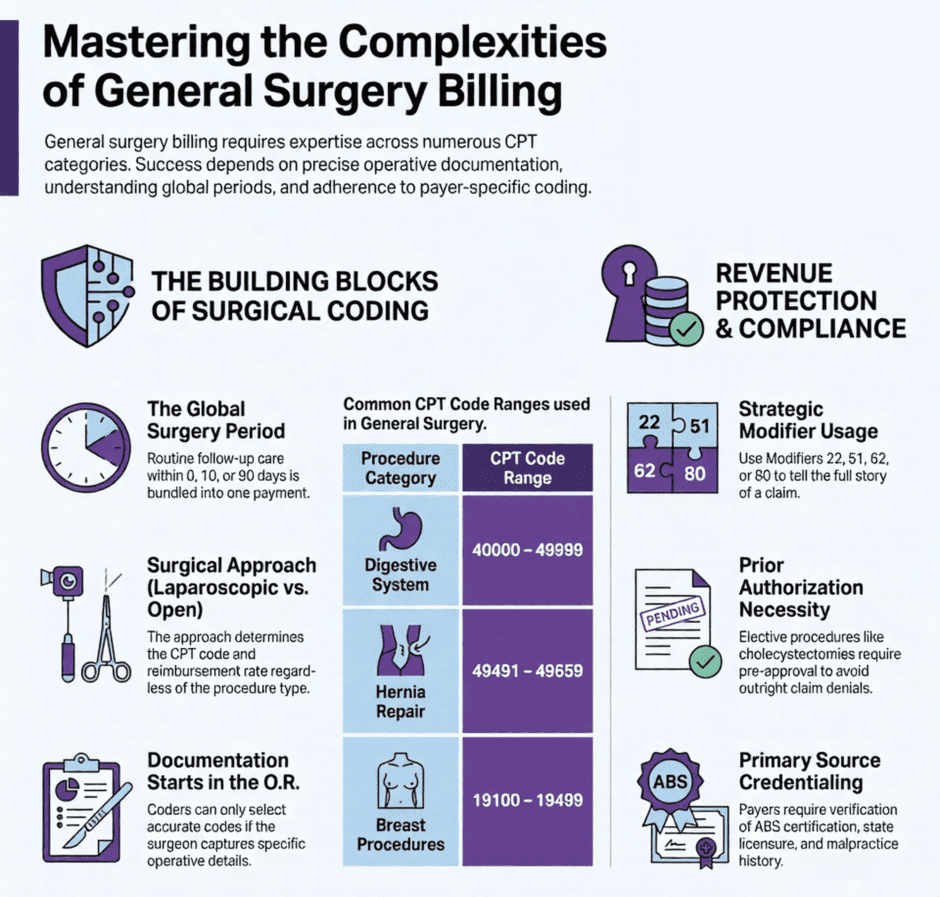
 Medicare assigns every procedure a global period of 0, 10, or 90 days, and most commercial payers follow it. For a 90-day procedure, the global package covers the visit the day before surgery, the surgery itself, and routine postoperative care for 90 days after. A routine wound check in week three isn’t billable. For 10-day minor procedures, the package starts on the day of the procedure.
Modifiers tell the payer that a service during the global period falls outside the package. The ones general surgery uses most often are listed below.
- Modifier 57 (an E/M the day before or the day of a major procedure where the decision for surgery was made)
- Modifier 25 (a significant, separate E/M on the same day as a minor procedure)
- Modifier 24 (an unrelated E/M during the postoperative period)
- Modifier 58 (a staged or planned related procedure during the postoperative period, which starts a new global period)
- Modifier 78 (an unplanned return to the operating room for a related complication, which doesn’t start a new global period)
- Modifier 79 (an unrelated procedure during the postoperative period, which starts a new global period)
Medicare doesn’t pay separately for treating a complication in the office or at the bedside during the global period. A complication is separately payable only when it requires a return to the operating room, billed with modifier 78. Commercial payers vary, so the contract decides. Billing 25 instead of 57 on a decision-for-surgery visit is one of the most common surgical denials.
Laparoscopic vs. Open Approach
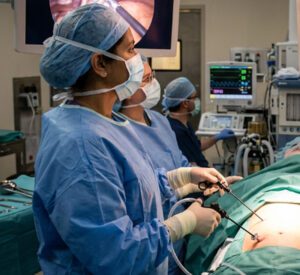 For most abdominal procedures, the laparoscopic and open versions have different codes and different payment. Cholecystectomy is a common example. Laparoscopic cholecystectomy is 47562, with cholangiography it’s 47563, and with common bile duct exploration it’s 47564. Open cholecystectomy is 47600, or 47605 with cholangiography.
When a case starts laparoscopically and converts to open, only the open procedure is billed, and the operative report should state when and why the conversion happened. A diagnostic laparoscopy isn’t billed separately when it leads directly into the definitive procedure in the same session. Robotic assistance doesn’t have its own CPT code and is reported with the laparoscopic code.
Hernia Repair Coding
Hernia coding changed significantly in 2023. Open, laparoscopic, and robotic repairs of anterior abdominal hernias (ventral, umbilical, incisional, spigelian, and epigastric) now all bill from 49591 to 49618. The code is chosen by total defect size (under 3 cm, 3 to 10 cm, or over 10 cm), whether the hernia is initial or recurrent, and whether it’s reducible or incarcerated or strangulated. Mesh placement is included in these codes and isn’t billed separately. The older ventral, umbilical, and laparoscopic codes, including 49560 to 49590 and 49652 to 49657, were deleted.
Inguinal hernias still use their own codes. Open repairs in patients age 5 and older bill as 49505 for an initial reducible hernia, 49507 for incarcerated or strangulated, and 49520 or 49521 for recurrent. Laparoscopic inguinal repair is 49650 for initial and 49651 for recurrent. Pediatric inguinal codes separate by age. Mesh isn’t separately billable with inguinal repair either.
Bilateral repairs in the same session bill with modifier 50 or with RT and LT, depending on the payer. The operative report has to state the defect size, the status of the hernia, and whether it’s a recurrence, because each of those changes the code.
Abdominal Procedures
 Appendectomy bills as 44970 when done laparoscopically and 44950 when open. An open appendectomy for a ruptured appendix with abscess or generalized peritonitis uses 44960. For a perforated appendix done laparoscopically, the perforation is captured in the diagnosis code, since 44970 covers both.
Open partial colectomy codes run from 44140 to 44160 and separate by what was done after resection, such as anastomosis, colostomy, or Hartmann’s procedure. Laparoscopic colectomies have their own range, 44204 to 44213, with the same distinctions. The operative report needs to state the extent of resection and how the bowel was reconstructed, or the coder can’t pick between neighboring codes.
When a second procedure is done in the same session, it’s billable only if it has its own indication and isn’t bundled into the primary procedure under NCCI edits. Secondary procedures take modifier 51 for multiple-procedure payment, and a procedure that’s normally bundled but separately justified may need modifier 59 or XS. Our guide on choosing the correct CPT code covers how documentation drives code selection.
Breast Surgery Coding
 Image-guided breast biopsies bill as 19081 to 19086, split by guidance type (stereotactic, ultrasound, or MRI), with add-on codes for each additional lesion. These codes include the imaging guidance and placement of a localization clip, so the guidance isn’t billed separately. A core biopsy without imaging is 19100, and an open incisional biopsy is 19101.
Partial mastectomy (lumpectomy) bills as 19301, or 19302 when an axillary lymphadenectomy is done in the same session. Simple mastectomy is 19303. Modified radical and radical mastectomy have their own codes. Sentinel node mapping (38900) and axillary node excision (38525) are reported separately when performed. When immediate reconstruction is done in the same session by a plastic surgeon, each surgeon bills their own codes.
Assistant Surgeons and Co-Surgeons
An assistant surgeon bills the same CPT code as the primary surgeon with modifier 80. Modifier 82 is used in a teaching hospital when a qualified resident isn’t available. Medicare pays an assistant 16% of the fee schedule amount, but only for procedures the Physician Fee Schedule allows assistants on. When an NP or PA assists, the code takes modifier AS.
Co-surgery is different. When two surgeons each perform a distinct part of one procedure, both bill the same code with modifier 62, and each is paid a share of the fee. Each surgeon’s operative note has to describe their own portion. Confusing 62 with 80 is a common reason both surgeons’ claims deny.
Prior Authorization for Elective Surgery
Many payers require prior authorization for elective procedures such as hernia repair, cholecystectomy, bariatric surgery, and breast procedures. Authorizations are often tied to the CPT code, the facility, and a date range. A change in any of them, such as moving the case to a different surgery center or converting to a different procedure, can leave the claim without a valid authorization.
Checking requirements at scheduling, and updating the authorization when the plan changes, prevents most authorization denials. When the procedure performed differs from the one authorized, many payers allow the authorization to be updated within a short window after surgery.
General Surgeon Credentialing

Board certification and payer enrollment
General surgeons certify through the American Board of Surgery after residency and the board’s qualifying and certifying exams. Surgeons with fellowship training in areas such as surgical oncology or colorectal surgery may need that training documented for some payers and procedures. Payers verify education, training, board status, licensure in each state, DEA registration, malpractice history, and an NPDB query, usually through CAQH ProView. Medicare enrollment runs through PECOS.
Hospital and surgery center privileges
Every hospital and ambulatory surgery center credentials surgeons separately, and privileges are granted procedure by procedure based on training and case volume. A new procedure at an existing facility may require documented training or proctored cases first. Payer enrollment doesn’t cover a case done where the surgeon isn’t privileged. Our FAQ on how hospital privileges relate to insurance credentialing covers the difference. Starting privileging and payer enrollment at the same time avoids a gap where a surgeon can operate but can’t bill, which is why you can’t bill what you can’t credential.
Payer Contracting for Surgical Groups
Surgery groups often have leverage in payer contracting, especially when they cover multiple facilities, take trauma or emergency call, or serve a region with limited surgical access. Contract reviews should look at rates for the group’s highest-volume codes, how the payer handles assistant surgeon and co-surgery payment, and whether the contract follows Medicare’s global surgery rules or its own.
General Surgery Billing FAQs
What’s the difference between modifier 57 and modifier 25?
Modifier 57 is used on an E/M the day before or the day of a major (90-day) procedure when that visit is where the decision for surgery was made. Modifier 25 is used on a significant, separate E/M on the same day as a minor (0 or 10-day) procedure.
Can a complication during the global period be billed?
Under Medicare, only when it requires a return to the operating room, billed with modifier 78. Treating a complication in the office or at the bedside is part of the global package. Commercial payers set their own rules.
Which CPT codes are used for cholecystectomy?
Laparoscopic cholecystectomy is 47562, with cholangiography it’s 47563, and with common bile duct exploration it’s 47564. Open cholecystectomy is 47600, or 47605 with cholangiography.
How are ventral and umbilical hernias coded now?
Since 2023, open, laparoscopic, and robotic anterior abdominal hernia repairs all bill from 49591 to 49618, based on total defect size, initial or recurrent status, and whether the hernia was reducible or incarcerated. Mesh is included.
Is imaging guidance billed with a breast biopsy?
No. Image-guided breast biopsy codes (19081 to 19086) include the guidance and clip placement, so separate imaging guidance codes aren’t billed with them.
What happens when a laparoscopic case converts to open?
Only the open procedure is billed. The operative report should document when and why the conversion happened.
What’s the difference between modifier 62 and modifier 80?
Modifier 62 is for co-surgeons who each perform a distinct part of one procedure and split the fee. Modifier 80 is for an assistant surgeon, whom Medicare pays 16% of the fee schedule amount on procedures that allow an assistant.
What board certification do general surgeons need for credentialing?
Most payers and facilities expect certification by the American Board of Surgery. Fellowship training may need to be documented for certain procedures, and every credential is verified with its original source.
Modifier choice decides whether a second procedure in the same session gets paid, and our general surgery CPT codes reference covers modifiers by procedure type.
Where Medwave Comes In for General Surgeons
 General surgeons see patients in the office, the ED, the OR, and on the floor, and the global period follows them everywhere. Medwave applies 57 and 25 for the decision for surgery, uses 24 for unrelated postoperative care, and follows each payer’s assistant-at-surgery and co-surgeon rules. Our billing team keeps general surgery at a 98% clean claim rate.
Taking call at a new hospital means new privileges and sometimes new payer contracts. Our credentialing team covers both, with payer enrollment averaging 85 days, and our payer contracting team reviews surgical fee schedules before you sign.
Picking up call coverage somewhere new? Let us know below.