

Pulmonology billing covers spirometry in the office, a bronchoscopy in the hospital, and a ventilated patient in the ICU, often in the same week for the same physician. Pulmonology credentialing has to keep pace with that range, since every hospital and ICU a pulmonologist covers needs its own privileges on top of payer enrollment.
Key Takeaways
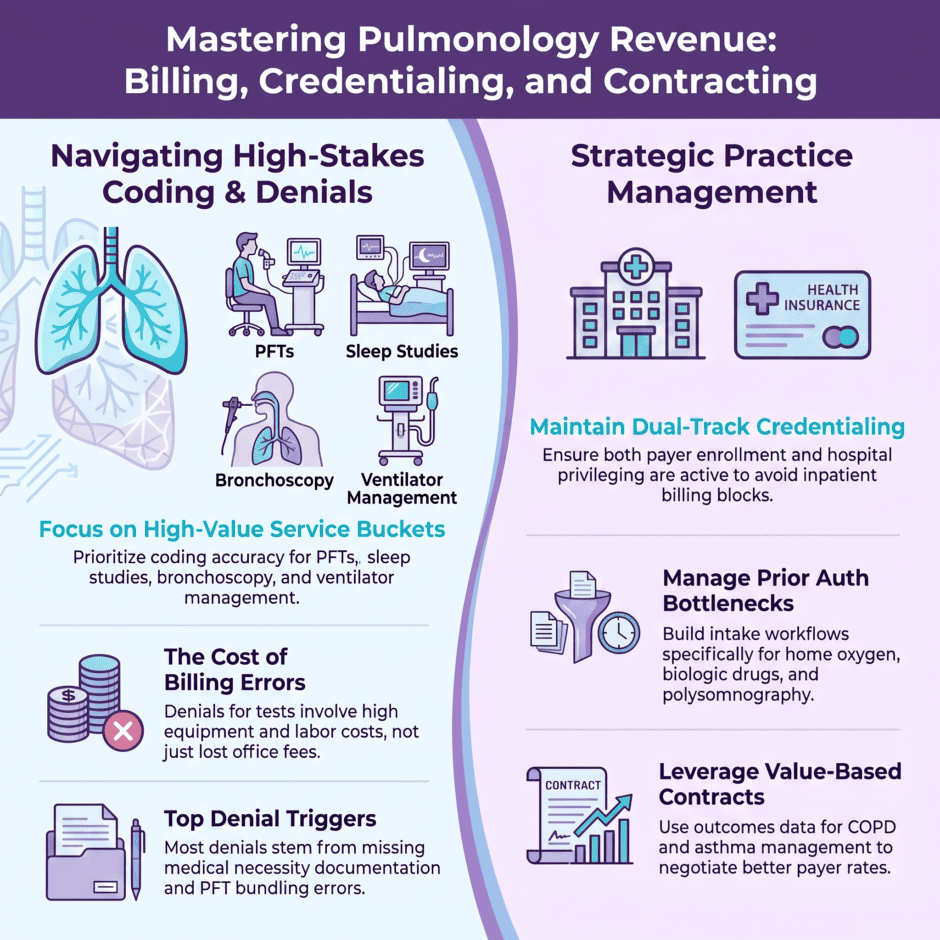
- PFT codes are built in layers, so 94060 already includes spirometry and add-on codes like 94729 only bill with a primary test.
- In-lab polysomnography bills as 95810 or 95811, and home sleep apnea tests use a separate, lower-paying code set.
- Ventilator management can’t be billed with an E/M visit by the same physician on the same day, so ICU days usually bill as critical care or hospital visits.
- Asthma biologics given in the office need prior authorization, correct drug units, and documented step therapy.
- Each pulmonologist needs hospital privileges at every facility they cover, in addition to payer enrollment.
Pulmonary Function Testing
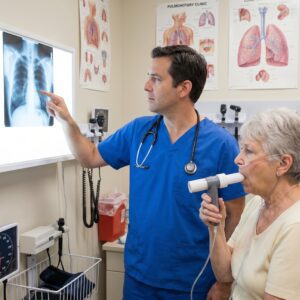
 PFT codes stack on each other, and most PFT billing errors come from billing a component that’s already included in a larger code. Spirometry bills as 94010. Spirometry before and after a bronchodilator bills as 94060, which already includes 94010, so the two are never billed together. Lung volumes bill as 94726 by plethysmography or 94727 by gas dilution, and diffusing capacity bills as add-on 94729, which can only be billed with a primary PFT code on the same date.
Other common tests include the six-minute walk with oximetry (94618) and exercise testing for bronchospasm (94617). Pulse oximetry (94760 and 94761) is bundled into other services under Medicare and rarely pays on its own.
When the PFT lab belongs to a hospital, the pulmonologist bills only the interpretation with modifier 26, and the hospital bills the technical side. Each test needs an order, a diagnosis that supports it, and a signed interpretation.
Sleep Studies
In-lab polysomnography bills as 95810, and a split-night or titration study with CPAP bills as 95811. Home sleep apnea tests use 95800, 95801, or 95806 depending on the channels recorded, and Medicare uses its own G0398 through G0400 codes for home testing. Home tests pay much less, but many payers require one before they’ll approve an in-lab study, unless the patient has a condition like significant lung disease or heart failure that makes home testing unreliable.
Practices that run their own sleep lab carry equipment, technician, and facility costs on top of the interpretation, which our sleep study labs page covers in more detail.
Bronchoscopy and Procedures
 Diagnostic bronchoscopy bills as 31622, and each added service has its own code, including bronchoalveolar lavage (31624), endobronchial biopsy (31625), and transbronchial lung biopsy (31628). Endobronchial ultrasound bills as 31652 or 31653 based on the number of lymph node stations sampled, and navigational bronchoscopy adds 31627. The base diagnostic code is included in every surgical bronchoscopy code, so 31622 isn’t billed alongside them.
Thoracentesis with imaging guidance bills as 32555, and pleural procedures, chest tubes, and indwelling catheters each carry their own codes. Hospital and outpatient procedures need the right place of service, since the professional fee drops when the facility bills its own claim.
ICU and Hospital Care
Pulmonologists who cover the ICU bill critical care as 99291 for the first 30 to 74 minutes and 99292 for each additional 30 minutes, and Medicare pays the first 99292 only once total time reaches 104 minutes. Ventilator management (94002 through 94004) covers the physician’s work managing the ventilator, but CPT doesn’t allow it on the same day as an E/M service by the same physician. A day with a full evaluation bills as critical care or a hospital visit, and ventilator management bills only on days without one.
Medicare doesn’t pay consultation codes, so a pulmonary consult on a Medicare inpatient bills as initial hospital care (99221 through 99223). Our hospital medicine page covers critical care time rules in more detail.
Chronic Disease and Office Visits
Most pulmonology office visits are follow-ups for COPD, asthma, interstitial lung disease, or sleep apnea, billed as 99212 through 99215 and leveled by medical decision-making or time. Medicare’s G2211 add-on applies to visits that are part of ongoing care for a serious or complex condition. Chronic care management (99490 and 99439) pays for time spent coordinating care between visits when the patient has two or more chronic conditions and has given consent.
Inhaler or nebulizer training bills as 94664, and a nebulizer treatment given in the office bills as 94640.
Asthma Biologics and Prior Authorization
 Biologics for severe asthma, such as omalizumab, mepolizumab, and benralizumab, are often given in the office. Each drug bills in units under its own HCPCS code, the injection bills as 96372, and Medicare requires the JW or JZ modifier on single-dose vials. Nearly every payer requires prior authorization, usually with documented failure of high-dose inhaled therapy and lab values like a blood eosinophil count, and the authorization has to be renewed on the payer’s schedule.
Home oxygen works differently. The DME supplier bills Medicare for the oxygen, but the pulmonologist provides the qualifying oxygen saturation or blood gas test, a recent face-to-face evaluation, and the order. When that documentation is missing or stale, the supplier’s claim is denied and the patient is caught in the middle.
Where Pulmonology Claims Get Denied
Most pulmonology denials come from a short list of causes. They include 94010 billed with 94060, add-on PFT codes billed without a primary test, ventilator management billed on the same day as an E/M visit, in-lab sleep studies without the documentation a payer wants first, and biologics given after an authorization lapsed. Our list of the top reasons claims get denied covers the general causes. Tracking denials by payer and reason each month shows whether a problem sits in documentation, coding, or the authorization workflow.
Pulmonology Credentialing
 Payers verify board certification in pulmonary disease, and often critical care or sleep medicine, through the American Board of Internal Medicine, along with licensure, DEA registration, and malpractice history. Most pulmonologists also cover at least one hospital, and privileges at each facility run on their own timeline. A pulmonologist who is enrolled with a payer but not privileged at the hospital can’t bill for that inpatient work.
Privileging and payer enrollment should start together as soon as a physician signs, since a new pulmonologist’s services can’t bill under another physician’s NPI while enrollment is pending. That’s why you can’t bill what you can’t credential. CAQH attestations, license renewals, and hospital reappointments then need tracking on a calendar so one lapsed date doesn’t stop a provider’s claims.
Payer Contracting for Pulmonology
Pulmonology revenue leans heavily on testing, so the rates for PFTs, sleep studies, and bronchoscopy matter as much as the E/M fee schedule. A contract that pays well on office visits but underpays 94060, 94726, or 95810 costs the practice on every test. Payer contracting reviews should compare those codes against Medicare and local benchmarks, and check whether a plan pays different rates for in-lab and home sleep testing. Federal and state rules shape what can be negotiated, which we cover in the laws that govern payer contract negotiations.
Pulmonology Billing, Credentialing FAQ
Can 94010 and 94060 be billed together?
No. 94060 covers spirometry before and after a bronchodilator and already includes the spirometry in 94010. Bill one or the other based on what was performed.
Can ventilator management be billed with critical care?
Not by the same physician on the same day as an E/M service. When the physician provides critical care or a hospital visit, ventilator management is included. It bills on its own only on days without an E/M service.
Why do in-lab sleep studies get denied?
Many payers require a home sleep apnea test first unless the patient has a condition that makes home testing unreliable. An in-lab study without that documentation is a common denial.
Who bills Medicare for home oxygen?
The DME supplier bills for the oxygen. The pulmonologist provides the qualifying oxygen test, a recent face-to-face evaluation, and the order, and missing documentation causes the supplier’s claim to deny.
Do asthma biologics need prior authorization?
Almost always. Payers usually want documented failure of high-dose inhaled therapy and supporting lab values, and authorizations need renewal on the payer’s schedule.
What does a new pulmonologist need before billing biologics?
Active enrollment with the patient’s plan, then a prior authorization for each patient and each drug. Some plans also require the drug to come from a specialty pharmacy, which means the practice bills only the administration. Medwave usually completes payer enrollment in about 85 days.
Spirometry and other asthma workup tests carry their own codes, listed in our guide to asthma treatment CPT codes.
What Medwave Handles for Pulmonary Practices
 Medwave checks PFT and bronchoscopy bundling, separates ventilator management from E/M days, and confirms biologic authorizations before the first injection. Pulmonology billing through our team averages a 98% clean claim rate.
Pulmonologists who cover ICUs need hospital privileges as well as payer enrollment. Our credentialing team runs both at once, and payer enrollment averages 85 days.
If biologic denials are piling up, the form below is the quickest way to reach us.