

If you work in therapy billing, you have probably seen Modifier 96 and Modifier 97 on claim forms without being entirely sure when each one applies. That confusion is more common than you might think, and it causes real problems, such as denied claims, audit flags, and benefit exhaustion for patients who still need care. Getting these two modifiers right is not just a coding detail. It has a direct impact on your revenue cycle, your documentation quality, and your ability to defend claims when a payer comes knocking.
Both modifiers attach to the same types of therapy CPT codes, but they mean very different things. One tells the payer the patient is learning a skill for the first time. The other says the patient is trying to get back a skill they had before. That clinical distinction, as straightforward as it sounds, is the heart of the matter.
Key Takeaways
- Modifier 96 = habilitative therapy. The patient is developing a skill they have never had.
- Modifier 97 = rehabilitative therapy. The patient is recovering a skill they previously had but lost.
- Using the wrong modifier can result in claim denials, incorrect benefit tracking, or audit problems.
- Documentation must back up whichever modifier you use.
- Commercial plans often separate habilitative and rehabilitative benefit pools, making correct modifier use even more important.
- Medicare Part B does not universally require these modifiers, but always verify your specific payer rules.
- Companies like Medwave specialize in billing, credentialing, and payer contracting and can help therapy practices apply these modifiers correctly every time.
What’s Modifier 96?
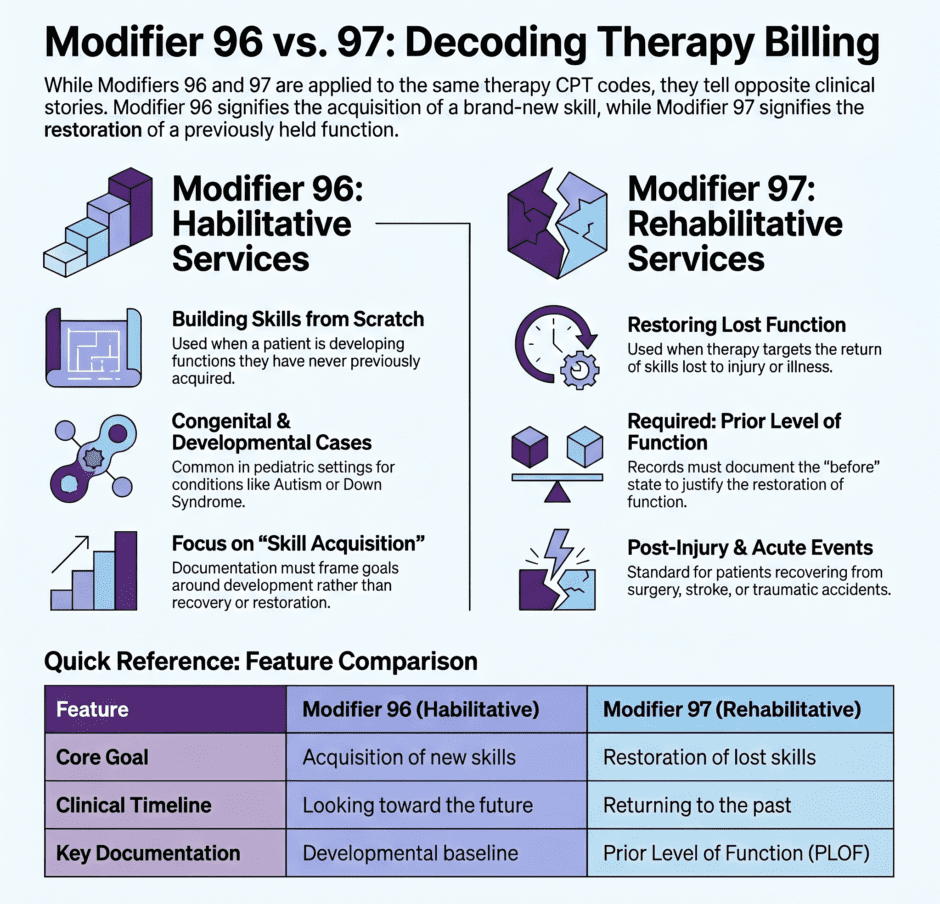
 Modifier 96 is appended to a CPT code when the therapy service being billed is habilitative in nature. Habilitative care focuses on helping a patient develop skills and functions they have never acquired. We are not talking about recovery here. We are talking about building something from scratch.
Think about a four-year-old with Down syndrome who has never used utensils independently or a toddler with spina bifida who is just beginning to take her first steps. Or a child with autism spectrum disorder who has not yet developed consistent communication patterns. In all of these cases, the therapy goal is skill acquisition, and Modifier 96 is the correct code to append to the CPT code. The targeted skill simply has not previously been acquired.
It is worth noting that Modifier 96 is not reserved exclusively for children. Adults with congenital or lifelong conditions who have never developed certain abilities also qualify for habilitative care. That said, the bulk of Modifier 96 claims do come from pediatric settings.
For documentation to support Modifier 96, the records need to clearly show a few things. First, there should be a confirmed developmental or congenital diagnosis. Second, the evaluation notes need to confirm that the skill in question has never been acquired. Third, and this is where many providers fall short, the treatment goals must be framed around skill development rather than recovery. A goal that reads “patient will restore prior ambulation” on a Modifier 96 claim is going to raise eyebrows during a review. A better framing: “Patient has not achieved age-appropriate bilateral coordination. Treatment focuses on skill acquisition to support self-feeding independence.” Short, clear, and accurately tied to the modifier.
What’s Modifier 97?
 Modifier 97 tells a completely different story. This modifier goes on claims for rehabilitative therapy, where the focus is on restoring function the patient once had but lost due to illness, injury, surgery, or another medical event.
A 58-year-old who was fully independent before a stroke and now needs speech therapy to regain language function is a classic Modifier 97 case. So is a runner who tears their ACL and needs physical therapy to return to their pre-injury activity level. Or an office worker who fractures her wrist and needs occupational therapy to regain the ability to type. In every one of these scenarios, there is a documented “before” the event and a gap to close between where the patient is now and where they used to be.
The documentation requirements for Modifier 97 center on what is called the prior level of function, or PLOF. Without a clearly documented PLOF, a rehabilitative claim can look unsupported to any reviewer. Payers want to see what the patient could do before, when that changed, and what therapy is doing to close that gap. A solid example of how this might look in the chart: “Patient was previously independent with stair negotiation and household ambulation. Following CVA, requires moderate assistance for both. Therapy targets restoration of pre-morbid mobility and functional independence.” That language connects the dots and ties the modifier selection directly to a specific clinical rationale.
The Real Difference Between the Two
Here is the simplest way to think about it: Modifier 96 is about the future, and Modifier 97 is about the past.
With Modifier 96, you are documenting a journey toward something new. With Modifier 97, you are documenting a return to something the patient already had. The procedure code on both claims might be identical, but the modifier tells the payer which story applies.
Imagine two patients both receiving speech therapy under CPT 92507. Patient A is a six-year-old with congenital apraxia of speech who has never developed consistent articulation patterns. Patient B is a 45-year-old who suffered a traumatic brain injury and lost the speech clarity he had before his accident. Same CPT code. Different modifiers. Patient A gets Modifier 96, and Patient B gets Modifier 97. The procedure is similar; the clinical story is not.
This distinction also carries serious financial weight because many commercial payers maintain separate benefit pools for habilitative and rehabilitative services. Under the Affordable Care Act, both categories are listed as required health benefits for non-grandfathered individual and small group plans. States set their own benchmark plans, however, and benefit structures can vary widely. Some plans give patients 30 visits for rehabilitation and an entirely separate 30 visits for habilitation. If a habilitative claim is mistakenly billed with Modifier 97, those visits get pulled from the wrong pool. The patient may run out of covered visits for one category while a separate pool of habilitative visits sits untouched. That kind of downstream error feels minor during billing but becomes a genuine problem when a patient is told they have no more covered visits remaining.
Why Medicare is a Separate Conversation
 Medicare Part B does not universally require Modifier 96 or Modifier 97 for outpatient therapy claims. This is one of the areas where providers get tripped up, because the commercial payer world and the Medicare world play by different rules.
That does not mean you can ignore modifier requirements for Medicare patients entirely. You need to check current guidance from the Centers for Medicare and Medicaid Services and confirm requirements with your Medicare Administrative Contractor (MAC). MACs can have jurisdiction-specific requirements that differ from national guidance. Assuming Medicare works the same as your commercial payers is a mistake worth avoiding.
How Claims Go Wrong
The most common mistakes with Modifier 96 and Modifier 97 are predictable once you see them. Omitting the modifier when the payer requires it is the most frequent error, and it often happens because a biller is unsure which one applies. Skipping it entirely leads to a denial or a documentation request. The second most common mistake is applying Modifier 97 to a habilitative service, largely because many billers treat rehabilitation as the default. It is not. The third problem, the one that tends to surface during audits rather than initial claims review, is when documentation simply does not support the modifier that was used.
For example, if you append Modifier 96 to a claim but the evaluation notes do not mention a developmental diagnosis or confirm the absence of prior skill development, a reviewer is going to have questions. The modifier and the documentation need to tell the same story from start to finish.
Getting Your Workflow Right
 Modifier accuracy is not just a coding team problem. It starts at intake, long before a claim is ever submitted.
The information gathered during a patient’s first visit, including developmental history, onset timing, prior functional independence, surgical history, and any school or early intervention involvement, is what gives clinicians and billers the foundation to classify services correctly. If that intake data is vague or missing, you end up catching errors late in the process, and that is when they cost the most. On the clinical side, the way goals are written in the plan of care needs to match the modifier. A clinician who writes goals about restoring prior function on a Modifier 96 claim has created a mismatch that will show up in any audit.
Training clinicians on the difference between skill acquisition language and skill restoration language pays off over time. Standardized EHR templates with built-in documentation prompts, habilitative fields for Modifier 96 cases and prior level of function fields for Modifier 97 cases, can guide clinicians toward more consistent charting without adding friction to their workflow.
On the billing side, a review process before claim submission should confirm that the modifier is present when required, that it matches the diagnosis, and that the authorization category lines up with the correct benefit pool. Communication between your clinical team and your revenue cycle team is what keeps these pieces aligned. When that communication breaks down, modifier errors follow. When EHR systems are configured to flag modifier requirements and track authorizations by benefit type, errors are caught before the claim leaves the building rather than after a payer review.
Real-World Coding Scenarios
Scenario 1 (Habilitative)
A five-year-old with autism spectrum disorder presents for occupational therapy due to delayed fine motor development. He has never independently manipulated fasteners or demonstrated age-appropriate bilateral coordination. The therapy plan targets foundational motor skill development.
Correct code: CPT 97530 with Modifier 96. The skills have never been acquired, so this is habilitative care.
Scenario 2 (Rehabilitative)
A 62-year-old patient undergoes rotator cuff repair following a fall. Before the injury, she was fully independent with overhead reaching and all daily activities. The therapy plan targets restoration of shoulder mobility and return to prior function.
Correct code: CPT 97110 with Modifier 97. The therapy is aimed at restoring what was lost, making this rehabilitative care.
Scenario 3 (Same CPT, Different Modifiers)
Two patients receive speech therapy under CPT 92507. One is a child with congenital apraxia of speech who has never developed consistent articulation. The other is an adult who lost established speech clarity following a traumatic brain injury. The CPT code is identical, but the modifier is not. Modifier 96 for the child, Modifier 97 for the adult.
Staying Audit-Ready
 Modifier selection does more than signal clinical intent. It determines how payers interpret the entire episode of care, and when services are misclassified, the consequences often surface during audits.
Audit exposure tends to cluster around a few predictable situations. Modifiers omitted when required, habilitative services billed as rehabilitative, documentation that lacks developmental context, and goals that do not align with the modifier that was used. To build a strong defense, your records should clearly show whether the diagnosis is congenital or acquired, establish either a developmental baseline (Modifier 96) or a prior level of function (Modifier 97), frame goals in language that matches the modifier’s intent, and keep progress notes consistent with the original treatment rationale throughout the entire episode.
Therapy Billing FAQ
Can the same patient have both Modifier 96 and Modifier 97 claims?
Yes. A patient could receive habilitative speech therapy for a developmental delay and separately receive rehabilitative physical therapy following a broken leg. Each claim carries the appropriate modifier based on the specific service being billed.
What if a patient has both a congenital condition and a new injury?
Each service should be evaluated independently. If therapy for the congenital condition targets skill acquisition, use Modifier 96. If therapy for the new injury targets restoration of prior function, use Modifier 97. Document each service distinctly.
Do I always have to use one of these modifiers?
Not always. Requirements vary by payer. Some commercial plans require them; others do not. Medicare Part B does not universally require them. Always check your payer-specific guidelines before submitting.
What happens if I use the wrong modifier?
At best, the claim gets processed under the wrong benefit pool, which can deplete the wrong category of visits for the patient. At worst, it can trigger a denial, a reprocessing request, or an audit finding if the pattern repeats over time.
How should goals be written to support Modifier 96?
Goals for Modifier 96 claims should focus on developing or acquiring skills, not recovering them. Use phrases like “patient will develop,” “patient will acquire,” or “patient will achieve age-appropriate [skill]” rather than language tied to a prior baseline.
Are these modifiers used across all therapy disciplines?
Yes. Modifier 96 and Modifier 97 apply across physical therapy, occupational therapy, and speech-language pathology. The modifier selection is driven by the clinical nature of the service, not by which discipline is delivering it.
What is the difference between habilitative and rehabilitative therapy for insurance purposes?
Commercial payers treat habilitative and rehabilitative services as separate benefit categories. Habilitative services help a patient develop skills they have never had. Rehabilitative services help a patient recover skills they previously lost. Many plans assign separate visit limits to each category, which is why correct modifier use affects both coverage accuracy and patient access to care.
Does Medicare require Modifier 96 or 97 for therapy claims?
Medicare Part B does not universally require these modifiers for outpatient therapy claims. Providers should confirm requirements with their Medicare Administrative Contractor and stay current on CMS guidance, as requirements can vary by jurisdiction.
Can physical therapists, occupational therapists, and speech-language pathologists all use these modifiers?
Yes. Modifier 96 and Modifier 97 apply across therapy disciplines. The modifier selection is based on the clinical nature of the service being provided.
What documentation is needed to support Modifier 96?
You need a confirmed developmental or congenital diagnosis, documentation that the target skill has never been acquired, and treatment goals framed around skill development rather than recovery.
What documentation is needed to support Modifier 97?
You need a clearly documented prior level of function, a record of when and how function declined, and treatment goals tied to restoring that previously demonstrated ability.
What happens when habilitative visits are billed under rehabilitative benefits by mistake?
The patient’s rehabilitative visit count gets depleted, even though the services were habilitative. When the patient later needs rehabilitative care, their benefits may appear used up. Correcting this after the fact requires reprocessing and can delay care.
Summary: Modifier 96 and 97 are Misunderstood
 Modifier 96 and Modifier 97 are two of the more misunderstood modifiers in therapy billing, but they do not have to be. When you keep the core question in mind, “is this patient developing a skill for the first time or recovering one they already had?”, the right modifier usually becomes clear. The harder part is making sure your documentation, your goal-writing, and your billing process all stay aligned with that answer across every clinician, every location, and every payer.
Getting it right matters from both a compliance standpoint and a financial one. Incorrect modifier use leads to claim denials, benefit misclassification, and audit exposure. Getting it right consistently requires training, clean intake processes, well-structured documentation, and open communication between clinical and billing teams.
If your practice needs support putting those pieces together, Medwave is here to help. Medwave specializes in billing, credentialing, and payer contracting for therapy providers and healthcare organizations. Whether you are working through a modifier issue, building better billing workflows from the ground up, or trying to tighten up your payer contracting strategy, having a team that knows documentation requirements and payer policies in detail can make a meaningful difference in your outcomes.
Disclaimer: The information in this article is for educational purposes only and does not constitute legal, billing, or reimbursement advice. Coding requirements and payer policies vary by jurisdiction, payer contract, and care setting. Always verify modifier usage with current CPT guidance, CMS, and applicable payer policies.

Co-Founder and COO of Medwave, bringing more than 30 years of hands-on experience in healthcare revenue cycle management, payer contracting, and medical credentialing.