

Pediatric billing follows a patient from a newborn exam in the hospital nursery to a sports physical at seventeen, and the preventive codes change at set birthdays along the way. Layer in vaccine counseling, the Vaccines for Children program, and Medicaid’s EPSDT screening requirements, and a single well visit can carry six or seven billable lines.
Pediatric credentialing has its own pressure point. So much pediatric volume runs through Medicaid managed care that a lapsed MCO enrollment can stop a large share of a practice’s claims at once.
Key Takeaways
- Preventive visit codes follow five age bands, while sick-visit E/M codes are the same at every age.
- VFC doses bill the administration code, with the product code at $0 and the SL modifier where the state requires it.
- Vaccine counseling codes 90460 and 90461 apply through age 18 and bill per vaccine component.
- EPSDT screens like developmental, behavioral, vision, hearing, and lead testing each have their own codes and documentation.
- Every pediatrician, NP, and PA needs enrollment with each Medicaid MCO the practice’s patients carry.
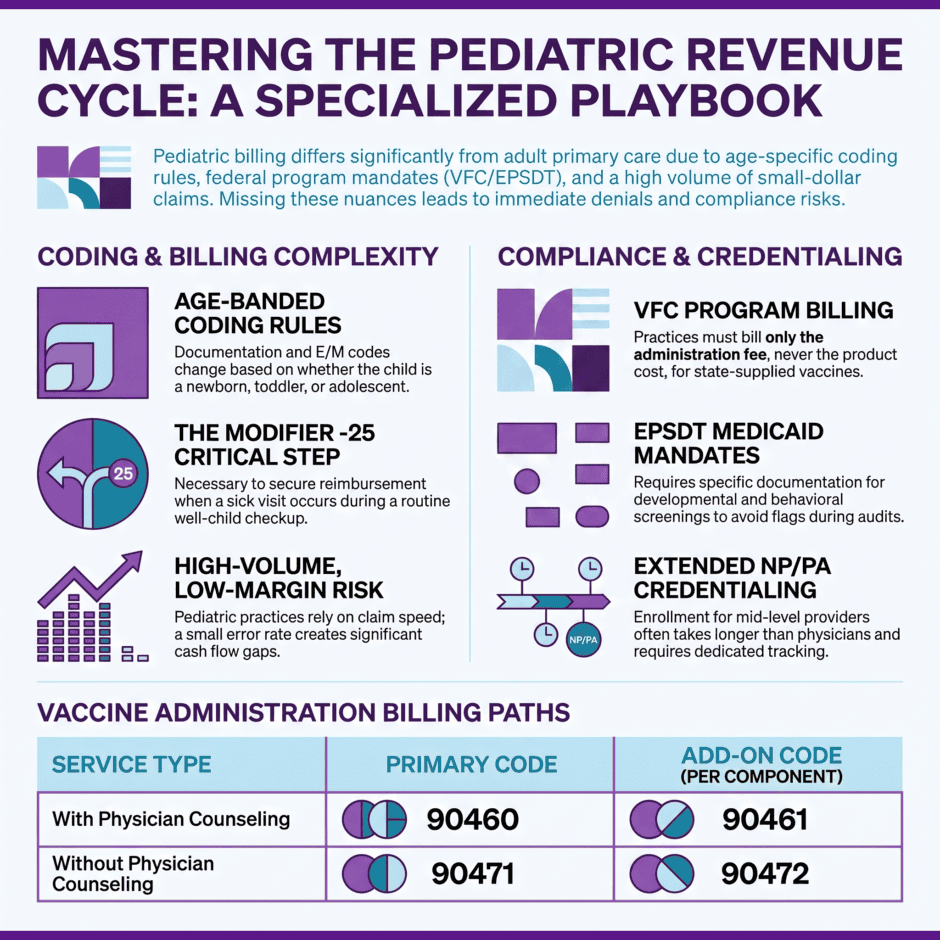
Age-Based Coding in Pediatrics
 Preventive visits are where age drives the code. New-patient well visits bill as 99381 for infants under one, 99382 for ages 1 through 4, 99383 for 5 through 11, and 99384 for 12 through 17, with the established-patient versions running 99391 through 99394. A patient who turns 5 or 12 between visits moves to the next code, and billing the old bracket is one of the easiest denials to avoid.
Sick visits work differently. Problem-oriented office visits use the same 99202 through 99215 codes for a toddler as for an adult, leveled by medical decision-making or total time. The 2026 E/M and telehealth rules apply to pediatric practices the same way they apply everywhere else.
Newborn care
Normal newborn care has its own code family. 99460 covers the initial hospital or birthing center evaluation, 99461 covers the same service in another setting, 99462 covers each subsequent hospital day, and 99463 covers a newborn admitted and discharged on the same date. Sick newborns and NICU care move to a separate set of critical and intensive care codes.
High volume, low margin
Pediatric visits usually pay less per encounter than many adult specialties, and practices make it up on volume. A denial rate a surgical group could absorb can drain a pediatric office’s cash flow, since there’s less margin on each claim.
Well Visits, Sick Visits, and Modifier 25
When a physician finds and treats a separate problem during a well visit, like an ear infection spotted at a routine check, both the preventive code and a problem-oriented E/M can be billed. The E/M carries modifier 25, and the note has to show work beyond the routine exam. A minor issue that takes no extra workup is part of the preventive visit and doesn’t support a second code.
Vaccine Billing and the VFC Program
 The Vaccines for Children program supplies vaccines at no cost for children through age 18 who are Medicaid-eligible, uninsured, or American Indian or Alaska Native. Underinsured children qualify only when vaccinated at an FQHC, an RHC, or a deputized provider.
Since the practice didn’t pay for a VFC dose, it can’t bill for the vaccine itself. Most state Medicaid programs want the product code on the claim at $0 with the SL modifier so they can track state-supplied doses, and they pay only the administration fee, which each state caps. Billing a VFC dose at the practice’s purchase price looks like a false claim to an auditor, not a simple error.
Administration codes
When the physician or other qualified professional counsels the family, administration for patients through age 18 bills as 90460 for the first vaccine component and 90461 for each additional component. A combination vaccine like MMR has three components, so it bills as one unit of 90460 and two units of 90461. Without counseling, or for patients 19 and older, administration bills as 90471 and 90472 by vaccine rather than by component. Many payers also require the National Drug Code on vaccine lines.
EPSDT Screening Requirements
EPSDT is the Medicaid benefit for enrollees under 21. It requires states to cover screening visits on a set schedule, along with vision, hearing, dental, and lab services and any treatment needed to correct problems the screens find. Most states follow the AAP Bright Futures periodicity schedule for timing.
Each screen bills separately from the preventive visit when it’s performed and documented. Developmental screening with a standardized tool like the ASQ bills as 96110. Brief emotional and behavioral assessments, including adolescent depression screens, bill as 96127. Vision and hearing screens bill as 99173 and 92551, fluoride varnish as 99188, and a caregiver depression screen at an infant visit as 96161. Medicaid also requires blood lead testing at 12 and 24 months. A screen billed without the tool’s name and score in the note is a common audit finding.
Credentialing Pediatric Providers

Physicians, NPs, and PAs
Most pediatric groups run a mix of pediatricians, nurse practitioners, and physician assistants. Medicaid programs generally enroll NPs and PAs under their own NPIs, while some commercial plans only recognize them under a supervising physician, which changes who appears as the rendering provider on the claim. If the billing setup doesn’t match the payer’s credentialing file, claims can deny months after they were paid.
Medicaid and MCO enrollment
State Medicaid enrollment comes first, and each Medicaid managed care plan then credentials the provider on its own. A pediatric group in a state with five MCOs needs every provider enrolled with all five, and each runs its own revalidation schedule. Our guide to getting credentialed with Medicaid walks through state enrollment and MCO timelines. VFC enrollment runs separately through the state immunization program.
Payer Contracting for Pediatric Practices
Since well visits and vaccine administration make up so much of pediatric revenue, the preventive and administration rates matter more in a pediatric contract than the sick-visit fee schedule. A payer can offer competitive E/M rates while underpaying 99391 through 99394 and 90460, and that gap costs a pediatric practice more than almost any other specialty. Payer contracting reviews should compare those codes against Medicaid and commercial benchmarks in the practice’s market.
Common Denial Triggers in Pediatric Claims
Most pediatric denials trace back to a short list of causes. They include billing a preventive code from the wrong age band, a missing modifier 25 on a same-day sick visit, a VFC dose billed without the $0 product line or the SL modifier, screening codes billed without the tool and result in the note, and vaccine lines missing the NDC or a modifier the payer requires.
Confidential adolescent services raise a separate problem. When an explanation of benefits for a 16-year-old’s confidential visit goes to the parent who holds the policy, it creates a privacy issue on top of any billing dispute, so practices need a plan for how those services are billed.
Pediatric Billing, Credentialing, Contracting FAQ
Do sick-visit E/M codes change with a child’s age?
No. Problem-oriented visits use the same 99202 through 99215 codes at every age. Only preventive visit codes, newborn codes, and vaccine counseling codes are tied to the patient’s age.
Can a practice bill for a vaccine received through the VFC program?
Only the administration fee. The vaccine itself was supplied at no cost, so most state Medicaid programs require the product code at $0 with the SL modifier, and they pay the state’s capped administration fee.
When do 90460 and 90461 apply instead of 90471?
90460 and 90461 apply when a physician or qualified health professional counsels the family and the patient is 18 or younger. They bill per vaccine component. Without counseling, or for patients 19 and older, administration bills as 90471 and 90472 per vaccine.
Can a well visit and a sick visit be billed on the same day?
Yes, when the physician addresses a separate problem that takes work beyond the preventive exam. The problem-oriented E/M carries modifier 25, and the note has to show the extra work.
What does EPSDT require from a pediatric practice?
EPSDT covers Medicaid enrollees under 21 and requires screening visits on a set schedule, plus vision, hearing, lab, and developmental screens. Each screen performed is billed and documented with the tool used and the result.
How long does pediatric credentialing take?
Medwave averages 85 days across payers. Groups with several Medicaid MCOs should start applications early, since each plan credentials on its own schedule after state Medicaid enrollment is approved.
Why Pediatricians Choose Medwave for Billing, Credentialing, and Contracting
 Medwave handles pediatric billing, credentialing, and payer contracting under one team. We check age bands on every preventive claim, bill VFC doses the way each state wants them, and match screening codes to the documentation before claims go out, which is how we hold a 98% clean claim rate.
On credentialing, we enroll pediatricians, NPs, and PAs with state Medicaid, every MCO your patients carry, and commercial plans, with an 85-day average turnaround. Practices that also see adult patients can find related services on our primary care page, and and you can’t bill what you can’t credential explains why enrollment has to come first.
Contact Medwave below to see how we can support your pediatric practice.