

Psychiatry billing is its own animal. It is not therapy billing, and it is not general medical billing either. It sits in between, blending time-based psychotherapy codes with medical E/M visits, medication management, and strict documentation rules that most other specialties never have to touch. If you run a psychiatry practice, or you are a psychiatrist thinking about opening one, getting psychiatry billing and credentialing right from day one is what separates a practice that gets paid on time from one that spends its energy chasing denials.
This guide walks through what makes psychiatry billing different, the codes and modifiers that matter most in 2026, how credentialing works for psychiatric providers, and what payer contracting actually looks like once you are ready to negotiate rates instead of just accepting whatever a payer offers.
Key Takeaway
This guide covers how psychiatry billing, credentialing, and payer contracting work together, including the CPT codes and modifiers that matter most, why credentialing takes longer for psychiatrists than for most other specialties, and where practices tend to lose revenue at the negotiating table. Medwave handles all three pieces for psychiatry practices so providers can spend their time with patients instead of paperwork.
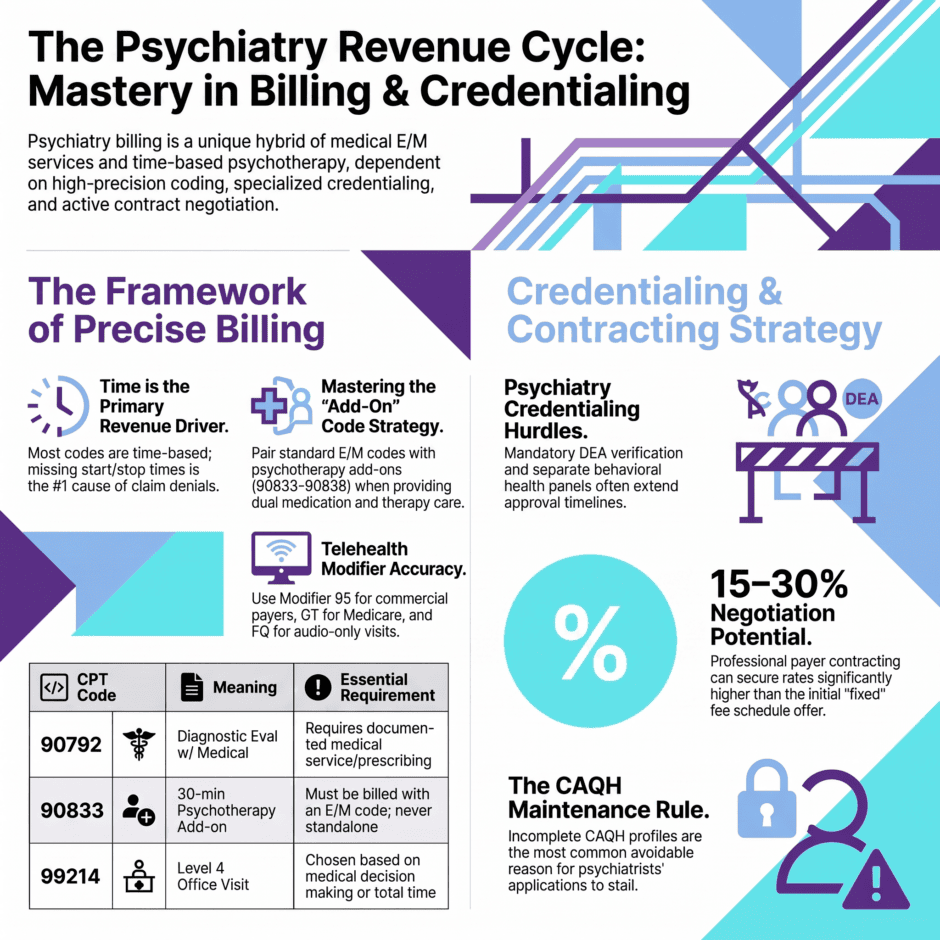
Quick-Reference: Psychiatry Codes and Modifiers at a Glance
Bookmark this table. It is the fast lookup for the codes and modifiers covered in detail below.
| Code / Modifier | What It Means | Watch Out For |
|---|---|---|
| 90791 | Psychiatric diagnostic evaluation, no medical service | Do not use if a medical component (like a medication discussion) took place |
| 90792 | Psychiatric diagnostic evaluation with medical service | Requires documentation showing the medical service; missing it triggers a denial |
| 90833 / 90836 / 90838 | Psychotherapy add-on codes (30 / 45 / 60 min) | Must be billed with an E/M code, never standalone |
| 99213 / 99214 / 99215 | Standard E/M codes by time or medical decision making | Match the code to documented time, not habit |
| 90839 / 90840 | Crisis psychotherapy codes | Documentation must reflect true acute risk or decompensation |
| 96130 | Psychological/neuropsychological testing evaluation | Only licensed psychologists and physicians can bill this, not master's-level clinicians |
| Modifier 95 | Telehealth, most commercial payers | Confirm per payer; not universal |
| Modifier GT | Telehealth, typically Medicare | Do not swap with 95 without checking payer rules |
| Modifier FQ | Medicare audio-only behavioral health visit | Applies mainly in rural or no-video situations |
| POS 10 | Patient at home (telehealth) | Pays the non-facility rate |
| POS 02 | Facility-based telehealth | Pays the lower facility rate |
What Is Psychiatry Billing, Credentialing, and Payer Contracting?
 Three separate but connected processes keep a psychiatry practice financially healthy.
Billing is the day-to-day work of coding visits correctly, submitting claims, and following up when a payer denies or underpays. For psychiatry, this means knowing the difference between a diagnostic evaluation, a psychotherapy session, and a medication management visit, and picking the code that matches exactly what happened in the room.
Credentialing is the process of getting a psychiatrist approved to join an insurance company’s network. It involves verifying medical school, residency, board certification, license status, malpractice history, and DEA registration. Every payer runs its own version of this check, and a psychiatrist working with ten payers needs ten separate approvals.
Payer contracting comes after credentialing. Once a psychiatrist is approved, the payer sends a contract that spells out reimbursement rates, timely filing deadlines, and the rules for the relationship going forward. This is the step where a practice can negotiate, though many psychiatrists never realize the fee schedule in that contract is not fixed in stone.
Why Psychiatry Billing Is Harder Than It Looks
Most medical specialties bill a fixed procedure code for a fixed service. A psychiatrist doing an appendectomy would bill one code, done. Psychiatry does not work that way. Nearly every code in behavioral health is time based, which means the clock, not the diagnosis, drives what you can bill.
A 45-minute session and a 60-minute session are two different codes with two different payment rates. If your documentation does not clearly note the start and stop time, or the total minutes spent, a payer can deny the claim or downcode it to a lower-paying service. This single issue, missing or vague time documentation, is consistently ranked as the top denial reason across behavioral health billing.
On top of that, psychiatrists often provide both medical and therapeutic care in the same visit. A patient might get a medication check and a therapy conversation in one appointment. Billing that correctly means pairing an E/M code with a psychotherapy add-on code, not billing psychotherapy alone. Get this pairing wrong and the claim either gets rejected outright or gets paid at a fraction of what the visit was worth.
Add telehealth into the mix, and the rules multiply again. Different payers want different modifiers for a virtual visit, and using the wrong one is an easy way to turn a clean claim into a denied one.
Psychiatry CPT Codes You Need to Know
Here is a quick reference for the codes that show up most often on a psychiatrist’s claim form.
- 90791 – Psychiatric diagnostic evaluation without medical services. Used for the first visit when no prescribing happens.
- 90792 – Psychiatric diagnostic evaluation with medical services. Used when the first visit includes a medical component, such as a medication discussion.
- 90833, 90836, 90838 – Psychotherapy add-on codes (30, 45, and 60 minutes) billed alongside an E/M code, not by themselves.
- 99213, 99214, 99215 – Standard E/M codes, chosen based on visit time or medical decision making. A 20 to 29 minute visit typically lands at 99213, while 40 to 54 minutes usually supports 99214.
- 90839, 90840 – Crisis psychotherapy codes for acute situations involving imminent risk or severe decompensation. These pay at a premium rate but require documentation that matches the severity of the visit.
- 96130, 96136, 96138 – Psychological and neuropsychological testing codes. Only licensed psychologists and physicians, including psychiatrists, can bill 96130. This is a common scope-of-practice mistake for practices that also employ master’s-level clinicians.
- 90885 – Psychiatric evaluation of records and reports, used when no patient contact occurs.
Every one of these codes needs a diagnosis (ICD-10) that lines up with the service. A psychiatric evaluation code paired with a diagnosis that does not match the documented condition is one of the fastest ways to get a claim kicked back.
Telehealth and Modifier Rules for Psychiatry
 Telepsychiatry is now a normal part of care, but the modifier rules behind it are anything but simple.
Modifier 95 is the one most commercial payers want on a telehealth claim. Medicare, on the other hand, often wants GT, and modifier FQ applies specifically to Medicare audio-only behavioral health visits, which matter a lot in rural areas or for patients without reliable video access. Place of service matters too. POS 10 signals the patient was at home, which supports the non-facility payment rate. POS 02 signals a facility setting, which pays less.
Get any one of these wrong, and you are looking at a denial or a lower payment than you earned. Since every payer treats telehealth modifiers a little differently, the safest move is building a payer-specific cheat sheet into your billing workflow rather than relying on memory.
Common Psychiatry Billing Denials and How to Fix Them
Five issues account for most of the denials psychiatry practices deal with.
First, missing or vague time documentation. If a note does not show exact start and stop times, or total session minutes, expect a downcode or a denial.
Second, mismatched codes. Billing 90837 as a standalone psychotherapy code when the visit actually included prescribing or medical decision making is a frequent and expensive error. The fix is billing the E/M code plus the correct add-on, supported by documentation that shows both components happened.
Third, missing prior authorization. Intensive outpatient programs, partial hospitalization, and some medication management services often need authorization before the visit, not after.
Fourth, wrong or missing modifiers on telehealth claims. This one is avoidable with a simple payer matrix that your billing team checks before every submission.
Fifth, credentialing gaps. A psychiatrist who sees patients before their credentialing is finalized with a payer will get denials for every claim tied to that panel, even if the clinical care was excellent. This is why credentialing timelines matter so much, and why it pays to start the process early.
Credentialing for Psychiatrists: What Makes It Different
 Credentialing a psychiatrist takes longer than credentialing most other specialists, and there are a few reasons why.
DEA registration verification adds a layer that many other specialties skip past quickly. Because psychiatrists prescribe controlled substances, payers want to confirm active, unrestricted DEA status before granting network approval. Any gap in that registration, even a lapsed renewal, can stall the whole file.
Behavioral health panels are also often separate from a payer’s general medical network. Some insurers carve out mental health benefits entirely to a third-party administrator, which means a psychiatrist may need to complete an entirely separate credentialing process just for the behavioral health side of a plan, even after being approved on the medical side.
CAQH ProView still forms the backbone of most credentialing applications, and keeping that profile current, with accurate license numbers, malpractice history, and work history, prevents a huge share of the delays practices run into. An expired or incomplete CAQH profile is one of the most common and most avoidable reasons a psychiatrist’s application sits untouched for weeks.
Group versus individual credentialing is another wrinkle. A psychiatrist joining a group practice needs to be credentialed both individually and as part of the group’s tax ID, and missing either half means claims get denied even though the provider is technically in network.
Payer Contracting and Reimbursement Rates for Psychiatry
This is where the real money conversation happens, and it is the piece most psychiatry practices skip.
Reimbursement for the same CPT code varies enormously by credential and by payer. A psychiatrist billing 90837 with a commercial payer might see anywhere from $140 to $220 per session, while a master’s-level clinician billing the identical code for the identical time might only collect $90 to $165. Doctoral-level and MD prescribers consistently command the highest tier, but only if the contract reflects that.
Medicaid reimbursement swings even more by state. Psychotherapy rates under state Medicaid programs can run as low as 46 percent of the Medicare rate in some states and well above 200 percent in others. If your practice sees a mix of Medicare, Medicaid, and commercial patients, knowing exactly where each payer’s rate lands matters for financial planning, not just billing accuracy.
Fee schedules are also not fixed once signed. Payers expect providers to negotiate, and many psychiatry practices simply accept the first offer without ever pushing back. Practices that work with someone experienced in payer contracting often secure meaningfully better terms, sometimes 15 to 30 percent higher, just by knowing what to ask for and when to ask.
Value-based contracting is also becoming a bigger part of the picture in psychiatry. CMS launched behavioral health innovation models in several states, and commercial payers are starting to offer enhanced rates tied to collaborative care and outcome tracking. A psychiatry practice that is only thinking about fee-for-service rates is likely missing newer contract structures that pay more for measurable outcomes.
Best Practices for Psychiatry Revenue Cycle Management
A few habits separate psychiatry practices that get paid consistently from those that do not.
Document time on every note, every time, even when a visit runs long or short of the typical bracket. Build a payer-specific reference sheet for telehealth modifiers and update it whenever a payer changes its rules. Verify eligibility and behavioral health carve-outs before the first visit, not after the claim gets denied. Track CAQH expiration dates on a calendar so recredentialing never sneaks up. And review your fee schedule against current market rates at least once a year, because a contract signed three years ago is rarely still competitive today.
How Medwave Supports Psychiatry Practices
Medwave works with psychiatry practices across billing, credentialing, and payer contracting, and treats these three services as one connected system rather than three separate vendors handing off work.
On the billing side, Medwave’s team knows the difference between 90791 and 90792, how to pair E/M codes with psychotherapy add-ons correctly, and which telehealth modifier each payer expects. On credentialing, Medwave tracks CAQH profiles, DEA verification, and behavioral health panel enrollment so psychiatrists are not stuck waiting weeks longer than necessary. On payer contracting, Medwave reviews fee schedules against current market benchmarks and pushes for stronger rates instead of letting a first offer stand as the final word.
Frequently Asked Questions
What is the difference between CPT 90791 and 90792?
90791 covers a psychiatric diagnostic evaluation with no medical service component. 90792 covers the same evaluation but includes a medical service, such as discussing medication options. Billing 90792 without documentation showing a medical service is a common cause of denial.
Can a psychiatrist bill psychotherapy and an E/M visit on the same day?
Yes, but the psychotherapy must be billed as an add-on code (90833, 90836, or 90838) alongside the E/M code, not as a standalone psychotherapy code. Documentation needs to show that both a medical component and a distinct therapy component took place.
Why do psychiatry claims get denied so often for telehealth visits?
The most frequent reason is a mismatched modifier. Commercial payers often want modifier 95, Medicare typically wants GT, and audio-only visits under Medicare need modifier FQ. Place of service coding also affects payment, since POS 10 and POS 02 pay differently.
How long does credentialing take for a new psychiatrist?
Credentialing timelines vary by payer, but psychiatrists often wait longer than other specialists because of DEA verification and separate behavioral health panel enrollment. A well-maintained CAQH profile can shave real time off this process.
Does Medicaid pay the same rate for psychiatry services in every state?
No. Medicaid reimbursement for psychotherapy and psychiatric evaluation codes varies widely by state, in some cases running far below the Medicare rate and in other states running well above it.
Is it worth renegotiating a payer contract after it is signed?
Often, yes. Fee schedules are not permanent, and many payers expect providers to push back at renewal time. Practices that never revisit their contracts tend to fall behind current market rates over several years.
What billing code do psychiatrists use most?
Time-based psychotherapy add-on codes paired with E/M visits are the most frequently billed combination for prescribing psychiatrists, while 90791 and 90792 are the most common codes for initial evaluations.
Do psychiatrists need separate credentialing from therapists?
Yes, in most cases. Even within the same behavioral health panel, a psychiatrist’s application requires DEA and prescribing verification that a licensed therapist’s application does not.
What is a fee schedule in payer contracting?
A fee schedule is the list of rates a payer agrees to pay for each CPT code under a signed contract. It is the document that determines what a practice actually collects per visit.
Summary
 Psychiatry billing, credentialing, and payer contracting each carry their own set of rules, and getting any one of them wrong slows down the money coming into a practice. Time-based codes, telehealth modifiers, DEA-linked credentialing, and rate negotiation all demand attention that a busy psychiatrist rarely has time to give while also seeing patients. Medwave handles billing, credentialing, and payer contracting for psychiatry practices so providers can spend more time treating patients and less time on paperwork and denied claims.
If your practice is ready for cleaner claims, faster credentialing, and stronger payer contracts, reach out to Medwave below to get started.