

Gastroenterology revenue comes mostly from procedures: colonoscopies, upper endoscopies, biopsies, and polyp removals performed in an endoscopy suite or ambulatory surgery center. Each of those claims depends on the same question, which is why the procedure was done. A colonoscopy for a patient with no symptoms is screening and usually costs the patient nothing. The same colonoscopy ordered for rectal bleeding is diagnostic and carries a deductible and coinsurance. Code it the wrong way and the patient gets a bill they weren’t expecting, or the practice gets a denial.
Credentialing adds a second requirement. A gastroenterologist has to be enrolled with the payer and privileged at the facility where the procedure happens, and the claim fails if either one is missing.
Key Takeaways
- Medicare screening colonoscopies bill as G0121 (average risk) or G0105 (high risk). Commercial screening bills the CPT code with modifier 33.
- When a polyp is removed during a Medicare screening colonoscopy, the procedure code gets the PT modifier, and patient coinsurance is 15% through 2026.
- Medicare treats a colonoscopy after a positive stool test as screening, not diagnostic.
- The anesthesia claim for a screening colonoscopy needs the same screening modifier as the procedure claim.
- A gastroenterologist needs both payer enrollment and facility privileges before procedure claims can be paid.
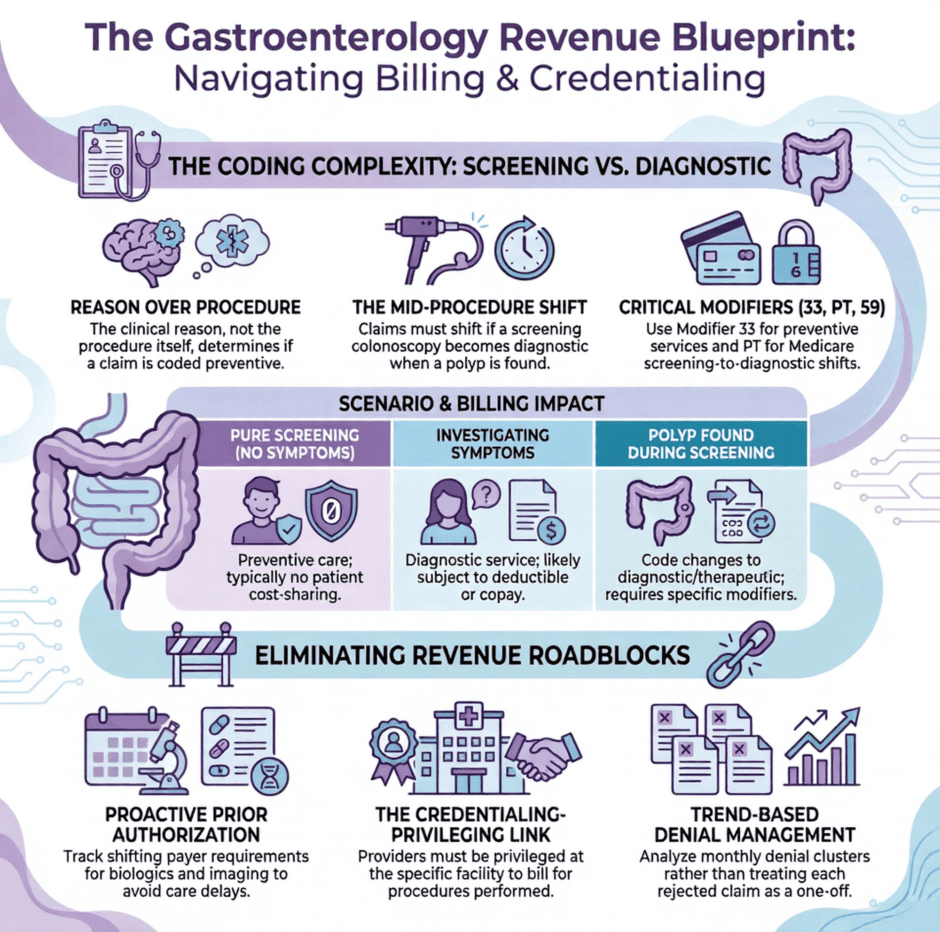
Screening vs. Diagnostic: The Decision Behind Every GI Claim
 A colonoscopy is screening when it’s performed on a patient with no symptoms to look for colorectal cancer. Medicare and most commercial plans cover screening starting at age 45. Medicare covers an average-risk screening colonoscopy once every 10 years and a high-risk screening once every 2 years, so frequency has to be checked before scheduling.
A colonoscopy is diagnostic when it’s ordered to evaluate symptoms such as bleeding, anemia, or a change in bowel habits, or as surveillance after a prior finding. Diagnostic colonoscopies bill standard CPT codes, and the patient’s deductible and coinsurance apply.
The hardest case is a screening exam that finds something. If a polyp is removed during a screening colonoscopy, the procedure becomes therapeutic, but the patient still started with a screening exam. Medicare and commercial plans handle that differently.
- Medicare: bill the procedure code (45385, for example) with the PT modifier. The Part B deductible is waived, but the patient owes coinsurance on the procedure. That coinsurance is phasing down by law, from 15% through 2026 to 10% from 2027 to 2029 and to zero in 2030.
- Commercial plans: bill the procedure code with modifier 33. Federal guidance requires most commercial plans to cover polyp removal during a screening colonoscopy without cost-sharing.
A colonoscopy performed after a positive stool-based test, such as FIT or Cologuard, is also treated as screening under Medicare and under federal guidance for commercial plans. Billing it as diagnostic sends the patient a bill they shouldn’t owe. The AGA’s screening colonoscopy coding FAQ covers the payer-specific details.
Common GI CPT and HCPCS Codes
- G0121: Screening colonoscopy, patient not at high risk (Medicare)
- G0105: Screening colonoscopy, patient at high risk (Medicare)
- 45378: Diagnostic colonoscopy
- 45380: Colonoscopy with biopsy, single or multiple
- 45384: Colonoscopy with lesion removal by hot biopsy forceps
- 45385: Colonoscopy with lesion removal by snare
- 43235: Diagnostic upper endoscopy (EGD)
- 43239: Upper endoscopy with biopsy
- 91110: Capsule endoscopy of the small bowel
- 00812: Anesthesia for screening colonoscopy
Our guide to which CPT codes are used in colonoscopy billing covers the full colonoscopy code family, including incomplete procedures and multiple-procedure rules.
Anesthesia, Pathology, and Facility Claims
A single colonoscopy can generate three or four separate claims: the gastroenterologist’s professional claim, the facility claim from the ASC or hospital, the anesthesia claim when an anesthesia provider gives monitored sedation, and the pathology claim for any specimens. If the screening modifier is on the procedure claim but missing from the anesthesia claim, the patient can be billed for anesthesia on what should have been a no-cost screening. Anesthesia for a screening colonoscopy bills 00812, and the screening modifier has to match across both claims. Our anesthesiology page covers how anesthesia claims are built.
When the gastroenterologist performs moderate sedation personally, it bills separately with 99152 and 99153 rather than through an anesthesia code.
Prior Authorization in Gastroenterology
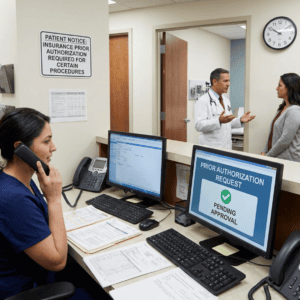 Screening colonoscopies rarely need prior authorization, but much of the rest of GI care does. Capsule endoscopy, advanced imaging during a GI workup, and biologic infusions for Crohn’s disease and ulcerative colitis are the most common triggers. Biologics usually need documented failure of conventional therapy before the payer will approve them, and many plans require reauthorization every 6 to 12 months.
An approval also has to match what was billed. If the authorization lists one code and the claim goes out with another, the claim can deny even though an approval exists. This is covered in why an approved authorization can still end in a denied claim.
Where GI Claims Get Denied
Most GI denials trace back to a short list of causes:
- A screening colonoscopy billed before the frequency interval is up, or for a patient the payer doesn’t consider eligible
- The wrong screening modifier for the payer, such as PT on a commercial claim or 33 on a Medicare claim
- A diagnosis code that doesn’t support medical necessity for a diagnostic procedure
- Multiple procedures in one session billed without the correct modifier or sequence
- A missing or mismatched prior authorization for capsule studies or biologics
Fixing these depends on the procedure note. When the gastroenterologist states the indication clearly (screening, symptoms, surveillance, or follow-up after a positive stool test) and documents what was removed and how, the coder can choose the right code and modifier the first time. Our billing team reviews denials by cause each month so a recurring error gets fixed at the source.
Gastroenterology Credentialing
Board certification and payer enrollment
Gastroenterologists complete an internal medicine residency followed by a three-year gastroenterology fellowship, then certify through the American Board of Internal Medicine. Payers verify both the internal medicine and gastroenterology certifications, along with licensure, DEA registration, and malpractice history, through CAQH ProView, now part of DataSpring. A lapsed CAQH profile can stall enrollment or recredentialing without any notice to the provider.
Facility privileges
Most GI procedures happen in a hospital endoscopy unit or an ASC, and each facility credentials the gastroenterologist separately. Payer enrollment doesn’t cover a procedure performed at a facility where the physician isn’t privileged, and payer participation is checked by facility as well as by provider. A new gastroenterologist needs credentialing with each payer and each facility before the first procedure day.
Payer Contracting for GI Practices
Procedure volume gives GI practices more leverage than most specialties. A few dollars per colonoscopy adds up over thousands of procedures a year, so comparing each payer’s rates to Medicare and to regional benchmarks shows where negotiation will pay off. Practices that own or partner with an ASC can negotiate the facility rate as well as the professional fee.
Gastroenterology Billing & Credentialing FAQs
Is a colonoscopy always billed as a preventive service?
No. It’s preventive only when performed as screening on a patient without symptoms, or as a follow-up to a positive stool-based screening test. A colonoscopy ordered for symptoms or surveillance is diagnostic, and the patient’s cost-sharing applies.
What happens to billing when a polyp is removed during a screening colonoscopy?
The claim moves to the procedure code for the removal. Medicare requires the PT modifier and charges the patient coinsurance, which is 15% through 2026 and drops to zero by 2030. Most commercial plans require modifier 33 and can’t charge cost-sharing.
What’s the difference between modifier PT and modifier 33?
PT is Medicare’s modifier for a colorectal screening that became diagnostic or therapeutic. Modifier 33 is the commercial modifier for a preventive service. Using the wrong one for the payer is a common cause of denials and incorrect patient bills.
Does the anesthesia claim need a screening modifier too?
Yes. Anesthesia for a screening colonoscopy bills 00812, and the anesthesia claim needs the same screening modifier as the procedure claim. Without it, the patient can be billed for anesthesia on a screening exam.
Do GI procedures need prior authorization?
Screening colonoscopies rarely do. Capsule endoscopy, some advanced imaging, and biologic infusions for inflammatory bowel disease usually do, and biologics often need reauthorization every 6 to 12 months.
Why can’t a credentialed gastroenterologist bill for every procedure?
Payer enrollment is only half of it. The physician also needs privileges at the hospital or ASC where the procedure happens, and the payer has to recognize that facility. A gap in either one stops the claim.
Medwave in the GI Practice
 GI revenue runs through the endoscopy suite, and so do most GI denials. Medwave codes screening, surveillance, and diagnostic colonoscopies by Medicare’s rules, adds PT or 33 when a screening finds polyps, and ties anesthesia and pathology claims to the right indication. Our billing team clears 98% of GI claims on the first pass.
Gastroenterologists who scope at ASCs and hospitals need privileges at each one. Our credentialing team handles those alongside payer enrollment, which runs about 85 days, and our payer contracting team can benchmark your endoscopy rates against Medicare.
If ASC claims are stuck, the form below is the fastest way to reach us.