

Healthcare providers face a lot of administrative requirements, but few cause as much confusion as the ongoing credentialing process. You’ve spent years in school, completed your residency, passed your boards, and got credentialed with insurance companies so you can actually get paid for treating patients. Then someone tells you that you need to handle “revalidation” or “recredentialing,” and the paperwork never really ends.
These two terms get used interchangeably, but they’re different processes with different requirements, different timelines, and different consequences if you miss them. Knowing the difference isn’t just terminology. It’s about keeping your practice running and avoiding situations where you can’t bill for services you’ve already provided.
Key Takeaways
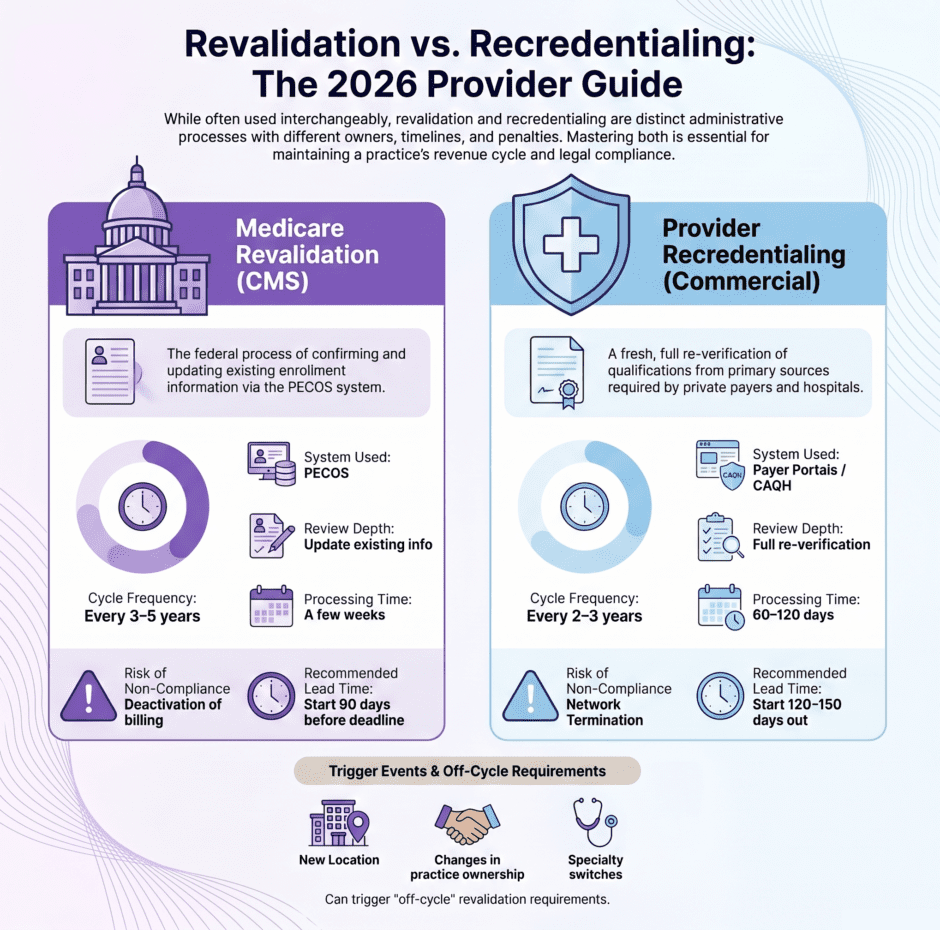
Revalidation is Medicare’s periodic re-enrollment process, currently required every three to five years depending on your provider category. Recredentialing is what private payers and hospitals require (typically every two to three years) and involves re-verifying your qualifications from primary sources. Missing either can suspend your ability to bill. Both require early action: start Medicare revalidation 90 days before your deadline, and private payer recredentialing 120 to 150 days out.
What’s Medicare Revalidation?
 Medicare revalidation is the federal government’s periodic re-enrollment process. Medicare requires providers to revalidate their enrollment to maintain billing privileges. For most providers, that cycle is every five years. However, starting January 1, 2026, CMS reduced the revalidation cycle to every three years for certain higher-risk provider categories as part of updated screening requirements, so it’s worth confirming which cycle applies to your enrollment.
During revalidation, you’re confirming and updating the information Medicare has on file. You need to verify your practice locations are still current, update any changes to your licensing or credentials, confirm your specialty designation, and make sure your contact information is accurate. Think of it as Medicare asking you to confirm everything is still correct before extending your billing privileges.
The process happens through the Provider Enrollment, Chain, and Ownership System (PECOS). You’ll receive notification from Medicare when your revalidation is due, usually several months before the deadline. You log into PECOS, review your existing information, make any necessary updates, and submit your revalidation application.
Certain events can trigger an off-cycle revalidation requirement outside the standard schedule. Changes in your practice ownership structure, adding or changing practice locations, switching your specialty or scope of services, and situations where Medicare identifies potential compliance concerns all require action between cycles. If your billing privileges have ever been deactivated and you want to reactivate them, revalidation is also required.
Missing a Medicare revalidation deadline has serious consequences. Your billing privileges get deactivated. You’re still seeing patients and providing care, but you’re not getting paid for it. Getting reactivated requires completing the revalidation process and can involve significant delays and revenue gaps.
What’s Provider Recredentialing?
Recredentialing is the term private insurance companies and hospitals use for their periodic review process. While revalidation is specific to Medicare, recredentialing is what you’ll deal with for commercial payers like Blue Cross, Aetna, and UnitedHealthcare. Hospitals use this term for their medical staff renewal processes as well.
The timeline for recredentialing is shorter than Medicare’s cycle. Most private payers require recredentialing every two to three years. Hospitals often follow a similar schedule, though some conduct annual reviews for certain privileges.
Recredentialing is more thorough than revalidation. Medicare revalidation focuses on confirming existing information is still accurate. Recredentialing involves re-verifying your qualifications from scratch, a fresh review, similar to what happened during your initial credentialing.
During recredentialing, organizations check that your medical license is active and free from disciplinary actions, verify your board certifications are current, confirm your malpractice insurance meets their coverage requirements, review any new malpractice claims or settlements, screen state and federal databases for sanctions or exclusions, and verify your DEA registration if you prescribe controlled substances.
Many organizations also review quality and performance data during recredentialing. Patient satisfaction scores, prescribing patterns, patient complaints, and outcomes data may all be included. Hospitals in particular often tie recredentialing to ongoing professional practice evaluation and peer review. As of 2026, several major commercial payers, including UnitedHealthcare, have moved to continuous monitoring models rather than relying solely on the periodic recredentialing review.
The recredentialing process requires completing an application similar to your initial credentialing. You’ll provide updated information and documentation. The organization then verifies everything, which can take anywhere from 60 to 120 days, sometimes longer depending on the payer’s workload.
Revalidation vs. Recredentialing: Side-by-Side Comparison
| Factor | Medicare Revalidation | Provider Recredentialing |
|---|---|---|
| Who requires it | Medicare (CMS) | Private payers, hospitals |
| System used | PECOS | Payer/hospital credentialing portals; CAQH |
| Review depth | Confirm and update existing enrollment info | Full re-verification from primary sources |
| Processing time | A few weeks after submission | 60–120 days |
| Lead time recommended | 90 days minimum | 120–150 days minimum |
| Cycle length | 3–5 years (varies by provider category as of 2026) | Every 2–3 years |
| Consequence of missing | Billing privileges deactivated | Network termination; new application required |
 While both processes keep your credentials current, here are the distinctions that affect how you manage them.
Who Requires What?
Medicare uses revalidation. Private insurance companies and hospitals use recredentialing. If you participate in Medicaid, different states may use either term, so check your state’s specific requirements.
How Often Does It Happen?
Standard Medicare revalidation occurs every five years, but CMS now applies a three-year cycle to certain higher-risk provider categories effective January 2026. Private payer and hospital recredentialing typically happens every two to three years, meaning you’re dealing with recredentialing cycles more frequently.
How Detailed is the Review?
Revalidation focuses on confirming and updating information already on file. Recredentialing involves re-verifying your credentials from primary sources and conducting a fresh review of your qualifications.
How Long Does It Take?
Once you submit your Medicare revalidation, processing typically happens within a few weeks. Recredentialing with private payers often takes 90 to 120 days because of the more extensive verification involved.
What Happens if You Miss It?
Missing Medicare revalidation leads to deactivation of billing privileges. Serious stuff, but correctable by completing the revalidation process. Missing recredentialing with a private payer can result in termination from their network, requiring a full new application to get back in.
Why This Matters for Your Practice
The practical impact is significant. If you’re enrolled with Medicare and credentialed with multiple commercial payers and one or more hospitals, you’re juggling different renewal cycles with different requirements. Medicare might need revalidation in year one, Blue Cross might need recredentialing in year two, your hospital privileges might come up for renewal in year three, and then the cycle starts again.
Missing any of these deadlines creates revenue problems. Deactivated Medicare billing privileges mean no payment for Medicare patients. Getting dropped from a commercial payer’s network means patients may need to find new providers, and you lose that portion of your practice. Lapsed hospital privileges mean you can’t admit patients or perform procedures there.
The administrative burden is real. Each cycle requires gathering documentation, completing applications, and following up to confirm everything processes correctly. For busy providers trying to see patients and run a practice, tracking multiple renewal deadlines with different requirements can overwhelm even a well-organized office.
Common Mistakes Providers Make
 One frequent mistake is assuming all renewals work the same way. Providers get comfortable with how one organization handles things and miss important differences with another payer. Medicare’s revalidation process through PECOS is very different from filling out a recredentialing application for a private insurance company.
Not tracking renewal dates properly is another common problem. You might know you need to revalidate with Medicare, but do you have the actual deadline marked with enough lead time? Many providers only realize their renewal is due when they receive a notification, which doesn’t leave much buffer if problems come up.
Incomplete applications and documentation cause significant delays. Missing a required form, an improperly signed attestation, or a missing malpractice insurance certificate can push you past your deadline. With recredentialing timelines already running 90 to 120 days, any delays compound quickly.
Not updating information promptly between cycles is also an issue. If you move your practice location, change your malpractice carrier, or let a board certification lapse and then recertify, update that information with all your payers immediately. Waiting until your next renewal cycle creates problems.
How to Stay on Top of Both Processes
The key to managing revalidation and recredentialing is organization and planning. You need a system to track all your different renewal dates, what each organization requires, and when to start the process.
Create a master calendar that includes:
- Medicare revalidation dates (check the CMS Revalidation Due Date List)
- Each commercial payer’s recredentialing schedule
- Hospital medical staff renewal dates
- License renewal dates for all states where you’re licensed
- Board certification expiration and recertification dates
- Malpractice insurance renewal dates
- DEA registration renewal
Set reminders well in advance of actual deadlines. For Medicare revalidation, start the process at least 90 days before your deadline. For commercial payer recredentialing, begin 120 to 150 days out to account for the longer processing times.
Keep a current document file ready for any credentialing process. That file should include your medical school diploma and transcripts, residency and fellowship completion certificates, current medical licenses from all states, board certifications, current malpractice insurance certificate and declarations page, DEA certificate, and an up-to-date CV.
Review and update your information regularly, even between formal renewal cycles. If something changes, a new practice location, updated board certification, new malpractice carrier notify all your payers immediately. This makes the actual renewal process much simpler because your information is already current.
When to Get Help
 Many practices handle revalidation and recredentialing in-house, but it’s time-consuming work that requires close attention to each payer’s requirements. Missing deadlines or making mistakes on applications carries real financial consequences.
This is why many providers work with credentialing specialists or companies that handle these processes as part of their services. Medwave provides billing, credentialing, and payer contracting services, including tracking renewal dates, preparing applications, gathering required documentation, following up with payers, and making sure everything gets completed on time.
The cost of credentialing services is often offset by avoiding revenue disruption from missed deadlines, deactivated billing privileges, or network terminations. There’s also real value in freeing up your time to focus on patient care rather than paperwork.
Revalidation vs. Recredentialing FAQ
What is the difference between revalidation and recredentialing?
Revalidation is Medicare’s process for periodically re-enrolling providers to maintain billing privileges, currently required every three to five years depending on your provider category. Recredentialing is the term private insurance companies and hospitals use for their own periodic review process, which occurs every two to three years. Revalidation confirms existing information is current; recredentialing involves re-verifying qualifications from primary sources.
How often does Medicare revalidation occur?
Standard Medicare revalidation occurs every five years. As of January 1, 2026, CMS applied a three-year cycle to certain higher-risk provider categories. Check the CMS Revalidation Due Date List in PECOS to confirm your specific deadline.
What happens if you miss a Medicare revalidation deadline?
Missing a Medicare revalidation deadline results in deactivation of your billing privileges. You cannot submit claims for Medicare patients until you complete the revalidation process and billing privileges are reactivated. The process can involve significant delays and revenue gaps.
How long does recredentialing take with a private payer?
Recredentialing with most private payers takes 60 to 120 days from the time you submit a complete application. Payers vary in their processing speed, and any missing documents can extend that timeline further. Starting 120 to 150 days before your deadline gives you adequate buffer.
Does missing recredentialing with a private payer affect Medicare?
No, they are separate processes. However, if you are terminated from a private payer’s network for missing recredentialing, you lose access to that payer’s patients and revenue stream. A termination from a commercial payer does not automatically affect your Medicare enrollment, but it does require you to go through a full new credentialing application with that payer to regain network participation.
Is revalidation the same as recredentialing?
No. Revalidation is specific to Medicare and involves confirming your existing enrollment information is still accurate. Recredentialing is used by private payers and hospitals to conduct a fresh verification of your qualifications. They have different timelines, different review depths, and different consequences if missed.
How often do providers need to recredential with insurance companies?
Most private insurance companies require recredentialing every two to three years. Hospitals typically follow a two-year cycle. Some payers have moved to continuous monitoring models as of 2026 rather than relying solely on periodic reviews.
What triggers an off-cycle Medicare revalidation?
Changes in practice ownership, adding or changing practice locations, switching specialty designations, and Medicare compliance concerns can all trigger revalidation outside your standard five-year cycle.
Can a credentialing service handle both revalidation and recredentialing?
Yes. Credentialing services like Medwave track renewal dates for both Medicare revalidation and commercial payer recredentialing, prepare the required applications, gather documentation, and follow up with payers to ensure timely completion.
Summary: Revalidation vs. Recredentialing
 Revalidation and recredentialing serve similar purposes, keeping your credentials current, but they’re not the same process. Medicare uses revalidation on a three-to-five-year cycle depending on your provider category. Private payers and hospitals use recredentialing on shorter two-to-three-year cycles. Both are required to maintain your ability to bill for services and see patients in network.
Missing these deadlines directly affects revenue. The key is staying organized. Make absolutely sure to track all your renewal dates, start the process early, and submit complete applications. Whether you manage this in-house or work with a credentialing service, having a system in place protects your billing, your credentialing status, and the payer contracts that keep your practice running.
Medwave handles billing, credentialing, and payer contracting for healthcare practices. If you’re looking to take revalidation and recredentialing off your plate, along with the rest of the administrative burden, contact us to learn how we support your practice.

Co-Founder and COO of Medwave, bringing more than 30 years of hands-on experience in healthcare revenue cycle management, payer contracting, and medical credentialing.