

Fertility preservation billing turns on one question that has nothing to do with the procedure itself, which is why the patient is freezing eggs, sperm, or embryos. A patient preserving fertility before chemotherapy may be covered under a state mandate, while a patient freezing eggs electively usually pays out of pocket or through an employer fertility benefit, even though the codes are the same.
Key Takeaways
- Medically necessary fertility preservation is identified with Z31.84 plus the diagnosis that threatens fertility, such as a cancer requiring gonadotoxic treatment.
- More than a dozen states require certain health plans to cover fertility preservation when a medical treatment is likely to cause infertility.
- Cryopreservation bills by specimen type (89258 for embryos, 89259 for sperm, 89337 for oocytes), and storage bills annually under its own codes.
- Many patients are covered through fertility benefit managers, which use their own networks, authorizations, and bundled payments.
- Self-pay patients are entitled to a Good Faith Estimate before scheduled services under the No Surprises Act.
Medical vs. Elective Fertility Preservation
 Coverage depends on why preservation is needed. When a patient faces surgery, chemotherapy, radiation, or another treatment likely to cause infertility, the preservation is often called iatrogenic or medically indicated. Claims for it use Z31.84, the code for an encounter for a fertility preservation procedure, along with the underlying diagnosis. Practices that see many cancer patients often coordinate with the referring oncology team, since timing is tight and authorization has to move quickly.
More than a dozen states, including California, New York, New Jersey, Illinois, Connecticut, and Maryland, require state-regulated plans to cover medically indicated fertility preservation. Self-funded employer plans aren’t bound by those mandates, so the plan type has to be confirmed before assuming coverage. Elective egg or embryo freezing is rarely covered by a standard health plan, and it’s usually paid by the patient or through an employer fertility benefit.
Documentation for a medically indicated case should name the planned treatment, explain why it threatens fertility, and record the referring physician’s recommendation. Denials for lack of medical necessity usually come from a claim that went out with only the fertility code and no supporting diagnosis.
Procedure and Storage Codes
A preservation cycle produces several claims. Ovarian stimulation monitoring bills as office visits, pelvic ultrasounds, and hormone labs. Oocyte retrieval bills as 58970, with ultrasound guidance for follicle aspiration billed as 76948. The stimulation drugs are usually covered under the pharmacy benefit through a specialty pharmacy, not billed by the clinic.
- 58970 (follicle puncture for oocyte retrieval)
- 89258 (cryopreservation of embryos)
- 89259 (cryopreservation of sperm)
- 89337 (cryopreservation of mature oocytes)
- 89335 (cryopreservation of testicular reproductive tissue)
- 89342 (storage of embryos, per year)
- 89343 (storage of sperm, per year)
- 89346 (storage of oocytes, per year)
- 89352, 89353, and 89356 (thawing of embryos, sperm, and oocytes)
Ovarian tissue cryopreservation still bills under a Category III code at most payers. Storage is billed once a year per specimen type, and even plans that cover the initial cryopreservation often limit or exclude ongoing storage. When an IVF cycle creates embryos for transfer, our genetic testing page covers how preimplantation genetic testing is billed by the lab.
Fertility Benefit Managers
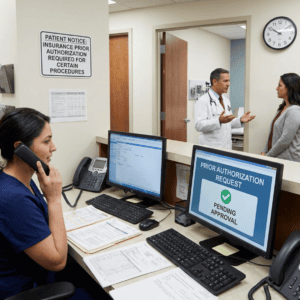 Many employers provide fertility coverage through a fertility benefit manager instead of the medical plan. These companies run their own provider networks, issue their own authorizations, and often pay a bundled amount for a defined cycle instead of paying each code separately. Others reimburse the patient after the clinic is paid directly. A clinic that isn’t in the manager’s network may not be able to bill it at all, and a cycle billed outside its authorized bundle can deny even when every code is correct.
Each fertility benefit manager has its own contracting and credentialing process, separate from the patient’s health plan. Practices that see many employer-covered patients should be in the networks their local employers use.
Self-Pay Patients and Storage Accounts
Patients paying out of pocket are entitled to a written Good Faith Estimate before scheduled services under the No Surprises Act, listing the expected services, codes, and charges. A final bill $400 or more above the estimate can be disputed. Cycle packages should spell out what’s included, such as monitoring, retrieval, freezing, and the first year of storage, and what’s billed separately.
Storage becomes a long-running account. Annual fees renew for years, patients move or change contact information, and consent forms govern what happens to specimens if fees go unpaid. Billing for storage needs accurate renewal dates, clear statements, and a process for unpaid balances that follows the signed disposition agreement.
Credentialing for Fertility Practices

Physicians
Reproductive endocrinologists certify in obstetrics and gynecology and then in reproductive endocrinology and infertility through the American Board of Obstetrics and Gynecology. Payers verify both certifications, licensure, DEA registration, and malpractice history. Practices that also provide general gynecology follow the rules on our OBGYN page.
Laboratories and clinic reporting
Andrology testing such as semen analysis falls under CLIA, and many embryology labs choose accreditation through the College of American Pathologists reproductive laboratory program or The Joint Commission. Embryology lab directors often hold certification from the American Board of Bioanalysis. Clinics that perform IVF report cycle outcomes to the CDC under federal law, usually through SART, and programs that handle donor eggs, sperm, or embryos register with the FDA as tissue establishments.
Networks and recredentialing
Each health plan and fertility benefit manager credentials the clinic and its physicians separately. Most health plans recredential every three years, and a lapse stops payment from that plan until it’s restored, which is why you can’t bill what you can’t credential.
Fertility Preservation Billing FAQs
Is fertility preservation covered by insurance?
When it’s medically indicated, such as before cancer treatment, many plans in states with fertility preservation mandates must cover it. Elective egg freezing is usually self-pay or covered through an employer fertility benefit.
What diagnosis code is used for fertility preservation?
Z31.84, for an encounter for a fertility preservation procedure, along with the diagnosis that threatens fertility, such as the cancer being treated.
How is egg freezing billed?
Oocyte retrieval bills as 58970 with ultrasound guidance as 76948, and cryopreservation of mature oocytes bills as 89337. Monitoring visits, ultrasounds, and labs are billed separately.
How are storage fees billed?
Annually, per specimen type. 89342 covers embryo storage, 89343 sperm storage, and 89346 oocyte storage. Many plans that cover the initial freezing limit or exclude ongoing storage.
Do state fertility mandates apply to every health plan?
No. They apply to state-regulated plans. Self-funded employer plans are governed by federal law and don’t have to follow state mandates.
Do self-pay fertility patients need a Good Faith Estimate?
Yes. Uninsured and self-pay patients are entitled to a written Good Faith Estimate before scheduled services, and a bill $400 or more above it can be disputed.
How Medwave Handles Fertility Preservation Revenue
 Medwave sorts each patient into the right path before the first monitoring visit. We check whether a state mandate applies, whether the plan is self-funded, and whether a fertility benefit manager holds the benefit. From there we bill covered cycles with the diagnosis that supports them and handle self-pay estimates and storage renewals. Our billing, credentialing, and payer contracting teams work from the same account history, so a network gap and a stalled claim get fixed together.
Credentialing for reproductive endocrinologists and clinics with health plans and fertility benefit managers averages 85 days with us. On the contracting side, we review how each agreement pays for retrieval, freezing, and storage, and our guide to payer contracting negotiation strategies covers how those conversations go.
If your clinic is adding preservation services or carrying a backlog of storage balances, send us a note below and we’ll take a look.