

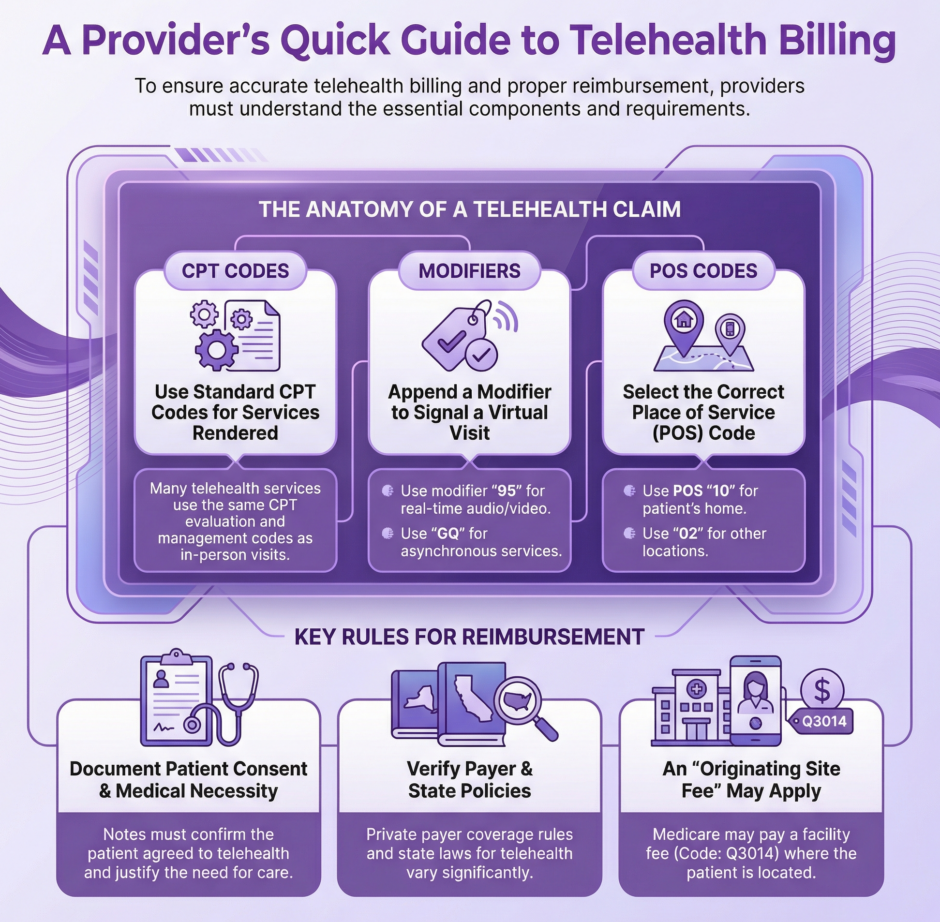
Telehealth billing comes down to four things on every claim, which are the right code, the right modifier, the right place of service, and documentation that shows why the visit was virtual. Medicare’s telehealth flexibilities now run through December 31, 2027, which gives practices time to build that process before the next deadline arrives. Medwave handles billing and credentialing for practices that deliver care remotely, and this page covers the rules we apply to those claims.
Key Takeaways
- The Consolidated Appropriations Act, 2026 extended Medicare’s telehealth flexibilities through December 31, 2027, but they remain temporary and depend on Congress.
- Medicare pays telehealth billed with place of service 10 (patient at home) at the non-facility rate and place of service 02 at the facility rate, so the code you choose changes the payment.
- Modifier 95 identifies real-time audio and video, and modifier 93 identifies audio-only, so a Medicare claim carries the right modifier alongside place of service 02 or 10.
- The 2026 originating site facility fee, billed with Q3014, is $31.85, and it does not apply when the patient is at home.
What Telehealth Billing Covers
Telehealth is any clinical service delivered through telecommunications technology. Real-time video visits and audio-only visits are the most common. Practices also bill patient-initiated online messages, short virtual check-ins, review of recorded images or video, and remote monitoring programs. Each of those has its own codes and its own rules, and a claim that uses the wrong set is denied even when the care was sound.
Remote monitoring splits in two. Remote patient monitoring tracks physiologic data such as blood pressure or glucose readings, and remote therapeutic monitoring tracks non-physiologic data such as therapy adherence and response. Our guides to remote patient monitoring codes and remote therapeutic monitoring codes go through each program.
Medicare Telehealth Rules Through 2027
On February 3, 2026, the President signed the Consolidated Appropriations Act, 2026, which extends Medicare telehealth flexibilities through December 31, 2027, according to Noridian Medicare. KFF notes that most of these flexibilities are still temporary, while a handful have become permanent through earlier legislation and annual fee schedule rulemaking. The 2026 fee schedule rule, for example, permanently removed frequency limits on telehealth subsequent inpatient visits, nursing facility visits, and critical care consultations, as summarized in KFF’s explainer on Medicare telehealth coverage.
The practical effect is that a practice can plan its telehealth revenue through 2027 and should still expect another extension fight afterward. We track that in what the 2027 extension means, and the coding side is covered in how 2026 E/M and telehealth rules are changing.
Telehealth CPT Codes by Service Type
Most telehealth visits use the same CPT codes as in-person care, with the modifier and place of service carrying the virtual information. The codes below are the ones practices use most often, and the 2026 CPT code updates list what changed this year.
- Office and outpatient E/M visits use 99202 through 99205 for new patients and 99211 through 99215 for established patients. Code 99201 was deleted in 2021.
- Patient-initiated online digital E/M services use 99421 through 99423.
- Virtual check-ins use G2012 for 5 to 10 minutes and G2252 for 11 to 20 minutes. G2010 covers remote evaluation of recorded video or images.
- Subsequent inpatient visits use 99231 through 99233, and subsequent nursing facility visits use 99307 through 99310.
- Psychotherapy uses 90832 through 90838, crisis psychotherapy uses 90839 and 90840, and family psychotherapy uses 90846 and 90847, and our psychiatry billing page covers the rest of that specialty.
Remote Therapeutic Monitoring Codes
Remote therapeutic monitoring is the area where the rules are most often misread. The APTA’s practice advisory on RTM codes sets out the requirements, and our remote therapeutic monitoring billing page applies them.
- 98975 covers initial setup and patient education. It is reported once per episode of care, and only after the device has been activated and monitoring runs at least 16 days.
- 98976 covers a respiratory device supply and 98977 covers a musculoskeletal device supply. Each is reported only when 16 days of data collection occur within a 30-day period.
- 98980 covers the first 20 minutes of treatment management in a calendar month and requires at least one interactive communication. It is not reported for less than a full 20 minutes.
- 98981 covers each additional full 20 minutes of treatment management in the same calendar month.
Telehealth Modifiers and Place of Service
Two pieces of information tell the payer a service was virtual. The modifier describes the modality, with 95 for real-time audio and video and 93 for audio-only. The place of service describes where the patient was, with 10 for the patient’s home and 02 for any other location. For Medicare, the place of service also decides the rate, since CMS Transmittal 12671, Billing and Payment for Telehealth Services with Place of Service (POS) 10, directs payment at the non-facility rate for POS 10 and the facility rate for POS 02.
That gap makes a wrong place of service an underpayment. The code reflects the patient’s location, whatever the clinician’s. Other payers set their own rules, and some still ask for GT or GQ, or for POS 11 with modifier 95, so each payer’s policy has to be checked. Our Medicare modifiers guide covers the full list.
The Originating Site Facility Fee
When a patient receives a telehealth service at a qualifying originating site such as a clinic, that site can bill HCPCS code Q3014. The payment for 2026 is $31.85, up from $28.64 in 2023, according to the CMS List of Telehealth Services. The fee goes to the originating site, so the distant site practitioner does not bill it, and CMS states that POS 10 does not apply to originating site facilities billing it. A visit with the patient at home produces no Q3014.
Documentation That Supports the Claim
A telehealth claim gets audited on the same basis as an in-person one, plus a few extras that show the visit was valid as a virtual service.
- The patient’s location and the provider’s location for the visit.
- The modality used, and the reason when a visit was audio-only.
- Consent, where the payer or the state requires it.
- The clinical note, with medical necessity and the history, exam, or decision making that supports the E/M level or time billed.
- The platform used, kept in the record so the privacy and technology requirements can be shown.
Private Payers, State Rules, and Credentialing
Commercial payers diverge from Medicare more than most practices expect. Some restrict telehealth to certain specialties or in-network providers, some pay audio-only visits at a lower rate, and some require prior authorization. Our FAQ on how payer contracts handle telehealth explains where that gets decided.
State law adds another layer. States differ on telehealth payment parity, consent requirements, and prescribing, and the clinician generally must be licensed where the patient is located. See which states participate in multi-state licensing models before adding patients in a new state. A claim also only pays when the clinician is enrolled with that payer, which is the subject of whether you need separate credentialing for telehealth.
Keeping Telehealth Revenue Clean
Most telehealth denials trace to setup, since the visit itself is usually sound. Check that the claim scrubber accepts the telehealth modifiers and place of service codes, that charge capture adds Q3014 where it applies, and that clinicians know which modifier goes with which modality. Then track telehealth denials by payer and reason code so a pattern shows up within a month. Our overview of why telehealth billing keeps getting more complex explains why that review has to be recurring.
Telehealth Billing FAQs
What modifier is used for telehealth?
Modifier 95 identifies a service delivered by real-time audio and video, and modifier 93 identifies an audio-only service. Medicare pairs them with place of service 02 or 10, and other payers may require different modifiers, so each payer’s policy should be checked before billing.
What is the difference between POS 02 and POS 10?
POS 10 is telehealth provided in the patient’s home, and POS 02 is telehealth provided anywhere else. Medicare pays POS 10 at the non-facility rate and POS 02 at the facility rate.
Does Medicare still pay for telehealth in 2026?
Yes. The Consolidated Appropriations Act, 2026 extended Medicare’s telehealth flexibilities through December 31, 2027. They remain temporary and depend on future congressional action.
What is the difference between remote patient monitoring and remote therapeutic monitoring?
Remote patient monitoring tracks physiologic data such as blood pressure or glucose. Remote therapeutic monitoring tracks non-physiologic data such as therapy adherence and response, and it uses the 98975 through 98981 code family.
What is Q3014 and when can it be billed?
Q3014 is the Medicare telehealth originating site facility fee, which is $31.85 for 2026. It is billed by the site where the patient is located and does not apply when the patient is at home.
What documentation does a telehealth claim need?
The record should show the patient’s and provider’s locations, the modality used, consent where required, and a clinical note that supports medical necessity and the billed E/M level.
Where Medwave Fits in a Telehealth Practice’s Billing
 Telehealth claims go wrong at the seams between coding, enrollment, and payer policy, so our telehealth billing services handle those pieces together. Our medical billing team applies each payer’s modifier and place of service rules to the claim, and our medical credentialing team enrolls clinicians with the payers they bill.
Telehealth payment terms are set in the payer contract, including which services are covered, whether audio-only visits pay the same as video, and how the rate compares with the in-person fee. Our payer contracting team reads those terms with the practice before a telehealth program launches, so the billing rules and the contract agree.
When telehealth claims do come back denied, the cause is usually a modifier, a place of service value, or an enrollment gap, and each one has a different fix. Those denials are worked through our denial management process, which traces each one to its reason code and corrects the setting that produced it.
Tell us which payers and states you see patients in, and we’ll map the modifier, place of service, and enrollment requirements for each.