

Pain management practices bill a mix that few other specialties have. A single patient might have an office visit, an epidural steroid injection, a facet joint block followed weeks later by radiofrequency ablation, a urine drug test, and an ongoing controlled substance prescription. Each of those services follows its own coding rules, and most of the procedures need prior authorization and documented results from earlier treatment before a payer will cover them.
Credentialing carries more weight here too. Pain physicians who prescribe controlled substances need a current DEA registration and, in many states, a state controlled substance registration as well. A lapse in either one stops more than prescribing. It can also stop claims.
Key Takeaways
- Epidural, facet, and radiofrequency ablation codes include fluoroscopic or CT guidance, so 77003 isn’t billed with them.
- Facet joint and RFA codes are billed by spinal region and level, with modifier 50 for bilateral procedures.
- Medicare policies limit how often epidurals, facet injections, and RFA can be repeated in a 12-month period, and they require documented pain relief from earlier procedures.
- Intrathecal pump refills bill as 95990 or 95991, and the drug is billed separately.
- Pain physicians need a current DEA registration and, in many states, a separate state controlled substance registration.
Interventional Procedure Coding
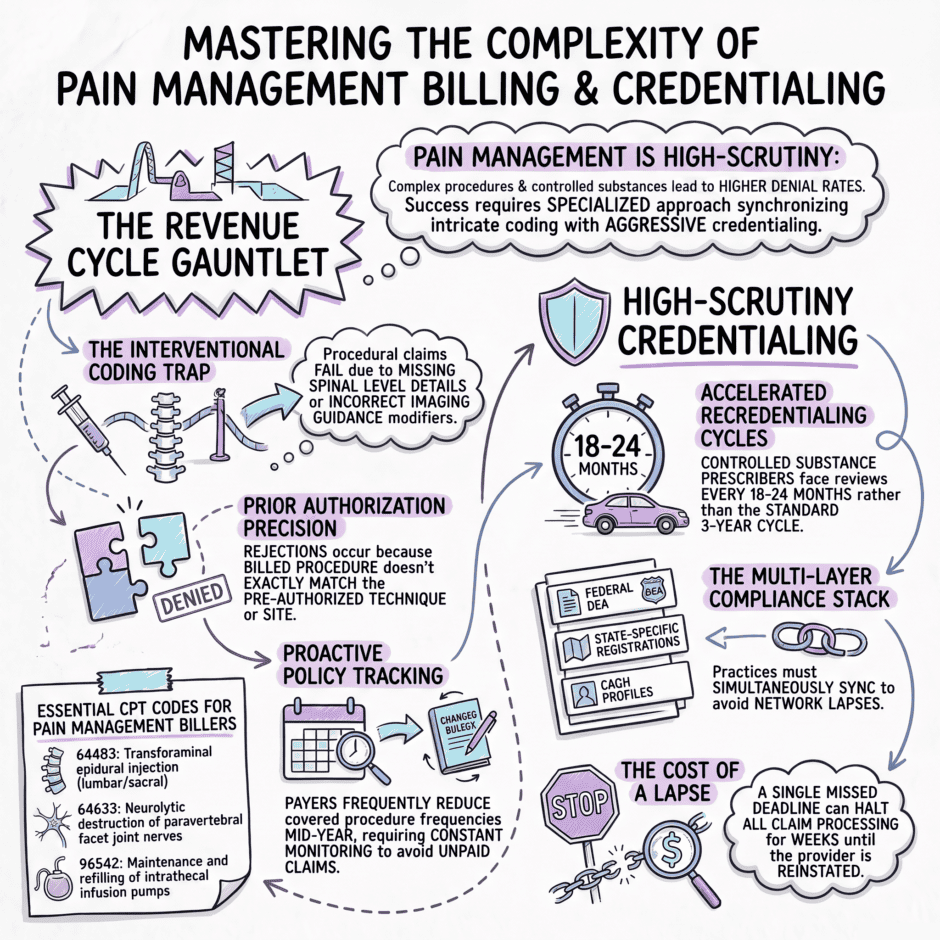
 Most interventional pain codes are split by spinal region and by number of levels. Epidural steroid injections bill by approach. Interlaminar injections use 62321 in the cervical or thoracic spine and 62323 in the lumbar or sacral spine. Transforaminal injections use 64479 for cervical or thoracic and 64483 for lumbar or sacral, with add-on codes 64480 and 64484 for each additional level.
Facet joint injections and medial branch blocks follow the same pattern. 64490 to 64492 cover the cervical and thoracic spine, and 64493 to 64495 cover the lumbar and sacral spine, billed by the number of levels treated. Bilateral procedures take modifier 50. Radiofrequency ablation of the facet joint nerves bills as 64633 for the first cervical or thoracic joint and 64635 for the first lumbar or sacral joint, with 64634 and 64636 for each additional joint.
All of these codes include imaging guidance. Billing fluoroscopic guidance (77003) or CT guidance with them is unbundling and will be denied or recouped. Sacroiliac joint injection (27096) includes imaging guidance as well.
Other common procedures include trigger point injections, billed as 20552 for one or two muscles and 20553 for three or more, and spinal cord stimulator trials, billed as 63650 per lead placed.
- 62321 and 62323 (interlaminar epidural injection, cervical or thoracic and lumbar or sacral)
- 64479 to 64484 (transforaminal epidural injection, by region, with add-ons for additional levels)
- 64490 to 64495 (facet joint injection or medial branch block, by region and level)
- 64633 to 64636 (radiofrequency ablation of facet joint nerves, by region and joint)
- 27096 (sacroiliac joint injection with imaging guidance)
- 20552 and 20553 (trigger point injections)
- 63650 (percutaneous spinal cord stimulator lead placement)
- 95990 and 95991 (intrathecal pump refill and maintenance)
Medicare Frequency Limits and Documentation
Medicare contractors publish coverage policies for epidural steroid injections and facet joint procedures, and many commercial plans follow similar rules. Epidurals are generally limited to four sessions per spinal region in a rolling 12 months and are covered for radicular pain, not for axial back pain alone. Before RFA, Medicare expects two diagnostic medial branch blocks, each producing significant pain relief. Repeat RFA in the same region requires documented relief from the earlier ablation and is limited to two sessions per region in 12 months.
Meeting these limits depends on the record. Each procedure note needs the region and levels treated, the pain score before and after, and the patient’s response to earlier procedures. Payers also expect documentation of conservative treatment, such as physical therapy or medication, before the first interventional procedure. Missing any of these is the most common reason pain procedure claims are denied or recouped on audit.
Prior Authorization
 Most commercial plans and many Medicare Advantage plans require prior authorization for interventional pain procedures, often through a radiology or musculoskeletal benefit manager. The request usually needs imaging results, the levels to be treated, and records showing conservative treatment and the results of earlier procedures.
The authorization has to match what’s performed. A different spinal level, a change from unilateral to bilateral, or an added level can leave the claim without a valid approval, even though the patient was authorized for a procedure that day. We cover this in why an approved authorization can still end in a denied claim.
E/M Visits, Pumps, and Drug Testing
An office visit on the same day as a procedure is billable only when the physician addresses a significant, separate problem, and the E/M line needs modifier 25. A visit that only confirms the planned injection is part of the procedure. When a separate anesthesia provider gives sedation, that claim is billed separately. Our anesthesiology page covers how those claims work.
Patients with implanted intrathecal pumps need regular refills and reprogramming. Refill and maintenance bill as 95990, or 95991 when the work requires a physician. Pump analysis and reprogramming without a refill use 62367 to 62370. The drug used in the refill is billed separately with its own HCPCS code and units.
Practices that prescribe opioids usually run urine drug tests as part of treatment agreements. Presumptive screens bill as 80305 to 80307. Definitive testing bills as G0480 to G0483 for Medicare and from 80320 to 80377 for many commercial plans. Payers limit how often definitive testing is covered and expect the record to explain why each test was ordered. Our toxicology page covers lab billing in more detail.
Pain Management Credentialing

Board certification
Pain medicine is a subspecialty certification offered through the American Board of Anesthesiology, the American Board of Physical Medicine and Rehabilitation, and the American Board of Psychiatry and Neurology, after a pain medicine fellowship. Payers verify the primary board certification and the pain subspecialty, along with licensure and malpractice history. Facilities and surgery centers often grant privileges procedure by procedure, so a physician may need separate approval for spinal cord stimulator placement or RFA.
DEA and state controlled substance registrations
Every prescriber needs a DEA registration for each state where they prescribe, and DEA registrations renew every three years. Many states also require a separate state controlled substance registration with its own renewal date, and most require prescribers to check the state prescription monitoring program before prescribing opioids. Payers verify DEA and state registrations at credentialing and recredentialing, so an expired registration can hold up a provider’s network status.
CAQH and recredentialing
Most payers recredential every three years using the provider’s CAQH ProView profile. A lapsed CAQH profile can stall recredentialing without notice, and a provider who drops out of a network can’t bill that plan until reinstated, which is why you can’t bill what you can’t credential.
Pain Management Billing FAQs
Is fluoroscopic guidance billed with an epidural or facet injection?
No. Epidural, facet joint, and RFA codes include imaging guidance, so 77003 and CT guidance codes aren’t billed with them.
How are bilateral facet joint injections billed?
The facet code for the region and level is billed with modifier 50. Additional levels use the add-on codes for that region.
How often will Medicare cover epidural steroid injections?
Medicare policy generally allows up to four epidural sessions per spinal region in a rolling 12 months, for radicular pain, with documented relief from earlier injections.
What does Medicare require before radiofrequency ablation?
Two diagnostic medial branch blocks, each producing significant pain relief. Repeat RFA in the same region needs documented relief from the earlier ablation and is limited to two sessions per region in 12 months.
How are intrathecal pump refills billed?
Refill and maintenance bill as 95990, or 95991 when the work requires a physician. The drug used in the refill is billed separately with its own code and units.
Do pain physicians need a state controlled substance registration?
In many states, yes. It’s separate from the DEA registration, has its own renewal date, and payers verify both.
Why Pain Management Practices Choose Medwave for Billing & Credentialing
 Medwave handles pain management billing, credentialing, and payer contracting under one team. We code by region and level, keep imaging guidance off the claims that include it, track frequency limits before procedures are scheduled, and match authorizations to the levels treated. That’s how we hold a 98% clean claim rate.
On credentialing, we enroll pain physicians, NPs, and PAs with Medicare, Medicaid, and commercial plans and track DEA, state controlled substance registrations, licenses, and CAQH profiles, with a 60-day average turnaround.
Contact Medwave below to see how we can support your pain management practice.