

How ambient listening technology is pushing coding intensity higher, raising real questions about healthcare costs and reimbursement.
AI scribes are helping doctors spend less time on paperwork and more time with patients. But two new studies show a side effect nobody planned for, billing codes are creeping upward at hospitals using these tools, which means higher costs for insurers and patients. It is not necessarily fraud, but it is a problem worth measuring.
Key Takeaways
AI medical scribes are speeding up documentation and easing clinician burnout, but two 2026 studies found they’re also driving up coding intensity, with one flagging roughly $22 million in extra maternity claims spending and another projecting up to $2.3 billion in added healthcare costs industry-wide. Researchers don’t believe this is fraud; more complete AI-generated notes naturally support higher-level codes than rushed manual documentation did. Still, payers are watching closely for sudden coding jumps and mismatched diagnoses, so practices using AI scribes should tighten internal coding audits and make sure clinicians review every note before it’s finalized.
The Promise Was Simple Enough
 Doctors are buried in paperwork. Anyone who has sat in an exam room watching their physician type notes instead of making eye contact knows how disruptive clinical documentation has become. AI scribes, which use ambient listening technology to record and transcribe patient visits automatically, were supposed to fix that. And in many ways, they have.
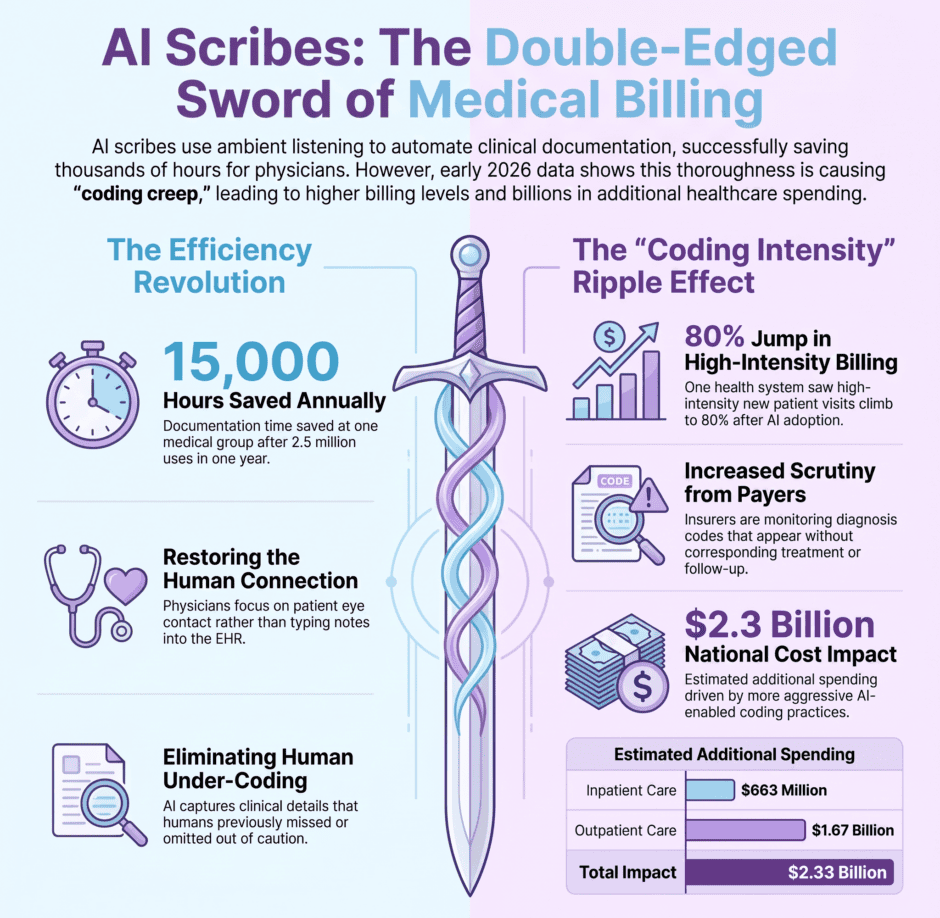
The technology lets physicians focus on the patient in front of them, not the keyboard. Studies back this up. One analysis of AI scribe use at The Permanent Medical Group found the technology saved 15,000 hours of documentation time after 2.5 million uses in a single year. That is not a small number. For a profession battling widespread burnout, tools like these feel like a lifeline.
But a pair of studies released in early 2026 are raising a harder question. What happens when AI scribes document more thoroughly than humans ever did?
What the Research Actually Found
Two separate analyses, released just weeks apart, both point to the same trend, coding intensity is going up at hospitals that have adopted AI scribing tools.
The Blue Cross Blue Shield Association (BCBSA), working with its data analytics partner Blue Health Intelligence, looked at deidentified claims data from tens of thousands of maternity cases across the country. What they found was striking. Cases coded for acute posthemorrhagic anemia, a serious condition that typically requires a blood transfusion, had jumped significantly. A meaningful portion of patients coded with that diagnosis never actually received a transfusion or any other treatment you would expect to go along with it.
That gap between the code and the care translated into roughly $22 million in additional spending between 2023 and 2024.
The second study, from healthcare market intelligence firm Trilliant Health, took a broader look. Researchers examined national all-payer claims data across six large hospital systems from 2018 to 2024, all of which had publicly announced their adoption of AI scribing technology. What they found was a consistent upward shift in evaluation and management (E/M) billing codes across both new and established patient visits, particularly toward the higher-intensity codes at the top of the scale. At one health system, coding for high-intensity new patient visits climbed as high as 80%.
So, is This Fraud? Not Exactly.
 This is where it gets interesting, and a little complicated to sort out.
Luke Chalker, chief product officer at Blue Health Intelligence, described how his team first noticed something was off. Facility-to-facility differences in coding trends were showing up that could not be explained by the usual suspects, things like the type of care setting or a regional public health issue. The changes were too sharp, too sudden. As he told TechTarget’s Revenue Cycle Management, he called it a “massive step-change growth” at certain facilities.
What made the connection to AI scribes plausible was timing. There was no major shift in how care was actually being delivered. But there was a clear, parallel trend in the adoption of ambient AI tools, many of which are also marketed as revenue cycle optimization platforms.
Allison Oakes, chief research officer at Trilliant Health, offered what might be the most honest framing of the situation. As Oakes told TechTarget’s Revenue Cycle Management, the shift makes sense given what these tools do:
“These AI-enabled scribing tools are allowing clinical documentation to be captured more thoroughly and accurately.” As she put it, “It’s a little bit of a double-edged sword.”
Her point is well-taken. The most likely explanation is not that hospitals are gaming the system on purpose. It is that providers have historically been under-coding their visits, partly due to incomplete notes, partly out of caution around the False Claims Act, and partly because the old documentation process simply missed things. AI scribes do not miss things. They capture the full length of a visit, every diagnosis mentioned, every clinical detail discussed. When you feed all of that into a billing system, the codes that come out are going to be more intensive.
Here are the main reasons researchers believe coding intensity is rising under AI scribes:
- AI tools capture more clinical detail than manual documentation, including diagnoses that might have been left out before.
- Ambient listening technology tracks the actual length of a visit with precision, which directly affects E/M code selection.
- AI scribes are designed to follow billing rules accurately, which may naturally push codes toward higher levels.
- Providers who previously under-coded out of caution or habit are now seeing full documentation without gaps.
The Patient in the Middle
Here is where the story stops being just a billing issue and becomes a patient issue.
When coding intensity goes up, reimbursement goes up. And when reimbursement goes up, payers face higher costs. Those costs do not stay with the insurance company. They flow down to members in the form of higher premiums and higher out-of-pocket bills, especially for anyone on a high-deductible health plan.
Blue Health Intelligence estimated that more aggressive coding practices enabled by AI tools could contribute approximately $2.3 billion in additional healthcare spending. That breaks down to around $663 million on the inpatient side and at least $1.67 billion in outpatient settings.
Patients are not receiving more care. They are not receiving better care. They are receiving a more detailed record of the care they already got, and that record is generating a bigger bill.
Dr. Luann Racher, an OB-GYN professor at the University of Arkansas for Medical Sciences who uses ambient listening technology in her practice, is clear that upcoding is not the intent. As Racher told TechTarget’s Revenue Cycle Management, the intent behind the tool has never been to inflate bills:
“The goal of using this generative AI tool is never to upcode, never to overcharge.” The documentation, she said, is meant to be accurate and precise, “and that then is transferred over into how the billing is coded.”
And she makes an important point, clinicians at her institution still review the AI-generated notes before they go to the billing team. The technology is not autonomously submitting codes without any human review.
Still, good intentions do not change outcomes. If the documentation is more complete and billing codes reflect that completeness, the dollars follow.
What Payers are Watching
 Insurers are paying close attention, and their concern is specific. The issue is not simply that costs are going up. It is that costs are going up without a corresponding change in the quality or quantity of care delivered.
As Chalker told TechTarget’s Revenue Cycle Management, the concern for payers comes down to one thing, whether the technology is actually changing care, not just the bill.
“Where it becomes an issue for payers is when it is clear that the technology is doing something to drive reimbursement up, but there is no clear path that the technology is doing anything to drive care to change as well,” he said.
That is a reasonable standard. If AI scribes were improving outcomes, accelerating diagnoses, or catching clinical problems that would otherwise be missed, higher billing codes might be justified. But so far, the data does not clearly support that link.
Here are four things payers are actively monitoring in response to the AI scribe trend:
- Step-change increases in high-intensity E/M codes at facilities after AI adoption.
- Diagnosis codes appearing in records without corresponding treatment or follow-up.
- Facility-to-facility variations in coding that cannot be tied to patient population differences.
- Revenue cycle optimization features bundled into AI scribe platforms that may be designed to maximize code capture.
The Rules Have Not Caught Up Yet
The big question hanging over all of this is whether the current billing code framework is still the right tool for the job.
When E/M coding guidelines were written, they were built around the assumption that documentation was imperfect and human. A physician trying to write notes from memory at the end of a busy clinic day was going to leave things out. The codes were calibrated to that reality.
AI scribes operate in a completely different mode. They are present in the room. They hear everything. They record it all. The resulting documentation reflects a level of detail that the old coding rules were never designed to handle.
As Oakes told TechTarget’s Revenue Cycle Management, she put the question directly:
“As AI is changing our documenting practices, does that mean we potentially need to be reconsidering what the rules are that we use for determining the billing codes?”
That is a fair challenge, and it is one that CMS, payers, and professional medical associations will eventually have to take up. But policy changes move slowly, and in the meantime, the billing patterns are already shifting.
What This Means for Revenue Cycle Teams
 If you are on the billing side of a health system or working with a revenue cycle management partner, this situation creates some real-world challenges.
More detailed documentation from AI scribes means more data flowing into the coding process. That is genuinely useful in many ways. It reduces denials tied to missing clinical information and supports stronger medical necessity arguments. But it also means your team needs to be paying close attention to coding accuracy and internal audits, not just volume.
Payers are going to push back. Expect increased scrutiny on high-intensity E/M codes, particularly in outpatient settings. Expect more prior authorization demands and more requests for clinical documentation when codes jump to the top of the scale. Having solid internal controls and a billing team that knows how to respond to those inquiries is going to matter more, not less.
At Medwave, we work with healthcare practices every day on exactly these kinds of challenges. When something like an AI-driven shift in coding intensity starts changing what payers expect, we are positioned to help practices stay ahead of it. Getting the coding right from the start is always better than fighting a denial after the fact.
AI Scribe FAQs
Should providers stop using AI scribes because of this?
That is almost certainly the wrong takeaway. The documentation and burnout benefits of AI scribes are real and well-documented. The better response is to make sure there are internal review processes in place so that AI-generated notes are checked by a clinician before they drive billing decisions.
Are AI scribes the same as AI coding tools?
Not exactly, though they overlap. AI scribes focus on capturing and generating clinical notes during a patient visit. Some platforms then use that documentation to suggest billing codes, which is where the revenue cycle optimization piece comes in. Others feed the notes into a separate coding workflow. The specific setup varies by vendor.
What can practices do right now to manage this risk?
A few practical steps include conduct regular internal audits comparing coding intensity before and after AI scribe implementation, make sure clinicians are actually reviewing AI notes rather than rubber-stamping them, and stay in close contact with your billing and coding team or revenue cycle partner about any unusual shifts in payer behavior.
Will CMS change the E/M coding rules to account for AI documentation?
Not yet, but the conversation is starting. Researchers are calling for a reexamination of whether current billing code frameworks are well-suited to AI-generated documentation. Any regulatory changes would take time, but this is a question the industry will need to answer.
How does this affect payer contracting?
Payer contracts often include provisions around coding accuracy and audit rights. As AI scribe adoption spreads, expect payers to take a closer look at those provisions. Practices with strong payer contracting support will be better positioned to negotiate terms that are fair and to respond effectively if a payer initiates a coding audit.
Does using an AI scribe automatically increase billing codes?
Not automatically. AI scribes capture more complete documentation, which can result in higher-intensity codes when the clinical picture supports it. The codes are still selected based on documented information, but AI tools tend to capture more of that information than manual note-taking does.
Is it illegal for AI scribes to cause higher billing codes?
Not necessarily. If the documentation accurately reflects the care provided, higher codes are legitimate. Problems arise when codes are assigned for diagnoses or services that were not clinically supported, regardless of what tool was used to generate the notes.
What is evaluation and management (E/M) coding?
E/M coding is the system used to bill for patient visits, from routine check-ups to high-acuity encounters. The codes range from lower intensity (CPT 99202-99203 for new patients, 99212-99213 for established) to higher intensity (99205 for new, 99215 for established). Higher codes mean higher reimbursement.
How are payers responding to AI-driven coding changes?
Payers like Blue Cross Blue Shield are already analyzing claims data to spot unusual coding patterns. Many are expected to respond with tighter audit criteria, more frequent documentation requests, and potentially new contract provisions related to AI-generated documentation.
Summary: How AI Scribes are Changing Medical Billing
 AI scribes are genuinely valuable. Giving physicians their time back, reducing burnout, and improving the quality of clinical documentation are meaningful wins for a healthcare system under serious strain. None of that should be minimized.
But the billing ripple effects are real. When documentation gets more thorough, codes get more intensive, and when codes get more intensive, costs go up for payers, employers, and patients. That chain of cause and effect does not require anyone to act in bad faith. It just requires a system with incentive structures that have not been updated to match the capabilities of the tools now being used inside it.
The research on this is still early. Both the BCBSA and Trilliant Health analyses are among the first of their kind, and more data will emerge as AI scribe adoption continues to spread. But the direction is clear enough that providers, payers, and revenue cycle teams need to be paying attention now.
If you are working through how these changes might affect your practice’s billing, credentialing, or payer contracts, the team at Medwave is here to help. We specialize in medical billing, credentialing, and payer contracting, and staying ahead of exactly these kinds of industry shifts is what we do.
Sources:
- Blue Cross Blue Shield Association / Blue Health Intelligence analysis (March 2026)
- Trilliant Health outpatient coding intensity study (March 2026)
- Jacqueline LaPointe, “How AI Scribes Are Shifting Coding Intensity, Reimbursement,” TechTarget Revenue Cycle Management (March 17, 2026)
- American Medical Association AI scribe productivity data
- The Permanent Medical Group AI scribe time savings study

Co-Founder and COO of Medwave, bringing more than 30 years of hands-on experience in healthcare revenue cycle management, payer contracting, and medical credentialing.