

Emergency department visits are the one E/M family where time doesn’t count. A 99285 has to be earned on medical decision-making alone, and that single rule shapes how ED notes are written, how they’re coded, and how they hold up on audit.
Key Takeaways
- ED visits (99281 to 99285) are leveled by medical decision-making only. Time can’t be used to choose the level.
- Critical care can be billed on the same day as an ED visit when the ED visit came first, and Medicare pays the first 99292 at 104 minutes.
- Under the prudent layperson standard and the ACA, health plans can’t require prior authorization for emergency care or deny it based only on the final diagnosis.
- The No Surprises Act bars balance billing for emergency care and sends out-of-network payment disputes to negotiation and independent dispute resolution.
- Locum tenens billing only covers a substitute for an absent enrolled physician, not a new hire waiting on enrollment.
ED Visit Levels
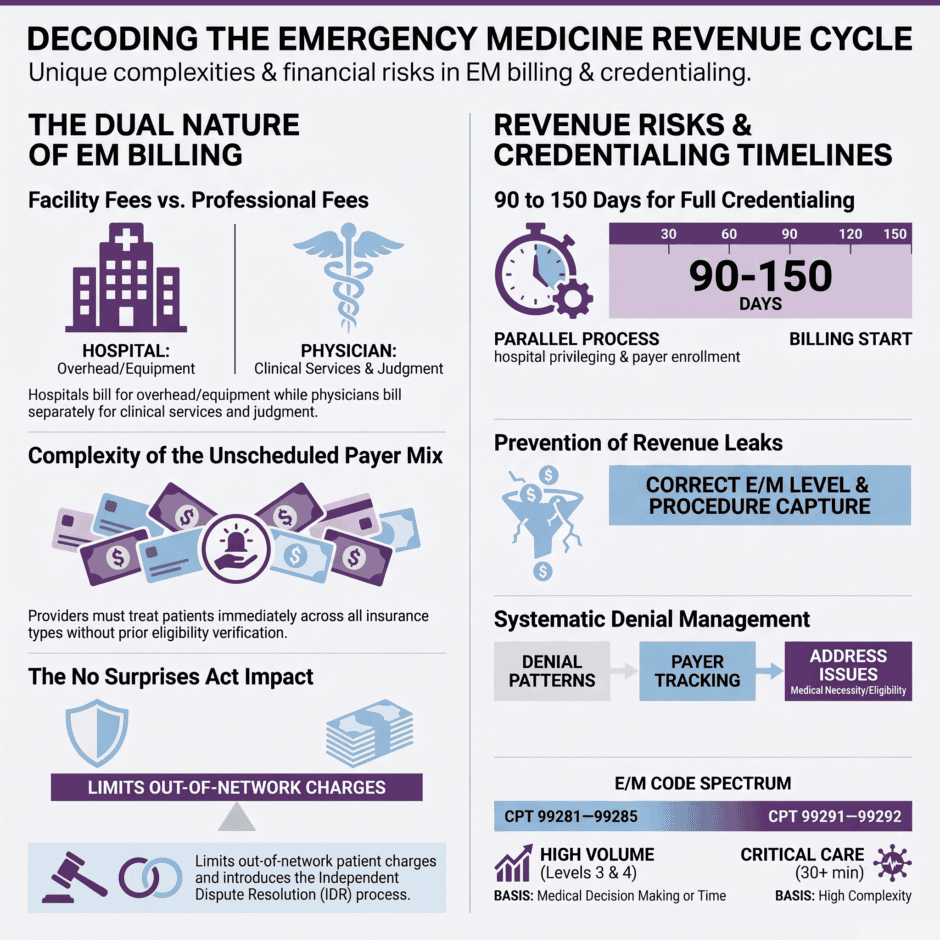
 Since 2023, office and hospital E/M levels can be chosen by medical decision-making or total time, but emergency department visits can’t. 99281 to 99285 are leveled by medical decision-making alone, based on the number and complexity of problems addressed, the data reviewed and analyzed, and the risk of the management decisions. A 99285 needs high complexity in two of those three areas.
That puts the weight on the note. A chest pain workup that documents the differential considered, the ECG and troponin interpreted, the decision about admission versus discharge, and why, supports a high level. The same workup documented as “chest pain, labs normal, discharged” doesn’t. Practices that consistently bill 99283 for visits that met 99284 criteria give up revenue on every shift, and practices that bill 99285 without that documentation invite audits. Our guide to which CPT codes are used in emergency room billing covers each level.
Critical Care in the ED
Critical care requires a critical illness or injury that acutely impairs one or more vital organ systems with a high probability of life-threatening deterioration, plus the physician’s direct management of it. 99291 covers the first 30 to 74 minutes. Under CPT, 99292 adds each additional 30 minutes starting at 75 minutes, but Medicare pays the first 99292 only once total time reaches 104 minutes. Time spent on separately billed procedures doesn’t count, and the note has to state the total critical care time.
Since 2023, Medicare allows an ED visit and critical care on the same day by the same physician when the ED visit happened first, before the patient became critical. The ED visit carries modifier 25. Critical care provided by more than one physician of the same specialty in the same group is billed as one service, with their time combined. Our hospital medicine page covers critical care rules in more detail.
Procedures and Interpretations
Procedures done in the ED are billed in addition to the ED visit, with modifier 25 on the visit when it goes beyond the decision to do the procedure. Laceration repairs are coded by repair type, anatomic group, and total length. Simple repairs bill from 12001 to 12021, intermediate from 12031 to 12057, and complex from 13100 to 13160, with lengths added together within the same type and anatomic group. Moderate sedation bills as 99152 and 99153 when the emergency physician provides it while performing the procedure.
When an emergency physician treats a fracture and refers the patient for follow-up, the fracture care code is often billed with modifier 54 for the initial treatment only, so the orthopedist can bill the follow-up. ECG interpretation bills as 93010 when the emergency physician provides the formal interpretation. X-ray interpretations are usually billed by the radiologist, and Medicare pays for one interpretation per study.
Split/shared visits with NPs and PAs bill under whichever practitioner performed the substantive portion, with the FS modifier. Visits billed under an NP or PA pay at 85% under Medicare.
Facility and Professional Claims
 Every ED visit produces two claims. The hospital bills the facility claim on an institutional form, with its own ED level, revenue codes, and payer contracts. The emergency physician group bills the professional claim with the ED visit code, procedures, and interpretations under its own contracts. The two levels are set by different criteria and don’t have to match.
For independent emergency groups, the professional claim is entirely the group’s responsibility, including the demographic and insurance data, which often has to be pulled from the hospital’s registration system after the visit. Incomplete or late registration data is behind a large share of ED eligibility denials, so the data feed from the hospital matters as much as the coding.
Emergency Coverage Rules and the No Surprises Act
Health plans have to cover emergency services under the prudent layperson standard, which looks at the symptoms a reasonable person would see as an emergency, not the final diagnosis. Under the ACA, plans can’t require prior authorization for emergency care and have to apply in-network cost-sharing even when the ED or physician is out of network. A denial that cites a benign final diagnosis, or a missing authorization for an emergency visit, can be appealed on those grounds. The appeals process for denied claims starts with the physician’s note.
The No Surprises Act bars out-of-network emergency providers from balance billing patients beyond in-network cost-sharing. Payment comes from the plan, which makes an initial payment or denial. If the group disagrees, it can start a 30-day open negotiation and then, if that fails, take the claim to independent dispute resolution, where an arbitrator picks between the two offers. Each step has strict deadlines, and missing one ends the group’s right to dispute that claim.
Where ED Claims Get Denied
 Most ED denials come from a short list of causes. These include incomplete or wrong insurance data from registration, high-level visits without documentation to support the decision-making, critical care billed without a time statement, procedures billed without modifier 25 on the visit or with modifier 59 used where it doesn’t belong, and duplicate interpretations billed when the radiologist already read the study. Tracking denials by payer and reason each month shows whether a problem is in registration, documentation, or coding, and our denial management process works them by cause.
Emergency Medicine Credentialing
Board certification and privileges
Emergency physicians certify through the American Board of Emergency Medicine or the American Osteopathic Board of Emergency Medicine. Payers verify board status, licensure, DEA registration, and malpractice history, and each hospital the group covers grants privileges separately. Hospital privileging and payer enrollment should run at the same time, since a physician can’t work shifts without privileges and can’t bill without enrollment.
New hires and locum tenens
A new emergency physician’s services can’t be billed until that physician’s own enrollment is approved. Billing a new hire’s patients under another physician’s NPI isn’t allowed. Medicare’s locum tenens rules only apply when a substitute covers for a regular, enrolled physician who is absent, for up to 60 continuous days, billed under the absent physician’s NPI with the Q6 modifier. They don’t cover a new physician filling an open position. This is why you can’t bill what you can’t credential, and why groups that hire often need enrollment started before the first shift is scheduled.
NPs and PAs
Many EDs staff fast-track areas with NPs and PAs. Each needs their own payer enrollment, and their visits bill under their own NPI unless the split/shared requirements are met.
Payer Contracting for Emergency Groups
Emergency groups have leverage in payer contracting because they cover every patient who comes through the door, and because out-of-network disputes under the No Surprises Act cost plans time and money too. Contract reviews should compare rates for 99283 to 99285 and critical care against Medicare and regional benchmarks, since those few codes drive most of a group’s revenue.
Emergency Medicine Billing FAQs
Can ED visit levels be chosen by time?
No. ED visits (99281 to 99285) are leveled by medical decision-making only. Time can be used for office and hospital E/M, but not for ED visits.
Can an ED visit and critical care be billed on the same day?
Yes, under Medicare since 2023, when the ED visit happened before the patient became critical. The ED visit carries modifier 25.
When does Medicare pay 99292?
Once total critical care time reaches 104 minutes. CPT allows 99292 starting at 75 minutes, so commercial payers may follow either threshold.
Can a health plan deny an ED visit because the final diagnosis wasn’t an emergency?
Not under the prudent layperson standard, which looks at the presenting symptoms rather than the final diagnosis. Plans also can’t require prior authorization for emergency care.
Can a new emergency physician bill under another physician’s NPI while enrollment is pending?
No. Locum tenens billing only covers a substitute for an absent enrolled physician, for up to 60 continuous days under Medicare. A new hire’s services can’t be billed until their own enrollment is approved.
How does the No Surprises Act affect emergency groups?
Out-of-network emergency providers can’t balance bill patients beyond in-network cost-sharing. The plan pays directly, and disputed payments go through open negotiation and then independent dispute resolution, each with strict deadlines.
Who bills the X-ray interpretation for an ED patient?
Usually the radiologist. Medicare pays for one interpretation per study, so the emergency physician’s review is generally part of the ED visit.
Why Emergency Medicine Groups Choose Medwave
 Medwave handles emergency medicine billing, credentialing, and payer contracting under one team. We level ED visits on decision-making, apply critical care thresholds by payer, capture procedures and interpretations, bill split/shared visits correctly, and track No Surprises Act deadlines on out-of-network claims. That’s how we hold a 98% clean claim rate.
On credentialing, we enroll emergency physicians, NPs, and PAs with Medicare, Medicaid, and commercial plans and coordinate privileges at each hospital the group covers, with a 60-day average turnaround.
Contact Medwave below to see how we can support your emergency medicine group.