

The authorization number is right there in the system. It says approved. Yet, the claim comes back denied anyway, flagged for an authorization mismatch. If that sequence sounds familiar, you are not imagining things and you are not alone. It is one of the more frustrating gaps in revenue cycle work, because everything on the surface looks fine right up until the remittance advice proves otherwise.
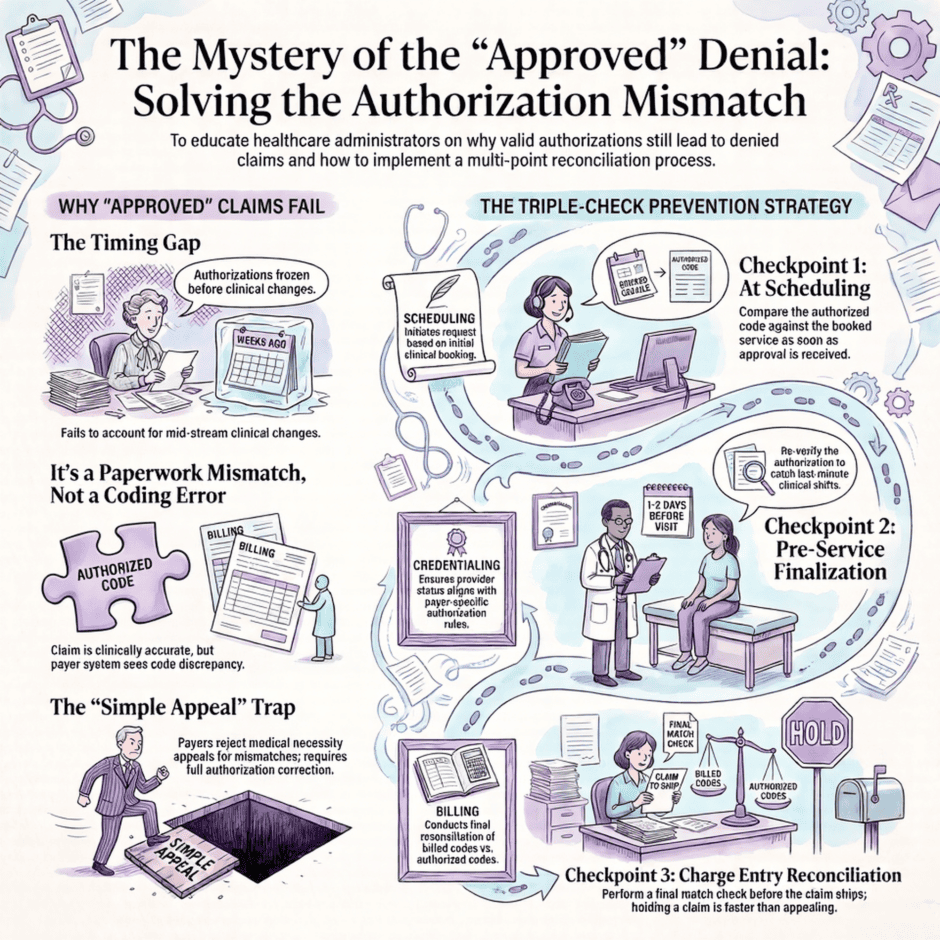
 Here is the short version of what is happening. The code that got approved and the code that ends up on the claim are often set at two different points in time, sometimes weeks apart. A scheduler enters a procedure code early to get the authorization moving. The payer approves that code. Then the plan changes, a second site gets added, or the physician documents something slightly different once the actual visit or procedure happens. Nobody circles back to check whether the approved code still matches what was billed. The payer’s system catches the gap even when your own team does not, and the claim denies with a message that has nothing to do with medical necessity and everything to do with a paperwork mismatch that was preventable.
This kind of denial is quietly expensive because it hides in plain sight. A valid authorization sitting in your system creates a false sense of security, so the claim doesn’t get a second look before it goes out the door. By the time the denial lands, the money is stuck behind a slower fix. Correcting the authorization first, then rebilling, rather than a simple appeal.
Key Takeaways
- Authorization mismatch denials happen when the code approved by the payer no longer matches the code that was actually performed or billed.
- Most payers will not accept a straightforward appeal for this type of denial. They require the authorization itself to be corrected before the claim can be resubmitted.
- The fix works best as a habit, not a one-time save: check the authorized code against the treatment plan at more than one point before the claim ever ships.
- Practices that build in a pre-billing reconciliation step recover this revenue far faster than practices that discover the mismatch only after a denial.
- Billing, credentialing, and payer contracting all touch this problem, which is why fixing it usually takes more than one department working in isolation.
What Actually Causes the Mismatch
Think about the timeline of a typical authorization. A front desk or scheduling team member requests approval for a service, often days or weeks before it happens. They enter a CPT code based on what is scheduled at that moment. The payer reviews it, approves it, and issues an authorization number tied specifically to that code, not to the patient’s overall care, just that one code.
Then time passes. Plans shift. A provider decides a bilateral procedure is needed instead of a single side. An add-on service gets included once the physician sees what is actually going on. A visit that was expected to be a routine follow-up turns into something more involved. All of this is normal clinical decision-making. The problem is that the authorization, frozen at the moment it was approved, does not update itself when the plan changes.
By the time billing happens, the code on the claim reflects what was actually done. The code on file with the payer reflects what was expected weeks earlier. Those two codes no longer match, and the payer’s adjudication system is built to catch that kind of discrepancy automatically. It denies the claim, often with a remark code that specifically flags a mismatch between the authorized service and the billed service, separate from any denial code related to medical necessity or coverage.
It is worth being clear about something here. This is not a billing error in the traditional sense. Nobody coded the visit wrong. The CPT code on the claim is accurate for what happened. The failure is that no one checked the approved code against the final code before the claim left the building.
Why a Simple Appeal Rarely Works
 A lot of billing teams try to appeal these denials the same way they would appeal a medical necessity denial. Attach the documentation, explain what happened, and ask the payer to reconsider. This approach usually fails here, and it is worth knowing why before you burn a few weeks of turnaround time finding out the hard way.
Payers generally treat an authorization mismatch as an authorization problem, not a payment dispute. Their process typically requires the original authorization to be corrected or updated to reflect the service that was actually performed, and only then will they accept a resubmitted claim. An appeal that argues the service was medically appropriate does not address the actual issue, which is that the authorization on file describes a different procedure entirely.
That distinction matters for how you plan your workflow. If your team routes these denials into a standard appeals queue, they often sit for weeks waiting on a response that will eventually just tell you to fix the authorization and rebill. Recognizing the denial type early, and routing it straight to an authorization correction rather than a documentation-based appeal, saves real time.
The Timing Problem, and Where to Catch It
Since the mismatch is really a timing problem, the fix has to happen at more than one point along the way. Waiting until the claim is ready to submit is too late to catch everything cleanly, but it is also the last real checkpoint before money gets stuck. A layered approach works better than relying on any single review.
The first checkpoint sits close to when the case or visit gets scheduled. As soon as an authorized code is on file, someone should compare it against what is actually booked, particularly for anything involving multiple sides, add-on procedures, or services that commonly change based on what the provider finds. Catching a mismatch here means there is still time to request a correction through normal channels, without any urgency attached.
A second checkpoint makes sense closer to the date of service, once the plan is more or less finalized. Plans shift the most in the days leading up to a procedure or visit, so this is often where the biggest gaps between the authorized code and the actual plan show up. A quick comparison here, even a day or two ahead, catches drift while there is still room to fix it without holding up the schedule.
The final checkpoint belongs at charge entry, right before the claim goes out. This is the last chance to compare the billed code against what the payer actually approved. If there is a mismatch here, the smart move is to hold the claim and correct the authorization first rather than submit it and wait for the inevitable denial. A same-day hold beats a weeks-long appeal every time, and it keeps your accounts receivable from carrying claims that were never going to get paid on the first pass.
Why This Slips Through Even in Well-Run Practices
 It is easy to assume this only happens in practices with weak processes, but that is not really accurate. Authorization mismatch denials show up even in offices where staff are experienced and careful, mostly because the work of requesting authorizations and the work of billing claims often live in different parts of the workflow, sometimes handled by different people entirely, sometimes weeks apart.
The scheduler who requests the authorization may never see the final claim. The biller who submits the claim may have no visibility into what was originally authorized, especially if that authorization was requested a month earlier by someone in a completely different role. Without a deliberate step that connects those two points, the gap between them is where mismatches live.
There is also a volume problem. A busy practice generates dozens or hundreds of authorizations a month, and manually cross-checking every one against every claim is genuinely hard to sustain without a dedicated process or dedicated staff time set aside for exactly that task. It is not that anyone is careless. It is that the check often has nowhere specific to live in the daily workflow, so it gets skipped when things get busy, which is exactly when it matters most.
Fixing This for Good, Not Just for One Claim
Correcting a single denied claim gets the money back eventually, but it does not stop the next one from happening. A more lasting fix treats authorization-to-claim matching as its own step in the revenue cycle, with a clear owner and a clear point in the workflow where it happens, rather than something staff try to remember on top of everything else they are doing.
That often means writing down exactly when the check happens, who does it, and what to do when a mismatch turns up. It also means having a real answer for what happens when a mismatch does slip through anyway, because even a good process will not catch everything every time. Having a defined path for correcting the authorization and getting the claim resubmitted quickly matters just as much as catching problems before they happen.
This is also a good moment to note that authorization problems rarely stay contained to one part of a practice’s operations. A mismatch traced back far enough often connects to how a provider is credentialed with a given payer, or to the specific terms in that payer’s contract about what counts as authorized versus what requires a separate approval. Billing teams working in isolation from credentialing and contracting staff tend to keep hitting the same wall, because the root cause sits upstream of where the claim gets submitted.
Authorization Mismatch Denials FAQ
Why did my claim deny for a mismatch when I have a valid authorization on file?
Because the code the payer approved and the code that was actually billed no longer match. This usually happens when the treatment plan changes after the authorization request was submitted, and nobody updated the authorization to reflect the final plan.
Can I just appeal a mismatch denial like I would any other denial?
Usually not successfully. Most payers require the authorization itself to be corrected first, then the claim resubmitted. A standard appeal that only addresses medical necessity typically will not resolve this type of denial.
How far in advance should the authorized code be checked against the claim?
More than once. A check near scheduling, another closer to the date of service, and a final check at charge entry before the claim ships all catch different kinds of drift. Relying on just one checkpoint tends to miss something.
Is this considered a coding error?
Not usually. The code on the claim is often accurate for the service that was performed. The issue is that the authorization on file was never updated to reflect a change in the plan.
Does this only happen to disorganized practices?
No. It happens even in well-run offices, mostly because authorization requests and claim submission often involve different staff working at different points in time, with no dedicated step connecting the two.
Does an authorization mismatch affect my clean claim rate?
Yes. Because these denials often get miscategorized and routed to a standard appeals process, they tend to sit longer than they should, which drags down both your clean claim rate and your overall days in accounts receivable.
Should credentialing staff be involved in fixing this problem?
Often, yes. If a provider’s enrollment status with a payer affects what services require authorization in the first place, credentialing details can end up shaping how often mismatches occur.
Can payer contract terms make this worse?
They can. Some payer contracts define authorization requirements differently than others, and a practice juggling several contracts with different rules is more likely to see mismatches slip through if staff are applying one set of assumptions across every payer.
Summary: Denied Claims Exist Even Under Approved Authorization
 An authorization mismatch denial feels like a technicality, and in a narrow sense it is one. However, the dollars behind it are real, and the fix takes more coordination than most practices expect at first glance. Catching the gap between an approved code and a billed code requires attention at more than one point in the process, a clear owner for that task, and a way of routing these denials that skips the slow appeal path and goes straight to correcting the authorization.
At Medwave, this is exactly the kind of gap we look for across a practice’s revenue cycle. Our billing team builds pre-submission checks into the workflow so mismatches get caught before a claim ships rather than after it denies. Our credentialing team makes sure provider enrollment details stay current with each payer, which reduces the chances of authorization confusion in the first place. Additionally, our payer contracting work means we know exactly what each contract requires for authorization, so the rules your staff are working from actually match what the payer expects.
Billing, credentialing, and payer contracting were never meant to operate as separate silos, and closing the gap between them is often where the real fix lives.

Co-Founder and COO of Medwave, bringing more than 25 years of hands-on experience in healthcare revenue cycle management, payer contracting, and medical credentialing.