

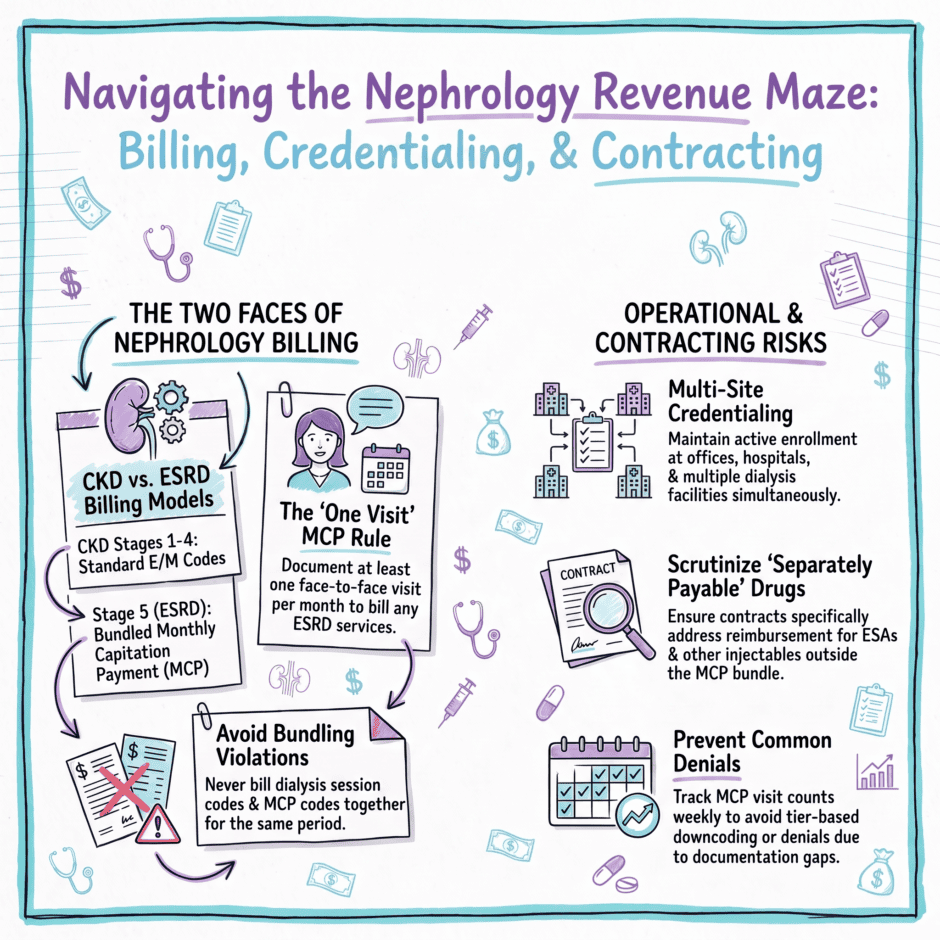
Nephrology billing changes once a patient reaches end stage renal disease. Before dialysis, kidney care is billed visit by visit like most specialties. After dialysis starts, Medicare pays the nephrologist one monthly amount per patient, set by the patient’s age, where they dialyze, and how many visits were documented that month. A missed visit drops the payment to a lower tier, and there’s nothing to appeal when the visit didn’t happen. The rules around that monthly payment are where most nephrology revenue is lost. They include partial months, hospital stays, home dialysis, and which payer is primary during a patient’s first months on dialysis. Credentialing adds another layer, since most nephrologists work across an office, one or more hospitals, and several dialysis units.
Key Takeaways
- ESRD care for in-center dialysis patients bills as one monthly capitation payment (90951 to 90962) per patient, tiered by age and by one, two to three, or four or more visits.
- Home dialysis patients bill under 90963 to 90966 by age, without visit tiers.
- Partial months, such as a patient starting dialysis mid-month, bill per day with 90967 to 90970.
- ESAs and other drugs given during dialysis are bundled into the dialysis facility’s payment and aren’t billed by the nephrologist.
- For ESRD patients with employer coverage, the employer plan pays first during a 30-month coordination period before Medicare becomes primary.
CKD Billing Before Dialysis
 For patients with chronic kidney disease who aren’t on dialysis, nephrology visits bill with standard office E/M codes, leveled by medical decision-making or total time. The diagnosis has to name the CKD stage (N18.1 to N18.5, with N18.30 to N18.32 for stage 3 subtypes), along with the conditions driving it, such as diabetes or hypertension. A generic kidney disease code doesn’t support the visit level most CKD care requires.
Medicare covers kidney disease education for patients with stage 4 CKD, up to six sessions billed as G0420 for individual sessions or G0421 for group sessions. ESAs given in the office to CKD patients who aren’t on dialysis are billed by the practice with the drug’s J-code and units, and payers expect hemoglobin levels documented with each dose.
ESRD Monthly Capitation Payment
Once a patient is on outpatient dialysis, the nephrologist bills one monthly capitation payment (MCP) code per patient per calendar month. For in-center hemodialysis, the code is chosen by the patient’s age group and the number of face-to-face visits that month. For adults age 20 and older, 90960 covers four or more visits, 90961 covers two or three, and 90962 covers one. Separate code sets cover patients under 2, ages 2 to 11, and ages 12 to 19.
Medicare requires at least one visit each month that includes a hands-on examination of the vascular access site. The visit count only supports the code when each visit is documented with its date and the provider who performed it. Only one MCP is billed per patient per month, by the physician or group managing the patient’s dialysis.
Home dialysis patients bill under 90963 to 90966 by age, which pay a monthly rate without visit tiers. Home patients still need regular face-to-face visits, and some of the monthly assessments can be done by telehealth under Medicare’s rules.
When a patient has less than a full month of outpatient dialysis, such as starting dialysis mid-month, receiving a transplant, or dying during the month, the nephrologist bills per day with 90967 to 90970 instead of the monthly code.
Hospital Stays and Dialysis Procedure Codes

Dialysis procedure codes (90935 and 90937 for hemodialysis, 90945 and 90947 for other dialysis) describe the physician’s evaluation during a dialysis session. In the outpatient setting, that work is part of the MCP, so these codes aren’t billed alongside it. They’re used mainly for inpatient dialysis and for patients who aren’t under an MCP that month.
When an ESRD patient is hospitalized, the nephrologist bills inpatient visits and dialysis procedures for the hospital days. How the month’s MCP is billed then depends on how many days of outpatient care remain. Practices that don’t track admissions often bill a full-month MCP that the record doesn’t support.
An E/M visit for a problem unrelated to ESRD, such as a separate infection, can be billed apart from the MCP when the documentation shows a distinct condition. Routine ESRD management in the same month can’t be billed as a separate visit.
Common Nephrology CPT Codes
- 90960, 90961, and 90962 (MCP for in-center dialysis, age 20 and older, by visit count)
- 90951 to 90959 (MCP for patients under age 20, by age and visit count)
- 90963 to 90966 (MCP for home dialysis, by age)
- 90967 to 90970 (ESRD services for less than a full month, per day, by age)
- 90935 and 90937 (hemodialysis procedure with evaluation)
- 90945 and 90947 (peritoneal and other dialysis procedures with evaluation)
- 36901 to 36909 (dialysis circuit angiography, angioplasty, and stenting)
- 50200 (percutaneous renal biopsy)
- G0420 and G0421 (kidney disease education, individual and group)
Interventional nephrologists who maintain dialysis access bill the dialysis circuit codes (36901 to 36909), which are built in layers by the most intensive treatment in each segment of the circuit. Imaging guidance is included in these codes.
Medicare Secondary Payer and the 30-Month Coordination Period
Patients with ESRD qualify for Medicare at any age, but Medicare isn’t always primary. When a patient also has coverage through an employer group health plan, that plan pays first for the first 30 months of Medicare eligibility based on ESRD. After the coordination period ends, Medicare becomes primary. Billing Medicare first during that window leads to denials or later recoupments.
Eligibility timing adds another wrinkle. Medicare coverage based on ESRD usually starts with the fourth month of in-center dialysis, or earlier for patients who start home dialysis training. Checking each patient’s entitlement date and other coverage at the start of dialysis keeps claims going to the right payer.
Nephrology Credentialing

Board certification and enrollment
Nephrologists complete an internal medicine residency and a nephrology fellowship, then certify through the American Board of Internal Medicine. Payers verify both certifications, along with licensure, DEA registration, and malpractice history, usually through CAQH ProView. A lapsed CAQH profile can stall enrollment without notice.
Multiple sites
Most nephrologists round at one or more hospitals and supervise patients at several dialysis units, often run by different organizations. Each hospital grants privileges separately, and each dialysis facility has its own medical staff process. Medicare enrollment has to list every practice location the group bills from, and Medicaid plans often require the same. A provider who isn’t approved at a site can’t bill for care there, which is why you can’t bill what you can’t credential.
NPs and PAs
Many nephrology groups use NPs and PAs for dialysis rounding. Their visits can count toward the MCP visit total when they’re enrolled and billing under the group’s arrangement, so each one needs their own payer enrollment before they start rounding.
Payer Contracting for Nephrology Groups
Commercial payers and Medicare Advantage plans don’t always follow Medicare’s MCP structure. Some pay a different monthly rate, some use different visit tiers, and some pay dialysis-related visits individually. Payer contracting for a nephrology group should compare each plan’s MCP rates to Medicare and regional benchmarks, and check how the plan pays for dialysis access procedures and office-administered drugs. Groups taking part in CMS kidney care models or value-based arrangements should confirm how those payments interact with fee-for-service billing.
Nephrology Billing FAQs
What is the Monthly Capitation Payment in nephrology billing?
It’s the monthly payment Medicare makes to the nephrologist for managing an outpatient dialysis patient. One code is billed per patient per month, chosen by the patient’s age, dialysis setting, and for in-center patients, the number of visits.
How many visits are needed for the highest MCP tier?
For in-center patients age 20 and older, four or more face-to-face visits in the month support 90960. Two or three visits support 90961, and one visit supports 90962.
How are home dialysis patients billed?
Under 90963 to 90966 by age. These codes pay a monthly rate without visit tiers, but home patients still need regular face-to-face visits.
What happens when a patient starts dialysis mid-month?
The nephrologist bills per day with 90967 to 90970 instead of the monthly code. The same applies when a patient has a transplant or dies during the month.
Does the nephrologist bill for ESAs given during dialysis?
No. Drugs given during outpatient dialysis, including ESAs, are bundled into the dialysis facility’s payment. ESAs given in the office to CKD patients who aren’t on dialysis are billed by the practice.
Is Medicare always primary for ESRD patients?
No. When the patient has employer group health coverage, that plan pays first for the first 30 months of Medicare eligibility based on ESRD. Medicare becomes primary after that.
Why Nephrologists Rely on Medwave
 Nephrology billing runs on a monthly cycle. Medwave assigns the ESRD monthly codes (90951 through 90970) by age and number of visits, prorates partial months, and keeps CKD office visits, access procedures, and hospital rounds separate. Our billing team keeps nephrology at a 98% clean claim rate.
Nephrologists round at dialysis units, hospitals, and offices, and our credentialing team gets them privileged and enrolled for each setting in about 85 days on average, including Medicaid enrollment in every state the group covers. We also keep recredentialing dates from slipping. Groups in kidney care value-based models also get payer contracting support with Medicare Advantage plans.
How many dialysis units do you cover? Start the conversation in the form below.