

Almost every cardiac test has two halves. The professional component pays the cardiologist for reading and interpreting the study, and the technical component pays whoever owns the equipment and employs the technologist. Which half a practice can bill depends on where the test was done, and getting that wrong is behind more cardiology denials and recoupments than any single code.
Key Takeaways
- Tests done in a hospital are billed by the cardiologist with modifier 26 for the professional component only. Tests done in the practice’s own office are billed globally.
- Nuclear stress testing is billed as several codes, including the imaging, the stress test components, the radiopharmaceutical, and any pharmacologic stress agent.
- Diagnostic cath codes bundle the injections and imaging, and Medicare bundles the PCI add-on codes for additional branches.
- Remote device monitoring and ambulatory ECG monitors bill under their own code families by duration and device type.
- Practices billing the technical component of nuclear cardiology to Medicare need facility accreditation, and nuclear imaging needs a radioactive materials license.
Echocardiography and Stress Testing
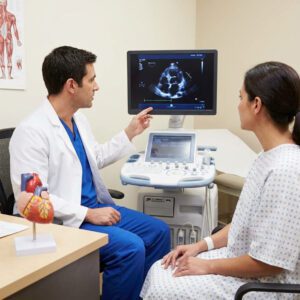 A complete transthoracic echo with spectral and color Doppler bills as 93306, which is the most common echo code. 93307 covers a complete echo without Doppler, and 93308 covers a limited or follow-up study. Stress echocardiography bills as 93350, or 93351 when the same physician also supervises the stress portion and provides continuous ECG monitoring. Payers check echo frequency closely and expect a new clinical reason for repeat studies, such as a change in symptoms or a decision about treatment.
Nuclear myocardial perfusion imaging is built from several lines. The SPECT imaging bills as 78452 for multiple studies at rest and stress. The stress test itself bills under 93015 globally, or 93016, 93017, and 93018 when supervision, tracing, and interpretation are split between the physician and facility. The radiopharmaceutical bills with its own HCPCS code and dose, and a pharmacologic stress agent such as regadenoson bills separately as a drug. Missing any one of those lines leaves part of the study unpaid.
Professional and Technical Components
When a cardiologist reads an echo, stress test, or nuclear study performed in a hospital or a facility the practice doesn’t own, they bill only the professional component with modifier 26. The hospital bills the technical component. When the practice owns the equipment and employs the technologist, it bills the global code with no modifier, which covers both halves.
Billing a global code for a hospital-based study is a duplicate claim against the hospital’s technical bill and will be recouped. The place of service on each claim has to match where the test was done, and the billing system has to know which sites are practice-owned. Our radiology page covers component billing for imaging more broadly.
Cardiac Catheterization and PCI
 Diagnostic cardiac catheterization codes 93451 to 93461 combine the catheter placement, the injections, and the imaging and interpretation into a single code chosen by which heart chambers were catheterized and which vessels were imaged. Coronary angiography is included in most of them, so separate injection codes aren’t billed.
Percutaneous coronary interventions bill by the most intensive treatment in each major coronary vessel. Stent placement bills as 92928, atherectomy as 92924, and angioplasty alone as 92920, with separate codes for bypass grafts, acute MI, and chronic total occlusions. Each code has an add-on for additional branches of the same vessel, and Medicare bundles those add-ons without separate payment, while some commercial plans pay them. A diagnostic cath that leads to a PCI in the same session can be billed separately only when the decision to intervene was based on the diagnostic findings.
In the hospital, the physician bills only the professional service. Stents, balloons, and other devices are billed by the facility.
Electrophysiology and Device Monitoring
Electrophysiologists bill ablations in the 93653 to 93656 range, depending on the arrhythmia treated, with add-on codes for additional mapping and ablation work. Device implants for pacemakers and ICDs bill by the device and leads placed.
After implant, device follow-up is a steady source of revenue that’s easy to miss. In-person interrogation and programming bill under the 93279 to 93289 range by device type. Remote interrogation of pacemakers and ICDs bills as 93294 or 93295 for the professional review over a 90-day period, plus 93296 for the technical component when the practice provides it. In-person and remote checks in the same period have rules that limit billing both.
Ambulatory monitors bill by duration and type. Holter monitoring up to 48 hours uses 93224 to 93227, extended monitoring beyond 48 hours uses 93241 to 93248, and mobile cardiac telemetry uses 93228 and 93229. Practices that also run remote blood pressure or weight monitoring for heart failure patients bill those under the remote patient monitoring codes.
Prior Authorization
Many commercial and Medicare Advantage plans send nuclear stress tests, stress echoes, cardiac CT and MRI, and elective caths through a radiology or cardiology benefit manager. Prior authorization requests usually need symptoms, prior test results, and risk factors. When the test performed differs from the one approved, such as a stress echo approved and a nuclear study done instead, the claim can deny even though an approval exists, which we cover in why an approved authorization can still end in a denied claim.
Cardiology Credentialing

Board certification and privileges
Cardiologists certify in cardiovascular disease through the American Board of Internal Medicine, with separate certifications for interventional cardiology, clinical cardiac electrophysiology, and advanced heart failure. Many also hold certification in nuclear cardiology or echocardiography. Hospitals grant cath lab and EP lab privileges procedure by procedure, often based on case volume, so a new interventionalist may need proctored cases before performing PCI independently.
Facility requirements for in-office testing
Practices that bill the technical component of nuclear cardiology to Medicare need accreditation from a CMS-approved organization such as the Intersocietal Accreditation Commission. Nuclear imaging also requires a radioactive materials license from the state or the Nuclear Regulatory Commission. Many commercial plans require echo lab accreditation as well. A lapse in any of these stops technical component payment for that service.
NPs, PAs, and recredentialing
NPs and PAs who see heart failure and follow-up patients need their own payer enrollment. Most payers recredential every three years, and a provider who drops out of a network can’t bill that plan until reinstated, which is why you can’t bill what you can’t credential.
Cardiology Billing FAQs
When does a cardiologist use modifier 26?
When reading a test performed in a hospital or another facility the practice doesn’t own. The facility bills the technical component, and the cardiologist bills only the interpretation with modifier 26.
How is a nuclear stress test billed?
As several codes. The SPECT imaging (78452), the stress test components (93015 or 93016 to 93018), the radiopharmaceutical, and any pharmacologic stress agent are each billed.
Does Medicare pay the PCI add-on codes for additional branches?
No. Medicare bundles the add-on codes for additional branches of a major coronary vessel. Some commercial plans pay them.
Can a diagnostic cath and a PCI be billed on the same day?
Yes, when the decision to intervene was based on the findings of the diagnostic cath in that session. A cath done only to guide a planned PCI is included in the PCI.
How is remote pacemaker and ICD monitoring billed?
The professional review bills as 93294 or 93295 per 90-day period, and the technical component bills as 93296 when the practice provides it.
Does an in-office nuclear cardiology lab need accreditation?
Yes, to bill the technical component to Medicare. Nuclear imaging also requires a radioactive materials license.
Cardiology Billing Backed by Medwave
 Cardiology mixes office visits, diagnostic testing, and procedures, and each one breaks in its own way. Medwave splits professional and technical components on echo, nuclear, and monitoring, confirms imaging authorizations before the study, and keeps cath lab follow-ups inside their global periods. Our billing team holds cardiology to a 98% clean claim rate.
Cardiologists who read studies at several hospitals need privileges at each one, plus payer enrollment that our credentialing team usually finishes in about 85 days. Imaging-heavy groups also get payer contracting support on the codes that bring in the most revenue.
Reach our cardiology team through the form below.