Medicare credentialing is the process through which CMS authorizes a healthcare provider to see Medicare beneficiaries and bill for covered services. Enrollment is managed through PECOS, the Provider Enrollment, Chain and Ownership System, and processed by regional Medicare Administrative Contractors (MACs) assigned to specific geographic areas. Processing typically takes 60 to 90 days from submission […]

- Home
- Articles (Page 3)
Articles
30 Medical Credentialing Use Cases

Medical credentialing requirements vary significantly depending on the situation. A new physician joining an established group practice faces a different process than a solo practitioner opening a second location, a surgeon seeking hospital privileges, or a provider adding telehealth services to an existing credential. Each scenario has its own documentation requirements, payer-specific steps, and timeline […]
Credentialing, Credentialing Use Cases, Medical CredentialingCredentialing After Relocating Your Medical Practice

Relocating a medical practice requires restarting the credentialing process with most payers, regardless of how long the provider has been credentialed in their previous location. Insurance networks operate regionally, and a credentialing approval in one state does not transfer to another. A Blue Cross Blue Shield contract in Pennsylvania is held by a separate regional […]
Credentialing, Credentialing Challenges, Relocation CredentialingMedical Billing Trends in 2026: AI, Prior Authorization Reform, Value-Based Payment Shifts

Three medical billing trends are having the most immediate operational impact in 2026. AI-powered claim scrubbing and denial prediction becoming standard in billing departments of all sizes, electronic prior authorization reaching meaningful interoperability across major payers, and value-based payment arrangements tying a growing share of reimbursement to quality metrics rather than visit volume. Each trend […]
AI, Articles, Artificial Intelligence, FHIR, Prior Authorization, Value Based CareHow to Get Credentialed with Medicaid: State Requirements, MCO Enrollment, Timelines

Medicaid credentialing differs from Medicare enrollment in one fundamental way. There is no single federal process. Each state operates its own Medicaid program with its own application portal, documentation requirements, and processing timelines. In states that have expanded Medicaid through managed care, providers must credential separately with each managed care organization (MCO) operating in the […]
Credentialing, Medicaid, Medicaid Credentialing, Medicaid MCO EnrollmentCredentialing Bottlenecks: How to Fix Slow Onboarding

Credentialing bottlenecks cost healthcare organizations an average of $7,500 per provider per month in non-billable revenue while applications are pending. For a group practice onboarding three physicians simultaneously, that is $22,500 in lost revenue every month the process runs long. Most of those delays are not caused by payers processing slowly, they’re caused by process […]
Credentialing, Credentialing Bottlenecks, Credentialing Problems, Medical CredentialingGroup NPI or Individual NPI: Which Fits Your Practice?

The National Provider Identifier (NPI) is a unique 10-digit number assigned by CMS to identify healthcare providers on claims. There are two types. A Type 1 NPI belongs to an individual provider. A physician, nurse practitioner, physical therapist, or any licensed professional who delivers patient care. A Type 2 NPI belongs to an organization, a […]
Group NPI, Individual NPI, NPIThe 5 Most Common Revenue Cycle Management Challenges and How to Fix Them

Revenue cycle management in healthcare covers every step between a patient scheduling an appointment and the practice receiving final payment on that account. That includes insurance eligibility verification, charge capture, medical coding, claim submission, denial management, payment posting, and patient balance collection. When any of those steps breaks down, revenue slows, and in a medical […]
RCM, RCM Challenges, Revenue Cycle, Revenue Cycle ManagementA Guide to Provider Credentialing with PacificSource

Provider credentialing serves as a fundamental quality assurance process in healthcare, ensuring patients receive care from qualified medical professionals. For healthcare providers seeking to join PacificSource’s network, mastering the credentialing process opens doors to serving one of the Pacific Northwest’s most established health insurance organizations. PacificSource operates as a not-for-profit health insurer serving Oregon, Washington, […]
Credentialing, Medical Credentialing, PacificSource, PacificSource CredentialingWhy Credentialing Applications Get Denied: The Most Common Reasons, How to Fix Them

Credentialing applications get denied or delayed for a predictable set of reasons. Incomplete documentation, expired credentials, unexplained work history gaps, adverse licensure actions, and closed payer panels account for the large majority of credentialing setbacks. Most of them are preventable with the right preparation before the application is submitted. The sections below cover each major […]
Credentialing, Credentialing Denials, Credentialing ProblemsHow 2026 E/M and Telehealth Rules are Changing

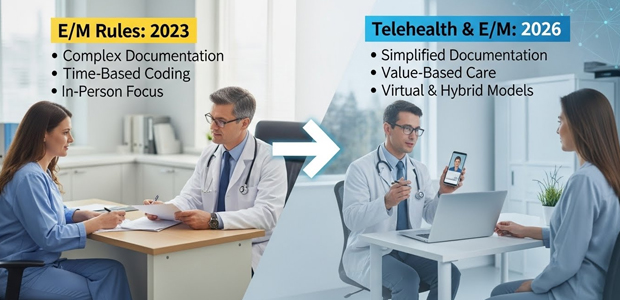
The 2026 CMS rules for Evaluation and Management services and telehealth introduce changes that affect how providers document visits, select E/M code levels, and bill for remote care. The changes are not cosmetic adjustments to existing guidelines, they modify how medical decision-making components are weighted, clarify time-based coding for total encounter time, and establish which […]
E/M, E/M coding, Telehealth BillingProfessional and Peer References in Medical Credentialing

Professional and peer references are required components of most medical credentialing applications. They serve a specific purpose that documentation alone cannot fulfill, providing a firsthand evaluation of the provider’s clinical competence, professional conduct, and character from colleagues who have worked directly with them. Most credentialing applications require two to five references, typically split between professional […]
Credentialing, Credentialing ReferencesOut-of-Network Billing: How to Appeal Low Payments and Recover Fair Reimbursement

Out-of-network billing operates without a contracted rate, which means the provider sets their charges and the payer determines what they consider an appropriate payment, and those two numbers are rarely the same. Payers use methodologies like “usual and customary” rates, “allowed amounts,” and geographic database benchmarks to calculate payments that frequently fall well below the […]
Medical Billing, OON, Out of Network, Out-of-Network ProviderPhysician Credentialing Checklist: Every Document You Need, When to Start Gathering It

A physician credentialing application requires documents from every stage of a provider’s career. The medical school transcripts, residency completion certificates, state licenses, DEA registration, malpractice insurance declarations, board certifications, and a gap-free work history. Gathering those documents takes longer than most providers expect. Medical schools and licensing boards that still operate on paper can take […]
Credentialing, Credentialing Checklist, Credentialing DocumentationCan Providers Practice with Pending Credentialing Applications? Options, Risks, and Rules

Providers can see patients while credentialing applications are pending, but the options for how they get paid, and the compliance requirements that apply, vary significantly depending on the arrangement. The three most common approaches are treating self-pay patients, working under locum tenens arrangements billed through a credentialed practice, and obtaining temporary or emergency privileges from […]
Credentialing, Credentialing Applications, Credentialing ChallengesHow to Renegotiate Payer Contracts for Higher Reimbursement Rates

Most payer contracts are signed once and left untouched for years. The reimbursement rates in those contracts were set at the time of signing and do not automatically increase to reflect rising practice costs, inflation, or changes in what the market supports. A contract that was reasonable five years ago may now be paying below […]
Contract Analysis, Payer Contracting, Rate NegotiationsWhat Credentialing Specialists Do: How Provider Verification Works, Why It Matters

A credentialing specialist is the person responsible for verifying that a healthcare provider holds the qualifications they claim before that provider can treat patients at a facility or bill insurance for services. The verification covers medical school education, residency and fellowship training, active state licensure, DEA registration, board certifications, professional work history, peer references, malpractice […]
Credentialing, Credentialing SpecialistHow to Keep Your CAQH ProView Profile Current, Why It Affects Every Payer Relationship

CAQH ProView is a centralized database operated by the Council for Affordable Quality Healthcare that allows providers to enter their professional credentials once and authorize participating payers to access that data directly for credentialing and verification purposes. More than 1,800 healthcare organizations use it, including most major commercial payers, hospital systems, and managed care organizations. […]
Articles, CAQH ProView, Credentialing, RecredentialingHow to Use Claims Data and Outcome Metrics in Payer Contract Negotiations

Payer contract negotiations that rely on reputation and historical relationships alone produce worse outcomes than negotiations backed by claims data, outcome metrics, and cost-per-episode analysis. Insurance companies now deploy actuaries, data scientists, and clinical analysts to evaluate provider performance across dozens of metrics before setting contract terms. A provider who walks into a negotiation without […]
Data-Driven Contracting, Payer Contracting, Value Based CareHospital Privileging for Physicians: Types, Application Process, Renewal Requirements

Hospital privileges are facility-specific authorizations that determine what procedures and services a physician can perform within a particular hospital. A medical license establishes that a provider is qualified to practice medicine in a state. Hospital privileges establish what that provider is approved to do within a specific facility, which procedures, which patient populations, and under […]
Credentialing, Hospital Privileging, Privilege TypesHealth Insurance Company Directory: Major Payers, Market Share, Credentialing Priority

This directory covers the major health insurance companies providing medical coverage in the United States, organized by market share and network reach. For healthcare providers and billing teams, knowing which payers dominate a given market, how they are structured, and what credentialing relationships they require is foundational to building a practice’s payer mix and prioritizing […]
Centene, Commercial Health Insurance, CVS Health/Aetna, Elevance Health, Health Insurance Companies, Humana, UnitedHealth, UnitedHealth GroupPayer Contract Analysis: How to Evaluate Reimbursement Rates, Payment Terms, Contract Risk

Payer contracts determine what a practice gets paid for every service it delivers, and most practices sign them without a complete analysis of their terms, reimbursement methodology, or long-term financial implications. A contract that looks reasonable based on headline reimbursement rates may be unprofitable when administrative burden, payment timelines, and claims process requirements are fully […]
Payer Contract Analysis, Payer ContractingAmbulatory Surgery Center (ASC) Credentialing

Ambulatory surgery centers operate under a credentialing framework that differs from hospital-based credentialing in two significant ways. Firstly, ASCs focus on specific surgical specialties rather than the broad scope of services a hospital covers, which means credentialing committees must evaluate providers against specialty-specific competency standards rather than general medical qualifications. Secondly, ASCs are governed by […]
ASC Credentialing, ASC Privileging Process, CredentialingHow to Reduce Credentialing Delays and Administrative Burden in Your Practice

Provider credentialing typically takes 90 to 120 days from initial application submission to payer approval, and that timeline assumes a complete, error-free application. Most applications are neither. Missing documents, data discrepancies between the application and primary sources, and outdated information in CAQH profiles all generate deficiency notices that reset the clock. For a new physician […]
Credentialing, Credentialing Delays, Primary Source VerificationWhy Outsource Medical Credentialing? Cost, Speed, Compliance Advantages Explained

Outsourced credentialing is the practice of contracting a specialized third-party service to manage provider credential verification, payer enrollment applications, and ongoing revalidation on behalf of a healthcare organization. The alternative, handling credentialing internally, requires dedicated staff with specific expertise in payer requirements, CAQH management, primary source verification, and license tracking across multiple states and renewal […]
Credentialing, Credentialing Costs, Outsourced Credentialing