

Three medical billing trends are having the most immediate operational impact in 2026. AI-powered claim scrubbing and denial prediction becoming standard in billing departments of all sizes, electronic prior authorization reaching meaningful interoperability across major payers, and value-based payment arrangements tying a growing share of reimbursement to quality metrics rather than visit volume.
Each trend affects billing operations differently. AI tools reduce first-pass denial rates but require workflow changes and staff retraining that take several months to stabilize. Prior authorization reforms are reducing turnaround times for some specialties while leaving others largely unchanged. Value-based programs add reporting and documentation obligations that billing and clinical teams have to manage together to avoid payment penalties.
This article covers each major 2026 billing trend in practical terms, what it means for day-to-day billing operations, and where practices should focus attention to stay ahead of changes that will affect revenue before year end.
Key Takeaways
Medical billing in 2026 is being reshaped by AI-powered claim scrubbing, more interoperable electronic prior authorization, and value-based payment models tying reimbursement to quality metrics, alongside expanding price transparency rules, growing patient payment responsibility, rising cybersecurity demands, and a shift toward hybrid outsourcing arrangements.
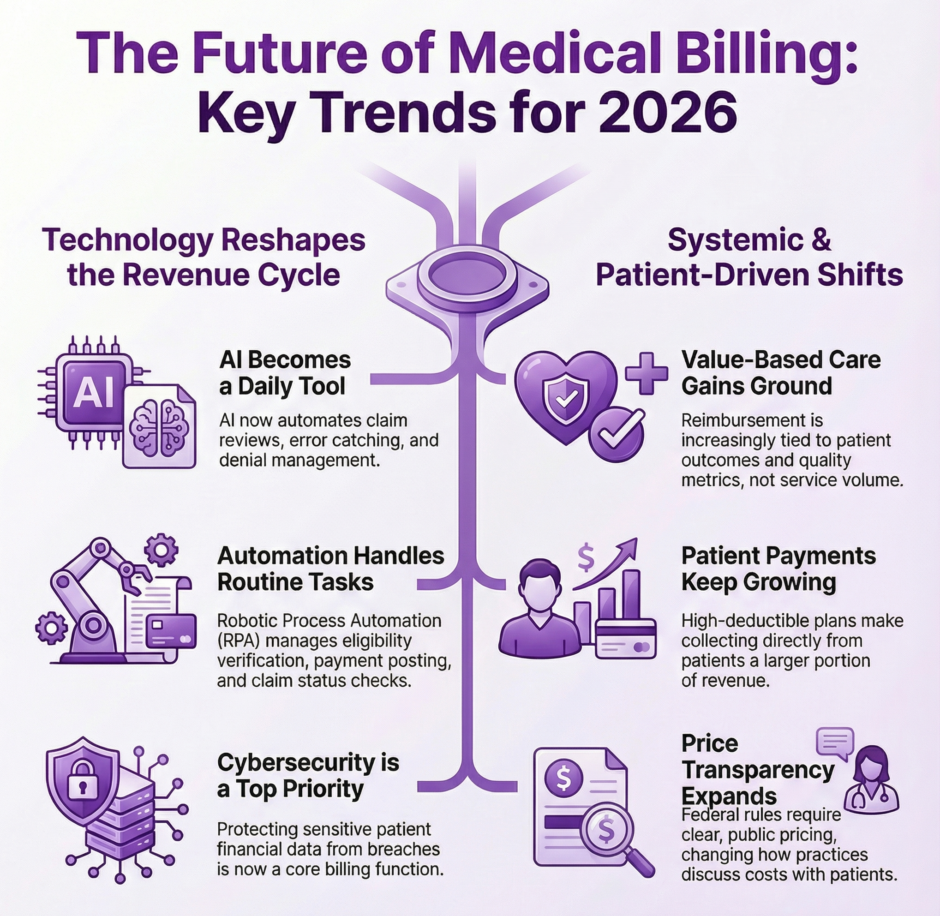
Artificial Intelligence Becomes a Daily Tool
 Artificial intelligence has moved beyond the experimental phase in medical billing. In 2026, AI-powered tools are becoming standard equipment in billing departments across the country. These systems can now review claims before submission, catching errors that would typically result in denials. They analyze patterns in your organization’s billing data to identify common mistakes and suggest corrections before claims ever leave your office.
The real power of AI in billing shows up in its ability to handle repetitive tasks that consume hours of staff time. Coding suggestions based on documentation, eligibility verification, and initial claim scrubbing all happen automatically. This frees up your billing team to focus on more difficult cases that require human judgment and expertise.
Denial management has particularly benefited from AI integration. These systems can predict which claims are most likely to face denials based on historical data, allowing your team to address potential issues proactively. When denials do occur, AI tools can prioritize which ones to appeal based on likelihood of overturn and dollar value, helping you deploy your resources more effectively.
The cost of AI tools has decreased significantly, making them accessible to smaller practices that couldn’t afford early versions. Cloud-based AI solutions now operate on subscription models that don’t require major upfront investments. This democratization of technology means practices of all sizes can compete more effectively in an increasingly challenging billing environment.
Prior Authorization Gets a Digital Makeover
Prior authorization has long been one of the most frustrating aspects of medical billing, causing treatment delays and administrative burden. In 2026, we’re seeing meaningful progress toward streamlining this process through digital solutions and changing payer policies.
Electronic prior authorization (ePA) systems are finally reaching critical mass. More insurance companies now accept electronic submissions, and the systems are becoming genuinely interoperable rather than requiring separate logins and processes for each payer. This consolidation saves substantial time for practices that previously juggled multiple portals and phone calls to secure authorizations.
Some payers are experimenting with real-time prior authorization decisions for certain procedures and medications. Rather than waiting days or weeks for approval, providers receive instant decisions during the patient encounter. This approach reduces administrative overhead and allows patients to start treatment faster.
The 2026 landscape also includes more payers adopting “gold card” programs that exempt high-performing providers from certain prior authorization requirements. If your practice maintains strong approval rates and appropriate utilization patterns, you may qualify for expedited or waived authorization processes. This creates an incentive for quality care while reducing administrative friction.
Despite these improvements, prior authorization remains a significant challenge. Staying current with each payer’s requirements and maintaining documentation standards that support quick approvals continues to require dedicated attention and resources.
Value-Based Care Gains More Ground
 The shift from fee-for-service to value-based payment models continues to accelerate in 2026. More payers are tying reimbursement to quality metrics, patient outcomes, and cost efficiency rather than simply volume of services provided. This fundamental change in how healthcare gets paid affects billing operations in several ways.
Revenue cycle teams now need to track and report quality measures alongside traditional billing data. Meeting benchmarks for patient satisfaction, clinical outcomes, and preventive care affects your bottom line directly. This means billing departments are working more closely with clinical teams to ensure proper documentation of quality indicators.
Risk-based contracts are becoming more common, where providers take on financial risk for the total cost of care for a patient population. These arrangements require sophisticated data analytics to track spending patterns, identify high-risk patients, and manage care effectively. Billing systems must integrate with clinical and care management platforms to provide the full picture needed for these models.
Bundled payments for episodes of care represent another growing trend. Rather than billing separately for each service during a treatment episode, providers receive a single payment covering all related care. This requires careful tracking of all services provided, coordination among multiple providers, and often, internal reconciliation to distribute payment appropriately among participants.
The billing implications of value-based care extend to denial management as well. When quality metrics aren’t met, payments may be reduced or withheld. Fighting these “denials” requires clinical documentation demonstrating quality standards were achieved, which differs from traditional claim appeals focused on medical necessity or coding accuracy.
Price Transparency Requirements Expand
Federal price transparency rules that began in previous years continue to expand in scope and enforcement in 2026. Hospitals and health systems must now display clear pricing information for a broader range of services, and enforcement actions for non-compliance are increasing.
For billing departments, this means ensuring your organization’s pricing data is accurate, up-to-date, and properly displayed. The administrative burden of maintaining these public-facing price lists adds to the workload, particularly as payers frequently change their negotiated rates.
Price transparency is also changing patient interactions around billing. More patients are checking prices before receiving care and asking questions about their financial responsibility upfront. Front desk staff and billing representatives need training to handle these conversations effectively and provide accurate estimates based on the patient’s specific insurance coverage.
Some organizations are finding that transparency around pricing helps build trust with patients and can actually improve collection rates. When patients know what to expect financially before receiving care, they’re better prepared to meet their payment obligations.
The trend toward transparency extends beyond posted prices to clear, understandable billing statements. Patients are demanding bills they can actually read and decipher. Medical billing in 2026 requires thinking about the patient experience, not just getting claims paid by insurance companies.
Automation Handles More of the Revenue Cycle
Robotic process automation (RPA) is taking on an expanding role in revenue cycle operations. These software tools can perform rules-based tasks that previously required human staff, from posting payments to following up on unpaid claims.
Common applications of RPA in medical billing include:
- Automatic eligibility verification before appointments
- Electronic payment posting from EOBs
- Routine claim status checks
- Patient statement generation and mailing
- Aging report analysis and work queue creation
- Data entry between non-integrated systems
The benefit of automation is speed and consistency. Automated processes don’t make typos, forget steps, or handle the same situation differently depending on the day. This reliability reduces errors and ensures work gets completed even when staff are out sick or on vacation.
However, automation works best when combined with human expertise. Complex cases, unusual situations, and tasks requiring judgment still need skilled staff. The most effective billing operations in 2026 use automation to handle routine work while directing human effort toward cases that truly need it.
Cybersecurity Becomes a Billing Priority
 Healthcare data breaches continue to make headlines, and billing systems contain some of the most sensitive information in your organization. In 2026, cybersecurity in the revenue cycle isn’t just an IT concern, it’s a billing department priority.
Billing staff are on the front lines of protecting patient financial information. This means training on recognizing phishing attempts, following password policies, and understanding data handling protocols. Many breaches result from human error rather than technical vulnerabilities, making staff awareness critical.
Vendor management also plays a role in billing security. Most organizations work with clearinghouses, collection agencies, and other third-party billing services. Each vendor relationship creates potential security risks that need to be assessed and managed through proper contracts and oversight.
The financial impact of a data breach extends beyond immediate response costs. Reputation damage can affect patient volume, and regulatory penalties for inadequate data protection continue to increase. Building security practices into daily billing operations is now a business necessity.
Patient Payment Responsibility Keeps Growing
High-deductible health plans remain popular among employers, meaning more patients face significant out-of-pocket costs before insurance coverage kicks in. In 2026, collecting from patients represents a larger portion of total revenue for most practices, and billing operations must adapt accordingly.
Point-of-service collections are becoming standard practice. Rather than sending bills after the visit, practices are collecting co-pays, deductibles, and estimated patient responsibility at check-in or check-out. This requires front desk staff who can check eligibility, estimate patient responsibility, and handle payment conversations professionally.
Payment plans and financing options are nearly universal now. Offering patients flexible payment arrangements increases the likelihood of collection and maintains positive patient relationships. Many practices partner with third-party financing companies to offer extended payment terms without carrying the accounts receivable themselves.
Digital payment options continue to expand. Patients expect to pay bills online, through mobile apps, or via text message. Offering convenient payment methods removes friction from the collection process and improves payment rates.
The challenge is balancing aggressive collection efforts with patient satisfaction and retention. Practices that are too aggressive in pursuing payment may drive patients away. Finding the right approach requires clear policies, well-trained staff, and often, compassionate flexibility for patients facing genuine financial hardship.
Outsourcing Models Change
 The traditional model of outsourcing all billing to a third-party company is giving way to more flexible arrangements in 2026. Hybrid models where some functions stay in-house while others are outsourced allow organizations to maintain control over critical operations while benefiting from specialist expertise in challenging areas.
Common hybrid approaches include keeping charge entry and front-end processes in-house while outsourcing denial management, credentialing, or complex payer contracting. This allows your team to maintain direct patient contact and clinical documentation control while leveraging external expertise for specialized tasks.
Companies like Medwave offer targeted support in areas like medical billing, credentialing, and payer contracting. This allows practices to fill gaps in their capabilities without committing to full-service outsourcing arrangements. You maintain control of your revenue cycle while accessing expertise that might be too expensive or difficult to develop internally.
The decision about what to outsource depends on your organization’s size, internal capabilities, and strategic priorities. What’s clear in 2026 is that very few practices are trying to do everything themselves anymore. Strategic partnerships have become the norm rather than the exception.
Telehealth Billing Matures
Telehealth exploded during the pandemic and has settled into a permanent part of healthcare delivery by 2026. The billing practices around virtual visits have matured, though some challenges remain.
Most payers now have established telehealth policies, reducing the confusion of the early telehealth era. Reimbursement rates have stabilized, and coding guidelines are clearer. However, policies still vary by payer and by state, requiring ongoing attention to billing rules.
Audio-only visits present particular billing challenges. Some payers cover them while others don’t, and the documentation requirements differ from video visits. Staying current with each payer’s telehealth policies remains important for appropriate billing.
The technology platforms used for telehealth visits now integrate better with practice management and billing systems. This reduces manual data entry and helps ensure charges don’t get missed. However, workflow issues still occur, particularly ensuring providers document visits properly and billing staff know which visits occurred.
Summary: Medical Billing Trends in 2026
 The medical billing trends emerging in 2026 point toward a future where technology handles more routine tasks, payment models focus increasingly on value rather than volume, and patient financial responsibility continues to grow. Organizations that adapt to these changes will find opportunities for improved efficiency and financial performance.
Staying ahead requires ongoing education, strategic technology investments, and sometimes, partnerships with specialists who can provide expertise your internal team may lack. The billing terrain will keep changing, but practices that remain flexible and forward-thinking will be best positioned for whatever comes next.
Whether you manage billing for a small practice or a large healthcare system, paying attention to these trends and planning how they affect your operations will help you maintain healthy revenue cycle performance in an increasingly challenging environment.
Let Medwave handle all of your medical billing needs and/or challenges.

Co-Founder and COO of Medwave, bringing more than 30 years of hands-on experience in healthcare revenue cycle management, payer contracting, and medical credentialing.