

Locum tenens arrangements have become a routine part of how medical practices keep their doors open when a provider is out. A physician takes a two-week vacation, a nurse practitioner goes on maternity leave, or a specialist is pulled away for continuing medical education. The practice brings in a substitute provider to cover the schedule and patients continue to be seen.
 Except for the billing department, life does not always go smoothly. Locum tenens billing looks simple from the outside, but it carries a specific set of Medicare rules that are easy to misapply, and the consequences of getting them wrong range from denied claims to overpayment liability to audit findings.
The Q6 modifier, the 60-day rule, documentation requirements, exclusion screening obligations, and payer-specific differences all have to be managed correctly, every time.
This article covers how locum tenens billing works, where the rules come from, and what your practice needs to do to stay clean and compliant.
Key Takeaways
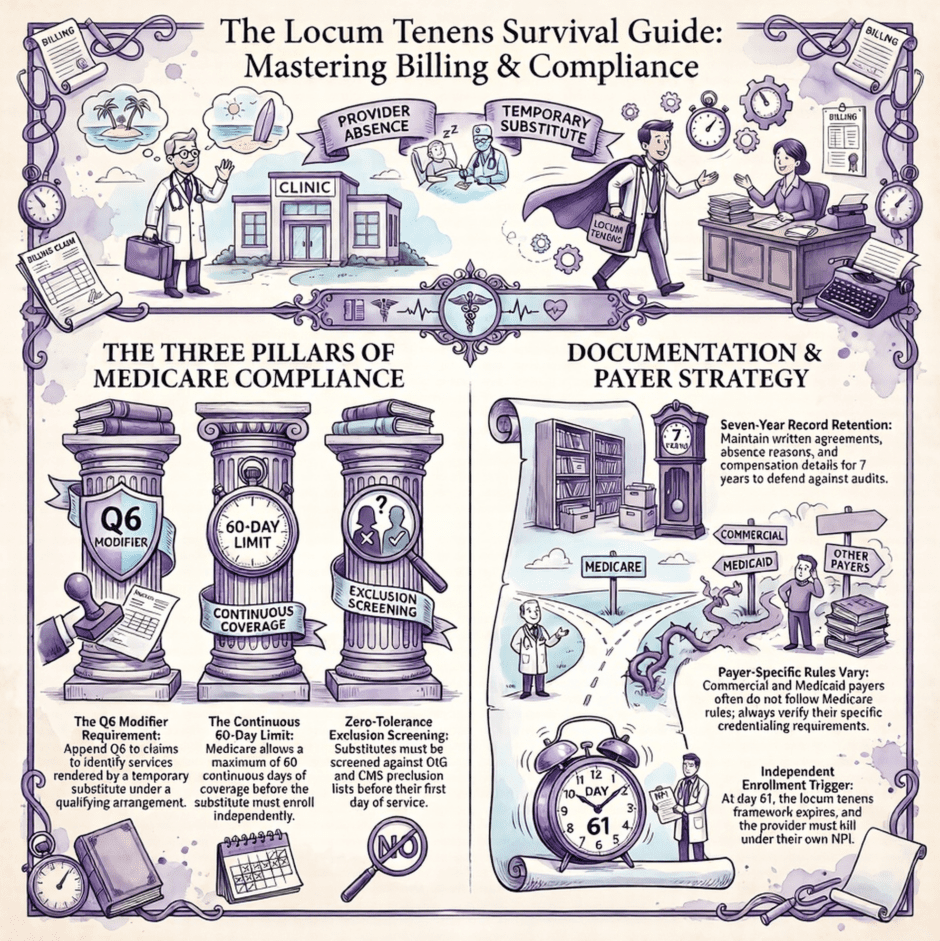
- Use the Q6 modifier on Medicare claims when a substitute provider renders services under a locum tenens arrangement.
- The arrangement must not exceed 60 continuous days under the regular provider’s NPI.
- The substitute provider must be excluded/preclusion screened before their first date of service.
- Commercial payers and Medicaid do not follow Medicare’s rules, verify each payer separately.
- Document every arrangement in writing. Retain records for 7 years.
What’s Locum Tenens Billing?
A locum tenens arrangement is a temporary coverage arrangement where a substitute provider renders services in place of a regular provider who is temporarily unavailable. The term comes from the Latin phrase meaning “to hold the place of,” and that is essentially what the substitute provider does. They step in, see the patients, and step back out when the regular provider returns.
Under Medicare, when a locum tenens arrangement is properly structured, the regular provider can bill for services rendered by the substitute using their own National Provider Identifier, with the Q6 modifier appended to indicate that a substitute provider performed the work. This is the core of locum tenens billing, and it is what makes the arrangement administratively workable for practices. Without this provision, every temporary substitute provider would need to be independently enrolled with Medicare before seeing a single patient, which would make short-term coverage arrangements nearly impossible to execute quickly.
The kinds of situations that trigger locum tenens arrangements are common. A primary care physician takes vacation. A psychiatrist goes out on medical leave. A surgeon attends a week-long CME conference. A solo practitioner needs coverage during a temporary illness. In each case, the practice may bring in a substitute provider to maintain patient access, and locum tenens billing is how those services get reimbursed under Medicare.
What is important to recognize up front is that locum tenens billing is a specific, rules-based framework with defined eligibility conditions. It is not a general workaround for billing any substitute provider under any regular provider’s NPI. The rules matter, and staying within them is what separates a clean arrangement from a compliance problem.
What’s the Q6 Modifier and When Do You Use It?
 The Q6 modifier is the billing mechanism that identifies a claim as being rendered by a substitute provider under a locum tenens arrangement. When appended to a claim, it tells Medicare that the service was performed not by the regular provider whose NPI appears on the claim, but by a temporary substitute acting in their place.
For Medicare to process a Q6 claim correctly, the arrangement has to meet several specific conditions. The regular provider must be unavailable due to illness, vacation, continuing medical education, or another temporary absence. The substitute provider must be paid on a per diem or fee-for-service basis by the regular provider, not as a permanent employee. The substitute must not provide services to Medicare patients over a continuous period of longer than 60 days, which we will cover in detail shortly.
There are situations where Q6 should not be used even when a substitute provider is involved. If the substitute provider is a permanent employee of the practice, the arrangement does not qualify as locum tenens under Medicare’s definition and cannot be billed with Q6. If the arrangement has been running on a continuous basis without a defined end date, it has likely crossed out of the locum tenens category. And if the substitute provider is billing their own services directly under their own NPI, Q6 is not applicable.
One of the most common misapplications of Q6 is using it for long-term coverage arrangements that were initially set up as temporary but never formally transitioned. When a substitute provider starts being treated functionally as a permanent staff member, the locum tenens framework no longer applies, regardless of how the arrangement is labeled internally.
What’s the 60-Day Rule for Locum Tenens Billing?
CMS requires that locum tenens arrangements not exceed 60 continuous days. This is not a soft guideline. It is a hard limit, and exceeding it without enrolling the substitute provider independently is one of the most well-documented sources of locum tenens billing errors and overpayment findings.
The 60-day period is calculated continuously from the first date the substitute provider begins rendering services under the arrangement. It is not reset by weekends, holidays, or days when the substitute does not actually see patients. If a substitute provider starts covering on March 1 and is still covering on May 1, the 60-day limit has been reached, and continuing to bill under Q6 after that point creates overpayment liability.
What happens at day 61 is straightforward. The substitute provider must either stop rendering services or enroll in Medicare independently and begin billing under their own NPI. Continuing to use Q6 beyond 60 continuous days is a billing error, and CMS’s data analytics tools are designed to catch exactly this kind of pattern. Claims analysis that shows a single substitute provider rendering services under Q6 for more than 60 continuous days is a recognized audit trigger.
Managing this operationally requires intentional tracking.
Here is a practical approach:
- Record the start date of every locum tenens arrangement in a centralized tracking system the day the arrangement begins, not retroactively.
- Set a calendar alert at day 45 to evaluate whether the arrangement will exceed 60 days and, if so, initiate the substitute provider’s independent enrollment immediately.
- Document the end date of every arrangement when it concludes and retain that documentation as part of your compliance records.
- Assign a specific staff member accountability for monitoring all active locum tenens arrangements at any given time.
The enrollment process for Medicare takes time, which is exactly why the 45-day alert matters. If you wait until day 58 to start enrollment paperwork, you will not have the substitute provider’s independent enrollment in place before the limit is reached.
What Documentation is Required for Locum Tenens Billing?
 Informal locum tenens arrangements that exist only in someone’s memory are a compliance liability waiting to surface. CMS auditors reviewing locum tenens claims expect documentation that supports the arrangement, and without it, even a legitimately structured arrangement becomes difficult to defend.
Every locum tenens arrangement should be supported by a written agreement between the regular provider and the substitute provider. That agreement should capture the reason for the regular provider’s absence, the dates the arrangement covers, the identity of both providers, and the compensation structure confirming that the substitute is being paid on a per diem or fee-for-service basis rather than as a permanent employee.
At the claims level, the regular provider’s NPI appears as the billing provider, and the Q6 modifier is appended to each service rendered by the substitute. The rendering provider field should reflect the substitute provider’s information where required, depending on your claims format. Getting this right at the claim level is important because it creates an accurate record of who actually performed the service.
Retain locum tenens documentation for as long as you would retain any other Medicare billing record, which is generally a minimum of seven years. If a post-payment audit surfaces locum tenens claims from several years ago, the documentation you kept at the time of the arrangement is what you have to work with.
Does a Locum Tenens Provider Need Medicare Enrollment?
One question that comes up frequently is whether a locum tenens provider needs to be independently enrolled in Medicare. The answer is nuanced. Under the locum tenens billing framework, the substitute provider does not need to be independently enrolled in Medicare in order for claims to be submitted under the regular provider’s NPI with Q6. However, the substitute provider must be eligible to enroll in Medicare. That means they cannot be excluded from federal healthcare programs, they cannot be on the CMS preclusion list, and they must hold the appropriate state licensure to practice in the state where services are rendered.
Exclusion screening is not optional. Before any locum tenens arrangement begins, the substitute provider must be checked against the Office of Inspector General exclusion list and the CMS preclusion list. Using an excluded provider in a locum tenens arrangement, even unknowingly, creates liability for the practice. The services rendered by an excluded provider cannot be reimbursed by Medicare, and claims submitted for those services are subject to recoupment.
Build exclusion screening into your locum tenens onboarding process as a required step before the provider’s first date of service. Document the date of the screening, the result, and who conducted it. Run the check again periodically for any arrangements that extend beyond a few weeks.
State licensure is equally non-negotiable. The substitute provider must be licensed in the state where they are rendering services. This becomes particularly relevant in telehealth-based locum tenens arrangements, where a substitute provider might be located in a different state than the patients they are seeing. Cross-state telehealth licensure requirements apply regardless of the billing arrangement, and a locum tenens framework does not create any exception to state licensure law.
How Do Commercial Payers and Medicaid Handle Locum Tenens Billing?
 A significant mistake practices make is assuming that Medicare’s locum tenens billing rules apply uniformly to commercial payers and Medicaid. They do not.
Commercial payers vary widely in how they handle substitute provider arrangements. Some recognize the Q6 modifier and process Q6 claims similarly to Medicare. Others require the substitute provider to be independently credentialed with the plan before any claims can be submitted under that provider’s care. Submitting a commercial claim with Q6 to a payer that does not recognize the modifier, or that requires independent credentialing, results in a denial.
The only reliable way to manage this is to build a payer-specific locum tenens billing matrix. For each payer in your mix, document whether locum tenens billing is recognized, what the modifier or billing requirements are, and whether credentialing of the substitute provider is required. Update that matrix whenever payer contracts are renewed or policies change.
Medicaid is similarly variable. Each state Medicaid program makes its own rules about substitute provider billing. Some states follow Medicare’s locum tenens framework closely. Others require the substitute provider to be independently enrolled in the state Medicaid program regardless of the arrangement. Applying Medicare’s Q6 logic to a Medicaid claim in a state that does not recognize that framework creates a billing error.
Check your state Medicaid provider manual specifically for guidance on substitute provider billing before assuming Medicare rules apply.
How Does Locum Tenens Billing Affect Prior Authorization and Telehealth?
Prior authorizations add a layer of complication to locum tenens arrangements that practices often do not think about until a claim comes back denied. If a patient’s course of treatment was authorized under the regular provider’s NPI and a locum tenens provider takes over mid-course, it is worth verifying whether the payer treats that as a continuous authorized service or whether a new authorization is needed for the substitute provider.
Some payers will process claims under an existing authorization even when a different provider renders the service, as long as the billing NPI remains the same. Others will require notification that a substitute provider is involved or will require a new authorization. This needs to be verified with each payer, and the answer is not always obvious from the authorization documentation itself.
For telehealth, locum tenens billing adds address and NPI reporting requirements on top of the standard telehealth billing rules. The rendering provider’s practice location, not a home address, should generally be reported on telehealth claims even when a locum provider is rendering the service remotely. POS 10 applies when the patient is at home, and POS 02 applies when the patient is at another non-home location. These rules do not change because a substitute provider is involved.
What are the Most Common Locum Tenens Billing Errors?
Most of the problems that surface in locum tenens billing audits come from a short list of repeating mistakes:
- Exceeding the 60-day limit without enrolling the substitute provider. This is the single most common and most costly locum tenens billing error. It is also one of the most preventable. Active tracking from the first day of every arrangement is the only reliable protection against it.
- Using Q6 for arrangements that do not qualify. Employed substitutes, long-term arrangements, and arrangements where the substitute provider is billing independently under their own NPI are all situations where Q6 does not apply. Applying it anyway creates a billing misrepresentation.
- Skipping exclusion and preclusion list screening. The assumption that a substitute provider is in good standing with CMS is not a substitute for actually checking. Screening takes minutes. An excluded provider billing under a practice’s NPI is a problem that takes significantly longer to resolve.
- Missing or informal documentation. Written agreements, absence documentation, and claims-level accuracy are all required to substantiate a locum tenens arrangement in an audit. Practices that rely on informal understandings rather than documented agreements have little to stand on when a reviewer asks for records.
Locum Tenens Billing FAQ
What is the Q6 modifier and when should I use it?
The Q6 modifier is used to identify Medicare claims for services rendered by a substitute provider under a qualifying locum tenens arrangement. It is appended to claims submitted under the regular provider’s NPI when the substitute provider meets all of CMS’s locum tenens conditions. It should not be used for employed substitutes, long-term arrangements, or situations where the substitute is billing under their own NPI.
How long can a locum tenens arrangement last under Medicare?
CMS limits locum tenens arrangements to 60 continuous days. After 60 days, the substitute provider must enroll in Medicare independently and bill under their own NPI. Continuing to use Q6 beyond the 60-day limit creates overpayment liability.
Does a locum tenens provider need to be enrolled in Medicare?
Not necessarily enrolled, but they must be eligible to enroll. That means they cannot be excluded from federal healthcare programs, cannot be on the CMS preclusion list, and must hold the appropriate state licensure. Excluded providers cannot participate in locum tenens arrangements regardless of how the billing is structured.
What happens if we exceed the 60-day locum tenens limit?
Claims billed with Q6 beyond 60 continuous days are considered improperly billed and subject to recoupment as overpayments. CMS’s claims analysis tools are designed to identify this pattern. The substitute provider should be enrolled independently before the 60-day limit is reached if the arrangement needs to continue.
Do commercial payers follow the same locum tenens billing rules as Medicare?
Not always. Commercial payers vary widely in how they handle substitute provider arrangements. Some recognize Q6; others require independent credentialing of the substitute provider. Verify each payer’s locum tenens policies and build a payer-specific billing matrix to manage the differences.
What documentation do I need for a locum tenens billing arrangement?
At minimum, a written agreement between the regular and substitute provider capturing the dates, the reason for the regular provider’s absence, the compensation structure, and the identity of both providers. Retain this documentation for at least seven years alongside the claims it supports.
Can an excluded provider work as a locum tenens?
No. An excluded provider cannot render services that are billed to Medicare or Medicaid under any arrangement, including locum tenens. Using an excluded provider creates overpayment liability for every claim submitted for their services.
What is the difference between a locum tenens provider and a permanently employed substitute?
A locum tenens provider is a temporary substitute paid on a per diem or fee-for-service basis who covers for a specific, temporary absence. A permanently employed substitute is a staff member of the practice and does not qualify for locum tenens billing. Permanently employed substitutes must be independently enrolled and bill under their own NPI.
What modifier is used for locum tenens billing?
The Q6 modifier is used on Medicare claims to identify services rendered by a substitute provider under a qualifying locum tenens arrangement. It is appended to the claim billed under the regular provider’s NPI and signals to CMS that a temporary substitute performed the work.
How does the 60-day rule work for locum tenens providers?
CMS requires that a locum tenens substitute provider not render services continuously for more than 60 days under the regular provider’s NPI using the Q6 modifier. The 60 days is measured continuously from the first date of service, not just days when the provider actually saw patients. After 60 days, the substitute must enroll independently in Medicare.
Can an excluded provider work as a locum tenens?
No. Excluded providers are barred from participating in Medicare and Medicaid in any capacity, including as locum tenens substitutes. Every substitute provider must be screened against the OIG exclusion list and the CMS preclusion list before their first date of service.
What is the difference between locum tenens billing and incident-to billing?
Locum tenens billing uses the Q6 modifier to bill for services rendered by a substitute provider temporarily covering for an absent regular provider. Incident-to billing is a Medicare provision that allows non-physician practitioners to render services under physician supervision, with the claim billed under the physician’s NPI at 100 percent of the fee schedule. They are different frameworks with different eligibility conditions and documentation requirements.
Do prior authorizations transfer when a locum tenens provider takes over a patient’s care?
It depends on the payer. Some payers will honor an existing authorization when the billing NPI remains the same even if a substitute rendered the service. Others require notification or a new authorization when a different provider is involved. Verify with each payer before assuming an authorization transfers automatically.
Can a nurse practitioner or PA serve as a locum tenens provider?
Yes. CMS’s locum tenens billing rules apply to physicians and, in certain circumstances, to non-physician practitioners including nurse practitioners and physician assistants, provided all standard locum tenens eligibility conditions are met. Verify payer-specific rules for NPP locum tenens arrangements.
What happens if a locum tenens provider is not properly screened?
Claims submitted for services rendered by an excluded provider,even unknowingly,are subject to recoupment. The practice bears liability for those claims regardless of whether the exclusion was known at the time of service. Screen every substitute provider before their first date of service without exception.
Is the Q6 modifier used for commercial insurance claims?
Not universally. The Q6 modifier is a Medicare-specific modifier. Commercial payers may recognize it, require a different modifier, or require the substitute provider to be independently credentialed before any claims are accepted. Verify with each payer before submitting.
Let Medwave Support Your Locum Tenens Billing Compliance
 Locum tenens billing is one of those areas where the rules are specific enough that small process gaps create real financial and compliance risk. The 60-day limit, the Q6 modifier requirements, the documentation standards, the exclusion screening obligations, and the payer-by-payer differences all have to be managed correctly and consistently.
Medwave provides medical billing, provider credentialing, and payer contracting services to healthcare practices across the country. Our team manages the details that keep locum tenens billing compliant, including Q6 modifier accuracy, 60-day arrangement tracking, substitute provider exclusion screening, payer-specific billing matrix management, and pre-submission claim review. We also handle credentialing for temporary and permanent providers to make sure every provider in your practice is properly enrolled and in good standing before they see their first patient.
If your practice uses locum tenens arrangements regularly and has not recently reviewed your billing process against current CMS requirements, that review is worth doing before a claim review does it for you.
Contact Medwave today to schedule a locum tenens billing compliance review.

Co-Founder and COO of Medwave, bringing more than 25 years of hands-on experience in healthcare revenue cycle management, payer contracting, and medical credentialing.