

 Few areas of healthcare administration carry as much financial weight, and as much confusion, as payer contracting. It determines what a provider gets paid for the care they deliver, which patients can afford to see them, and how much administrative friction a practice deals with every time a claim goes out the door. Yet many providers sign their first payer contract with only a general sense of what they are agreeing to, and many more let existing contracts renew year after year without ever revisiting the terms.
This guide walks through the full lifecycle of a payer contract. What it is, why it matters, how to negotiate one, how to renegotiate or restructure an existing agreement, how to manage and optimize contracts once they are signed, and the mistakes that cost providers the most money.
Key Takeaways
Payer contracting is the process of negotiating and managing agreements between healthcare providers and insurance companies. This guide covers what payer contracts include, how to negotiate a new one, how to renegotiate or restructure an existing one, how to manage and optimize contracts after signing, and the most common mistakes providers make along the way.
What Is Payer Contracting?
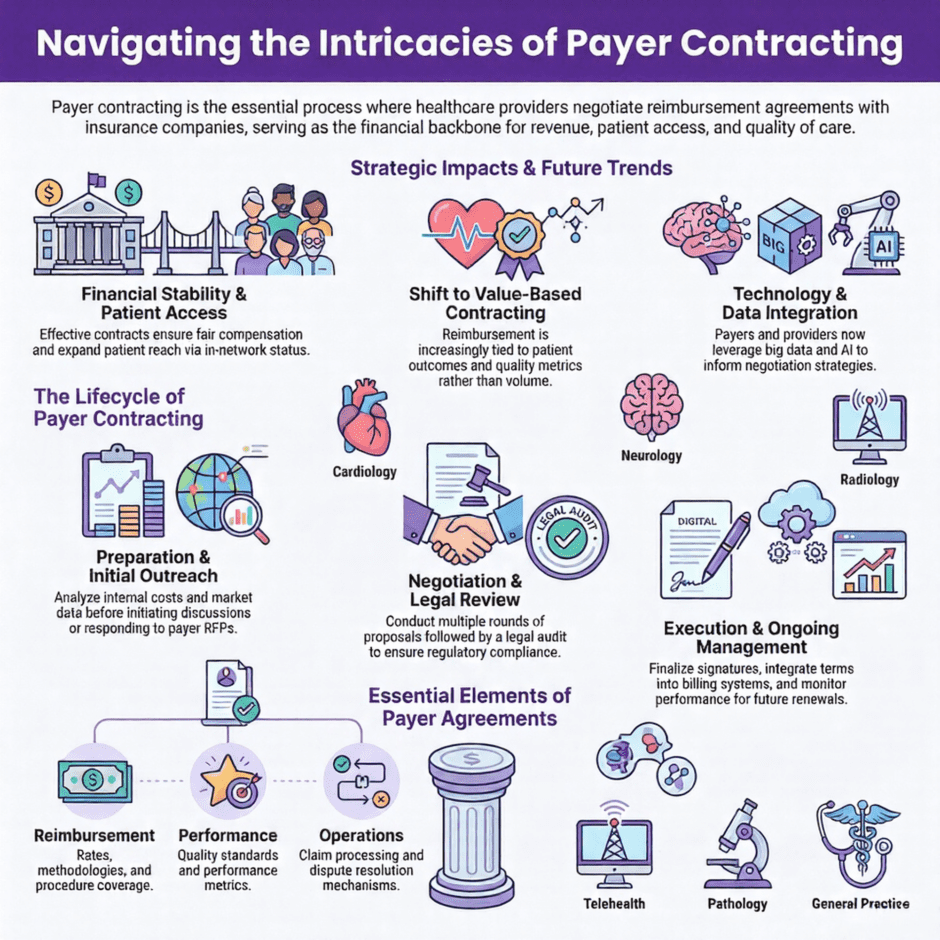
Payer contracting is the process by which healthcare providers negotiate and establish agreements with insurance companies and other payers for reimbursement of medical services. These contracts set the terms under which a provider delivers care to a payer’s members and how the provider gets paid for it.
A typical payer contract includes six core components:
- Reimbursement rates and methodology (fee-for-service, value-based, bundled, or a mix)
- Covered services and procedures
- Performance metrics and quality standards, when applicable
- Claims submission and processing procedures, including timely filing windows
- Dispute resolution mechanisms
- Contract duration, renewal terms, and termination clauses
Payer contracting is closely related to, but distinct from, medical credentialing. Credentialing verifies a provider’s qualifications and gets them approved to participate in a payer’s network. Contracting sets the financial and operational terms once that participation is approved. A provider can be credentialed with a payer and still be operating on outdated or unfavorable contract terms, which is exactly why the contracting side deserves its own ongoing attention.
Why Payer Contracting Matters for Healthcare Providers
The terms in a payer contract affect a practice in ways that compound over time.
Reimbursement rates set the ceiling on revenue per encounter. A rate that sits two or three percentage points below market on high-volume codes adds up fast. A practice billing a few hundred claims a month on an underpriced code can be leaving tens of thousands of dollars a year on the table without realizing it, because the shortfall never shows up as a single obvious number. It shows up quietly, claim by claim.
Network status affects patient access. Patients overwhelmingly prefer in-network providers to avoid out-of-pocket surprises, so a practice’s payer mix directly shapes who can walk through the door. A strong contract with a dominant regional payer can expand a patient base meaningfully; a weak one, or none at all, can quietly shrink it.
Quality metrics tied to contract terms increasingly affect reimbursement directly, not just eligibility. Many current contracts include performance-based components, meaning the terms a provider negotiates today shape the revenue tied to outcomes tomorrow.
Well-negotiated contracts also reduce administrative friction. Clear claims processing timelines and defined dispute resolution steps mean fewer denied claims sitting in accounts receivable and less staff time spent chasing payers for answers.
Negotiating a New Payer Contract
 Negotiating a payer contract for the first time starts well before anyone picks up the phone. Providers who walk in with data walk out with better rates than providers who walk in with hope.
Start with your own numbers. Pull historical claims volume, payer mix, and average reimbursement across the services billed most often. Specialty practices should know their CPT code distribution cold, since payers negotiate code by code far more often than they negotiate a blanket percentage increase. Knowing which five or six codes make up most of a practice’s revenue tells a negotiator exactly where to focus.
Know the market next. What are comparable practices in the region getting paid for the same codes? This is where many first-time negotiators fall short. They know their own numbers but have no benchmark to argue from. Regional fee schedule data, whether sourced through a billing partner, a specialty society, or a network of peers, turns a vague request for a higher rate into a specific, defensible position.
Lead with value, not just the ask. Payers respond to practices that reduce their administrative burden and improve outcomes. This includes low denial rates, clean claim submission, strong quality metrics. A practice with a high clean claim rate is a cheaper trading partner for a payer than one that generates constant rework, and that is worth stating directly in the first conversation.
Expect the first offer to be an opening position, not a final one. Payers routinely start with a standard fee schedule and anticipate pushback on the codes that matter most to the provider. Come with two or three specific asks rather than a long list. A longer list dilutes leverage on the terms that actually move revenue.
Get everything in writing before signing, including any verbal assurances made during negotiation. Fee schedules, timely filing windows, and dispute resolution timelines belong in the contract language itself, not in a follow-up email with no contractual weight.
Before signing, run the proposed terms against our payer contract negotiation checklist to confirm rate benchmarks, risk clauses, and protective language are all covered.
Restructuring Contract Terms
Restructuring is distinct from renegotiating a rate. Restructuring changes the shape of the agreement itself, most often by shifting from a pure fee-for-service model toward value-based components, bundled payments for specific episodes of care, or risk-sharing arrangements tied to patient outcomes.
This kind of change usually comes from one of two directions. Either the payer proposes it as part of a broader shift toward value-based contracting across their network, or the provider initiates it because a fee-for-service structure no longer reflects how care is actually being delivered, particularly for practices doing more coordinated or team-based care.
Restructuring carries more operational risk than a simple rate renegotiation, because it usually requires changes to how a practice tracks and reports outcomes, not just how it bills. Before agreeing to restructured terms, a provider should confirm what new reporting requirements come with them, what data infrastructure is needed to meet those requirements, and what the financial downside looks like if performance targets are not met in a risk-sharing arrangement. A favorable rate wrapped around an unrealistic reporting burden is not actually a favorable contract.
Renegotiating an Existing Payer Contract
 Renegotiation is a different conversation than an initial negotiation, because the leverage points are different. A provider renegotiating has a claims history with that specific payer.
The strongest renegotiation case starts with performance data. If claim denial rates are low, if quality metrics are strong, if patient volume with that payer has grown, that history becomes the argument. Payers are far more willing to move on rate when a provider can show measurable value delivered under the existing contract, rather than projected value from a new relationship.
Timing matters more in renegotiation than in initial contracting. Most contracts specify a renewal window and a notice period for proposing changes. Missing that window often means being locked into existing terms for another full contract cycle. Track renewal dates actively rather than waiting for a payer to reach out, because payers rarely initiate a renegotiation in the provider’s favor.
Benchmark data becomes even more important here than in an initial negotiation. A provider asking for a rate increase without pointing to where current reimbursement sits relative to market is negotiating from a weaker position than one who can say precisely how far below benchmark a given code has fallen, and for how long.
Managing Contracts After Signing
Signing a contract is the beginning of the work, not the end of it. Contract management is the ongoing discipline of making sure a signed agreement is actually being honored and actually still fits the practice.
That starts with tracking the terms themselves. Reimbursement rates, timely filing windows, and renewal or termination dates should live somewhere accessible to billing staff, not buried in a signed PDF nobody revisits. When a claim gets underpaid relative to the contracted rate, someone needs to notice, and that only happens with active tracking.
Dispute resolution is part of management, not a last resort. Every contract should specify how billing discrepancies get resolved, and staff should know that process well enough to use it routinely rather than treating every underpayment as a one-off problem to be quietly absorbed.
Compliance monitoring matters just as much on contracts with quality or performance components. If a contract ties reimbursement to specific metrics, someone needs to be watching those numbers on an ongoing basis, not discovering at renewal time that a performance threshold was missed for the better part of a year.
Optimizing Contract Performance
 Optimization goes a step further than management. Where management asks “are we compliant with this contract,” optimization asks “is this contract actually working for us, and where is it not.”
The starting point is identifying underpaid codes. Comparing actual reimbursement against contracted rates, code-by-code, surfaces gaps that are easy to miss when looking only at total revenue. A practice can be profitable overall while still leaving real money on the table on a handful of high-volume codes.
Benchmarking against market rates on a regular cadence, not just at renewal time, turns optimization into an ongoing process instead of a once-a-year scramble. Fee schedules shift, regional reimbursement norms shift, and a rate that was competitive two years ago may not be today.
Optimization also means using contract performance data to build the case for the next renegotiation before it happens. Providers who track underpayment patterns and benchmark gaps throughout the contract term walk into renewal conversations with evidence already assembled, rather than starting that work from scratch when the renewal notice arrives.
Data-Driven Negotiation Approaches
Every stage above works better with real data behind it, and payers increasingly expect it. Both payers and providers are leaning more heavily on analytics to inform contract terms and monitor performance, which means a provider showing up to any negotiation, renegotiation, or restructuring conversation without data is negotiating at a disadvantage regardless of how strong the underlying practice performance actually is.
A data-driven approach pulls from a few consistent sources. Internal claims and reimbursement history, regional benchmark data, and quality or outcomes metrics where the contract includes them. The providers who negotiate the best treat this as a standing practice, not a project that spins up only when a contract is up for renewal. Reviewing reimbursement performance quarterly, rather than annually, catches underpayment trends early enough to act on them before they compound across an entire contract cycle.
Best Practices for Payer Contracting
 A few habits separate providers who consistently negotiate well from those who do not.
Review contracts before they auto-renew, not after. Set calendar reminders well ahead of renewal and notice deadlines, since many contracts require written notice months in advance to reopen terms.
Keep a single source of truth for contract terms across every payer relationship, so billing staff, front office staff, and leadership are all working from the same rate and policy information.
Build the negotiating case continuously, not seasonally. Track denial rates, underpayment patterns, and quality metrics as they happen rather than compiling them under time pressure right before a renewal conversation.
Bring in outside expertise for tough negotiations. Payer contracting language is dense, and provisions around dispute resolution, termination, and value-based components carry real financial consequences that are easy to miss without experience reading contracts like these regularly.
Common Mistakes to Avoid
The costliest payer contracting mistakes tend to repeat across practices of every size.
Letting contracts auto-renew without review is the most common one. A contract signed five years ago on market-rate terms may be well below market today, and auto-renewal means that gap never gets addressed unless someone actively intervenes.
Negotiating rate alone while ignoring operational terms is another. Timely filing windows, claims processing timelines, and dispute resolution provisions affect cash flow just as much as the headline reimbursement rate, and providers who focus only on rate often end up with a favorable number attached to unfavorable terms everywhere else.
Treating every payer the same is a mistake specific to practices with a broad payer mix. Different payers have different negotiation postures, different administrative processes, and different appetite for value-based terms. A one-size-fits-all approach to contract review misses payer-specific opportunities.
Failing to track performance against contract terms, once signed, means underpayments go unnoticed for months or years. This is the single most preventable revenue loss in payer contracting, because the fix is procedural, not strategic.
Frequently Asked Questions
What is the difference between payer contracting and credentialing?
Credentialing verifies a provider’s qualifications so they can join a payer’s network. Contracting sets the financial and operational terms of that relationship once credentialing is complete. A provider can be fully credentialed and still be working under outdated contract terms. In fact, it’s quite common.
How often should a payer contract be reviewed?
At minimum, contracts should be reviewed before every renewal date. Practices with strong contract management review performance against contract terms quarterly, so underpayment trends and benchmark gaps are caught well before a renewal conversation.
What is the difference between renegotiating and restructuring a payer contract?
Renegotiating typically means revisiting the reimbursement rate on existing contract terms. Restructuring changes the shape of the agreement itself, such as shifting part of the contract to a value-based or bundled payment model.
Can a small practice negotiate the same way a large health system does?
Smaller practices have less leverage on volume alone, but a smaller practice with strong quality metrics, low denial rates, and clear regional benchmark data can still negotiate meaningfully better terms than one that shows up without preparation.
What happens if a payer underpays relative to the contracted rate?
Every payer contract should specify a dispute resolution process for exactly this situation. Tracking contracted rates against actual reimbursement, code by code, is what allows a practice to catch and dispute underpayments before they compound.
How do I get credentialed with an insurance company?
Credentialing involves submitting an application, often through CAQH, along with licensure, malpractice history, and education verification to the payer, followed by the payer’s internal review and approval process before a contract can be executed.
What is a fee schedule in medical billing?
A fee schedule is the payer’s list of maximum reimbursement amounts for specific medical services and procedures, typically organized by CPT or HCPCS code, and it forms the financial backbone of a payer contract.
Why do insurance companies deny claims?
Common reasons include missing prior authorization, coding errors, timely filing violations, and services deemed not medically necessary under the payer’s coverage policy, many of which trace back to contract terms not being clearly understood or tracked.
What is value-based contracting in healthcare?
Value-based contracting ties provider reimbursement to patient outcomes and quality metrics rather than purely to service volume, shifting financial risk and reward toward measurable results.
How Medwave Handles Payer Contracting
Medwave manages payer contracting, rate negotiations, and renegotiations for healthcare providers nationwide, combining fee schedule benchmarking with hands-on negotiation support so practices are not navigating this process alone or from a position of limited data. For providers focused specifically on renegotiating existing agreements or securing better rates on high-volume codes, Medwave’s rate negotiation services are built around exactly this kind of ongoing, data-backed advocacy.
Summary: Payer Contracting Intricacies
 Payer contracting sits at the center of a practice’s financial health, and it touches every other part of revenue cycle management. A well-negotiated, well-managed contract supports accurate medical billing downstream, works in tandem with a strong medical credentialing foundation, and gives a practice the leverage it needs at every future renewal.
Providers who treat payer contracting as a one-time task rather than an ongoing discipline are the ones most likely to be leaving revenue on the table without ever seeing the number that proves it.
Contact us below, we can handle all of your payer contracting needs and/or challenges.

Co-Founder and COO of Medwave, bringing more than 30 years of hands-on experience in healthcare revenue cycle management, payer contracting, and medical credentialing.