
Provider credentialing serves as a fundamental quality assurance process in healthcare, ensuring patients receive care from qualified medical professionals. For healthcare providers seeking to join PacificSource’s network, mastering the credentialing process opens doors to serving one of the Pacific Northwest’s most established health insurance organizations. PacificSource operates as a not-for-profit health insurer serving Oregon, Washington, […]
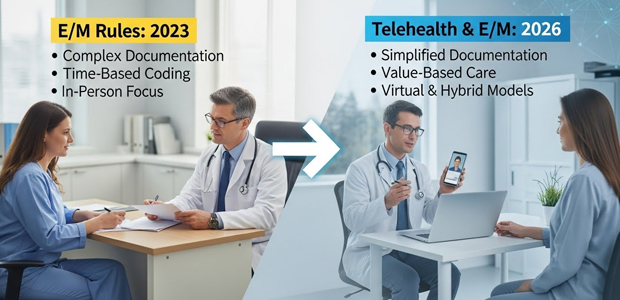
How 2026 E/M and Telehealth Rules are Changing

The 2026 CMS rules for Evaluation and Management services and telehealth introduce changes that affect how providers document visits, select E/M code levels, and bill for remote care. The changes are not cosmetic adjustments to existing guidelines, they modify how medical decision-making components are weighted, clarify time-based coding for total encounter time, and establish which […]
E/M, E/M coding, Telehealth BillingHow to Choose and Prepare Professional and Peer References for Credentialing

Professional and peer references are the part of a credentialing file you don’t control, unlike most of the paperwork. Other clinicians write them on their own schedule, and under the NAMSS best-practice standards, chasing a source that doesn’t respond falls back on you as the applicant. The file stays incomplete until the last one arrives. […]
Credentialing Applications, Credentialing Delays, Credentialing References, Peer Reference, Professional ReferenceOut-of-Network Billing: How to Appeal Low Payments and Recover Fair Reimbursement

Out-of-network billing operates without a contracted rate, which means the provider sets their charges and the payer determines what they consider an appropriate payment, and those two numbers are rarely the same. Payers use methodologies like “usual and customary” rates, “allowed amounts,” and geographic database benchmarks to calculate payments that frequently fall well below the […]
EOB, OON, Out of Network, Out-of-Network ProviderPhysician Credentialing Checklist: Every Document You Need, When to Start Gathering It

A physician credentialing application requires documents from every stage of a provider’s career. The medical school transcripts, residency completion certificates, state licenses, DEA registration, malpractice insurance declarations, board certifications, and a gap-free work history. Gathering those documents takes longer than most providers expect. Medical schools and licensing boards that still operate on paper can take […]
Continuing Medical Education, Credentialing Checklist, Credentialing Documentation, Hospital PrivilegesCan Providers Practice with Pending Credentialing Applications? Options, Risks, and Rules

Providers can see patients while credentialing applications are pending, but the options for how they get paid, and the compliance requirements that apply, vary significantly depending on the arrangement. The three most common approaches are treating self-pay patients, working under locum tenens arrangements billed through a credentialed practice, and obtaining temporary or emergency privileges from […]
Credentialing Applications, Credentialing Challenges, Credentialing Timelines, Locum Tenens, Medical CredentialingHow to Keep Your CAQH ProView Profile Current and Why It Affects Every Payer

CAQH ProView is a centralized database operated by the Council for Affordable Quality Healthcare that allows providers to enter their professional credentials once and authorize participating payers to access that data directly for credentialing and verification purposes. More than 1,800 healthcare organizations use it, including most major commercial payers, hospital systems, and managed care organizations. […]
Articles, CAQH ProView, Credentialing, RecredentialingHospital Privileging for Physicians: Types, Application Process, Renewal Requirements

Hospital privileges are facility-specific authorizations that determine what procedures and services a physician can perform within a particular hospital. A medical license establishes that a provider is qualified to practice medicine in a state. Hospital privileges establish what that provider is approved to do within a specific facility, which procedures, which patient populations, and under […]
Credentialing, Hospital Privileging, Privilege TypesHealth Insurance Company Directory: Major Payers, Market Share, Credentialing Priority

This directory covers the major health insurance companies providing medical coverage in the United States, organized by market share and network reach. For healthcare providers and billing teams, knowing which payers dominate a given market, how they are structured, and what credentialing relationships they require is foundational to building a practice’s payer mix and prioritizing […]
Centene, Commercial Health Insurance, CVS Health/Aetna, Elevance Health, Humana, UnitedHealth, UnitedHealth GroupWhat Are Patient-Centered Care Models?

Patient-centered care models organize a practice around what the patient needs and wants as well as the diagnosis in front of the provider. For most practices that sounds like good bedside manner. In practice it changes how visits are scheduled, how care is coordinated after the patient leaves, and which services the practice can bill […]
Patient Satisfaction, Patient-Centric Care, Patient-Centric Care Models, Patient-Friendly, Value Based CarePayer Contract Analysis: How to Evaluate Reimbursement Rates, Payment Terms, Contract Risk

Payer contracts determine what a practice gets paid for every service it delivers, and most practices sign them without a complete analysis of their terms, reimbursement methodology, or long-term financial implications. A contract that looks reasonable based on headline reimbursement rates may be unprofitable when administrative burden, payment timelines, and claims process requirements are fully […]
Contract Negotiations, Payer Contract Analysis, Prior Authorization, Rate Evaluation, ReimbursementAmbulatory Surgery Center (ASC) Credentialing

Ambulatory surgery centers operate under a credentialing framework that differs from hospital-based credentialing in two significant ways. Firstly, ASCs focus on specific surgical specialties rather than the broad scope of services a hospital covers, which means credentialing committees must evaluate providers against specialty-specific competency standards rather than general medical qualifications. Secondly, ASCs are governed by […]
ASC Credentialing, ASC Privileging Process, CredentialingWhy Outsource Medical Credentialing? Cost, Speed, Compliance Advantages Explained

Outsourced credentialing is the practice of contracting a specialized third-party service to manage provider credential verification, payer enrollment applications, and ongoing revalidation on behalf of a healthcare organization. The alternative, handling credentialing internally, requires dedicated staff with specific expertise in payer requirements, CAQH management, primary source verification, and license tracking across multiple states and renewal […]
Credentialing, Credentialing Costs, Outsourced CredentialingWhich CPT Codes are Used for Alopecia Treatment Billing?

CPT codes for alopecia treatment vary by the type of intervention performed. Intralesional corticosteroid injections use codes 11900 and 11901 depending on the number of lesions treated. Laser therapy for hair loss falls under the 96920-96922 range based on treatment area size. Hair transplant procedures use codes 15775 and 15776. Skin biopsy for diagnostic workup […]
Alopecia Treatment, Alopecia Treatment CPT Codes, CPT Codes, Dermatology BillingPayer Contract Negotiation: 3 Protective Phrases Every Healthcare Provider Needs

Payer contract negotiation is where healthcare organizations often lose reimbursement they’ve earned, even when both parties have agreed on rates. The culprits are predictable. They are hidden policy modifications, post-authorization claim denials, and contract gaps that leave new or unlisted services underpaid. According to the American Medical Association, more than 15% of commercial insurance claims […]
Healthcare Revenue Cycle Protection, Payer Contract Language, Payer Policy Change Notification, Prior Authorization Denial Prevention, Provider Contract Protection Clauses, Unlisted CPT Code ReimbursementWhat AI Can and Can’t Do in Medical Credentialing

AI in medical credentialing now handles real pieces of a provider file. It reads CVs and license copies, runs primary source checks, flags expiring documents and, with some vendors, calls payer lines to ask where an application stands. That last task used to cost a coordinator most of a morning on hold. What it still […]
Artificial Intelligence, CAQH, Medical Credentialing AI, Primary Source Verification, RecredentialingThe Credentialing Committee Process

The credentialing committee process is the last checkpoint between a provider’s application and the day that provider can treat patients at your facility. When the committee runs well, verified practitioners start on schedule and revenue follows. When it stalls, files sit between meetings, providers wait weeks for an answer, and every day of delay is […]
Credentialing Committee, Credentialing Compliance, Credentialing Software, Hospital Privileging, Provider CredentialingCredentialing Prompts for ChatGPT & AI Assistants

Credentialing prompts for ChatGPT and other AI assistants are replacing the cold calls and vendor demos that used to come with finding the right credentialing partner. A growing number of practice administrators and medical staff coordinators are turning to AI assistants. These include, but not limited to ChatGPT, Perplexity, Claude, to get fast, comparative answers […]
AI Credentialing Prompts, ChatGPT Healthcare, Medical Credentialing, Provider EnrollmentPECOS 2.0: Medicare Enrollment Gets a Major Upgrade

After years of anticipation, CMS has officially launched PECOS 2.0, a ground-up rebuild of how providers enroll in and maintain Medicare participation. This isn’t a cosmetic redesign, it changes daily workflow for anyone who touches Medicare enrollment, credentialing, or revenue cycle operations. Understanding what’s actually different in PECOS 2.0 keeps payments flowing and applications out […]
CMS, Medicare Billing, Medicare Enrollment, PECOS, RevalidationAcceleration of Revenue Cycle Metrics for Physician Groups

Revenue cycle metrics show whether a physician group’s clinical excellence is turning into financial health, even when patients are satisfied and clinical outcomes are stellar. But when you look at your financial statements, something doesn’t add up. Cash flow feels like a constant uphill battle, insurance denials seem to multiply overnight, and your administrative team […]
Revenue Cycle Automation, Revenue Cycle Metrics, Revenue Optimization