

Fee schedule drift is the gap between when Medicare publishes a payment change and when your charge master and claims reflect it. Practices lose money in that gap without a single denial to show for it.
Nothing about this is a staff failure. CMS spreads each change across a fall final rule, a January reset, and quarterly update files, and every Medicare Administrative Contractor loads those files on its own schedule. No single alert ties it together, so the first sign is usually a remittance that looks a little light, and revenue leaks for months before anyone traces it.
Below are the layers of Medicare payment change and a 90-day audit you can run against your own remittance data.
Key Takeaways
- Medicare pays the lower of your billed charge or the fee schedule amount, so a charge master that wasn’t raised after the January update leaves money unpaid on every claim.
- Starting in 2026, Medicare uses two conversion factors, one for qualifying APM participants and a slightly lower one for everyone else.
- Quarterly update files can change rates months after January, and mass adjustments only fix claims that already paid.
- Commercial contracts priced as a percentage of Medicare drift when they’re tied to an old year’s fee schedule.
- A 90-day lookback comparing remittances to the current fee schedule shows which claims paid short and which can still be corrected.
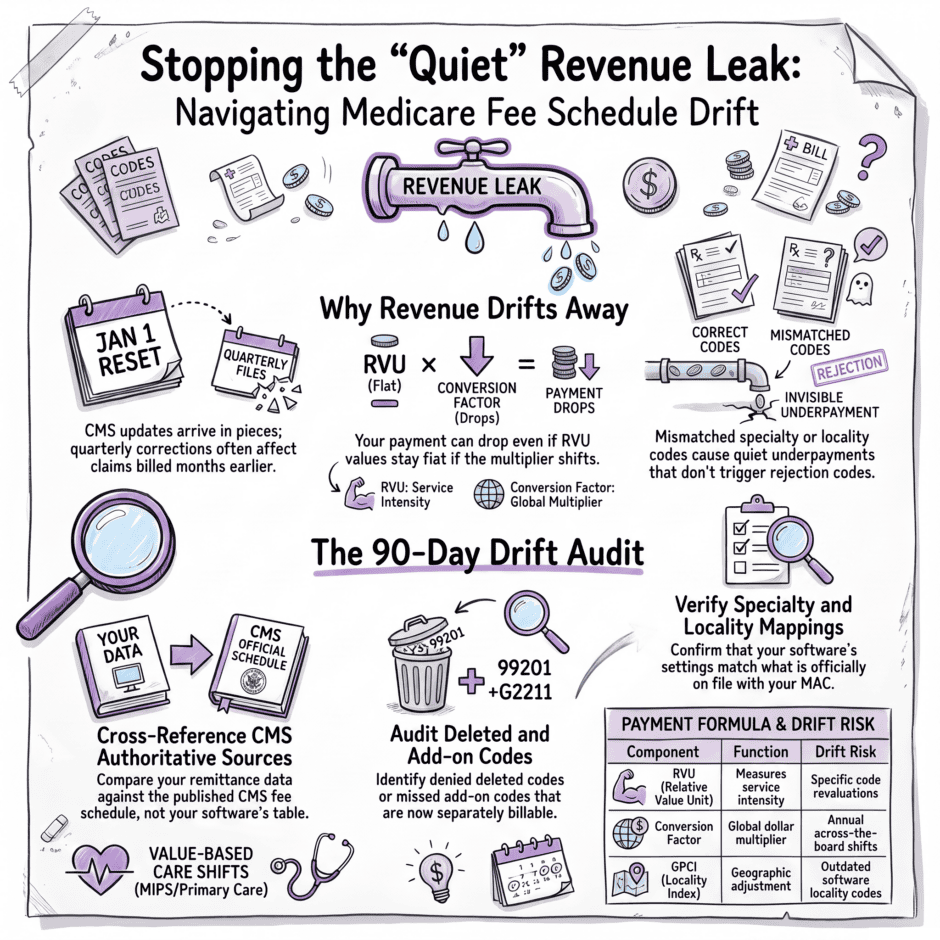
The January 1 Reset: New Codes, Deleted Codes, and Conversion Factor Changes

CMS finalizes a new Medicare Physician Fee Schedule every year, effective January 1. The final rule usually lands around November 1, which leaves about eight weeks to update charges, encounter templates, and any payer contracts that reference Medicare rates. For a small practice closing out the year, that goes fast.
Most people watch the conversion factor, the dollar amount CMS multiplies by the relative value units assigned to each CPT code. Several recent years brought conversion factor cuts driven by budget neutrality. In 2026 the structure itself changed. Medicare now has two conversion factors, $33.57 for qualifying participants in advanced alternative payment models and $33.40 for everyone else. The 2026 increase also carried a 2.5% statutory boost that applied to that year only, so 2027 rates start from a lower base unless Congress extends it.
The annual update also brings deleted codes, new codes, and revised RVUs. For 2026, CMS applied a −2.5% efficiency adjustment to the work RVUs of non-time-based services, which lowers payment for many procedures even though the conversion factor rose. Medicare gives no grace period for deleted CPT codes, so a deleted code left in an encounter template denies the moment the claim goes out. A new add-on code that nobody adds to the template causes no denial at all. It never gets billed, and a missing charge is much harder to spot than a rejection.
Cardiology, orthopedics, and internal medicine carry long code lists, so the detail tables deserve a line-by-line read. Most of what changes for a specific practice sits in those tables, not in the conversion factor headline.
RVUs vs. Conversion Factor: Why Your Remittance Changed When Your Codes Didn’t
Medicare payment for a service is the sum of its work, practice expense, and malpractice RVUs, each adjusted by the locality’s geographic index and multiplied by the conversion factor. When the conversion factor moves and the RVUs don’t, every payment tied to those RVUs still changes. Billing managers who only check whether a code’s RVUs moved can miss a rate change that touched every claim.
Three things on your side decide whether you collect the full amount.
- Medicare pays the lower of the billed charge or the fee schedule amount. If your charge for a code sits below the new allowable, Medicare pays your charge, and the difference disappears with no denial or remark code to flag it.
- Your MAC sets the locality from the ZIP code of the service location on the claim. A new office, a wrong address in the billing system, or claims routed under the wrong location can price at another locality’s rate.
- Nurse practitioners and physician assistants billing under their own NPI are paid 85% of the fee schedule. Visits that could have met incident-to rules but were billed under the NPP, or the reverse, shift payment on every claim.
A specialty designation on file with your MAC doesn’t change a physician’s fee schedule rate. It can still trigger denials on codes Medicare restricts by specialty, and it affects MIPS reporting, so check it once a year.
Your billing software’s expected-payment table does a different job. It flags a short payment when a remittance posts, and if it still holds last year’s rates, underpaid claims post as paid in full and nobody looks twice. Ask your vendor when each update was loaded instead of assuming a software release included it.
The Staging Problem: Why Quarterly Updates Still Affect January Claims
The November final rule doesn’t settle everything. Quarterly updates follow in January, April, July, and October, correcting RVUs, adding codes that were pending, and adjusting payment policies. Each one goes to the MACs as a change request, and each MAC loads it into its claims system on its own timeline.
The effective date determines which rate applies to a service. The load date determines whether a claim processes correctly the first time, so a claim for a new code submitted before the MAC loaded it can deny or pay at the old rate. After a retroactive rate correction, MACs usually reprocess affected claims through a mass adjustment, but that reaches only claims that paid. Claims that denied outright need corrected resubmission, and Medicare’s one-year timely filing limit from the date of service keeps running.
Newer codes show up most often in these corrections. Telehealth services, care management, and complexity add-ons all fall in that group, and they appear on primary care and specialty visits every day. When a first-quarter claim for one of them looks wrong, pull the specific transmittal or MLN Matters article for that update before guessing.
Value-Based Adjustments: Changes That Don’t Appear in the RVU Table

Practices in value-based arrangements, and groups that mix primary care with specialists, carry a third layer of change on its own calendar.
MIPS adjustments hit Part B fee schedule payments two years after the performance year, so 2024 performance sets 2026 payment. Base rates can hold steady while a MIPS penalty or bonus moves final payment by several percentage points. That lag is why this year’s payments rarely line up with this year’s billing decisions.
Each clinician gets an individual MIPS score unless the group reports together, so one provider’s bonus can hide another’s penalty when numbers are only reviewed at the practice level. Pull payments by provider, separate claims under value-based arrangements from straight fee-for-service, and compare provider totals before rolling them up.
Primary care practices should also confirm they’ve adopted the codes added in recent years, including Advanced Primary Care Management (G0556 to G0558), chronic care management, transitional care management, and prolonged services. They’re paid services that go unbilled when templates are built around routine visits.
A 90-Day Fee Schedule Drift Audit
This audit runs on data you already have. It shows which claims paid short, which can still be corrected, and which settings need to change so next quarter doesn’t repeat the problem.
- Export 90 days of remittance data, including claims that paid, denied, and paid at zero, in a format you can sort by CPT code and rendering provider.
- Compare your billed charge for each high-volume code to the current Medicare allowable for your locality. Any code where your charge sits below the allowable loses money on every claim until the charge is raised.
- Compare paid amounts to the current published fee schedule. Where payment doesn’t match, check the service location, the rendering provider type, and whether the claim processed before the MAC loaded the latest quarterly update.
- Search claim history for codes deleted in the January update. Denied claims with a deleted code can be resubmitted with the replacement code if they’re still within timely filing.
- Check that this year’s new and add-on codes are in your encounter templates and are being billed where documentation supports them.
- Review commercial contracts that pay a percentage of Medicare and confirm which year’s fee schedule each one references.
- Ask your software vendor which quarterly update is loaded in your expected-payment tables, and schedule a review two to three weeks into each quarter.
Steps one through five and step seven are bookkeeping that a patient office manager can finish in a week or two. Step six is where most practices stall, because repricing a contract that’s tied to an old fee schedule means renegotiating it, and that is rarely a one-person afternoon task.
Fee Schedule Drift FAQ
How often does Medicare update the physician fee schedule?
CMS publishes a final rule each fall that sets rates for the next calendar year, effective January 1. Quarterly updates in January, April, July, and October then add, delete, or revise codes and RVUs, so one policy change can play out across several updates.
What’s the difference between an RVU change and a conversion factor change?
An RVU change adjusts the relative value of one specific code. A conversion factor change is a single dollar amount applied to every RVU-based payment. When the conversion factor moves, payment changes for every code, even if none of the RVUs did.
Why does Medicare pay less than the fee schedule amount on some of my claims?
The most common reasons are a billed charge set below the allowable, a service location that prices at a different locality, and services billed under a nurse practitioner or physician assistant, which pay at 85%. A MIPS adjustment from two years earlier can also reduce payment across all Part B claims.
Do I need to update my billing software after every CMS update?
Your vendor loads fee schedule updates, but timing varies. Medicare will pay its own rate regardless of your software’s tables. A stale table matters because it stops your system from flagging short payments, and a charge master that isn’t updated can leave payment below the allowable.
Will a mass adjustment fix my underpayments automatically?
Only for claims that paid before a retroactive rate correction was loaded. Claims that denied, claims billed with a deleted code, and claims where your own charge was below the allowable aren’t touched by a mass adjustment.
Where Medwave Fits in Fee Schedule Review

Fee schedule drift follows the way CMS releases changes, with a fall final rule, a January reset, and corrections through the year. That makes it a maintenance task that needs a calendar, not a one-time cleanup.
Few practices can fit a quarterly audit between daily claims, patient calls, and prior authorizations. Medwave handles billing, credentialing, and payer contracting under one roof, so we can check charges against each year’s allowables, keep service locations and provider enrollments current, and reprice contracts that pay a percentage of Medicare. Keeping credentialing and contracting in step with billing is what stops these gaps from reopening each year.
Send us a 90-day remittance export and we’ll show you which claims paid short and why, before the next update lands.

Co-Founder and COO of Medwave, bringing more than 25 years of hands-on experience in healthcare revenue cycle management, payer contracting, and medical credentialing.