
If you’ve credentialed with Blue Cross Blue Shield in one state and assumed the next state would go the same way, you’re about to find out how wrong that assumption can be. BCBS runs as a collection of independently owned and operated licensees, each running its own credentialing shop under a shared brand, and that structure is exactly why so many practices get tripped up when they expand across state lines.
Key Takeaways
- Blue Cross Blue Shield is a federation of independently owned and operated licensee companies, not a single national payer, and each licensee sets its own credentialing rules within its own territory.
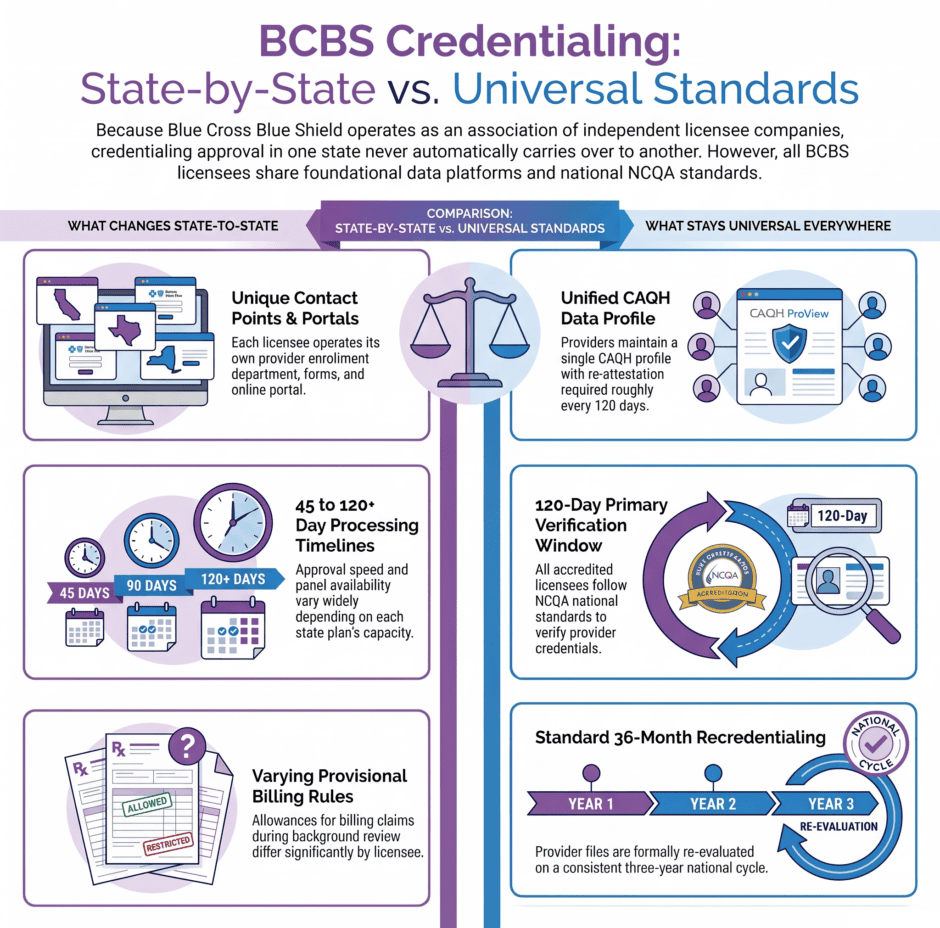
- What changes state to state? The contact point, the application portal, the processing timeline, panel status, and whether provisional billing is available while your file is under review.
- What stays the same everywhere? You build your profile once in the CAQH Provider Data Portal (the platform formerly known as CAQH ProView, now operating as DataSpring), and every licensee still follows NCQA’s national primary source verification and recredentialing standards.
- Getting approved by one BCBS licensee gives you zero standing with another, even when both licensees share the same parent company, like Anthem’s state-level Blue plans.
What Makes BCBS Different From Every Other National Payer?
 UnitedHealthcare is one company. Aetna is one company. Cigna is one company. When your practice gets credentialed with any of them, that approval generally applies across the country, with some regional variation in network access.
Blue Cross Blue Shield doesn’t work that way. The Blue Cross Blue Shield Association licenses its brand to roughly three dozen separately owned companies, each operating within its own exclusive territory. Anthem, now part of Elevance Health, is the largest single licensee and runs BCBS plans in fourteen states, including California, Ohio, Virginia, and New York. Most other licensees serve just one state. Such as Blue Cross Blue Shield of Michigan, Florida Blue, Independence Blue Cross in Pennsylvania, and Blue Cross Blue Shield of Texas are all standalone companies with their own leadership, their own provider networks, and their own credentialing departments.
Even Anthem’s fourteen state plans don’t share one credentialing process, which surprises a lot of practices that assume a shared parent company means a shared file. A provider approved by Anthem BCBS of Virginia holds no standing with Anthem BCBS of California, despite both operating under the same corporate parent. The brand is shared. The credentialing file isn’t.
Why Does BCBS Split Into Separate State Companies?
The short answer is history. Blue Cross and Blue Shield started as separate regional nonprofit plans dating back to the 1930s, and they grew up locally, tied to specific hospitals, medical societies, and state insurance regulators. When the national Blue Cross Blue Shield Association formed to license the brand and coordinate programs like BlueCard, it didn’t erase that local ownership. It layered a shared identity over dozens of already-independent companies.
That’s why BlueCard matters here, and why it’s so often misread. BlueCard lets a member with a Blue plan from one state access care from a provider credentialed with the Blue plan in another state, and it routes the claim back to the member’s home plan for payment. It’s a claims and network-access mechanism for patients who travel. It has nothing to do with letting a provider skip credentialing in a new state. If you’re licensed and practicing in Ohio, credentialing with BCBS of Michigan for a second office still means starting a new application with that specific licensee.
What Changes From State to State?
A handful of things vary by licensee, and they’re worth tracking separately for every state where you plan to bill.
Who you contact and where you apply
Every licensee has its own provider enrollment department, its own phone number, and usually its own online portal. BCBS of Illinois runs a different system than BCBS of North Carolina, which runs a different system than Highmark in Pennsylvania. There’s no single BCBS login and no shared help desk.
Processing timelines
Some licensees move fast. Others don’t. Published timelines across the BCBS system range from around 45 days on the quick end to 120 days or more, depending on the plan’s current application volume, staffing, and how closely its internal process tracks the NCQA minimums described below. A licensee running near capacity in one quarter can slow down noticeably by the next, so a timeline you got from a colleague last year isn’t a number you should plan around today.
Whether provisional billing is available
A growing number of BCBS licensees allow provisional network participation for providers who have a complete CAQH profile, an active state license, and a confirmed BCBS provider record ID, letting some claims process while the full file is still under committee review. Not every licensee offers this, and the eligibility rules differ where it exists, so confirming it early with the specific plan saves guesswork later.
Panel status
Open panels, closed panels, and waitlists are set at the licensee level, not nationally. A specialty that’s wide open with BCBS of Texas might be closed to new providers with a neighboring state’s plan, particularly in behavioral health and primary care markets where demand has outpaced network capacity.
Supplemental documentation
Most licensees will ask for the standard set. This includes current state license, DEA registration if you prescribe, board certification, malpractice coverage history, and a completed W-9. Some add state-specific requirements on top of that baseline, and a few schedule site visits for certain provider or facility types. Assume there could be an extra form and you’ll rarely be caught flat-footed.
What Stays the Same No Matter Which BCBS Plan You’re Working With?
 For everything that varies, a solid core stays constant across the entire BCBS system, and that consistency is what makes multi-state credentialing manageable instead of chaotic.
Nearly every licensee pulls your data from the CAQH Provider Data Portal, the platform providers have long known as CAQH ProView. CAQH rebranded its parent organization as DataSpring, powered by CAQH, in June 2026, but the portal address, your login, your CAQH ID, and your attestation schedule didn’t change. You still build one profile, keep it current with a re-attestation roughly every 120 days, and authorize each payer, including every BCBS licensee you’re applying to, to pull from it. Build that profile once and you’ve done the heaviest lifting for every BCBS application that follows.
The verification standards behind the scenes are also shared, because most BCBS licensees credential under NCQA accreditation, and NCQA sets national rules regardless of which state you’re in. As of July 1, 2025, NCQA shortened its primary source verification window from 180 days to 120 days for accredited organizations, and to 90 days for certified credentials verification organizations, per NCQA’s own program standards. That means every accredited BCBS licensee is working against the same tightened clock to confirm your license, education, board status, and sanctions history, no matter where you’re applying.
Recredentialing cycles follow the same national rhythm too. NCQA requires recredentialing every 36 months from your last approval date, and that three-year cycle holds across BCBS licensees the same way it does for other NCQA-accredited payers. What differs is how each licensee manages the lead-up. Some start reminders 90 days out. Others start at 120. But the underlying clock is the same everywhere.
How Long Does BCBS Credentialing Take, Realistically?
Plan on a range rather than a single number. Fast-processing licensees can finish in six to eight weeks when your CAQH profile is complete and clean at submission. Slower ones, or applications hitting a documentation gap, can stretch past four months. A missed CAQH re-attestation is one of the most common silent delays. Once a profile lapses into re-attestation-required status, a licensee generally won’t move your file forward until it’s resolved, and that alone can add another 30 to 60 days on top of whatever the base timeline already was.
Committee review adds its own variable. Many credentialing committees meet monthly, and some meet less often than that. Miss a submission deadline for that cycle by even a day, and your file waits for the next meeting rather than getting decided on the spot. Building in a buffer for committee scheduling, on top of the verification window, keeps your internal projections closer to reality.
What Happens if a Provider Relocates or Adds a Second State?
 Moving triggers a full restart with the new state’s BCBS licensee, and there’s no partial credit for prior approval elsewhere. A provider leaving Pennsylvania for New Jersey isn’t transferring an Independence Blue Cross file. They’re opening a fresh application with Horizon Blue Cross Blue Shield of New Jersey, submitted on that plan’s forms, reviewed by that plan’s committee, and subject to that plan’s timeline.
If a provider is joining an already-established group practice that holds active BCBS contracts in the new state, the process often becomes an addition to the group’s existing roster rather than a from-scratch application. That’s a meaningfully faster path, but it only works when the group’s contracts are already in place with that specific licensee, so it’s worth confirming before assuming it applies.
How Should a Multi-State Practice Track BCBS Credentialing Without Losing the Thread?
A few habits keep this from becoming unmanageable as a practice grows across state lines:
- Keep a separate tracker per BCBS licensee, not one combined “BCBS” row, since the contact information, portal, and timeline are different for each plan even when the brand looks identical.
- Log the licensee’s confirmed provisional billing eligibility the moment you learn it, so front-desk and billing staff know whether claims can move before full approval lands.
- Set a recurring internal reminder ahead of every CAQH attestation date across all providers, since one lapsed profile can quietly stall applications with multiple licensees at once.
- Note each licensee’s panel status by specialty at the time of application, because a closed panel today doesn’t mean closed forever, and reapplying at the right moment matters.
BCBS Credentialing FAQ
Is Blue Cross Blue Shield one insurance company?
No. BCBS is a brand licensed by the Blue Cross Blue Shield Association to roughly three dozen independently owned and operated companies, each with its own credentialing process, network, and leadership within its own territory.
Does getting credentialed with one BCBS plan cover me in another state?
No. Credentialing approval with one BCBS licensee doesn’t transfer to another, even when both licensees are owned by the same parent company, such as Anthem’s state-level plans.
What does BlueCard actually do if it isn’t credentialing?
BlueCard lets a member with a Blue plan from one state receive care from a provider credentialed with a different state’s Blue plan, then routes the claim back to the member’s home plan for payment. It’s a network-access and claims-routing tool for traveling members, not a credentialing shortcut for providers.
Is CAQH ProView still the platform BCBS plans use?
Yes, functionally. CAQH ProView is now called the CAQH Provider Data Portal, and CAQH’s parent organization rebranded as DataSpring, powered by CAQH, in June 2026. Your login, CAQH ID, and attestation schedule carried over without change.
How long does BCBS credentialing usually take?
It depends entirely on the licensee. Faster plans can finish in six to eight weeks with a clean CAQH profile. Others run 120 days or longer, especially with a documentation gap or a missed committee deadline.
How Medwave Handles BCBS Credentialing Across State Lines
 Medwave manages BCBS applications the way the system actually works. Licensee by licensee, with separate tracking for each state’s contact information, documentation requirements, and processing timeline. Our credentialing team keeps CAQH profiles current, follows up on committee deadlines before they’re missed, and flags provisional billing eligibility as soon as a licensee confirms it, so practices expanding into new states aren’t left guessing which BCBS plan is which. For background on the standard BCBS application steps within a single state, our guide to provider credentialing with Blue Cross Blue Shield walks through the process in more depth.
Credentialing a single provider with one BCBS licensee takes real attention. Managing a roster spread across a dozen states takes a system. Medwave provides medical credentialing services that track every BCBS licensee’s requirements separately, payer contracting support to make sure the rates behind each of those approvals actually reflect your market, and medical billing services that keep claims moving once you’re in-network. Contact Medwave to talk through your BCBS credentialing footprint across the states where you practice.

Co-Founder and COO of Medwave, bringing more than 25 years of hands-on experience in healthcare revenue cycle management, payer contracting, and medical credentialing.