

Urology practices bill across more settings than most specialties. A patient with BPH might have an office visit, a uroflow and post-void residual, an in-office cystoscopy, and a minimally invasive procedure at a surgery center, and each step follows different coding and authorization rules. Add drug administration for prostate and bladder cancer, and a single practice can be billing E/M visits, diagnostic tests, procedures, and buy-and-bill drugs in the same week.
Most denials in urology come from a short list of causes. They include billing diagnostic cystoscopy alongside a therapeutic one, billing a stent that’s bundled into the ureteroscopy, drug units that don’t match the dose given, and procedures done without a matching authorization.
Key Takeaways
- Diagnostic cystoscopy (52000) is bundled into therapeutic cystoscopy codes and isn’t billed separately in the same session.
- Ureteral stent placement (52332) is included in ureteroscopy with lithotripsy and stent (52356) and isn’t billed on top of it.
- Urodynamic studies split into professional and technical components when the test is done in a hospital setting.
- Drug claims for ADT and BCG need the HCPCS code, units matching the dose given, and a separate administration code.
- Most minimally invasive BPH procedures need prior authorization, and the authorization has to match the procedure billed.
Cystoscopy and Office Procedures
 Diagnostic cystourethroscopy (52000) is one of the most common procedures in urology, and it’s a separate procedure code. When a therapeutic cystoscopy is done in the same session, such as a biopsy, fulguration, stent placement, or foreign body removal, the diagnostic look is part of that procedure and 52000 isn’t billed. Billing both is one of the most frequent bundling denials in the specialty.
Prostate biopsy bills as 55700 once per session regardless of the number of cores. Ultrasound guidance (76942) and transrectal ultrasound (76872) may be billed separately depending on the payer, and the pathology on the cores is billed by the pathologist, not the urologist. Vasectomy is 55250 whether one or both sides are done.
Bladder cancer care often includes intravesical BCG. The instillation bills as 51720, and the drug bills as J9030 per instillation. Post-void residual measurement by bladder scan is 51798.
Urodynamics and Diagnostic Testing
Urodynamic testing is usually billed as a set of codes rather than one. Common components include complex cystometrogram with voiding pressure studies (51728) or with urethral pressure profile (51729), uroflowmetry (51741), EMG studies (51784), and intra-abdominal voiding pressure (+51797). Each has to be supported by the test report.
When urodynamics are performed in a hospital outpatient department, the urologist bills only the professional component with modifier 26, and the hospital bills the technical component. In the office, the global code covers both. Billing the global code for a hospital-based study is a common reason for recoupments.
Stone Procedures
 Kidney stone treatment bills by approach. Extracorporeal shock wave lithotripsy is 50590. Ureteroscopy with laser lithotripsy is 52353, or 52356 when a ureteral stent is placed in the same procedure. Stent placement (52332) is included in 52356 and shouldn’t be billed separately with it. Ureteroscopy with stone extraction and no lithotripsy is 52352.
Laterality matters on every stone claim. The RT, LT, or bilateral modifier has to match the operative report and the imaging. When the stent is removed later, the removal is often part of the original procedure’s global period, so it may not be separately billable depending on timing and setting.
BPH Treatment
BPH treatment ranges from medication management to several procedural options, each with its own code. Prostatic urethral lift bills as 52441 for the first implant and 52442 for each additional implant. Water vapor thermal therapy is 53854. Transurethral resection of the prostate (TURP) is 52601, and laser photoselective vaporization is 52648.
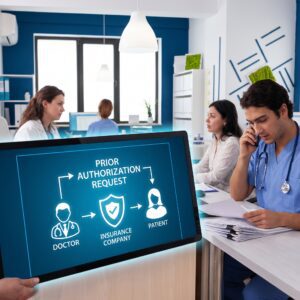
Commercial plans and Medicare Advantage plans usually require prior authorization for minimally invasive BPH procedures, often with documented symptom scores, prostate size, and a trial of medication first. The authorization has to match the procedure performed. An approval for one technique doesn’t cover a different one, which we cover in why an approved authorization can still end in a denied claim.
Drug Administration and Prostate Cancer Care
 Androgen deprivation therapy is a large part of urology revenue for practices that treat prostate cancer. Leuprolide products bill under their own HCPCS codes, such as J9217, with units calculated from the dose given. The injection itself bills separately as hormonal antineoplastic administration (96402). Units that don’t match the drug’s billing increment, or a missing administration code, are common reasons for underpayment.
Buy-and-bill drugs also need prior authorization from many commercial plans, and some plans require the drug to come through a specialty pharmacy instead. Medicare covers annual PSA screening (G0103) for men 50 and older, separate from diagnostic PSA testing for men already being followed for prostate cancer.
Modifiers Urology Uses Most
- Modifier 26 (professional component only, for hospital-based urodynamics and imaging)
- Modifiers RT, LT, and 50 (laterality and bilateral procedures on kidneys and ureters)
- Modifier 25 (a significant, separate E/M on the same day as an office procedure)
- Modifier 58 (a staged or planned related procedure during the global period, such as a second-stage stone procedure)
- Modifier 59 or XS (a distinct procedure on a separate site that’s normally bundled)
Our guide to using modifier 59 correctly covers when a bundled procedure can be billed separately.
Urology Credentialing

Board certification and enrollment
Urologists certify through the American Board of Urology, which requires a qualifying exam after residency and a certifying exam after a period of practice. Payers verify board status, licensure in each state, DEA registration, and malpractice history, usually through CAQH ProView. A current CAQH profile keeps enrollment and recredentialing from stalling.
Hospital and surgery center privileges
Each hospital and ambulatory surgery center credentials urologists separately, and privileges for robotic surgery, laser procedures, and newer BPH devices usually require documented training or proctored cases. A case can’t be scheduled at a facility where the surgeon isn’t privileged for that procedure, and payer enrollment doesn’t change that.
NPs and PAs
Many urology practices use NPs and PAs for follow-up visits, catheter changes, and BCG instillations. Each needs their own payer enrollment, and Medicare pays their services at 85% unless incident-to requirements are met. Until enrollment is approved, their visits can’t be billed, which is why you can’t bill what you can’t credential.
Urology Billing FAQs
Can diagnostic cystoscopy be billed with a therapeutic cystoscopy?
No. 52000 is a separate procedure code and is included in therapeutic cystoscopy codes performed in the same session.
Is a ureteral stent billed separately with ureteroscopy?
Not with 52356, which includes stent placement. When lithotripsy is done without a stent, the procedure bills as 52353.
How is a prostate biopsy billed?
CPT 55700 is billed once per session regardless of the number of cores. Ultrasound guidance may be billed separately depending on the payer, and the pathology is billed by the pathologist.
How are prostatic urethral lift procedures coded?
52441 covers the first implant and 52442 each additional implant. Most commercial and Medicare Advantage plans require prior authorization.
When does urodynamic testing need modifier 26?
When the test is performed in a hospital outpatient setting. The urologist bills the professional component with 26, and the hospital bills the technical component.
How is intravesical BCG billed?
The instillation bills as 51720, and the drug bills as J9030 per instillation.
Vasectomy is a procedure where the global surgical package trips up claims, and our vasectomy CPT codes guide explains what the package includes.
Urology Practices Partnering with Medwave
 Urology practices bill office procedures, drugs, imaging, and surgery, sometimes for the same patient in one week. Medwave handles cystoscopy bundling, drug units on prostate cancer injections, and global periods on surgical cases. Our billing team keeps urology at a 98% clean claim rate.
Urologists need hospital and ASC privileges along with payer enrollment, which our credentialing team typically completes in 85 days. Practices with in-office imaging or lithotripsy get payer contracting support on those service lines.
Use the form below to point us at the urology services you’d like reviewed first.