

Most practices don’t find out about the credentialing-billing connection until a stack of claims comes back denied. The biller did everything right. The claim was clean, the coding was accurate, the documentation was in order. And yet the payer rejected it anyway, because the provider submitting the claim wasn’t actually credentialed or contracted with that payer yet.
This is one of the more frustrating gaps in medical billing, and it’s rarely explained clearly to the people it affects most. Practice owners hire a billing company assuming that billing alone will get claims paid. However, billing is only the last step in a chain that starts much earlier, with credentialing and payer contracting. Skip or delay either one, and the billing step, no matter how well executed, hits a wall.
Key Takeaways
- Billing cannot function without credentialing and payer contracting happening first or alongside it.
- A denied claim due to credentialing status isn’t a billing error. It’s a structural gap most billing-only vendors can’t fix themselves.
- Practices that separate billing from credentialing and contracting often experience delays, denials, and confusion about who owns the problem.
- A payer contract isn’t a one-time signature. Rates need periodic review and renegotiation, or reimbursement falls behind while claims keep paying “clean.”
- Medwave handles billing, credentialing, and payer contracting under one roof, closing the gap that causes this exact issue.
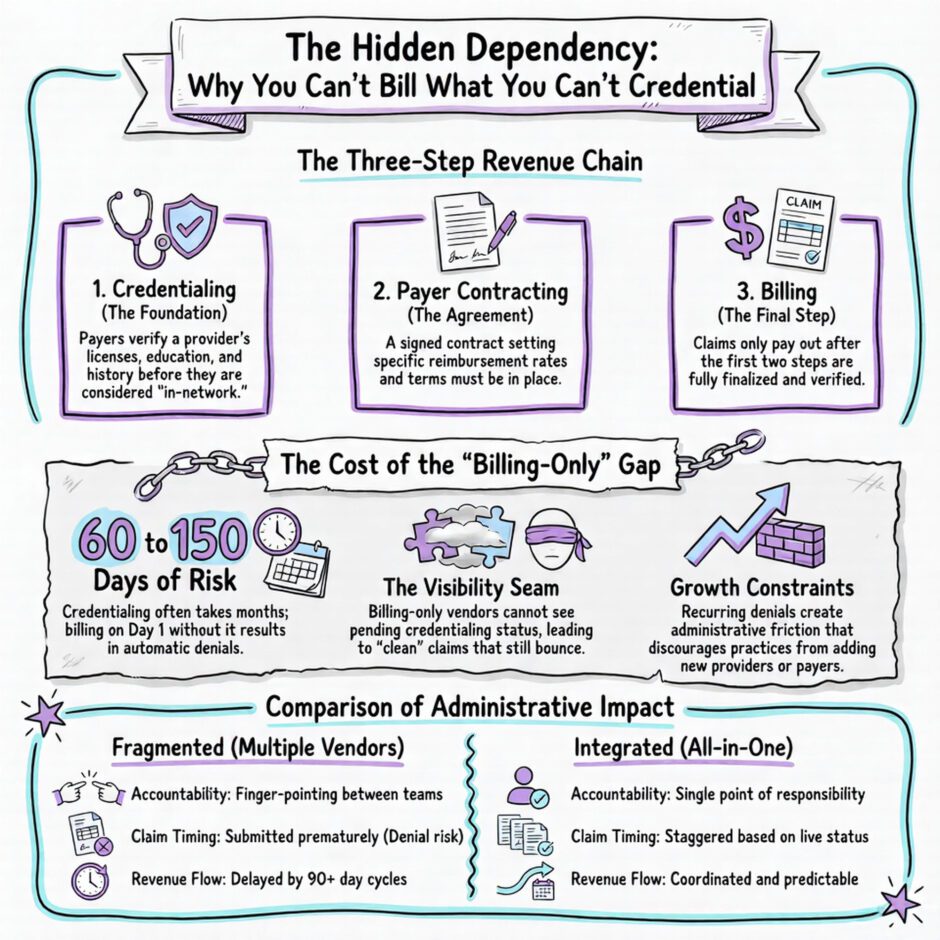
The Dependency Nobody Explains Upfront
 Here’s the part that catches practices off guard. Billing, credentialing, and payer contracting are three distinct processes, but they’re not independent of each other. They’re sequential and interlocking. A provider has to be credentialed with a payer, meaning that payer has verified the provider’s licenses, education, work history, malpractice coverage, and other qualifications, before that provider can even be considered “in network.” Then, separately, the practice needs a signed contract with that payer that sets reimbursement rates and terms. Only after both of those pieces are in place can billing for that provider, with that payer, actually work the way it’s supposed to.
Skip the credentialing step, or let it lag behind when a new provider joins a practice, and every claim submitted under that provider’s name to that payer is at risk. Not because the biller made a mistake. Because the underlying relationship between the provider and the payer isn’t finalized yet.
This is why a practice can have a rock star billing team and still watch denial rates climb. The billing team is doing its job. The problem sits one layer up, in credentialing and contracting, and most billing-only vendors have no visibility into that layer at all.
How Credentialing, Contracting, and Billing Depend on Each Other
Each step relies on the one before it with the same payer, and a delay at any point carries forward into claims.
| Step | What it does | What it depends on | What if it lags |
|---|---|---|---|
| 1. Credentialing | The payer verifies the provider's licenses, education, work history, and malpractice coverage | The provider's own documents, such as license verification, DEA registration, malpractice history, and references; 60 to 150 days per payer | Claims under that provider deny, even when they're clean, and some payers deny retroactively |
| 2. Payer contracting | A signed agreement with the payer sets reimbursement rates and terms | A credentialed provider and an active relationship with that payer | Claims deny or pay at lower out-of-network rates, and fee schedule changes go unnoticed |
| 3. Billing | Codes and submits claims, then follows up on denials | Both credentialing and contracting finalized with that payer | Staff time goes to appeals, cash flow slows, and nobody agrees on who owns the problem |
Why the Credentialing-Billing Gap Exists
Part of the issue is how the industry is structured. A lot of billing companies specialize narrowly. They’re excellent at coding, claims submission, and follow-up on denials, but credentialing and contracting are handled by someone else entirely, if they’re handled at all. Sometimes it’s an in-house staff member juggling ten other responsibilities. Sometimes it’s a separate vendor who has no visibility into the billing side. Either way, there’s a seam between the two functions, and seams are exactly where things fall through.
New provider onboarding is where this shows up most. A practice hires a new physician or nurse practitioner. The provider starts seeing patients on day one. Billing, reasonably enough, starts submitting claims right away because that’s the job. But credentialing with each individual payer can take anywhere from 60 to 150 days, sometimes longer, depending on the payer and the state. If contracting hasn’t caught up, every claim for that provider during that window either gets denied outright or gets paid at a lower out-of-network rate. Multiply that across a handful of payers and a handful of providers, and the revenue gap adds up fast.
Fee schedule and network status changes are another blind spot. A payer can update its contracted rates, or a provider’s status with a specific plan can lapse, and if nobody’s actively tracking payer contracting on an ongoing basis, billing keeps submitting claims as if nothing changed. The claims come back denied or underpaid, and the practice is left trying to figure out why, often weeks after the fact.
Renewal is where the same neglect gets expensive. Many payer contracts auto-renew on the rates signed years ago, and payers rarely volunteer an increase. Without someone watching for fee schedule drift and opening a renegotiation before the renewal window closes, a practice can get locked into another multi-year term of below-market reimbursement. Nothing gets denied, so nothing looks wrong.
What the Credentialing Gap Costs a Practice
 Denied and delayed claims are more than an inconvenience. They tie up staff time on appeals, they delay cash flow, and they create friction between a practice’s administrative team and its billing vendor when nobody can pinpoint whose job it was to catch the issue. Practice administrators end up playing middleman between a billing company that says “the claim was clean” and a credentialing team, whether internal or external, that says “the paperwork was submitted.” Meanwhile the payer just sees an unverified provider and denies the claim, no matter who’s right.
There’s also a slower, quieter cost. Practices that experience recurring credentialing-related denials sometimes start avoiding certain payers altogether, or they delay bringing on new providers because the administrative headache of getting them credentialed and contracted feels bigger than it should. That’s a growth constraint hiding behind what looks like a billing problem. Contracts that never get renegotiated do the same kind of damage from the other direction: every claim pays, just at a rate that stopped keeping up with the practice’s costs a few renewals ago.
Why Keeping These Functions Together Solves the Problem
This is the part that separates a genuine competitive advantage from a marketing line. When billing, credentialing, and payer contracting sit under one roof, with the same team tracking all three, the seam disappears. Credentialing status feeds directly into billing decisions. If a provider’s application with a specific payer is still pending, the team submitting claims knows it before a claim goes out the door, not after it bounces back denied. Payer contract terms and fee schedules are visible to the same people handling reimbursement follow-up, so rate changes don’t slip through unnoticed. When underpayment patterns show up in remittance data, that team already has the numbers to bring back to the payer and renegotiate before the contract rolls over on the same terms.
It also changes the accountability picture entirely. There’s no finger-pointing between a billing vendor and a credentialing vendor, because there’s one team responsible for the whole chain. When a denial happens, the root cause gets identified and fixed at the source instead of being treated as a one-off billing error.
For practices bringing on new providers, this matters even more. Instead of billing starting on day one and hoping credentialing catches up, the timeline can actually be planned. Credentialing and contracting can be initiated well before a provider’s start date, and billing can be staged to align with when each payer relationship is actually finalized. That kind of coordination is nearly impossible when three separate vendors are managing three separate pieces of the puzzle.
A Closer Look at Where the Timeline Breaks Down
 Think about the lifecycle of a single new hire at a mid-sized practice. The provider signs an offer letter in January and is told to start seeing patients by March 1st. HR and the practice manager are focused on onboarding logistics, badges, EHR access, scheduling templates. Credentialing paperwork often doesn’t get submitted to payers until sometime in February, because it’s waiting on the provider’s own documentation. Things like license verification, DEA registration, malpractice history, references, work history going back several years. Any missing piece sends the application back to the bottom of a payer’s queue.
By March 1st, the provider is seeing patients. Billing starts submitting claims because that’s what billing does. Some payers process credentialing faster than others, so a handful of claims might go through fine. Others sit in limbo for 90 days or more. When those claims start bouncing back weeks or months later, it’s often the practice’s front desk staff fielding confused patient phone calls about surprise bills, while the administrative team tries to untangle which payers are cleared and which aren’t.
This is exactly the kind of scenario where having credentialing, contracting, and billing under a single, coordinated process changes the outcome. Instead of a provider going live on the same date across every payer relationship, the smarter approach is staggering the start date by payer, based on actual credentialing status, and holding claims for payers still in process rather than submitting them prematurely and eating the denial. That requires the credentialing team and the billing team to be talking constantly, ideally because they’re the same team.
The Financial Ripple Effect
It’s easy to think of credentialing delays as a paperwork issue, but the financial impact is real and it compounds. A single provider seeing 15 to 20 patients a day, with a meaningful share of those visits tied to a payer where credentialing hasn’t cleared yet, can represent tens of thousands of dollars in claims that are denied, delayed, or written off entirely if the practice gives up on appealing them. Appeals take staff time. Staff time is money, even when it’s not a line item anyone tracks closely.
There’s a psychological cost too. Practice owners and administrators start to distrust their own revenue numbers. Is that dip in collections a seasonal thing, a coding issue, or a credentialing gap nobody flagged? Without clear visibility into all three functions, that question can go unanswered for months, and unanswered questions about revenue tend to erode confidence in the whole billing operation, even when the billing itself was never the problem.
What to Ask Before Choosing a Billing Partner
 If you’re evaluating billing vendors, or reconsidering the one you have, it’s worth asking a few pointed questions. Does this vendor handle credentialing and payer contracting directly, or is that outsourced or left to the practice? Do they review and renegotiate existing payer contracts, or only set up new ones? How do they track credentialing status for each provider across each payer, and how is that information shared with the billing team? If a claim is denied because of a credentialing gap, who owns fixing it, and how fast does that typically happen?
The answers to those questions tend to reveal a lot about whether a vendor is set up to prevent this problem or just clean up after it happens.
Credentialing Before Billing FAQ
Can a provider bill for services before they’re fully credentialed with a payer?
Generally, no. Most payers won’t reimburse claims submitted for a provider who hasn’t completed credentialing with them, and some will deny claims retroactively if credentialing was still in process when the service was rendered.
How long does credentialing usually take?
It varies by payer and state, but 60 to 150 days is a common range. Some payers move faster, others slower, and incomplete applications can add weeks to the timeline.
Is credentialing the same thing as payer contracting?
No. Credentialing verifies a provider’s qualifications. Contracting is the separate agreement that sets reimbursement rates and terms with a payer. A provider can technically be credentialed without a finalized contract, and billing still won’t work properly until both are done.
Do payer contracts need to be renegotiated?
Yes, periodically. Contracted rates tend to stay flat while operating costs and Medicare benchmarks move, and many contracts renew automatically on their original terms. Reviewing reimbursement rates and contract terms ahead of each renewal date gives a practice the data it needs to renegotiate before another term locks in.
Why would a billing-only vendor not catch this issue?
Because credentialing and contracting status often live outside their system entirely. If they’re not the ones managing those processes, they may not have real-time visibility into which providers are cleared with which payers.
Practices Also Ask
A lot of administrators want to know whether this is really as big a deal as it sounds, or whether it’s mostly a startup problem for brand-new practices. It isn’t limited to new practices at all. Established groups run into this constantly when they add providers, expand into new states, add new payer relationships, or let existing contracts roll over without renegotiating. Anytime there’s a change on the credentialing or contracting side, there’s a window where billing can get out of sync if nobody’s watching closely.
Another common question is whether switching to a vendor that handles all three functions is worth the disruption of changing billing companies. For practices dealing with recurring credentialing-related denials, or those planning to add providers in the near future, the answer is usually yes. The disruption of switching is temporary. The ongoing cost of a disconnected billing and credentialing process isn’t.
Summary: Providers Can’t Bill Without First Being Credentialed
 Billing problems that look like coding errors or payer stubbornness are often something else entirely, a credentialing or contracting gap that nobody caught in time. It’s not a flaw in the billing process itself. It’s a structural issue that shows up whenever billing operates separately from the two functions it actually depends on.
Medwave handles billing, credentialing, and payer contracting as one connected process, not three separate vendors passing a provider back and forth. That means credentialing status and payer contract terms are visible to the same team submitting claims, so gaps get caught before they turn into denials, and contracts that have fallen behind get renegotiated rather than renewed by default.
If your practice is dealing with denials that don’t make sense on the surface, or you’re planning to bring on new providers and want the timeline handled without the usual scramble, that’s exactly the kind of problem this approach is built to solve. Contact us below, we can help.

Co-Founder and COO of Medwave, bringing more than 30 years of hands-on experience in healthcare revenue cycle management, payer contracting, and medical credentialing.