

Ask five practice managers what full-cycle credentialing means and you will probably get five different answers. Some think it just means filling out an application. Others assume it covers the whole process from document collection to payer approval. That gap between the two is exactly why so many practices get burned. They pay for what they think is complete credentialing support, only to find out later that the vendor stopped showing up the moment the paperwork left their hands.
Full-cycle credentialing is the difference between a company that submits your application and a company that stays with it until a payer says yes. It sounds like a small distinction. In practice, it is the entire ballgame. With Medwave, the more providers or applications you bring into the process, the cheaper each one gets. Most of our clients find that surprising at first. It reflects how the work scales once the setup is done.
Key Takeaways
- Full-cycle credentialing covers everything from initial document collection through payer committee approval, not just form submission.
- Per-application pricing for credentialing and payer contracting drops as volume increases, because setup work and verification steps get more efficient at scale.
- A large share of credentialing problems trace back to vendors who submit an application and then go quiet, leaving practices to chase payers on their own.
- Medwave tracks every application weekly until it is approved, and bundles billing, credentialing, and payer contracting so nothing gets lost between departments.
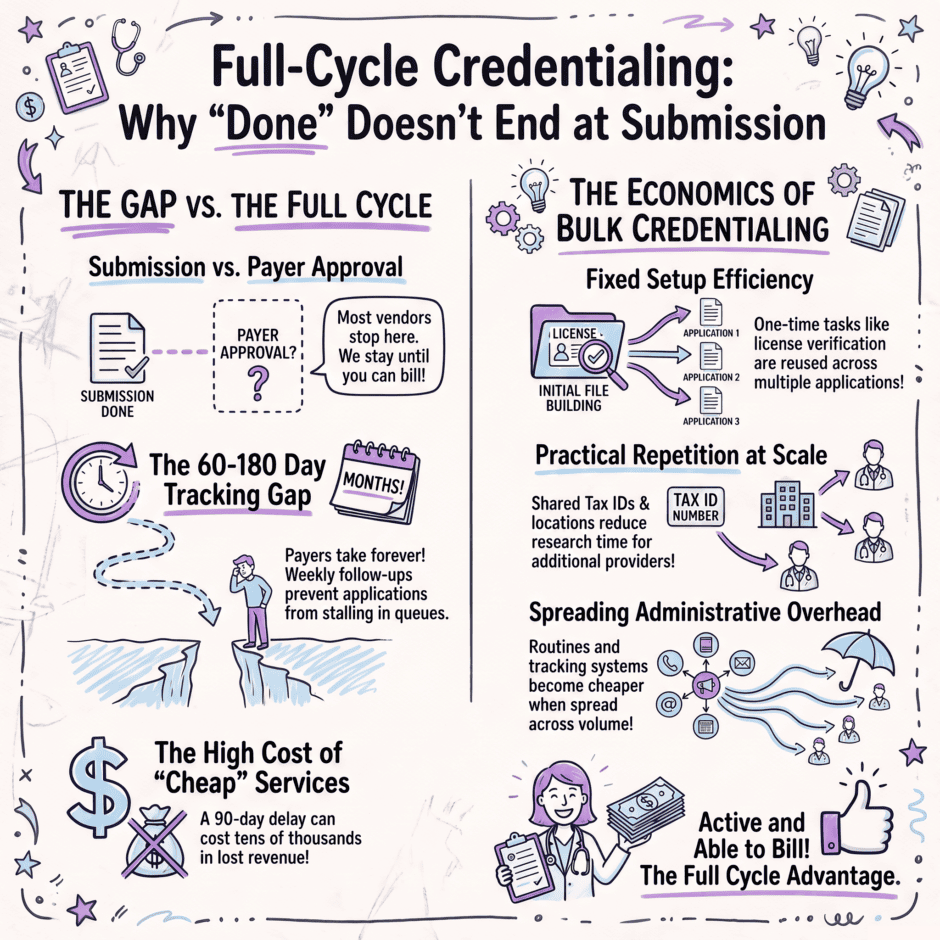
What Does “Full-Cycle Credentialing” Mean?
 The word “cycle” matters here. A cycle has a start and a finish. Too many credentialing services treat the job as finished the moment an application gets uploaded to a payer portal. That is the start of the cycle, not the end of it.
A true full-cycle process includes gathering every document a provider needs, from licenses to malpractice coverage to DataSpring CAQH attestation. It includes verifying that data against payer requirements before anything gets submitted, since a single mismatch can send an application to the back of the line. It includes tracking the application through committee review, which for most payers happens on a monthly schedule and can take anywhere from sixty to one hundred eighty days. It includes following up, repeatedly, until there is a signed network participation agreement in hand.
Where Most Vendors Stop
Plenty of companies advertise credentialing help but really only offer data entry. They collect what you give them, type it into a form, hit submit, and consider the job done. If a payer sends back a request for additional information, that email often lands in a queue nobody checks regularly. Weeks pass. The provider has no idea their application stalled until they try to bill a claim and it bounces.
Where the Cycle Actually Ends
The cycle should not end at submission. It ends when the provider is active in the network and able to bill for services without denials tied to enrollment status. Anything short of that is an incomplete job, no matter how the invoice is worded, and it is not what Medwave prices as a completed application.
Why Does Credentialing Pricing Drop When You Buy in Bulk?
This is a question we get on almost every discovery call, so it is worth explaining in plain terms rather than just showing a rate card.
A big chunk of the cost in any single credentialing application comes from fixed setup work. Someone has to build the provider’s file, confirm every license number, cross-check the CAQH profile, and prepare the application shell for a given payer. That setup work barely changes whether you are credentialing one provider or twenty. Once that foundation exists for a group or a location, adding more providers or more payer applications means reusing a lot of what’s already built.
The Real Cost Drivers Behind Per-Application Pricing
Verification calls to medical schools, licensing boards, and prior employers take roughly the same amount of staff time per provider regardless of volume. However, administrative overhead, like setting up the client relationship, building tracking systems, and establishing communication routines, gets spread across more applications when a practice brings multiple providers at once. Spread the same fixed cost across ten applications instead of one, and the math changes fast.
What Changes Operationally at Scale
There is also a practical efficiency gain. When a credentialing team works through a batch of applications from the same practice, they are often dealing with the same tax ID, the same group NPI, the same practice locations, and overlapping payer panels. That repetition cuts down on research time per application. A team that just finished verifying a practice’s malpractice coverage for provider one does not have to relearn that information for provider two. This is exactly why per-application pricing steps down at higher volume tiers rather than staying flat. It reflects real labor savings that get passed back to the client.
Why Cheap Credentialing Often Doesn’t End Up Cheap
 We looked at what other vendors in this space deliver, and a pattern shows up again and again across reviews and complaint boards. The problem is rarely the initial pitch. It is what happens after the contract is signed. Industry reporting on credentialing scams describes a recurring setup. A company promises full service, collects payment upfront, and then either delays endlessly or sends vague status updates without proof that anything was filed.
Payers are not always easy to reach. They send follow-up requests from generic email addresses that can look like spam, and they call during clinic hours when nobody can pick up. If the vendor handling your file is not checking for those requests on a set schedule, a missed message can add weeks to a timeline. A ninety-day hold on one provider’s start date can represent tens of thousands of dollars in lost billing revenue for a busy practice, the direct financial exposure of a vendor who submits and disappears. A low sticker price on an application nobody is actually tracking to approval is not the cheaper option, it just moves the real cost onto your revenue instead of onto the invoice.
How Does Full-Cycle Credentialing Protect Practices That are Scaling?
Growth is supposed to be a good problem. It stops feeling that way fast when five new hires all need to be credentialed with eight payers each, and the practice manager is trying to track forty applications in a spreadsheet.
Multi-Provider and Multi-Location Onboarding
When a practice adds providers or opens a new location, every one of those changes usually triggers a fresh round of credentialing. New addresses need to match DEA registrations exactly. New providers need DataSpring CAQH profiles built from scratch or updated if they are moving from another group. Handling this in bulk, with one team tracking every moving piece, prevents the kind of dropped ball that happens when different staff members each own a slice of the process with no shared visibility, and it’s exactly the scenario where per-application pricing drops the most.
Payer Contracting as the Natural Next Step After Credentialing
Getting credentialed only gets a provider into a payer’s system. It does not guarantee the reimbursement rate is fair. Once credentialing is done, payer contracting is where a practice can improve its financial position, by reviewing fee schedules and negotiating terms instead of accepting whatever was offered by default. Practices that treat credentialing and contracting as one connected process, rather than two separate vendors who never talk to each other, tend to catch these opportunities instead of missing them.
How Medwave Handles Full-Cycle Credentialing Differently
 We built our process around one idea, an application is not done until a payer says yes, not until we hit send.
Every file gets a documented submission trail, so there’s never a question of whether something was filed. Every open application gets a weekly follow-up, not a check-in only when a client asks for one. One team handles credentialing, billing, and payer contracting together, so if a credentialing gap threatens to cause a billing denial, someone already knows about it before it becomes a bigger problem.
We also structure pricing so it rewards practices that bring us more work at once. Whether that is credentialing five new hires ahead of a location opening or contracting with a dozen payers for an existing group, the per-application cost comes down as the batch grows. If you want a specific breakdown for your provider count and payer mix, that conversation is easy to have directly with our team rather than guessing from a general rate card.
Full-Cycle Credentialing FAQ
What is the difference between credentialing and full-cycle credentialing?
Standard credentialing can refer to just one piece of the process, often the application submission step. Full-cycle credentialing covers the entire path, from collecting provider documents through verification, submission, payer follow-up, and final network approval. The distinction matters because a vendor can technically “credential” a provider by submitting paperwork while never confirming the application gets approved.
Why does credentialing pricing get cheaper with more applications?
Setup work like building a provider file, confirming licenses, and preparing a payer application shell takes roughly the same effort per provider whether you submit one application or twenty. When that fixed cost gets spread across a larger batch, the per-application price drops. Repeated details across a group, like a shared tax ID or overlapping payer panels, also reduce research time per file.
How long does full-cycle credentialing usually take?
Most payers process applications on a monthly committee schedule, and a full cycle typically runs sixty to one hundred eighty days depending on the payer and how complete the initial submission is. Missing documents or slow responses to payer follow-up requests are the most common causes of delay beyond that window.
What should I ask about pricing before signing with a credentialing company?
Ask whether the per-application price actually drops as you add more providers or payers, and by how much. A flat rate that never moves regardless of volume usually means you’re paying for the same setup work over and over instead of once. It’s also worth asking whether payment ties to milestones, like submission and approval, rather than one lump sum charged upfront.
Does credentialing affect my payer contract rates?
Credentialing itself does not set your reimbursement rates. It only gets a provider approved to participate in a payer’s network. Payer contracting is the separate step where fee schedules and contract terms get negotiated, which is why practices benefit from having both handled by a team that communicates internally.
Summary: Affordable, Yet Complete Medical Credentialing is Hard to Find
 Most practices searching for “affordable credentialing” end up learning the term is doing a lot of work. Cut-rate vendors keep prices low by treating each application as a file to close, not a claim to eventually pay, which is fine until you’re six months in and still waiting on a payer effective date. The cheaper option often costs more once you count the revenue sitting in limbo.
At Medwave, we do this differently. We offer an affordable, scaling (the more you buy, the cheaper it gets) pricing system and provide thorough, full-cycle credentialing with frequent communication along the way. Our payer rep relationships (over 25 years’ worth) help smooth out any bumps along the way.
Credentialing, billing, and payer contracting were never meant to run as three separate errands handled by three separate vendors who never compare notes. At Medwave, we treat them as one connected job, because a gap in any one of them creates a problem in the other two. Our medical billing and credentialing services stay attached to an application until a payer commits, not until a form gets uploaded. Our credentialing team tracks every submission on a documented schedule so nothing goes quiet for weeks at a time. And once a provider is approved, our payer contracting team makes sure the rates behind that approval reflect fair market terms instead of a default fee schedule. If you are bringing on new providers, opening a new location, or just tired of chasing a vendor who stopped answering emails, reach out and we will walk you through what full-cycle support looks like for your practice.
For a full breakdown of what drives credentialing costs in general, see our guide on how much medical credentialing costs. Curious how the process plays out week to week? Our post on simplified credentialing for healthcare practices walks through it step by step.

Co-Founder and COO of Medwave, bringing more than 25 years of hands-on experience in healthcare revenue cycle management, payer contracting, and medical credentialing.