

Billing teams have been testing AI tools for a couple of years now, and most administrators expected the workload to shrink by this point. It hasn’t. At least, not in the way anyone hoped. Denials still pile up in the same queue. Claims still bounce back for the same missing modifiers. Staff still spend hours reworking submissions that should have gone out clean the first time.
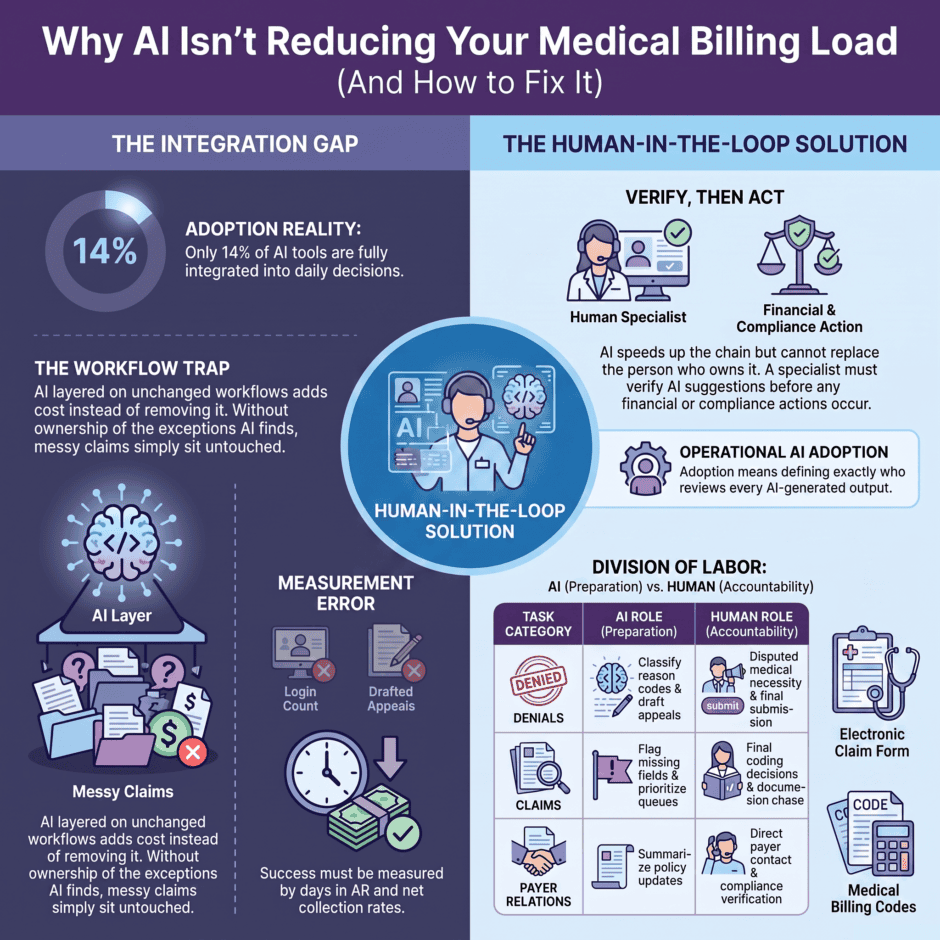
 The problem isn’t that the technology doesn’t work. A recent survey of healthcare leaders found that over half believe AI can genuinely change how healthcare operates when it’s applied the right way, yet only 14% said their AI tools were fully plugged into the decisions that matter most day to day. Another 53% said the integration was partial at best. That gap between belief and practice tells the real story. Most billing offices bought a tool without building the workflow around it.
Claims get paid because a person verified the flag, fixed the underlying issue, and resubmitted through the right channel before the timely filing deadline passed. AI can speed up parts of that chain. It cannot replace the person who owns it.
Key Takeaways
- AI without workflow ownership just adds a step. A tool that flags a denial or drafts an appeal still needs a person to verify it, act on it, and submit the final result.
- Integration is the actual bottleneck. Most billing teams report partial or no connection between their AI output and the system where claims actually get worked.
- Measuring the wrong thing hides the real cost. Counting logins or drafted appeals tells you nothing about whether claims get paid faster or the net collection rate improved.
- Redesigning the process matters more than the software. AI layered on top of an unchanged billing workflow tends to add cost instead of removing it.
What Operational AI Adoption Actually Looks Like in a Billing Office
Buying a license, running a short pilot, or turning on an AI feature inside a practice management system isn’t the same thing as adoption. A billing workflow becomes operational when a team can answer a few plain questions. What triggers the AI to act? What is it actually allowed to do? Who reviews the output before anything happens with it? Where do the unclear claims go? And how does the team know, in dollars and days, whether the process is actually faster than before?
Skip those questions, and AI tends to sit on top of the old process instead of replacing any part of it. A billing coordinator might use an AI tool to draft an appeal letter, then still spend the same amount of time confirming the CPT codes, checking the payer’s specific appeal window, and mailing or faxing the letter through the correct channel. The letter got written faster. The claim still took the same number of days to resolve, because nothing downstream of the drafting step actually changed.
Why AI Projects Stall in Revenue Cycle Teams
 There’s a pattern behind most stalled AI rollouts in billing offices, and it usually comes down to a handful of gaps rather than one big failure.
The output often never reaches the system where the work actually gets finished. A denial-detection tool might flag a claim in a dashboard nobody checks daily, while the billing team keeps working exclusively from the clearinghouse rejection report they’ve used for years. Staff training tends to stop at “here’s how you open the tool” instead of covering when to trust the output, when to override it, and how to document the final action taken. Data quality causes trouble too. Missing NPI numbers, outdated fee schedules, or inconsistent payer IDs make even a well-built AI tool produce shaky recommendations. And ownership of the exceptions rarely gets assigned. The easy claims might move faster, but the messy ones, the ones that actually eat up staff time, sit untouched because no one was told they’re now responsible for them.
The last and probably most common issue, billing teams measure the wrong thing. Counting how many times staff opened the AI dashboard says nothing about whether the practice’s net collection rate improved or whether days in accounts receivable actually dropped. Those are the numbers that matter, and they’re rarely the ones anyone tracks in the first ninety days.
Where Human Review Still Has to Stay in the Loop
AI can genuinely help with several tasks in a billing office. It can classify incoming denials by reason code, summarize a lengthy payer policy update, flag missing fields on a claim before submission, prioritize which accounts in a work queue need attention first, and draft the first pass of an appeal letter. What it should not be doing alone is anything with real financial or compliance consequences.
That includes final coding decisions, appeals involving disputed medical necessity, write-off approvals above a set threshold, and any payer communication where a wrong answer could delay reimbursement or trigger a compliance flag. A trained billing specialist still needs to verify the AI’s suggestion, chase the missing documentation, contact the payer directly, and document what was actually done. Skipping that step to save a few minutes tends to cost far more time later, once a denial comes back a second time or an underpayment goes uncaught.
Measuring Whether AI is Actually Saving Money
 The financial question is whether the practice is spending less, in total, to get paid. That means looking at the whole picture rather than the software subscription line alone.
Useful measures include cost per resolved claim, average denial follow-up time, first-pass claim acceptance rate, rework rate on claims the AI previously touched, days in accounts receivable, and the amount of supervisor time spent double-checking AI output. A tool that speeds up drafting but increases rework because staff don’t trust the result yet isn’t actually saving anyone money. Billing teams that get real value from AI tend to track these numbers before and after implementation, not just assume the improvement happened because the software vendor said it would.
AI can also increase administrative costs rather than reduce them, and this happens more often than most billing offices expect. It happens when the old manual process stays fully in place and AI gets added as an extra verification layer instead of a replacement for a step. It happens when data quality issues force staff to correct AI output more than they would have caught errors manually. It happens when a practice buys multiple overlapping tools that don’t talk to each other, so staff end up copying information between systems by hand anyway.
Where the Fee Schedule and Coverage Gaps Fit In
A billing team can have the sharpest AI-assisted denial workflow in the country and still lose revenue if the underlying fee schedule has drifted out of date or if the claim was submitted against outdated eligibility. AI is good at catching patterns in claims that have already gone out. It’s less useful for catching the upstream problem that caused the denial in the first place, whether that’s a stale contracted rate, a coverage change the front desk missed, or a coding update the payer adopted quietly last quarter. A billing-only fix tends to treat the symptom. The staff still has to trace the pattern back to its source, and that’s where a person’s judgment, not a model’s, actually closes the loop.
Should a Practice Build This Internally or Bring in Outside Support?
 Some practices have the staff, the systems knowledge, and the bandwidth to redesign a billing workflow around AI on their own. That tends to work best when there’s already a dedicated revenue cycle team, someone with the time to manage integration, and enough claim volume to justify the investment.
Many practices don’t have that bandwidth, and that’s a completely reasonable place to be. Chronic staffing gaps, high turnover in billing roles, and a denial backlog that keeps growing are common reasons practices look outside for help. A managed billing partner brings something an AI subscription alone can’t, a team that already owns the workflow end-to-end, backup coverage when someone is out, and accountability for the outcome rather than just the output.
AI Medical Billing Assistance FAQ
Why hasn’t AI reduced administrative work in medical billing yet?
Most billing teams haven’t connected their AI tools to a complete workflow. The software can flag or draft something, but a person still needs to verify it, act on it, and document the result before the claim is actually resolved.
Does AI still need human review in medical billing?
Yes. AI can help classify denials, summarize policy updates, or flag missing fields, but a trained specialist still needs to verify the output, contact the payer, and complete the follow-up. Coding decisions and appeals involving disputed medical necessity should stay with people.
Can AI replace a billing team?
No. AI can support the preparation work, but the accountability for a correctly paid claim still belongs to a person who understands payer rules and can catch what the tool misses.
How should a practice measure whether AI is actually helping with billing?
Track outcomes, not usage. Cost per resolved claim, denial follow-up time, first-pass acceptance rate, and days in accounts receivable tell you far more than how many times staff opened a dashboard.
Why does AI sometimes increase billing costs instead of reducing them?
This happens when the old manual process stays in place and AI gets added as an extra layer rather than a replacement for a step, or when poor data quality forces staff to correct AI output more than they would have caught errors manually.
Is AI worth the investment for a small billing team?
It depends on whether the practice can actually redesign the workflow around it. Without that redesign, a small team often ends up doing the same manual verification work plus managing a new tool.
What’s the biggest mistake practices make when adopting AI in billing?
Buying the tool before deciding which manual step it will replace, and who will own the exceptions it creates.
Can AI help catch underpayments?
It can help flag patterns that look off compared to the contracted rate, but confirming the actual underpayment and pursuing it with the payer still calls for a person who knows the fee schedule.
Does outsourcing billing mean giving up control?
Not with the right partner. A managed team should give a practice more visibility into claim status than an overloaded internal team usually can.
How Medwave Approaches AI-Assisted Billing

At Medwave, our billing team owns the outcome of every claim, not just a queue of AI-flagged items. Where AI-assisted tools help sort denials, prioritize work queues, or draft the first version of an appeal, a trained specialist still verifies the coding, confirms the payer’s current requirements, and follows the claim through to resolution.
Getting AI to actually reduce administrative work in billing isn’t about finding a better tool. It’s about building the workflow, and the accountability, around whatever tool a practice chooses.
That’s the same principle Medwave applies across billing, credentialing, and payer contracting. Technology can speed up a step, but a person still has to own the result. If your practice is dealing with denials that keep circling back, a growing accounts receivable balance, or a fee schedule that hasn’t been reviewed in years, that’s exactly the chain we help practices fix, together.

Co-Founder and COO of Medwave, bringing more than 25 years of hands-on experience in healthcare revenue cycle management, payer contracting, and medical credentialing.