


Provider credentialing is how insurance companies and hospitals confirm that a provider holds the qualifications they claim, then approve that provider to bill inside their network. Without it, there’s no Medicare or Medicaid billing and no commercial reimbursement, however well trained the provider is.
Plan on 90 to 120 days with most commercial payers.
It also never really ends. Most payers revalidate every two to three years, and every license, certification and malpractice policy has to stay current in between or the provider falls out of network.
Key Takeaways
- Credentialing verifies four kinds of provider information
- Education and training
- Licensure and certification status
- Malpractice history and coverage
- Work history, including any gaps
- Most commercial payers take 90 to 120 days to credential a new provider.
- Medicare enrollment through PECOS averages 60 to 90 days for a clean application.
- Incomplete applications cause more delays than any other mistake.
- Most payers recredential every two to three years.
Credentialing is what lets a provider bill insurance and admit patients to most hospitals. A brilliant physician who isn’t credentialed is, for billing purposes, unemployable.
The credentialing process has also gotten harder. Payers now expect primary source verification straight from the original institutions, and work that once took a few weeks now takes months.
The Main Players in Credentialing
Five organizations do most of the work. Knowing which one handles what saves you a lot of phone calls.
- CAQH, now rebranded as DataSpring, runs ProView, the database most commercial payers pull credentialing data from. You enter a provider’s information once and every participating payer reads it from there, which spares you a separate application for each insurer. The catch is upkeep. A profile has to be complete and re-attested every 120 days, or it goes inactive.
- NPPES issues the National Provider Identifier. Individual providers get a Type 1 NPI and organizations get a Type 2, and the number follows a provider for their entire career.
- PECOS is the CMS portal for Medicare enrollment, and every provider who wants to see Medicare patients goes through it. It asks for detailed ownership and practice location information. Expect 60 to 90 days. CMS rejects applications over small errors, so check every field twice before you submit.
- State medical boards license providers to practice in their states. Requirements and renewal schedules differ from state to state, and a lapsed license anywhere the provider practices causes credentialing trouble right away.
- Credentials Verification Organizations (CVOs) handle primary source verification for hospitals and health systems, and occasionally for payers. They go straight to the source, whether that’s a medical school or a former employer.
The Complete Credentialing Lifecycle
Credentialing starts before a new provider’s first day and keeps going for as long as they work for you.
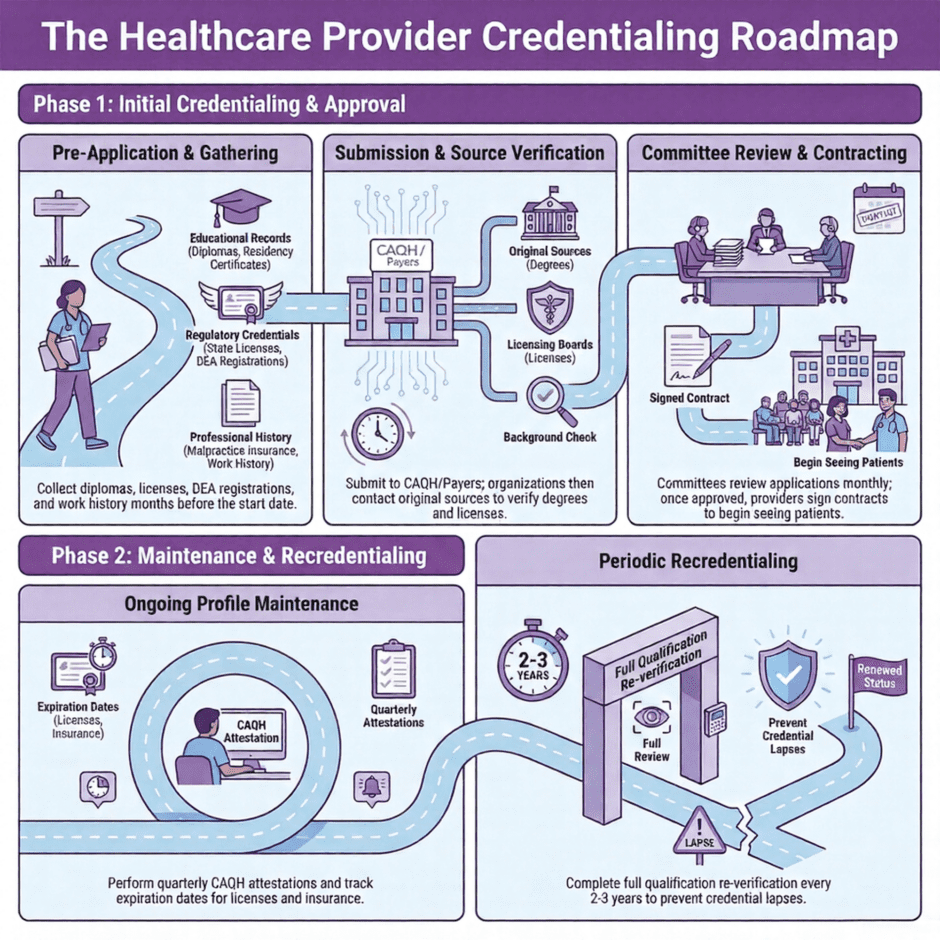
- Pre-application starts the day you decide to hire. Practices that stay ahead of delays collect documents months before the start date, including diplomas, licenses, DEA registration and malpractice policies. A checklist for each provider keeps anything from slipping.
- Application submission covers CAQH, Medicare and Medicaid where they apply, plus each commercial payer. The questions barely change from form to form, but the formats do. Some payers take electronic submissions while others still want paper by mail, and any incomplete form gets sent back.
- Primary source verification happens after you submit. The verifying organization contacts schools, licensing boards, certification boards and prior employers directly. It can take a few weeks or a few months, depending on how fast they answer.
- Committee review follows verification. Most payer and hospital credentialing committees meet monthly, so missing one meeting means waiting for the next.
- Approval and contracting come next. You sign the contract and receive an effective date, sometimes with a welcome packet. From that date on, the provider can see that payer’s patients.
- Ongoing maintenance never stops. CAQH needs re-attestation every 120 days, and licenses and DEA registrations expire on their own schedules. A change in practice location or employment status triggers an update too.
- Recredentialing comes every two to three years with most payers. It re-verifies qualifications and checks for new malpractice claims or license restrictions. It moves faster than initial credentialing, but a missed deadline can still cause a lapse.
Essential Documents Every Provider Needs
Having everything in hand before you submit is the easiest way to avoid a rejected application.
Expect to need most of these for every application.
Educational Documents
- Medical school diploma
- Medical school transcripts
- Residency completion certificate
- Fellowship certificates (if applicable)
- Continuing medical education records
Licenses and Registrations
- Current state medical license for each state of practice
- DEA registration certificate (if prescribing controlled substances)
- State controlled substance licenses (if required)
- ACLS/BLS certifications
- Specialty-specific certifications
Professional History
- Work history for the past 5 to 10 years with no unexplained gaps
- Explanation letters for any employment gaps
- Hospital privileges documentation
- Previous practice affiliations
- Professional references (usually 3 to 5)
Insurance and Legal Documents
- Current malpractice insurance certificate showing coverage limits
- Malpractice claims history for the past 10 years
- Any disciplinary actions or sanctions (these must be disclosed)
- Medicare/Medicaid opt-out forms (if applicable)
Common Credentialing Mistakes That Cost Time and Money
The same handful of errors cause most credentialing delays.
- Incomplete applications cause the most trouble. One blank field or one missing document sends the file to the back of the line, and credentialing committees won’t review an incomplete file at all. That single gap can cost months.
- Credentials that expire mid-process are next. If a license renews in two months and credentialing takes three, you’ll be sending the renewal partway through and waiting even longer.
- Unexplained work history gaps get flagged every time. Document the reason, whether it was family leave or extra training.
- Names have to match across documents. A license reading “John Andrew Smith” next to a DEA certificate reading “J.A. Smith” will earn you a request for clarification.
- Never skip a disclosure. Dismissed malpractice claims and minor license actions still have to be reported, and leaving one off can mean permanent denial.
- Follow up. Credentialing departments juggle hundreds of files, and a status call every two weeks keeps yours moving.
Timeline Expectations for Different Credentialing Types
 Credentialing timelines depend on who’s reviewing the application.
Major commercial carriers like Aetna, Cigna, UnitedHealthcare and Anthem usually take 90 to 120 days. Regional carriers can be faster or slower, depending on how they run things internally.
Blue Cross Blue Shield works through state associations, each with its own clock. Some approve in 60 to 90 days while others take 120 days or more. You’ll almost always file a separate application in each state where you practice, even though the brand is the same everywhere.
Medicare averages 60 to 90 days through PECOS when the application is clean. One error can add months.
Medicaid credentialing is the least predictable of the group. A few states finish in 60 to 90 days, but others take six months or longer and communicate poorly along the way. Start early.
Hospital privileges typically take 90 to 180 days, largely depending on how often the medical staff committee meets. Large health systems with dedicated credentialing teams tend to move faster than small community hospitals.
Multi-State Credentialing Challenges
Every additional state multiplies the work. Each one needs its own medical license, and each payer credentials the provider separately in each state. A physician licensed in Pennsylvania and New Jersey needs separate credentials with every payer in both.
The Interstate Medical Licensure Compact lets physicians in member states apply for licenses in several states through one application. Not every state participates. And a compact license doesn’t touch payer credentialing, which still happens state by state.
Practices near a state border need a plan for patients who cross it. Some payers will credential a provider to see patients from an adjacent state, but only with specific arrangements and a documented service area.
Telehealth brings the same problem to single-office practices. A provider needs a license in every state where their video patients are located, plus payer credentialing in each of those states.
Specialty-Specific Credentialing Considerations

Some specialties carry requirements beyond standard provider credentialing.
Surgeons document hospital privileges for each procedure they perform. Many payers also want proof of minimum case volumes, and peer review tends to be heavier.
Behavioral health licensing varies widely by state and by profession, from psychiatrists to licensed counselors. The bigger obstacle is often a closed panel. Some payers aren’t accepting new behavioral health providers at all because their networks are already full.
DME suppliers go through supplier credentialing, which is separate from provider credentialing. Expect facility inspections and accreditation from an organization such as ACHC or the Joint Commission. Most will also need a surety bond.
Labs need CLIA certification, and some need CAP accreditation as well. Technical directors get credentialed too, and quality control procedures have to be documented.
Managing Credentialing for Growing Practices
Credentialing gets harder with every provider you add.
A spreadsheet can track one or two providers. Past that, dedicated credentialing software earns its cost. Whatever you use should track submission dates and expected approvals, every license and certification renewal, CAQH attestations, and recredentialing deadlines.
Once you have more than two or three providers, one person should own credentialing, whether that’s an internal coordinator or an outside service. Someone has to be making the follow-up calls.
Build credentialing time into hiring. A provider starting January 1 should get an offer by late summer, with applications going out right away.
Technology and Credentialing

Credentialing technology has improved, though plenty of manual work remains. CAQH ProView lets a provider keep one profile for many payers, but a lot of payers still ask for supplemental applications on top of it.
Medicare’s PECOS runs entirely online. Many commercial payers accept electronic submissions through their portals, and some Medicaid programs have followed. Others still want paper.
Verification is getting faster too. The National Student Clearinghouse handles electronic degree checks for many medical schools, and most state boards post license status online. Some credentials still need a phone call or a mailed request.
Credentialing management software tracks every provider across every payer and sends reminders before renewals come due. Most tools also store documents and report status across the whole provider panel.
When to Outsource Credentialing
For a lot of practices, credentialing eventually takes more time and specialized knowledge than the staff can spare. Outsourcing to credentialing experts usually makes sense in four situations.
A new practice has the most to lose from mistakes, since every delayed approval pushes back the day it can start billing.
Hiring several providers at once overwhelms internal staff fast. Three new physicians, each credentialed with 15 to 20 payers, adds up to 45 to 60 applications.
Multi-state practices repeat the licensing and payer work in every state they operate in.
And if you’re seeing repeated denials or credential lapses, something in the process is broken. An outside team can find it and fix it.
Provider Credentialing FAQ
How long does provider credentialing take?
Most commercial payers take 90 to 120 days from submission to approval. Medicare enrollment through PECOS averages 60 to 90 days for a clean application, and Medicaid ranges from 60 days to six months or more depending on the state.
What documents are needed for provider credentialing?
Expect to provide education records, current state licenses, board certifications, malpractice insurance and claims history, and a work history covering the past five to ten years with any gaps explained. Providers who prescribe controlled substances also need a DEA registration.
How often does a CAQH profile need to be attested?
Every 120 days. A profile that isn’t re-attested goes inactive, and payers can’t pull from it.
How often do providers need to be recredentialed?
Most payers recredential every two to three years.
Can a provider bill a payer before credentialing is approved?
No. The provider can bill a payer only after that payer approves them and sets an effective date.
How Medwave Simplifies Provider Credentialing

At Medwave, we handle billing, credentialing, and payer contracting for healthcare practices of all sizes. Our credentialing team runs the whole lifecycle so your staff doesn’t have to.
We start the day you hire a new provider. We gather the documents, build the CAQH profile, submit to every relevant payer and keep following up until approvals come in.
After that, we track every expiration date, from licenses and malpractice policies to CAQH attestations and recredentialing deadlines. Our systems alert us months before anything lapses.
For multi-state practices, we manage licensing and payer credentialing separately in each state, and we know which states belong to the licensure compact.

Co-Founder and COO of Medwave, bringing more than 25 years of hands-on experience in healthcare revenue cycle management, payer contracting, and medical credentialing.