
Medical credentialing remains one of healthcare’s most difficult administrative challenges. The right software can transform this burden into a streamlined process, but selecting the wrong platform leaves organizations drowning in credentialing inefficiency. Knowing your specific credentialing tasks forms the foundation for making an informed software choice, and that foundation matters more than any single feature on a vendor’s pricing page.
Key Takeaways
Credentialing software isn’t one-size-fits-all. A 15-provider clinic and a 500-bed hospital system need fundamentally different platforms, even though vendors often market to both. The right starting point is your actual workload, not a feature checklist: verification volume, provider mix, facility count, and payer enrollment needs all narrow the field before you look at a single demo. Pricing runs from $15 to $50 per provider per month for smaller practices up to enterprise licensing with volume discounts, and most organizations underestimate how much manual credentialing already costs them in staff hours.
What Should You Know About Your Workload Before You Buy?
 Before diving into software features, organizations must assess their current credentialing situation. Small practices handling 10 to 15 providers annually face entirely different challenges than large health systems managing thousands of applications. Rural hospitals often struggle with limited staff resources, while urban medical centers deal with high-volume processing across multiple specialties.
Your provider mix matters just as much as your volume. Primary care physicians typically require straightforward verification, while specialists like neurosurgeons or interventional cardiologists demand far more documentation. Locum tenens providers add another layer of difficulty, since their temporary status and multi-facility assignments don’t fit neatly into standard workflows.
Most credentialing teams underestimate their true workload until they map it out. A single provider application touches dozens of verification points. Things like medical school transcripts, residency confirmations, board certifications, license validations, malpractice history, hospital privileges, and reference checks. Each point requires follow-up, documentation, and often re-verification when documents expire.
What Software Categories Should Drive Your Decision?
Primary Source Verification
This foundational task consumes the most time in traditional credentialing workflows. Manual verification means contacting medical schools, residency programs, licensing boards, and certification bodies one at a time, often taking weeks or months depending on how quickly each institution responds.
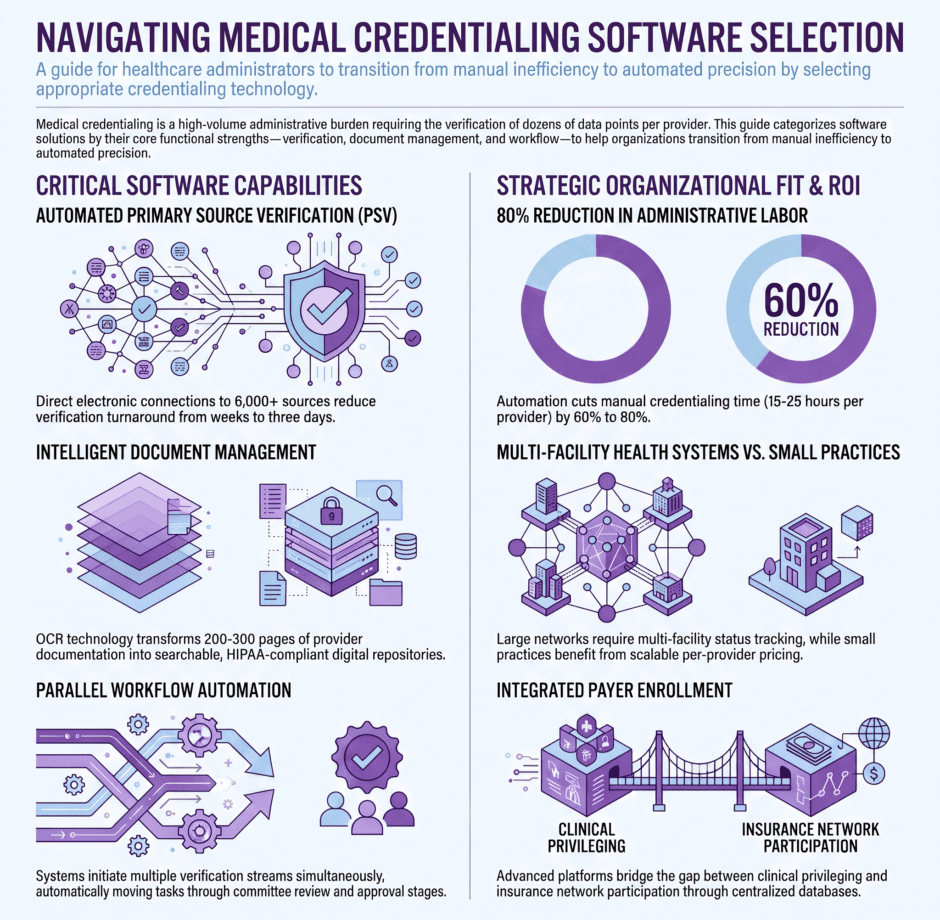
CredyApp addresses this bottleneck through automated verification that maintains direct connections with over 6,000 primary sources, covering 95% of U.S. medical schools and real-time connections with all 50 state medical boards.
Medallion takes an NCQA-certified approach, generating committee-ready files in as little as three days. It’s built for organizations that prioritize speed without sacrificing regulatory compliance.
For organizations working with international providers, IntelliCentrics offers specialized verification for foreign medical graduates, including connections to international medical schools and credential evaluation services many domestic-focused platforms miss entirely.
Document Management and Storage
A typical provider file runs 200 to 300 pages, and that multiplies fast across a full provider network. Paper-based systems create storage nightmares, and basic digital storage often lacks the organization needed for fast retrieval.
symplr Provider turns document chaos into searchable repositories through intelligent recognition that categorizes and files incoming documentation automatically, using OCR to make scanned files fully searchable and tracking expiration dates with renewal reminders.
MD-Staff offers cloud-based storage built around healthcare compliance, with audit trails, version control, and role-based access that meet HIPAA requirements.
PreCheck focuses on document collection through provider-facing portals where applicants upload their own files, with automatic validation of completeness and format.
Workflow Automation and Task Management
Credentialing has a strict sequence of steps, and manual processes built on paper checklists or spreadsheets create real opportunities for missed steps and inconsistent quality.
CPSI Credentialing & Privileging builds automated workflows that guide users through each step and move to the next task the moment a verification completes, supporting parallel processing to shorten overall turnaround.
Silversheet focuses on workflow for credentialing committees specifically, managing meeting schedules, distributing applications for review, and tracking approval status through multi-step processes, with integration back into hospital information systems.
Does Your Organization Type Change What You Need?
Hospital Systems
Large hospital networks face challenges smaller organizations never encounter. Separate credentialing processes across facilities for the same provider, varying documentation requirements by department, and credentialing committees that meet on different schedules.
Modio Health (formerly MedTrainer) tracks a single provider’s status across multiple locations while maintaining facility-specific requirements, supporting multi-step approval routing across committees and administrative channels.
CACTUS was built for medical staff offices specifically, managing bylaws, privileging decisions, and the audit trails Joint Commission compliance requires, with committee management tools that coordinate review processes across departments.
Ambulatory Surgery Centers
ASCs face their own pressures. High-volume, short-term credentialing for visiting surgeons alongside core staff privileges, often with limited administrative staff to manage it.
ASC Credentialing was built specifically for this environment, with templates for different surgical specialties and workflows tuned to ASC-specific regulatory requirements.
OperateSmart, from SIS, integrates credentialing with broader operational tools including scheduling, patient engagement, billing, and inventory management in a single platform.
Medical Groups and Clinics
Smaller practices often struggle with software built for enterprise health systems. They need real functionality without enterprise-level cost and setup overhead.
ProCredEx offers scalable pricing based on provider volume, with primary source verification, document management, and basic workflow automation suited to practices managing 20 to 100 providers.
How Does Payer and Insurance Enrollment Fit In?
 Modern credentialing extends well past hospital privileges into insurance network participation and Medicare/Medicaid enrollment, and managing those parallel processes is where a lot of software falls short.
Availity handles insurance credentialing across multiple payers through a single interface, maintaining connections with major insurers and government programs.
CAQH ProView gives providers one centralized place to maintain their credentialing data, which insurers and healthcare organizations can then access, cutting down on redundant data collection. Medwave built a CAQH ProView form to make this step easier for providers and groups.
ProviderTrust pairs traditional credentialing with ongoing monitoring, watching for credential changes or issues and alerting organizations before they become compliance problems.
CureMD focuses specifically on the payer enrollment side, offering an affordable path to faster provider onboarding for practices that mainly need help with that piece.
What Should You Consider for Implementation and Integration?
EHR Integration
Most organizations run an EHR that should talk to their credentialing software without friction. Poor integration means duplicate data entry and more room for error.
Epic MyChart includes basic credentialing functionality, though many organizations find it thin for anything beyond simple needs. Third-party tools like symplr Provider offer deeper Epic integration, syncing provider data while keeping specialized credentialing features intact.
Cerner users often pair with CPSI for native integration, automatically updating provider privileges in the EHR once credentialing wraps up.
Legacy System Migration
Moving off paper or an outdated digital system means preserving years of documentation for compliance and reference.
IntelliCentrics offers migration services that digitize paper files and pull data from legacy systems, handling scanning, extraction, and setup to reduce disruption. PreCheck offers similar support with added data cleanup and quality checks to keep migrated information accurate.
How Much Does Credentialing Software Cost, and What’s the Real ROI?
Pricing Models
Pricing varies a lot based on features, provider volume, and service level. Knowing the different models upfront helps you budget accurately instead of getting surprised later.
Per-provider pricing is common for smaller organizations, typically running $15 to $50 per provider per month depending on feature depth and automation level. Enterprise licensing fits large organizations better, and platforms like symplr offer volume discounts that meaningfully cut per-provider cost at scale. Service-based pricing bundles human verification with software access, which is what CredyApp offers for organizations that want to hand off verification work rather than manage it internally.
Return on Investment
Most organizations underestimate what manual credentialing already costs them. Administrative staff time is the biggest line item. Manual credentialing typically takes 15 to 25 hours per provider application. At average healthcare administrative wages, that’s roughly $300 to $500 in labor per application before benefits and overhead.
Software automation can cut that time by an estimated 60 to 80%, and the savings compound with faster processing that gets providers seeing patients sooner instead of sitting in a credentialing backlog.
How Do the Top Credentialing Platforms Compare?
| Platform | Best for | Key feature | Pricing model |
|---|---|---|---|
| CredyApp | High-volume primary source verification | 6,000+ direct source connections, all 50 state boards | Per-provider or service-based |
| Medallion | Speed-focused organizations | NCQA-certified, committee-ready files in 3 days | Per-provider |
| symplr Provider | Document-heavy operations, Epic shops | OCR search, deep EHR integration | Enterprise licensing |
| CACTUS | Hospital medical staff offices | Bylaws and privileging management, Joint Commission audit trails | Enterprise licensing |
| ProCredEx | Practices with 20 to 100 providers | Scalable pricing, basic workflow automation | Per-provider |
| Availity + CAQH ProView | Payer enrollment specifically | Single-interface multi-payer applications | Varies (often payer-funded) |
What Trends Are Shaping Credentialing Software in 2026?
 AI-assisted credentialing has moved from pilot to standard practice at a growing number of platforms, with systems that flag likely issues before they cause delays, predict processing timelines, and route verification steps automatically instead of waiting on a coordinator to notice a bottleneck.
Blockchain-based credential verification is still early but real. Certif-ID offers a blockchain-based platform for issuing and verifying digital certificates, aimed at cutting out repeated primary source checks across organizations.
The market itself keeps getting more crowded, with symplr, Verity, IntelliSoft, and Modio Health all competing on more sophisticated feature sets. More competition generally means more capable, more specialized options for buyers, but it also means more time spent narrowing the field.
How Do You Make the Final Decision?
Selecting credentialing software means matching your actual pain points to platform capabilities, not chasing every feature a vendor lists on their homepage.
Small practices handling straightforward verification tasks may find SimplyCred or ASC Credentialing perfectly adequate. Large health systems managing multi-facility credentialing typically need enterprise platforms like symplr Provider or CACTUS instead.
The strongest outcomes come from a clear read on your current process, a realistic sense of what needs to improve, and a platform evaluation that prioritizes your top two or three pain points over feature count. Taking that time upfront leads to better software fit and smoother credentialing operations down the road.
Credentialing Software FAQ
How much does medical credentialing software cost?
Most platforms charge $15 to $50 per provider per month for smaller organizations, while large health systems typically negotiate enterprise licensing with volume discounts.
What’s the difference between credentialing software and CAQH ProView?
CAQH ProView is a centralized database where providers store their credentialing data for payers to access. Credentialing software manages your organization’s internal verification, document, and workflow process, and often connects to CAQH ProView rather than replacing it.
Do small practices need dedicated credentialing software?
Practices with more than two or three providers usually benefit from dedicated software once spreadsheets and manual tracking start creating missed renewal dates or lost documents.
How long does it take to implement credentialing software?
Implementation timelines vary by platform and data migration needs, but most organizations should plan for several weeks to a few months, especially if migrating from paper or legacy systems.
What is the best software for medical credentialing?
There isn’t a single best platform. The right choice depends on organization size, provider volume, facility count, and whether payer enrollment or hospital privileging is the bigger pain point.
Is CAQH ProView free?
CAQH ProView is free for providers to use, though organizations may pay for tools that help manage or integrate CAQH data into broader credentialing workflows.
How often does credentialing need to be renewed?
Most payers and hospitals require recredentialing every two to three years, though license and certification renewals can happen on separate, shorter timelines.
Summary: Medical Credentialing Software Should Suffice Your Workflow Needs
 Choosing the right medical credentialing software means matching your organization’s specific tasks to the right technology, not picking whatever platform ranks highest in a review roundup. From primary source verification tools like CredyApp and IntelliCentrics to document management systems like symplr Provider and MD-Staff, each platform solves a different piece of the credentialing puzzle. Hospital systems need the multi-facility depth of CACTUS or Modio Health, while smaller practices are usually better served by leaner tools like ProCredEx or ASC Credentialing.
Medwave brings years of hands-on experience with these credentialing platforms, having used many of them internally for our own credentialing operations, so we’ve learned their strengths and limitations firsthand rather than from a spec sheet. Beyond credentialing software selection, our team supports the full revenue cycle. Including medical billing, provider credentialing, and payer contracting, so your software choice fits into a broader strategy rather than solving one problem in isolation.
Contact us below to talk through your credentialing software options and challenges.

Co-Founder and COO of Medwave, bringing more than 30 years of hands-on experience in healthcare revenue cycle management, payer contracting, and medical credentialing.