

Every credentialing delay traces back to one of a small number of root causes, even though it rarely feels that way when you’re the one chasing down a missing license copy. A physician can’t bill a payer’s network rate until credentialing clears, so every error in the process has a direct dollar cost attached to it, not just a paperwork headache.
This breaks down the seven operational failure points that cause the most credentialing delays, why each one happens, and what actually fixes it. If you’re dealing with a specific symptom rather than the process itself, our guides on CAQH application mistakes, why credentialing gets delayed, and why applications get denied go deeper on those individual scenarios.
Key Takeaways
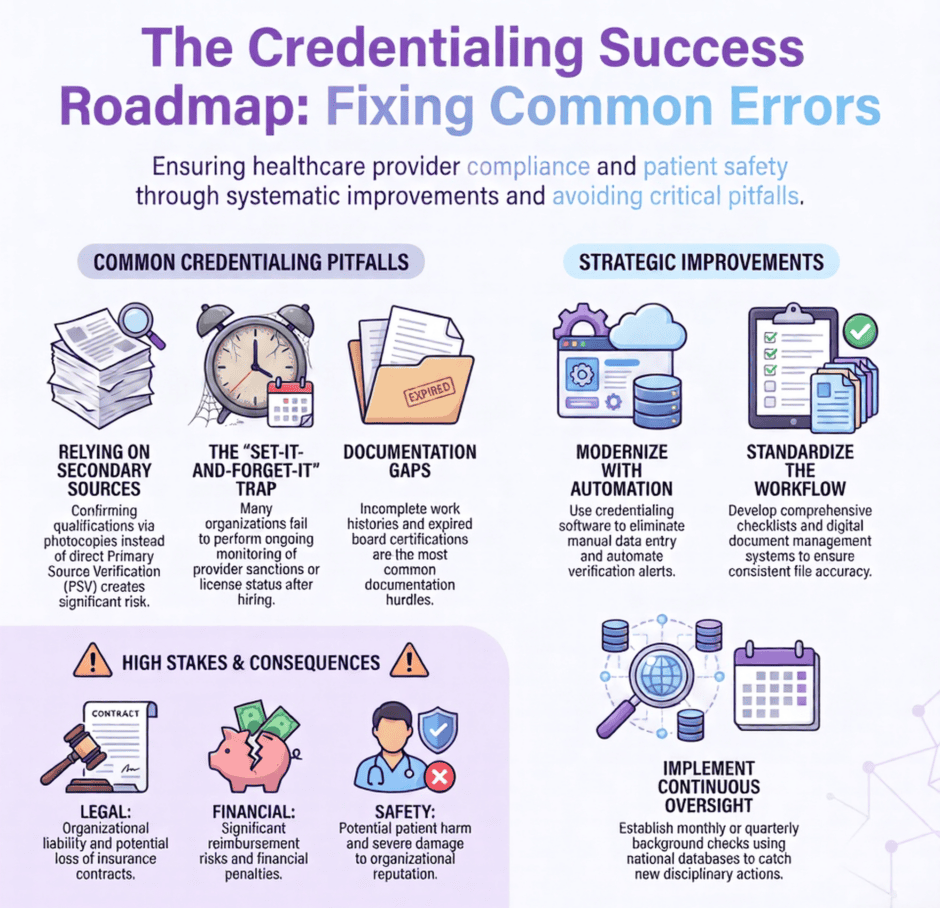
Credentialing errors fall into seven recurring categories: verification gaps, documentation lapses, missed ongoing monitoring, inefficient workflows, compliance gaps, poor communication, and technology mismatches. Each one adds measurable delay, from a two-week hold for a missing signature to a six-month restart for a lapsed DataSpring (formerly CAQH) attestation. Most of these failures are process problems, not staffing problems, which means most of them are fixable without adding headcount.
Why Does Credentialing Break Down in the First Place?
Credentialing exists to confirm that a provider is qualified, licensed, and legally able to treat patients, and payers treat it as a gate, not a formality. When that gate is handled poorly, the fallout isn’t limited to a delayed start date.
What’s actually at stake:
- Legal exposure for the organization if an unverified provider practices
- Denied claims and recoupments during any gap in active status
- A damaged relationship with the payer, which slows every future application from that practice
- Real financial loss, since providers can’t bill network rates until credentialing is complete
None of this requires a large organization to go wrong. Solo practices and single-specialty groups hit these same seven errors just as often as hospital systems, usually because there’s no dedicated person owning the process.
1. Why Does Incomplete Primary Source Verification Cause Delays?
Primary source verification (PSV) means confirming a credential directly with the institution that issued it, not accepting a photocopy or a provider’s own summary of their history. This is the step payers scrutinize hardest, and it’s where most credentialing files get flagged.
Where PSV usually breaks down:
- Accepting scanned documents instead of confirming directly with the source
- Skipping less obvious credentials (malpractice history, hospital privileges) while focused on the license
- Losing track of expiration dates until a payer flags them
- Treating PSV as a one-time task instead of a recurring check
The fix: build a PSV checklist that covers every credential type, not just the license and NPI, and use a verification tool or CVO that contacts primary sources directly rather than relying on submitted copies. Set expiration reminders at 60 and 30 days out, not 7.
2. What Documentation Errors Slow Down Credentialing?
Providers change jobs, add certifications, and update their professional history constantly, which means the documentation behind their credentialing file is almost always slightly out of date by the time it’s reviewed.
The recurring documentation gaps:
- Incomplete application forms with blank fields or missing signatures
- Expired board certifications still listed as current
- Work history gaps left unexplained
- Missing continuing education records
The fix: a standardized document checklist for every provider type you credential, a digital document management system instead of shared folders, and a quarterly internal audit of existing provider files rather than waiting for a payer to catch the gap first.
3. Why Do Practices Skip Ongoing Monitoring After Initial Approval?
Initial credentialing approval feels like the finish line, which is exactly the mindset that causes the next error. Credentialing isn’t a one-time event. A provider’s license, malpractice coverage, and sanction status can all change after approval, and payers expect you to catch that before they do.
Warning signs monitoring has lapsed:
- No process for checking sanctions or disciplinary actions after initial approval
- License expiration dates tracked manually, if at all
- No use of the National Practitioner Data Bank for ongoing checks
- Recredentialing treated as a surprise instead of a scheduled event
The fix: monthly or quarterly automated background checks, NPDB queries built into your recredentialing cycle, and a centralized tracking system so no single person is the only one who knows when a credential expires.
4. What Makes Credentialing Workflows Inefficient?
A slow workflow doesn’t just delay one provider, it compounds. Every returned application resets your position in a payer’s review queue, and for payers with monthly credentialing committees, that can mean missing an entire cycle and adding 30 days per occurrence.
Common workflow bottlenecks:
- Manual data entry across multiple systems that don’t talk to each other
- No standardized intake process for new providers
- Poor handoffs between credentialing staff, HR, and billing
- No tracking system, so status lives in someone’s inbox instead of a shared record
The fix: credentialing management software that automates routing and status notifications, a documented intake process every new provider goes through the same way, and cross-trained staff so the process doesn’t stop when one person is out.
5. Which Regulatory Compliance Gaps Put Practices at Risk?
Credentialing sits under a layered set of federal and state rules, and a small compliance miss can carry consequences well beyond a delayed application.
Where compliance gaps show up most:
- HIPAA handling of provider and patient data during the verification process
- State-specific licensing requirements that differ from your primary state
- Medicare and Medicaid credentialing rules that change more often than commercial payer rules
- Accreditation standards tied to specific payer panels
The fix: a compliance checklist reviewed at least twice a year, since these rules do shift, and a designated person or team responsible for tracking regulatory changes rather than assuming the credentialing software will catch them automatically.
6. How Does Poor Verification Communication Cause Errors?
Credentialing touches more people than most practices realize. The provider, internal credentialing staff, HR, medical staff offices, and the payer’s own verification team. A breakdown anywhere in that chain shows up as a delay.
Where communication fails:
- Unclear ownership of who’s responsible for responding to payer requests
- Slow turnaround on requests for additional documentation
- Incomplete answers that trigger a second round of questions
- No follow-up protocol once a request is sent
The fix: a standard response template for payer information requests, a defined turnaround time (48 hours is a reasonable internal standard), and a tracking log so nothing sits unanswered because no one realized it was still open.
7. What Technology Gaps Create Credentialing Errors?
Many practices are running credentialing through a mix of spreadsheets, email, and a payer portal that doesn’t connect to any of it. That patchwork is where errors get introduced even when the underlying data is correct.
Where technology creates friction:
- Systems that don’t integrate, so the same data gets entered multiple times
- Manual data transfer between credentialing software and billing systems
- No secure way to share sensitive provider documents
- Legacy systems that can’t keep pace with payer requirement changes
The fix: an integrated credentialing platform that connects to your billing and scheduling systems, so a change in one place updates everywhere, and a periodic technology audit to catch gaps before they cause a rejected application.
In-House vs. Outsourced Credentialing: Where Do Errors Happen More Often?
| In-House Credentialing | Outsourced Credentialing | |
|---|---|---|
| PSV accuracy | Depends on staff bandwidth and training | Dedicated specialists, direct-source verification built into the process |
| Ongoing monitoring | Often the first thing that lapses under workload | Scheduled and tracked as a standing service |
| Compliance updates | Relies on someone actively watching for changes | Tracked as part of the vendor's core responsibility |
| Cost of errors | Absorbed internally, often invisible until a claim denies | Contractually the vendor's responsibility to catch |
| Best fit for | Practices with a dedicated, experienced credentialing coordinator | Practices without bandwidth to monitor 7 error categories continuously |
Neither model is immune to these seven errors. The difference is usually whether monitoring and follow-up happen consistently, which is where in-house teams tend to fall behind once volume increases.
How Do You Build a Credentialing Error Prevention Strategy?
- Audit your current process against the seven error categories above and flag where you’re weakest.
- Standardize your checklists for PSV, documentation, and intake so the process doesn’t depend on one person’s memory.
- Automate what you can: expiration alerts, status tracking, and document requests are the easiest wins.
- Assign clear ownership for compliance monitoring and payer communication so nothing falls into a gap between roles.
- Review quarterly, not annually. Payer requirements and regulations shift more often than most practices expect.
Credentialing Errors FAQ
How long does credentialing take if there are no errors?
Most payers process a clean application in 60 to 120 days. A single error, like a missing signature or an expired document, typically adds 2 to 6 weeks per occurrence.
What’s the most expensive credentialing error to make?
An expired DataSpring (formerly CAQH ProView) attestation. Since most commercial payers pull from the same profile, a lapse can stall every pending application simultaneously, not just one.
Can a provider see patients before credentialing is complete?
Clinically, yes in many cases, with proper supervision arrangements. Billing a payer before enrollment is complete is the actual problem, and it can result in denied claims or recoupment.
Does outsourcing credentialing eliminate these errors?
It significantly reduces them, particularly around ongoing monitoring and compliance tracking, but it doesn’t eliminate the need for accurate, timely information from the provider.
How often should provider credentials be monitored after approval?
Monthly or quarterly, at minimum, using tools like the National Practitioner Data Bank. Waiting until recredentialing is due is what causes most of the errors in this article.
What documents are required for credentialing?
State license, DEA registration (if applicable), board certification, malpractice insurance documentation, work history, and a current DataSpring (CAQH) attestation are the core set most payers require.
What happens if a credentialing application is denied?
The provider typically can reapply, but the reason for denial needs to be corrected first. Repeated denials for the same issue can trigger closer payer scrutiny on future applications.
How do you fix a lapsed CAQH/DataSpring profile?
Log in and complete the re-attestation immediately. Every field should be reviewed, not just the one that triggered the lapse, since payers pull the full profile.
Is credentialing the same as licensing?
No. Licensing is issued by a state medical board and confirms a provider can practice. Credentialing is payer- or facility-specific and confirms a provider meets that organization’s requirements to bill or practice there.
Who is responsible for credentialing errors, the provider or the practice?
Both share responsibility in practice, but the credentialing team (in-house or outsourced) is typically accountable for catching errors before submission, since the provider often isn’t tracking payer-specific requirements themselves.
Summary: 7 Credentialing Errors Practices Keep Repeating
 Credentialing errors rarely come down to one bad form. They cluster into seven repeatable failure points. This includes incomplete primary source verification, documentation gaps, lapsed post-approval monitoring, inefficient workflows, regulatory compliance gaps, poor communication with payers, and disconnected technology. Each one adds real delay, from a couple of weeks for a missing signature to months if a DataSpring (CAQH) attestation lapses, since most commercial payers pull from that same profile.
The fix for most of these is procedural, not staffing. This includes standardized checklists, automated expiration alerts, clear ownership of payer communication, and monitoring that continues after initial approval instead of stopping there. Practices that treat credentialing as a system rather than a one-time task catch these errors before they turn into denied claims or lost revenue. Medwave handles credentialing, medical billing, and payer contracting together, so a caught credentialing gap doesn’t turn into a billing denial down the line.

Co-Founder and COO of Medwave, bringing more than 30 years of hands-on experience in healthcare revenue cycle management, payer contracting, and medical credentialing.