

If you’ve ever asked whether medical billing and revenue cycle management (RCM) are the same thing, you’re not alone. The two terms get used interchangeably all the time, even inside healthcare organizations that should know better. They’re related, but they’re not identical, and the difference matters if you’re trying to figure out where your practice is losing money.
Key Takeaways
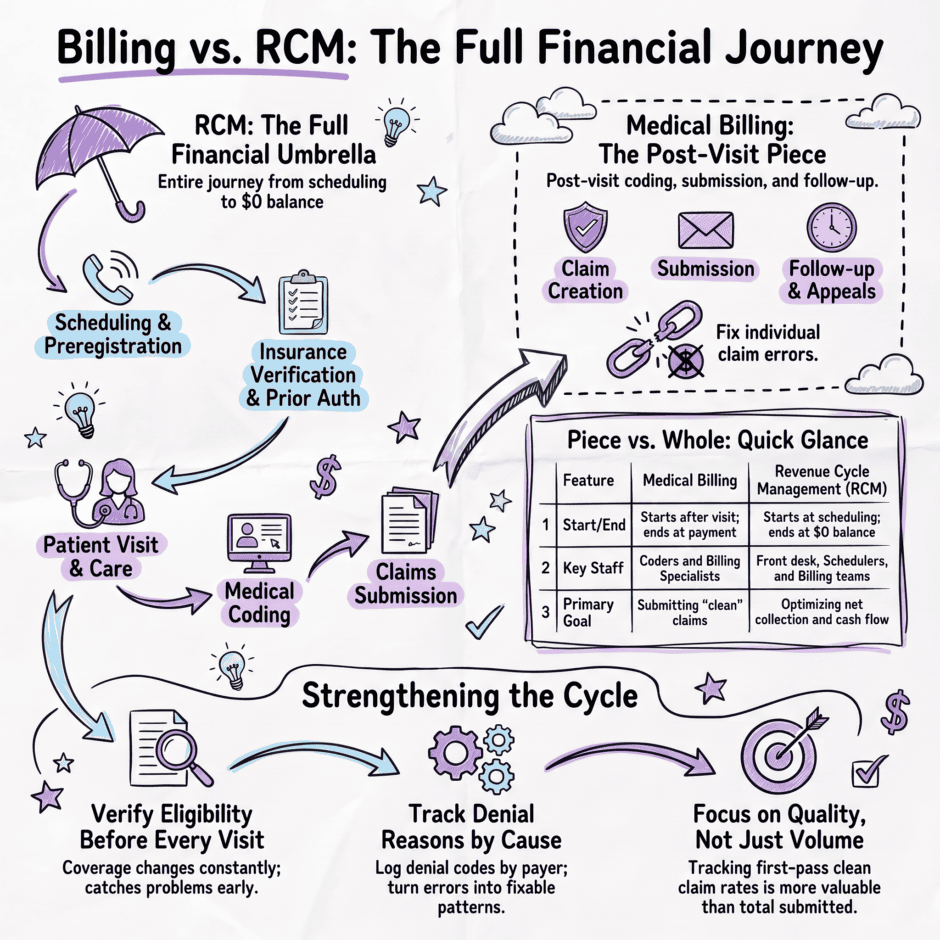
Medical billing is the process of coding, submitting, and following up on claims after a patient receives care. Revenue cycle management is the entire financial journey, starting when a patient schedules an appointment and ending when the account balance hits zero. Billing is one piece of RCM, not a replacement for it. Practices that treat the two as the same thing often miss the earlier stages of the cycle, like eligibility verification and prior authorization, where a lot of preventable denials actually start.
What’s Medical Billing?
 Medical billing is the process of translating a patient encounter into a claim, submitting that claim to a payer, and following it through to payment. It starts after the visit. A biller assigns CPT and ICD-10 codes based on what the provider documented, scrubs the claim for errors, sends it to the insurance company, and then tracks it until it’s paid, denied, or needs to be appealed.
Billing companies typically handle the coding, the claim submission, and the payment posting. They don’t usually touch patient registration, insurance verification, or scheduling. Those tasks happen earlier in the process and are normally handled inside the practice itself, which is exactly why billing on its own can’t catch every problem.
What’s Revenue Cycle Management?
Revenue cycle management is the full financial process a healthcare organization runs from the moment a patient books an appointment to the moment the account is paid in full. It includes medical billing, but it also includes everything that happens before and after the billing team gets involved.
That means insurance eligibility checks, pre-authorization for procedures that require it, accurate charge capture at the point of care, claim scrubbing, denial management, and payment posting once the money actually comes in. RCM is the umbrella. Medical billing is one of the pieces underneath it.
The Real Differences Between Medical Billing and RCM

Here’s where the two actually split apart.
Scope. Medical billing starts after the visit and ends when the claim is paid or denied. RCM starts before the visit, at scheduling and eligibility verification, and doesn’t end until the account balance is zero.
Who’s involved. Billing is usually handled by coders and billing specialists, either in-house or outsourced. RCM pulls in front-desk staff, schedulers, insurance verification teams, coders, billers, and collections, all working from the same data.
What gets measured. Billing performance is usually tracked by clean claim rate and days in accounts receivable. RCM performance looks at the whole picture: net collection rate, denial rate by cause, cost to collect, and how long it takes cash to actually land from the date of service.
Where problems get caught. A billing team can flag a coding error before submission. RCM catches problems earlier, like a lapsed insurance policy that would have caused a denial no matter how clean the claim was.
Where Medical Billing and RCM Overlap
The overlap is real, and it’s the reason the two terms get confused so often. Billing sits inside RCM as one of its most visible stages. A denied claim that gets caught, corrected, and resubmitted is a billing task, but the reason it got denied in the first place, whether that’s a missing prior authorization or a registration error, is an RCM problem.
This is also why billing and RCM teams have to talk to each other. A biller who sees the same denial code every week from the same payer needs a way to flag that pattern back to the front office, so the root cause gets fixed instead of just the symptom.
Common Mistakes That Blur the Line (and Cost Money)
 A few patterns show up again and again in practices that treat billing and RCM as the same function.
Skipping eligibility verification before the visit. This is the single biggest source of preventable denials. A patient’s coverage can lapse or change between visits, and if nobody checks before the appointment, the claim is going to bounce no matter how well it’s coded.
Not tracking denial reasons. A denied claim that just gets resubmitted without anyone logging why it was denied is a missed opportunity. Denial codes are data. Practices that track them by payer and by cause start seeing patterns that point straight at the fix.
Treating prior authorization as a billing problem. By the time a claim without the right authorization reaches the billing team, it’s usually too late to fix cheaply. Prior auth belongs earlier in the cycle, ideally at scheduling, not at claim submission.
No feedback loop between front office and billing. If the people checking patients in and the people submitting claims never compare notes, the same registration errors keep repeating month after month.
Measuring only claim volume, not claim quality. A practice that submits a lot of claims fast but doesn’t track how many get denied on the first pass is optimizing for the wrong number.
Five Ways to Strengthen Your Revenue Cycle
Fixing billing alone won’t fix a broken revenue cycle.
These five changes address the whole process, not just the claim submission step.
- Verify eligibility and benefits before every visit, not just new patients. Coverage changes happen constantly, and re-checking existing patients catches problems before they become denials.
- Get prior authorization requirements confirmed at scheduling, not after the visit. This shifts the work to the point where it’s cheapest and easiest to fix.
- Track denial reasons by payer and by cause every month. A denial trend report turns individual claim problems into a fixable pattern.
- Standardize charge capture at the point of care. The more consistent documentation is when the provider enters it, the fewer coding questions come up later.
- Review your fee schedules against actual payer reimbursement at least once a year. A contract that looked fair three years ago may be paying below market rate now, and that’s a payer contracting issue, not a billing one.
Which One Does Your Practice Actually Need?
Most practices don’t need to choose between medical billing help and RCM help. The real question is whether your current setup covers the whole cycle or just the middle of it.
If claims are getting submitted cleanly but you’re still seeing slow payments, high denial rates, or unpredictable cash flow, the problem usually isn’t in the billing step. It’s upstream, in eligibility checks, authorization, or how charges get captured at the point of care. That’s an RCM gap, not a coding problem, and no amount of re-billing will fix it.
Medical Billing vs. Revenue Cycle Management FAQ
Is revenue cycle management the same as medical billing?
No. Medical billing is one part of revenue cycle management. RCM covers the entire financial process, from scheduling and insurance verification through final payment. Billing covers coding, claim submission, and follow-up.
What’s included in RCM that isn’t included in medical billing?
Patient registration, insurance eligibility verification, prior authorization, charge capture, and denial trend tracking all fall under RCM but aren’t part of the billing function itself.
Do I need a separate RCM company if I already outsource my billing?
Not necessarily. Some billing companies only handle claim submission and follow-up. Others manage the full cycle, including eligibility checks and denial prevention. Ask what’s actually included before assuming your billing vendor is covering the whole process.
What causes most claim denials, billing errors or RCM gaps?
Most preventable denials trace back to problems earlier in the cycle, like eligibility issues or missing authorizations, rather than coding mistakes made by the billing team.
How is RCM performance measured differently from billing performance?
Billing is usually tracked by clean claim rate and days in accounts receivable. RCM performance also includes net collection rate, denial rate by cause, and cost to collect, which reflect the whole financial process, not just claim submission.
What does RCM stand for in medical billing?
RCM stands for revenue cycle management, the full financial process that includes medical billing as one of its stages.
Is medical coding part of RCM or billing?
Medical coding is typically grouped with billing, since it happens after the visit and directly feeds claim submission, though it’s still one piece of the larger revenue cycle.
Why do practices confuse medical billing and RCM?
Because billing is the most visible part of the revenue cycle. It’s the step patients and providers interact with most directly, so it often gets used as shorthand for the entire process.
How Medwave Handles Billing + RCM Together
 Medwave doesn’t split billing off from the rest of the revenue cycle. Claims get scrubbed and submitted with a 98% clean claim rate, but the work starts earlier than that, with eligibility verification, denial tracking by payer and cause, and a team that flags upstream problems instead of just resubmitting the same claim type every month. When a pattern shows up, like a specific payer denying a specific code combination, that gets fixed at the root instead of getting treated as a one-off billing fix.
Getting paid accurately and on time takes more than clean claims. It takes the eligibility check before the visit, the authorization confirmed ahead of time, the coding done right the first time, and a team watching for denial patterns before they repeat. Medwave handles all three sides of that, medical billing, provider credentialing, and payer contracting, so practices aren’t stitching together separate vendors to cover one financial process.

Co-Founder and COO of Medwave, bringing more than 30 years of hands-on experience in healthcare revenue cycle management, payer contracting, and medical credentialing.