

A clean claim rate is the share of your claims that get paid on the first submission, with no rejection, no denial, and no request for more information. It is one of the plainest numbers in medical billing, and it tells you more about the health of your revenue cycle than almost any report in your practice management system.

Think about what a low number means in practice. Every claim that fails the first pass lands on someone’s desk. That person has to find the problem, fix it, resubmit, and wait again. Multiply that by hundreds of claims a month and you have a full-time job that produces no new revenue.
Most practices never measure this. They watch total collections and assume the billing side is fine, until cash gets tight and nobody can say why. This guide walks through how the metric works, how to calculate it, where the benchmarks sit, and what actually moves the number.
Key Takeaways
- A clean claim is paid on the first submission with no edits, rejections, or follow-up requests.
- The formula is claims paid on first submission divided by total claims submitted, times 100.
- A rate of 95% or higher is considered excellent. Anything under 75% points to a broken front end.
- Most dirty claims trace back to registration, eligibility, coding, and missing authorizations, not to the payer.
- Scrubbing software, staff training, and routine audits move the number faster than appealing denials after the fact.
What Counts as a Clean Claim?
A clean claim is one a payer can process without asking you for anything. It has every required field filled in, the codes match the documentation, the patient and policy details are right, and it arrives before the filing deadline.
In practice, that comes down to a short checklist.
- All required data is present on the claim form.
- There are no errors or omissions anywhere on it.
- It follows the specific rules of the payer it is going to.
- It is filed inside the timely filing window.
- The ICD-10, CPT, and HCPCS codes are valid and fit together.
- Patient demographics match what the insurer has on file.
One detail trips people up. A claim can be accepted by your clearinghouse and still not be clean. Acceptance at the clearinghouse only means the file format passed. The payer can still reject or deny the claim on its own edits, which is why the definition hinges on actual payment, not on whether the claim went out the door.
The difference between a rejection and a denial matters here too. A rejection never enters the payer’s system, while a denial does and gets refused. If you want the full breakdown, our post on claim denial versus rejection covers it. Either one keeps a claim out of the clean column.
Why Does Clean Claim Rate Matter So Much?
 The money is the obvious reason. A claim paid in two weeks helps your cash flow far more than the same claim paid after two rounds of rework. But the metric reaches further than that.
Clean claims take less labor. Your billers spend their day on new work instead of chasing old problems, which lowers the cost to collect each dollar. Payments also land closer to the date of service, so your accounts receivable stays lean and fewer balances age past 90 days.
There is a quieter benefit as well. A steady clean claim rate tells you your process is stable. When the number drops, something upstream changed, maybe a payer updated an edit, a new hire is entering data differently, or an interface broke. It works like a smoke detector for the whole billing cycle.
Finally, it frees up people. When a practice stops fighting preventable errors, the front desk and clinical staff get time back for patients.
How Do You Calculate Clean Claim Rate?
The math is simple. Divide the number of claims paid on first submission by the total number of claims submitted, then multiply by 100.
If your practice sends out 1,000 claims in a month and 850 are paid with no rework, your clean claim rate is 85%. The other 150 needed a correction, a resubmission, or an appeal.
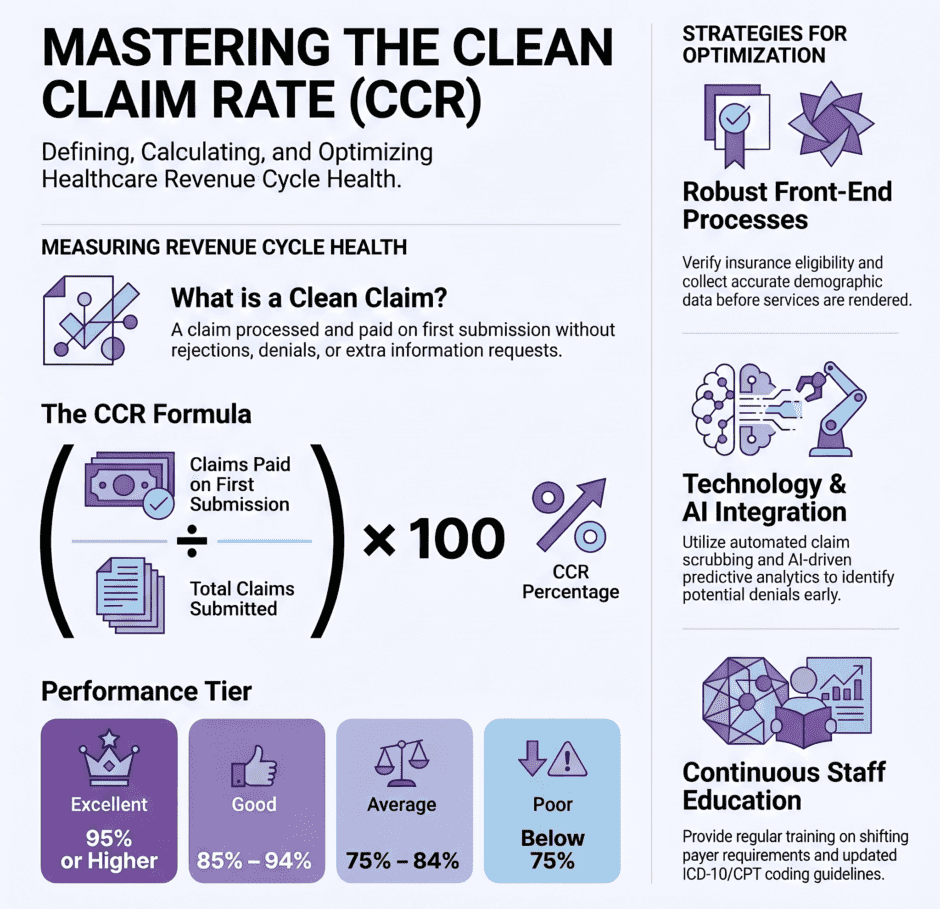
Be careful, though, because organizations measure this differently. Some leave out certain claim types, such as self-pay or workers’ compensation. Some track it over a rolling 90 days instead of a calendar month. Others count a claim as clean if it needed only a minor fix. None of these choices is wrong, but you need to pick one method and stick with it. Comparing this month’s number to last quarter’s is meaningless if the definition shifted in between.
It also helps to track the rate by payer and by claim type. A blended 90% can hide the fact that one commercial payer is sitting at 70%. Our guide to revenue cycle metrics shows where clean claim rate sits alongside days in A/R, denial rate, and net collection rate.
What Is a Good Clean Claim Rate?
Benchmarks vary by specialty, payer mix, and practice size, but these ranges are a fair starting point.
- Excellent is 95% or higher.
- Good is 85% to 94%.
- Average is 75% to 84%.
- Poor is anything below 75%.
Where you land inside those ranges depends on who you bill. A cardiology group with heavy Medicare volume faces different edits than a behavioral health practice juggling Medicaid managed care plans. Hospital-based billing, surgical specialties, and multi-location groups all run into their own friction points.
If you want a deeper look at targets for your own situation, we answer it directly in our FAQ on what clean claim rate your practice should aim for. For outside context, MDClarity also publishes a useful reference on the clean claim rate metric.
What Pulls Clean Claim Rates Down?
 Nearly every dirty claim traces back to a small set of causes. The patterns are predictable once you start sorting your rejections and denials by reason.
Registration errors lead the list. A transposed digit in a member ID, a misspelled last name, or an outdated address will stop a claim cold. Eligibility is next. If nobody confirmed coverage before the visit, you may be billing a plan that ended last month.
Coding problems come after that. Diagnosis codes that do not support the procedure, missing modifiers, and bundled services billed separately all trigger payer edits. Then there are authorizations. A service that needed prior approval and did not get it will be denied no matter how clean the rest of the claim looks.
Documentation gaps and slow charge capture add to the pile. If the note is incomplete or the charge goes in three weeks late, the claim either carries errors or misses the filing window.
Finally, there are system and people issues. Outdated software, an EHR that does not talk to the billing system, and staff turnover that drains knowledge all show up in the number. Payers change their rules constantly, too, and a team that is not watching bulletins will keep submitting claims the old way.
How Do You Improve Clean Claim Rate?
The most reliable gains come from fixing the front end. Catching a problem before the claim leaves costs a few minutes. Catching it after a denial costs far more.
Tighten Registration and Eligibility
Collect the insurance card and a photo ID at scheduling and again at check-in. Run an eligibility check before every visit, not just for new patients. Our walkthrough on how to verify insurance eligibility and benefits lays out the steps. If a service needs approval, get it in writing first. Our explainer on prior authorization shows how that process works.
Train Your Team on Payer Rules
Coding updates arrive every year, and payer policies shift more often than that. Short, regular training sessions beat a once-a-year marathon. Focus on the payers that make up most of your volume and the denial reasons you see most often. Our list of common denial codes and how to fix them is a good study sheet.
Scrub Claims Before They Go Out
Claim scrubbers check each claim against coding rules and payer edits before submission. Your practice management system probably has one built in, and your clearinghouse may add another layer. Using both catches more errors. If you are weighing options, we wrote about how to choose the right clearinghouse.
Connect Your Systems
When the clinical record and the billing system are separate islands, someone retypes data, and retyping creates mistakes. Linking them removes that step. We explain the payoff in our post on integrating EHR systems and medical billing.
Audit and Track
Pull a sample of submitted claims every month and review them for errors. Sort rejections and denials by reason code so you can see which fixes will pay off first. Give each biller feedback on their own error patterns. People improve fast when they can see the data.
Standardize the Workflow
Write down who does what, in what order, and by when. Checklists for common visit types cut variation. Clear roles mean nothing falls between two people who each assumed the other had it.
Which Tools Help Most?
 Technology will not fix a broken process, but it makes a good process easier to follow.
A practice management system handles claim generation, built-in edits, and reporting. A clearinghouse adds payer-specific rules and real-time claim status. A full revenue cycle platform ties those pieces together with end-to-end tracking and denial analytics.
Artificial intelligence is the newest layer. Some tools now flag claims that look likely to be denied, suggest codes from documentation, and spot error patterns across thousands of claims. They are useful as a second set of eyes. They still need a trained person to review what they flag, because a wrong suggestion applied at scale is a costly mistake.
How Does Clean Claim Rate Affect the Rest of Your Practice?
Money is the first effect, and the others follow from it. Better cash flow, lower administrative cost, and higher net revenue all trace back to claims getting paid the first time.
Operations improve too. Workflows run smoother, staff stop firefighting, and morale gets a lift because nobody enjoys redoing the same claim three times.
Patients feel it as well. Fewer billing errors means fewer confusing statements and fewer angry phone calls. When a claim is right the first time, the patient balance is right the first time, and that builds trust.
What Trends Are Shaping Clean Claims?
Automation keeps removing manual steps. Real-time eligibility checks, automated status updates, and rule-based denial routing already run in many practices, and the list is growing.
Predictive analytics is moving from a nice extra to a standard feature. Instead of telling you a claim was denied, newer tools warn you before submission that it probably will be.
Interoperability is improving slowly. Better data sharing between providers, payers, and clearinghouses should cut down on the mismatches that cause rejections. Some vendors are also testing blockchain for claim security and transparency, though adoption is still early and unproven.
None of these replaces solid basics. A practice with sloppy registration will still send dirty claims, whatever software sits on top.
Getting Your Claims Paid the First Time With Medwave
A strong clean claim rate is built one habit at a time, and it takes steady attention that many busy practices cannot spare. Medwave handles that work through medical billing that scrubs and tracks every claim, credentialing that keeps providers enrolled so claims are not denied for status, and payer contracting that protects the rates behind each code. Across the practices we bill for, our clean claim rate sits at 98%.
Clean Claim Rate FAQ
What is a clean claim rate?
A clean claim rate is the percentage of claims a payer pays on the first submission, without any rejection, denial, or request for more information. It is a core measure of billing accuracy.
How do you calculate clean claim rate?
Divide the number of claims paid on first submission by the total number of claims submitted, then multiply by 100. If 850 of 1,000 claims are paid without rework, the rate is 85%.
What is a good clean claim rate for a medical practice?
Most industry sources treat 95% or higher as excellent and 85% to 94% as good. A rate below 75% usually signals problems with registration, eligibility checks, or coding.
What are the most common reasons claims are not clean?
The usual causes are patient demographic errors, missed eligibility checks, coding mistakes, missing prior authorizations, and late or incomplete documentation. Sorting denials by reason code shows which one hurts your practice most.
How can a practice improve its clean claim rate quickly?
Start at the front end. Verify eligibility before every visit, get authorizations in hand, and run every claim through a scrubber before submission. Monthly audits and payer-specific staff training keep the gains in place.

Co-Founder and COO of Medwave, bringing more than 30 years of hands-on experience in healthcare revenue cycle management, payer contracting, and medical credentialing.