

Use this checklist before signing, renewing, or renegotiating any payer contract. It follows the standard review sequence used across healthcare contract negotiation. Rate review, terms review, risk review, and protective language.
1. Reimbursement Rate Review
- Confirm current reimbursement rates for your top 20 billed CPT codes by volume
- Compare proposed rates against Medicare fee schedule as a baseline benchmark
- Check for carve-outs or exceptions on high-volume or high-cost codes
- Confirm whether rates are a flat fee, percentage of billed charges, or percentage of Medicare
- Verify the rate effective date and whether it applies retroactively or prospectively
Medwave’s approach: Our payer contracting team benchmarks proposed rates against both Medicare and a proprietary comparison across our own book of the 15,000+ providers (we’ve worked with) before any client signs.
2. Payment Terms Review
- Confirm timely filing limits for initial claims
- Confirm timely filing limits for corrected claims and appeals
- Check prompt payment / interest penalty provisions for late payer payment
- Review claims processing timelines and whether they’re enforceable
- Confirm electronic payment (ERA/EFT) is supported and required
3. Contract Risk Review
- Identify auto-renewal clauses and required notice periods to opt out
- Check for unilateral rate change provisions (can the payer change rates without your agreement?)
- Review termination clauses, including termination without cause
- Check for most-favored-nation clauses that could limit future negotiations with other payers
- Review any value-based care or risk-sharing provisions and how they’re measured
4. Protective Language Checklist
- Confirm the contract explicitly lists which services and codes are covered
- Confirm language addressing new or unlisted CPT codes added after signing
- Confirm language protecting against post-authorization claim denials
- Confirm dispute resolution and appeals process is clearly defined
Medwave’s approach: We flag three specific protective phrases in every contract review, see our full breakdown in Payer Contract Negotiation: 3 Protective Phrases Every Healthcare Provider Needs.
5. Administrative Burden Review
- Review prior authorization requirements by service category
- Review documentation requirements for claims submission
- Confirm credentialing and recredentialing timelines tied to the contract
- Review any reporting requirements tied to value-based arrangements
6. Renewal and Renegotiation Triggers
- Set a calendar reminder at least 90 days before any auto-renewal or opt-out deadline
- Flag contracts with reimbursement rates unreviewed in more than 2 years
- Flag contracts where denial rates have risen since signing
- Flag contracts predating major changes to your service mix or patient volume
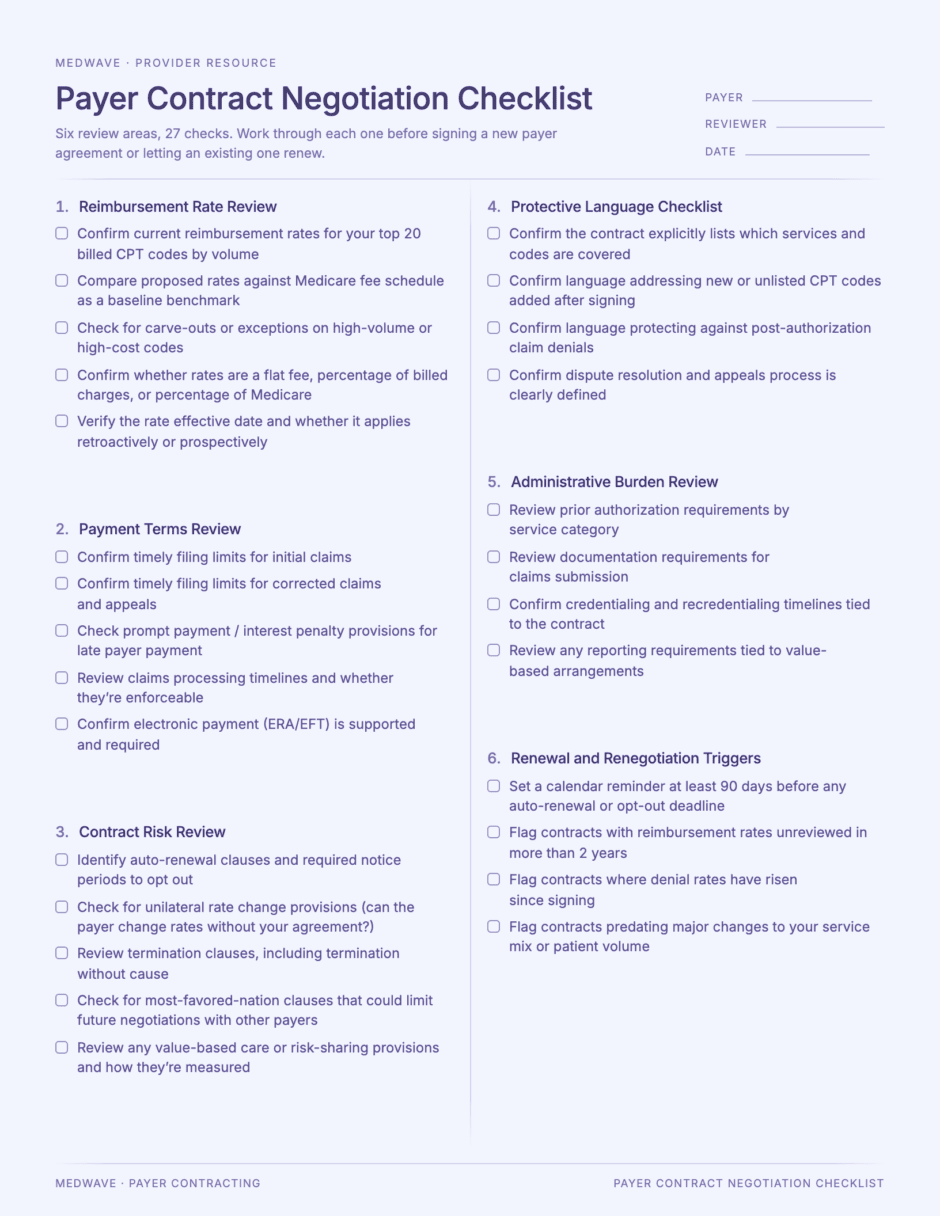
Payer Contract Negotiation Checklist
Download our payer contract negotiation checklist (PDF).
Payer Contract Negotiation FAQ
What is the Payer Contract Negotiation Checklist used for?
It is a review tool used before signing, renewing, or renegotiating any payer contract. It walks through rate review, payment terms, risk review, and protective language in a set sequence. The goal is to catch unfavorable terms before a provider commits to a contract.
What should be checked during the reimbursement rate review?
Providers should confirm current rates for their top 20 billed CPT codes by volume and compare proposed rates against the Medicare fee schedule. They should also check for carve-outs on high-volume codes and confirm whether rates are flat fees, a percentage of billed charges, or a percentage of Medicare. The rate effective date and whether it applies retroactively or prospectively should also be verified.
What are the main risks to look for in a payer contract?
Key risks include auto-renewal clauses with short opt-out windows, unilateral rate change provisions that let the payer adjust rates without agreement, and termination clauses that allow termination without cause. Most-favored-nation clauses and value-based or risk-sharing provisions should also be reviewed, since they can limit future negotiating room.
What protective language should a payer contract include?
A contract should clearly list which services and codes are covered and address how new or unlisted CPT codes added after signing are handled. It should also include language protecting against post-authorization claim denials and a clearly defined dispute resolution and appeals process. Medwave flags three specific protective phrases in every contract review.
When should a provider flag a contract for renegotiation?
A contract should be flagged if reimbursement rates have gone unreviewed for more than two years or if denial rates have risen since signing. Contracts that predate major shifts in service mix or patient volume should also be flagged. A calendar reminder set at least 90 days before any auto-renewal or opt-out deadline is recommended.
How does Medwave support providers with payer contracts?
Medwave’s payer contracting team benchmarks proposed rates against Medicare and against its own data across more than 15,000 providers it has worked with before a client signs. Medwave has also supported providers with medical billing and credentialing, reporting a 98 percent clean claim rate and average credentialing time of 85 days.
Related Reading
 For the full lifecycle view of payer contracting, see The Intricacies of Payer Contracting.
For a deeper walkthrough of evaluating reimbursement rates and contract risk, see Payer Contract Analysis: How to Evaluate Reimbursement Rates, Payment Terms, Contract Risk.
Medwave has supported more than 15,000 providers with medical billing, credentialing, and payer contracting. Our clean claim rate is 98 percent, and credentialing averages 85 days.