
BCBS credentialing takes more steps than most practices expect, because provider credentialing with Blue Cross Blue Shield means dealing with independent companies that each run their own application. A solo practitioner, a group practice, and a credentialing specialist handling a full roster all face the same basic problem. The paperwork looks familiar, but the rules change from plan to plan.
This guide walks through the process one step at a time, from the first document you gather to the final committee decision. It also covers the mistakes that stall applications and what to do when yours stalls anyway.
Key Takeaways
- BCBS is a group of independent companies, so each plan has its own application, requirements, and timeline.
- Gather your documents once. You will reuse them for every plan.
- Your CAQH profile must be complete, authorized for each BCBS plan, and re-attested every 120 days.
- Primary source verification usually takes 45 to 90 days, followed by committee review.
- Track each plan separately and follow up every two to three weeks.
- Start recredentialing about six months before the due date.
BCBS Credentialing Basics
Most national payers credential you once and apply that approval across the country. BCBS does not work that way. It operates through independent companies in different states, and each one makes its own credentialing decisions.
In practice, that means a few things.
- Each BCBS plan may have slightly different requirements.
- You might need to credential with more than one BCBS company.
- Documentation requirements can vary by state.
- Processing times differ between plans.
The Foundation: What You’ll Need
Before you start any application, pull together the full document set. Having it ready saves days later, since nearly every plan asks for the same core items.
Basic Documentation
 Current state medical license(s)
- DEA registration and state DPS/CDS (if applicable)
- Board certification(s)
- Professional liability insurance declaration page
- CV showing 5 years of work history with no gaps
- Medical school diploma
- Residency or fellowship certificates
- ECFMG certificate (if applicable)
- Government-issued photo ID
- Social Security card
- National Provider Identifier (NPI)
- CAQH profile
- Medicare and Medicaid numbers (if applicable)
 Current state medical license(s)
Gaps in work history draw questions, so explain any in writing before the plan asks.
BCBS-Specific Requirements
State-by-State Variations
Each BCBS plan has unique requirements, because each licensee runs its own credentialing process. We break down what changes and what stays the same in our guide to BCBS credentialing by state.
Common variations include different liability insurance minimums, state-specific background check requirements, varying site visit requirements, and plan-specific application forms. Check each plan’s current requirements before you submit anything. Anthem, a Blue brand owned by Elevance Health, is one example, and we cover its process in our guide to Anthem credentialing.
The CAQH Foundation
Like most major insurers, BCBS pulls provider data from CAQH. The platform is now called the CAQH Provider Data Portal, and many providers still know it as CAQH ProView.
BCBS plans add a few requirements of their own.
- Complete attestation every 120 days.
- Authorize every relevant BCBS plan to view your profile.
- Keep the profile consistent with each state application.
- Maintain current certificates and licenses.
A lapsed attestation is one of the easiest ways to stall a file, so put the next date on your calendar the day you finish.
The Application Process, Step by Step
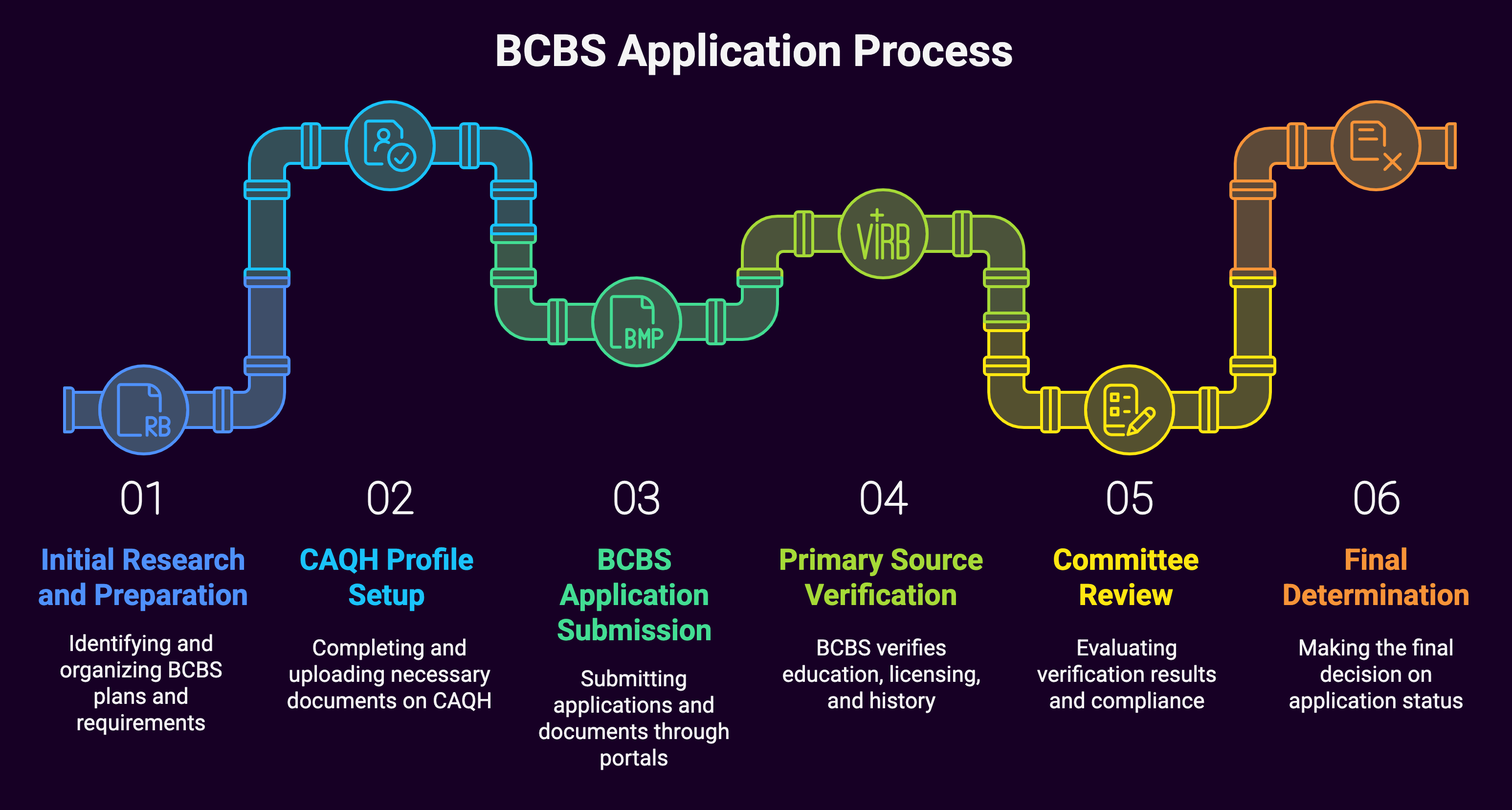
Step 1: Initial Research and Preparation
Start by identifying which BCBS plans apply to your practice. That usually follows your patient mix and the states where you see patients.
For each plan, review its specific requirements and build a checklist. Then organize your documentation by plan, so nothing gets mixed between applications.
Step 2: CAQH Profile Setup
Complete every section of your CAQH profile and upload the required documents. Authorize each BCBS plan you plan to apply to, and set attestation reminders. An incomplete profile is the most common reason an application sits untouched.
Step 3: BCBS Application Submission
Log in to the provider portal for each plan and complete its application. Submit the supporting documentation and pay any applicable fees. Write down the submission date and the confirmation number for every application, because you will need both when you follow up.
Step 4: Primary Source Verification
During this phase, BCBS checks your claims against the original sources. It verifies the following.
- Education and training
- Licensing
- Board certifications
- Work history
- Malpractice history
- Hospital privileges
- References
This step usually takes 45 to 90 days, depending on the plan.
Step 5: Committee Review
Once verification is done, the credentialing committee reviews your file. It looks at the verification results, practice patterns, quality indicators, and compliance history. Committees meet on a set schedule, so a file that misses a cutoff waits for the next meeting.
Step 6: Final Determination
The committee reaches one of three outcomes. It can approve you, deny you, or request additional information. A request for more information is not a denial, and answering it quickly keeps the file moving.
How Long BCBS Credentialing Takes
Plan on several months, not several weeks. Primary source verification alone usually runs 45 to 90 days, and committee review adds its own wait on top. A plan that meets monthly will not look at your file until the next meeting after verification finishes.
Delays tend to come from the same few places. An incomplete CAQH profile, an expired license or certificate, or a lapsed attestation can each push a file back to the start of the line. Missing information that BCBS has to request from you costs even more time, since every back-and-forth restarts the clock on that item.
The practical advice is simple. Begin the application as soon as you know a provider’s start date, and ask each plan early whether it offers provisional participation while the file is under review. Do not schedule patients with a plan until you have a confirmed effective date in writing.
Managing Multiple BCBS Plans
Credentialing with one plan is a project. Credentialing with several is a tracking problem.
Managing Multiple Applications
- Create a master tracking spreadsheet.
- Use consistent information across applications.
- Maintain separate files for each plan.
- Track deadlines and follow-up dates.
Tips for Multi-State Providers
- Prioritize by patient volume.
- Consider delegated credentialing.
- Use centralized document management.
- Set up a calendar for renewal dates.
Start with the plans that cover most of your patients. Those approvals bring in revenue first, and they teach you how the others are likely to run.
Best Practices for Staying on Track
Documentation Management
- Create digital copies of everything.
- Use consistent naming conventions.
- Maintain a credentialing calendar.
- Keep separate folders by BCBS plan.
- Store confirmation numbers and reference IDs.
 Create digital copies of everything.
Communication Strategies
Name one person to own every BCBS application, so questions never go to the wrong desk. Document each call and email as it happens. Follow up every two to three weeks, and keep written records of conversations. Submit everything through official channels only.
Common Challenges and Fixes
Mistakes That Delay Applications
A handful of errors cause most of the delays we see. Submitting an incomplete CAQH profile is the biggest one. Close behind are expired documents, unexplained gaps in work history, and forgetting to authorize a plan to view the profile. Applying to the wrong BCBS company for the state where you practice also happens more than it should, so confirm the plan before you fill out a single form.
Delayed Processing
If an application stalls, work through the checks in order.
- Check application status online.
- Contact provider relations.
- Verify your CAQH attestation.
- Submit any missing information promptly.
Information Discrepancies
Mismatched information between your CAQH profile and your application slows a file down fast. To resolve it, review every submission for consistency, then update CAQH immediately. Send corrections through the proper channels and follow up to confirm they were received.
Special Situations
Group Practice Considerations
 A group adds a second layer of work. Each provider needs an individual application, and the group agreement is managed separately. Coordinate the two so the timelines line up. Keep the group’s demographic information current, and look into delegated credentialing where a plan offers it.
Adding Practice Locations
When you add a location, notify each relevant BCBS plan. Then update your CAQH profile and complete the plan’s location add forms. Verify tax ID requirements too, since a mismatch between the location and the tax ID can hold up claims later.
Recredentialing Process
Plan ahead for recredentialing, because it arrives on a fixed cycle. Start about six months before the due date. Update all documentation, review any new requirements, and complete your CAQH re-attestation.
Maintaining Your BCBS Credentials
Approval is not the finish line. Plans expect you to keep your file accurate for as long as you participate.
Ongoing Compliance
- Track expiration dates.
- Monitor requirement changes.
- Update information promptly.
- Maintain an accurate CAQH profile.
- Document continuing education.
Regular Updates
Tell BCBS about practice changes, provider status updates, location changes, tax ID modifications, and coverage arrangements. Late notice is a common source of denied claims and lapsed participation.
Expert Tips for the Long Term
Building Strong Relationships
A named contact at the plan saves hours when something goes wrong. Establish contact with your provider representatives, attend BCBS provider workshops, and join provider advisory groups. Stay informed about policy changes before they reach your claims.
Quality Reporting
Learn how each plan measures quality, and take part in its quality programs. Document your outcomes, and meet reporting deadlines.
Resources and Support
Key Contacts
- Provider Services (plan-specific)
- Credentialing Department
- Network Management
- Technical Support
Online Resources
- BCBS plan websites
- Provider portals
- CAQH Provider Data Portal
- State medical board websites
Quick Reference Troubleshooting Guide
Common Issues and Solutions
Application Status Issues
 Application Status Issues
- Check the online portal.
- Contact provider services.
- Verify submission receipt.
- Follow up systematically.
Document Problems
- Review requirements carefully.
- Submit current versions.
- Follow format specifications.
- Keep submission records.
Timeline Concerns
- Start early.
- Follow up regularly.
- Document delays.
- Escalate when necessary.
Blue Cross Blue Shield Credentialing FAQ
Why is credentialing with Blue Cross Blue Shield different from other insurers?
BCBS operates through independent companies in different states rather than as one national entity. A provider may need to credential separately with multiple BCBS plans, and requirements like documentation, forms, and processing times can vary from state to state.
What documents are needed before starting a BCBS credentialing application?
Providers should gather a current state medical license, DEA registration, board certifications, a professional liability insurance declaration page, and a five-year work history CV with no gaps. Other items include the medical school diploma, residency certificates, a government-issued photo ID, an NPI number, and a completed CAQH profile.
What role does CAQH play in BCBS credentialing?
CAQH is the profile system BCBS plans use to collect provider information, and it requires attestation every 120 days to stay active. The platform is now called the CAQH Provider Data Portal and was formerly known as CAQH ProView. Providers must authorize each relevant BCBS plan within the profile and keep information consistent with what is submitted on state applications.
What are the main steps in the BCBS credentialing process?
The process starts with research and preparation, followed by setting up a CAQH profile and submitting plan-specific BCBS applications. After submission, BCBS conducts primary source verification of education, licensing, and work history. A credentialing committee then reviews the results before a final approval or denial decision.
How long does primary source verification typically take with BCBS?
Primary source verification generally takes between 45 and 90 days, though the exact timeline depends on the specific BCBS plan. During this stage, BCBS checks education, licensing, board certifications, work history, malpractice records, hospital privileges, and references.
What steps help providers manage credentialing with multiple BCBS plans?
Build a master tracking spreadsheet, keep information consistent across all submissions, and maintain separate files for each plan. Multi-state providers should also prioritize applications based on patient volume and consider delegated credentialing where available.
Summary: Where Medwave Fits in Your BCBS Application
Credentialing with BCBS rewards attention to detail, steady follow-up, and a tracking system that keeps each plan separate. Keep this guide handy while you work, and ask your local BCBS provider representative when a plan’s rules are unclear.
Medwave handles medical credentialing, payer contracting, and medical billing for practices, and the three depend on each other. A provider cannot bill a plan until the file is approved, and the payer contracting terms decide what each approved claim pays. If you would rather hand BCBS applications to a team that tracks them daily, book a consultation to go over your BCBS applications.

Co-Founder and COO of Medwave, bringing more than 25 years of hands-on experience in healthcare revenue cycle management, payer contracting, and medical credentialing.