

“Revenue leakage” describes circumstances wherein a healthcare provider has supplied care to a patient but doesn’t collect payment. In general, it happens when accounts receivable (AR) continue to be unpaid for too long and are inadvertently overlooked.
 The longer an account receivable remains outstanding, the less likely healthcare providers are to retrieve payment, even in part. If the AR cycle goes on more than 120 days, providers can usually hope for no more than a dime on the dollar reimbursement rate.
No one solution tackles the reasons for leakage, as blame may fall to the provider’s practices, its patients or its payers. That said, a more wide-ranging approach or outsourcing to a revenue cycle management (RCM) company may help reduce revenue leakage and the accompanying financial harm.
Key Takeaways
Revenue leakage happens when a provider delivers care but never collects payment, usually because AR sits unresolved too long (recovery drops sharply past 120 days); the top causes are unverified insurance, intake errors, and coding mistakes, and the fix is front-loaded process discipline (verify eligibility, collect copays at time of service, avoid patient balance write-offs) or, when staff/systems can’t keep pace, outsourcing revenue cycle management.
AR Cycles and RCM
Healthcare providers look at accounts receivable and revenue in terms of a cycle that begins with the patient’s initial appointment scheduling and remains open until that care provider receives payment.
Revenue cycle management takes aim at reducing inefficiencies that affect ARs being rejected by payers, put off by patients and growing old without notice or follow-up. A more far-encompassing RCM boosts the provider’s process flow from the moment the front desk collects the patient’s information.
Top Causes of Revenue Leakage in Healthcare
Revenue leakage may be ascribed to any number of sources, but recognizing the chief reasons allows healthcare providers to discover solutions.
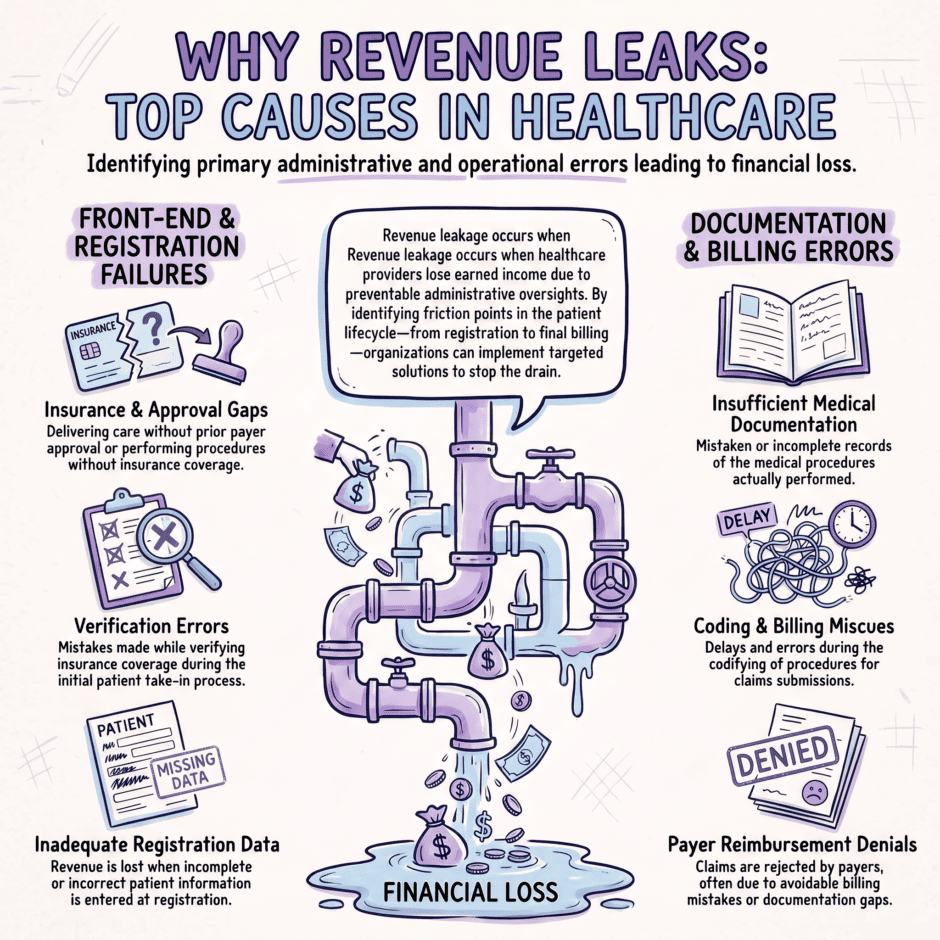
According to a source that provides management resources for healthcare organizations, revenue leakage can be attributed to these principal causes:
- Lack of payer approval prior to delivering care
- Errors in verifying insurance coverage in the course of patient take-in
- Inadequate registration information entered
- Mistaken or insufficient documentation of medical procedures
- Billing mistakes
- Engaging in a procedure without insurance coverage
- Payer reimbursement denials
- Delays or errors when codifying procedures for claims submissions
The good news here is that providers can tackle many of these causes of revenue leakage by simply assessing their processes, pinpointing inefficiencies and aiming for improvement.
Unverified insurance coverage persists as the chief supplier of claims denials. Coding errors are the principal reason for Medicare and Medicaid claim denials.
Merely cleaning up ordinary clerical errors will reduce claim denials centered on incorrect insurance and billing information.
Several of the primary strategies healthcare providers can rely on to help them minimize or eliminate revenue leakage are:
Process Optimization
Incidents that lead to revenue leakage can occur the moment the revenue cycle begins with a patient. Should staff incorrectly record info about the patient and their insurance plan, providers run the risk of payers denying claims right from the beginning of the cycle. Making mistakes when adding line items of services rendered and the equipment used for claims likewise contributes to a higher chance of denial.
Process optimization includes:
- Collect precise personal and insurance info from patients and check eligibility prior to their initial appointment.
- Make use of appointment reminders to let patients know in advance of what their anticipated costs will be.
- Stress to the front desk the magnitude of collecting patient copays immediately following care.
- Remove AR aging brackets from the bottom of statements, as they imply to patients that they can postpone payments.
- Send no more than two notices by mail before switching to phone calls.
More Payment Options
Many practices inadvertently put limits on their ability to be paid by patients by failing to offer various payment methods. This often takes place with the types of credit cards accepted or when practices lack payment plans. Patients who walk out the door without putting down a payment are 50 percent more apt to dodge paying their medical bills in the future. Finding ways to help boost collecting the patient’s responsibility up front will help stop major revenue leakage.
Don’t Write off Patient Balances
Healthcare providers routinely write off patient balances. But besides being counterproductive, it could also breach the terms of an insurance contract. Medicare expects healthcare providers to collect patient co-insurance, and private carriers assume the same with copays and deductibles. Providers run the risk of violating their contract and of the insurance company reducing allowed amounts to match what the healthcare provider accepted as payment in full when they wrote off the patient balance.
Search for Hidden Insurance Coverage
Patients often qualify for new of different coverage without notifying your intake staff. Make it a policy to at least verbally ask about insurance changes with every patient at every visit. Another tip is to confirm active Medicaid coverage at ever visit and check for Medicaid coverage for self-pay patients and Medicare patients with no supplemental coverage. Medicaid covers medical services up to three months prior to the patient’s coverage date, so don’t forget to check your system for qualifying charges.
Underpayments
One of the highest sources of revenue is knowing exactly what your services cost. Underpayments can be avoided by planning and revising your fee schedule as per the various insurance companies promptly. Seek expert assistance in defining your fee schedules.
Patient Centricity
As a healthcare provider, your primary responsibility is patient care and satisfaction. You might want to consider forming a customer service team that maintains consistent communications with your patients.
Revenue Leakage FAQ
What does revenue leakage mean in healthcare billing?
Revenue leakage happens when a provider gives care to a patient but never collects payment for it. This usually occurs when accounts receivable sit unresolved for too long and get overlooked by staff. The longer an account goes unpaid, the less likely the provider is to recover any of that money.
How does the age of an unpaid account affect recovery odds?
As an account receivable stays open longer, the odds of collecting on it drop sharply. Once an AR passes 120 days outstanding, providers can typically expect to recover only about ten cents on the dollar. This is why prompt follow-up on unpaid balances matters so much for protecting revenue.
What are the main causes of revenue leakage?
Common causes include treating patients without prior payer approval, errors made while verifying insurance during intake, incomplete registration details, and inaccurate documentation of procedures. Billing mistakes, coding delays or errors, and outright payer denials also contribute heavily. Unverified insurance coverage is the top driver of claim denials overall, while coding errors are the leading cause of Medicare and Medicaid denials.
What is an AR cycle and why does it matter for revenue leakage?
The AR cycle is the span from when a patient schedules an appointment to when the provider actually receives payment for that visit. Revenue leakage tends to creep in whenever this cycle stalls, whether from payer rejections, patient delays, or accounts that simply age without anyone following up. Keeping this cycle moving is central to limiting lost revenue.
How can healthcare providers reduce revenue leakage?
Providers can cut down on leakage by tightening front-desk processes such as verifying insurance eligibility before care and collecting copays at the time of service. Reviewing intake and coding steps to catch clerical errors also reduces claim denials tied to bad insurance or billing data. When in-house staff or systems cannot keep up with these demands, outsourcing to a revenue cycle management company is another practical fix.
Why is process optimization important in preventing revenue leakage?
Many leakage problems begin right at patient intake, when staff record incorrect insurance or personal details that later cause a payer to deny the claim. Mistakes in listing service line items can compound this problem further down the billing process. Reviewing and refining these front-end steps helps stop leakage before it starts rather than chasing unpaid claims later.
When to Outsource Your Revenue Cycle Management
Healthcare providers that grapple with revenue leakage may want to contemplate outsourcing their revenue cycle and accounts receivable management.
There are three chief factors for deliberating on when determining whether or not to outsource your RCM:
- What is your staff’s level of competence when it comes to fee billing, including accuracy and timely output?
- How adequate is your practice’s billing system?
- What is the level of ability of both your staff and technologies to expand with your practice’s growth?
If at least two of the above factors show weaknesses that can’t be swiftly improved, outsourcing is possibly the best option to steer clear of falling behind in billing and revenue capture.
Outsourcing can also help your practice surmount the challenges of ever-increasing regulations and decreased reimbursement levels. When it comes to making your practice more effective and as profitable as possible, Medwave can help. Let us know how we can lend a hand in plugging your revenue cycle leaks.

Co-Founder and COO of Medwave, bringing more than 30 years of hands-on experience in healthcare revenue cycle management, payer contracting, and medical credentialing.