

Ask ten people in a medical office to explain the difference between billing and credentialing, and you might get ten different answers. Some will say they’re basically the same department. Others will shrug and say “billing is the money part, credentialing is the paperwork part,” which isn’t wrong, but it barely scratches the surface.
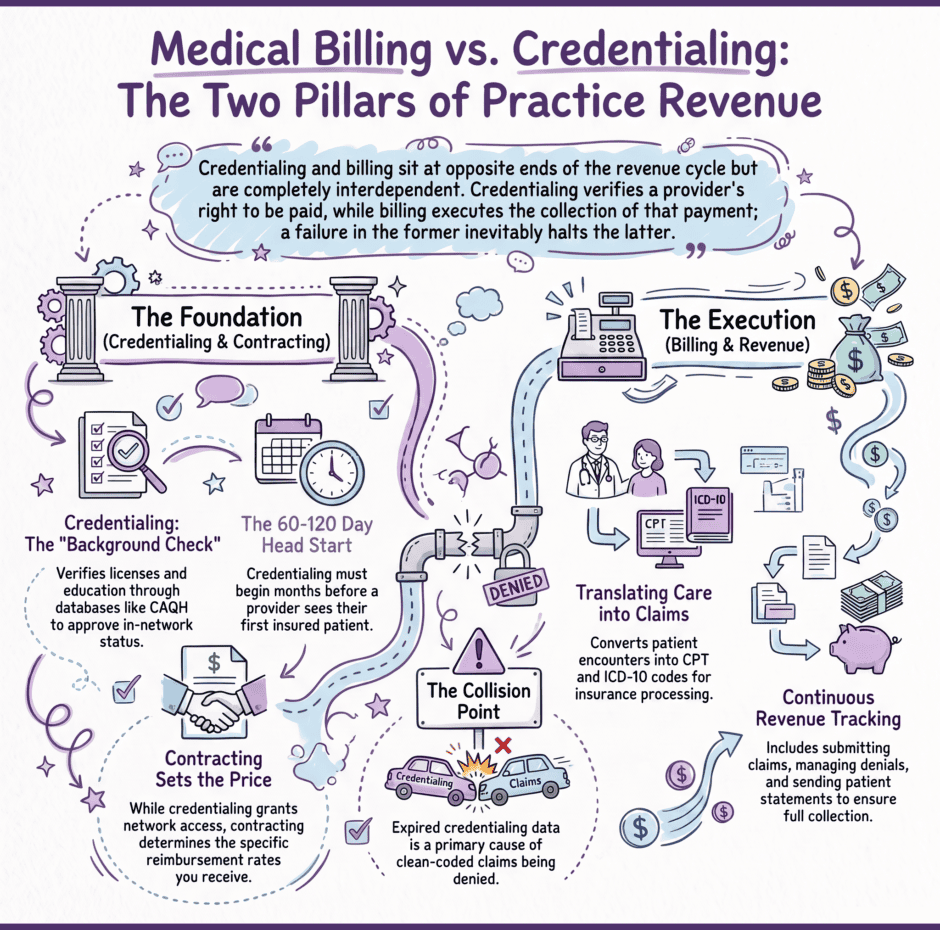
The truth is that these two functions sit at opposite ends of the revenue cycle, yet they depend on each other completely. A practice can have the best billing team in the state, but if a provider isn’t properly credentialed with a payer, every single claim tied to that provider can bounce back unpaid. On the flip side, a provider can be credentialed with every major insurance company in the country, but without accurate billing behind them, that credentialing does nothing to keep the lights on.
This article breaks down what each process actually involves, where they overlap, and why practices that treat them as separate silos tend to run into cash flow problems they never saw coming.
Key Takeaways
- Credentialing happens first. It’s the process of verifying a provider’s qualifications and getting them approved to join an insurance network.
- Billing happens after credentialing. It’s the process of submitting claims, using the correct codes, and collecting payment for services already rendered.
- Errors in credentialing (expired CAQH data, missed revalidation dates, incomplete applications) directly cause billing denials, even when the claim itself is coded perfectly.
- Payer contracting sits alongside credentialing, setting the actual reimbursement rates a provider will be paid once they’re in network.
- Practices that manage billing and credentialing together, rather than as disconnected tasks, tend to see fewer denials and faster payment cycles.
Credentialing Comes First, Always
 Before a provider can treat a single patient under an insurance plan and expect to get paid for it, that provider has to be credentialed. Credentialing is the background check of the medical world. Insurance companies want proof that a provider actually holds the license they claim to hold, that their education checks out, that their malpractice history is clean (or at least disclosed), and that nothing in their record should disqualify them from treating patients under that plan.
This isn’t a quick form to fill out over coffee. Credentialing usually starts with CAQH ProView, a centralized database where providers store their license numbers, work history, malpractice insurance details, board certifications, and a long list of other documents. Payers pull from this profile when deciding whether to approve a provider. If the CAQH profile is outdated or missing something, the whole process stalls, sometimes for weeks.
Once a payer reviews the file and everything checks out, the provider gets what’s called an effective date. That’s the date they’re officially allowed to bill that insurance company as an in-network provider. Anything billed before that date, even if the care was completely appropriate, usually won’t get paid at the in-network rate, and sometimes won’t get paid at all.
Credentialing doesn’t stop after the initial approval either. Most payers require recredentialing every two to three years, along with license renewals, updated malpractice coverage, and periodic revalidation with Medicare through PECOS. Miss one of those deadlines and a provider can quietly fall out of network without anyone noticing until claims start getting rejected.
Payer Contracting is the Piece People Forget
Credentialing gets a provider approved to join a network. Payer contracting determines what that provider actually gets paid once they’re in it. These two processes often get lumped together, but they’re not identical.
A provider can be fully credentialed with a payer and still be sitting on an outdated fee schedule that pays significantly less than what similar providers in the area are earning for the same CPT codes. Rate negotiation is its own skill set, and it’s one that a lot of independent practices simply don’t have the time or leverage to pursue on their own. Larger health systems have entire departments dedicated to renegotiating contracts every year. Smaller practices often accept whatever rate they’re offered at signup and never revisit it.
This matters because reimbursement rates can vary wildly between payers, and even between different plans offered by the same payer. Two practices doing identical work can end up with drastically different revenue simply because one negotiated better terms.
Billing is What Happens After the Care is Given
 Once a provider is credentialed and the visit or procedure has taken place, billing takes over. A medical biller translates what happened during that encounter into a language insurance companies can process. CPT codes for procedures, ICD-10 codes for diagnoses, and modifiers when extra context is needed to explain the circumstances of the visit.
The claim gets submitted electronically to the payer, and from there it enters a review process. Sometimes it’s paid cleanly. Often it’s not. A claim can be denied for dozens of reasons, wrong modifier, mismatched diagnosis and procedure codes, missing prior authorization, or a provider who wasn’t actually credentialed with that specific plan at the time of service.
Good billers don’t just submit claims and wait. They track every claim through the entire cycle, follow up on anything that stalls, appeal denials with supporting documentation, and post payments accurately once they arrive. When a claim is underpaid compared to the contracted rate, a sharp billing team catches it and pushes back. That kind of follow-through is where a lot of practices quietly lose revenue without realizing it, simply because nobody was watching closely enough.
Billing also includes patient-facing tasks like sending statements, explaining balances, and setting up payment plans. It’s a much more hands-on, day-to-day operation than credentialing, which tends to happen in bursts (heavy work during initial enrollment, then periodic maintenance after that).
Where the Two Processes Collide
Here’s where things get frustrating for a lot of practices. Billing and credentialing are handled by different people, sometimes different departments entirely, and sometimes different vendors altogether. When communication between the two breaks down, denials start piling up for reasons that have nothing to do with how the claim was coded.
A new provider joins a practice and starts seeing patients before their credentialing is finalized. The billing team, unaware of the delay, submits claims as usual. Every one of those claims gets rejected because the payer has no record of that provider being in network yet. Now the practice is stuck reworking claims, resubmitting them, and waiting weeks or months longer to get paid for care that was already delivered.
Or consider a provider whose recredentialing lapsed because nobody tracked the renewal date. Claims that would have sailed through a month earlier suddenly start bouncing. The billing team assumes it’s a coding issue and burns hours troubleshooting something that was never about coding at all.
This is exactly why practices benefit from treating billing and credentialing as connected functions rather than isolated tasks handled by whoever happens to have time. When the same team, or at least tightly coordinated teams, oversee both sides, these gaps close a lot faster.
Why the Distinction Matters for Practice Owners
 If you’re running a practice, or managing the administrative side of one, knowing where credentialing ends and billing begins helps you diagnose problems faster. A pile of denied claims doesn’t automatically mean your billing team made a mistake. It might mean a credentialing file expired three months ago and nobody caught it.
It also matters when you’re hiring or contracting for help. Some vendors only handle billing. Some only handle credentialing. Some, like practices that outsource their full revenue cycle, handle both plus contract negotiation, which tends to close a lot of the gaps described above. Knowing which service you actually need, or whether you need all three, saves you from signing a contract that only solves half your problem.
New practices in particular tend to underestimate how long credentialing takes. It’s common for the process to stretch 60 to 120 days per payer, depending on how quickly the payer processes applications and how complete the initial paperwork is. Practices that wait until a provider’s first day to start credentialing often end up with months of unbillable care sitting on the books.
Timing gets even trickier when a practice adds multiple providers at once, say during an expansion or after acquiring another group. Each provider’s file has to go through the same review with every payer the practice works with, and payers don’t process these on the same calendar. One insurer might clear a provider in six weeks. Another might take four months for the exact same paperwork. Without someone tracking each application separately, it’s easy to lose track of which providers are actually cleared to bill which plans.
There’s also a cost side to this that often gets overlooked. Every week a provider sits in credentialing limbo is a week of care that either goes unbilled, gets billed out of network at a lower rate, or gets pushed onto the patient as self-pay. For a busy provider seeing twenty or thirty patients a day, that adds up fast. A three-month credentialing delay on a single provider can represent tens of thousands of dollars in delayed or lost revenue, money that’s difficult to recover even after the credentialing eventually clears.
Staffing turnover makes this worse. When the person who tracks credentialing deadlines leaves a practice and nobody immediately picks up their spreadsheet, renewal dates slip through unnoticed. It’s a quiet kind of risk. Nothing looks wrong day to day until a batch of claims for one provider suddenly starts coming back denied, and by then the practice is already behind.
Medical Billing vs. Credentialing FAQ
Can a provider bill for services before credentialing is finished?
Generally, no. Most payers won’t reimburse for care given before the provider’s official effective date, and billing before that point usually results in denied or reworked claims.
Does credentialing guarantee a good reimbursement rate?
No. Credentialing only gets a provider approved to join a network. The reimbursement rate is set separately through payer contracting and rate negotiation.
How often does recredentialing need to happen?
Most payers require recredentialing every two to three years, though Medicare revalidation through PECOS follows its own schedule, typically every three to five years.
What’s the fastest way to avoid credentialing-related denials?
Keep CAQH ProView data current at all times, track every payer’s renewal deadline, and confirm effective dates before a new provider starts seeing patients under a plan.
Is credentialing a one-time process?
No. Initial credentialing gets a provider approved, but ongoing recredentialing, license renewals, and revalidation are required to stay in network long term.
Who typically handles credentialing at a small practice?
It varies. Some practices assign it to an office manager, others hire a credentialing specialist, and many outsource it entirely to a billing and credentialing company.
What happens if a claim is submitted under an uncredentialed provider?
The claim is almost always denied. Some practices can rebill under a supervising provider who is credentialed, but that depends on payer policy and the type of service.
Does payer contracting happen only once?
Rates can and should be revisited periodically. Fee schedules change, and practices that never renegotiate often end up underpaid compared to current market rates.
Summary: Difference Between Medical Billing and Credentialing
 Billing and credentialing aren’t competing departments fighting for the same job. They’re two halves of the same process, one that determines whether a provider can treat a patient under a given plan, and the other that determines whether the practice actually gets paid for it. Skip a step in credentialing and billing grinds to a halt. Ignore payer contracting and even clean claims pay out less than they should.
At Medwave, billing, credentialing, and payer contracting aren’t handled as separate afterthoughts. They’re managed together, which is exactly the point. When the team tracking your CAQH data is talking to the team submitting your claims, and both are backed by contract specialists who know what your rates should look like, denials drop and payments move faster. If your practice is losing time untangling why claims keep bouncing, it might be time to look at whether billing and credentialing are actually working together, or just sitting next to each other.

Co-Founder and COO of Medwave, bringing more than 30 years of hands-on experience in healthcare revenue cycle management, payer contracting, and medical credentialing.