

Medwave’s medical billing services take claims off your staff’s plate and get them paid faster. We handle the full cycle for you, from checking eligibility before a patient walks in to working the last denial on your aging report. Our team brings more than 25 years of billing experience. In that time, we’ve supported over 15,000 providers nationwide.
Most practices call us for the same reason. Money is sitting in unpaid claims, and nobody in the office has time to chase it.
Key Takeaways
- Medwave’s outsourced medical billing covers eligibility checks, coding review, claim submission, payment posting, denial management, and A/R recovery.
- We hold a 98% clean claim rate, so fewer claims bounce back and cash shows up sooner.
- Pricing is a percentage of what we collect, and the rate goes down as your claim volume goes up.
- Billing only works when credentialing and payer contracts are in order, and Medwave handles all three under one roof.
- You can keep your current software or use a cloud-based practice management and EHR system we provide at no cost.
What do Medwave’s Medical Billing Services Include?
Everything between the patient visit and the deposit in your bank account. That’s the short answer.
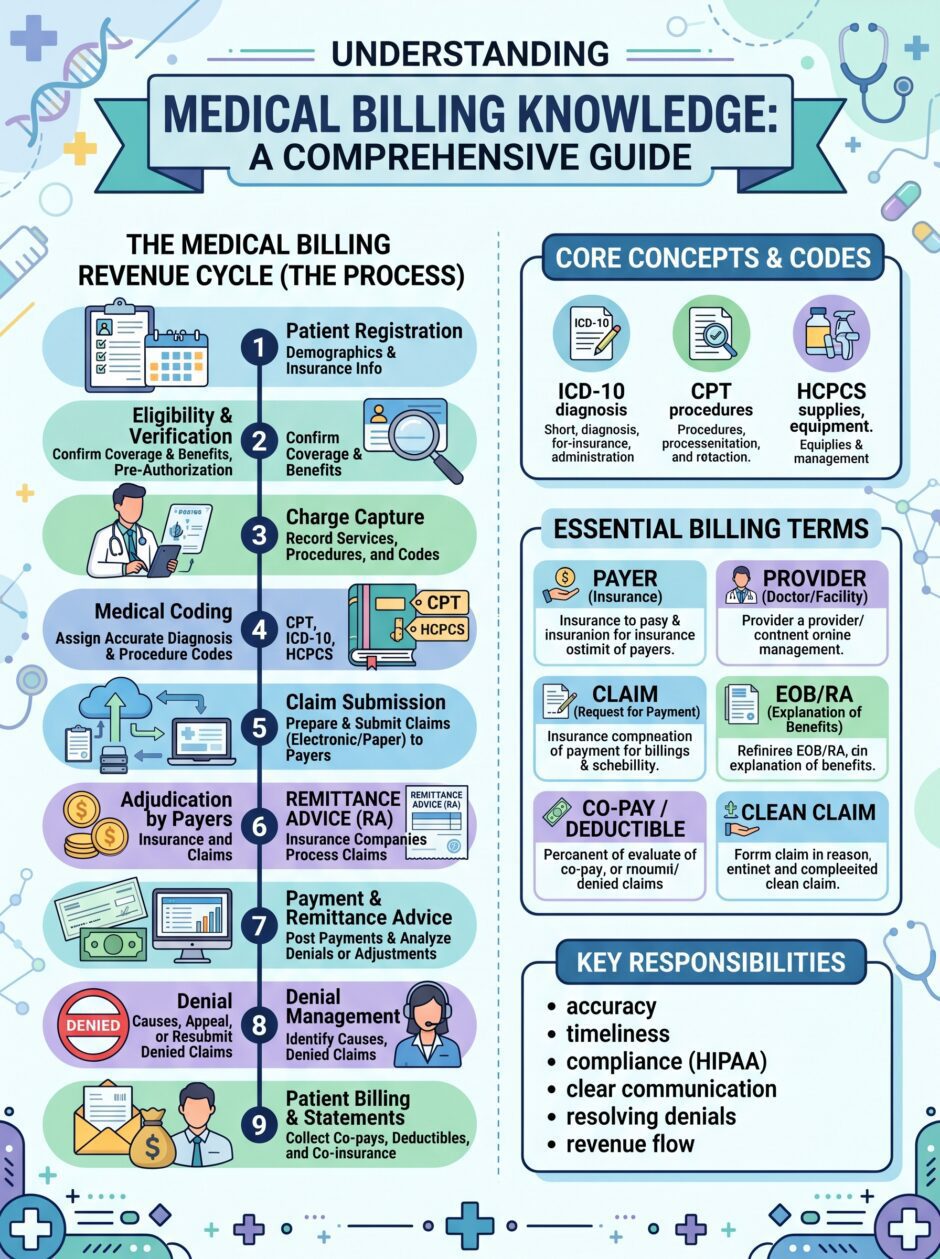
Here’s what that looks like day to day:
- Insurance eligibility and benefits verification before the appointment
- Prior authorizations for both in-network and out-of-network providers
- Charge entry and coding review using current ICD-10 and CPT codes
- Claim scrubbing, then electronic or paper submission
- Payment posting and ERA reconciliation
- Denial management and appeals
- A/R recovery for aged balances
- Patient statements
- Monthly reporting on collections, denials, and days in A/R
- Staff training on payer portals and coding updates
 Nearly every claim goes out electronically. When a payer still requires paper, we file on the CMS-1500 (02/12) form. Medicare only accepts paper claims from providers who qualify for a waiver from the electronic filing requirement, according to CMS guidance on the professional paper claim form.
Practices that see patients virtually get the same coverage through our telehealth billing team. Higher-volume groups can also add robotic process automation to handle repetitive posting and status checks.
How does Onboarding Work when You Switch Billing Companies?
Switching billing companies sounds painful. It doesn’t have to be, as long as the handoff is planned before the first claim moves.
Our process runs in this order:
- We review your practice: specialty, claim volume, payer mix, and the state of your current A/R. You get a quote based on what we find.
- Keep the system you already use, since our team has worked in most billing applications, or choose another of your liking or use ours.
- We confirm every provider is credentialed and linked to your group with each payer, and that ERA and EFT enrollments point to the right accounts.
- New claims start flowing through us while we work down the open balances your last vendor or in-house team left behind.
- Monthly reporting begins, so you can see exactly where every dollar stands.
Step three is where most switches go wrong. A provider who isn’t linked to the group contract will get denied no matter how clean the claim is.
To speed things up, our on-boarding documentation checklist lists everything we’ll ask for.
What Results can a Practice Expect from Outsourced Medical Billing?

Fewer rejections. Faster payments. Less staff time spent on hold with payers.
Medwave holds a 98% clean claim rate. That means 98 out of every 100 claims we submit pass payer edits on the first try, with no rejection for missing or mismatched data. Each claim that bounces back adds weeks to your payment timeline and pulls someone off other work to fix it, so that first-pass number matters more than most practices realize.
Clean claims only tell half the story, though. The other half is how much of the allowed amount you actually collect. We track your net collection rate every month and dig into the gaps, whether that’s underpayments, write-offs that shouldn’t have happened, or authorization mismatches that turn approved services into denials.
One thing we won’t do is promise a specific revenue increase before we’ve seen your numbers. Any billing company that does is guessing.
How Much do Medical Billing Services Cost?
Medwave charges a percentage of the money we collect for you. The exact rate depends on two things. Your claim volume and your specialty. Higher volume means a lower percentage.
We don’t publish a flat rate because a solo behavioral health practice and a multi-site orthopedic group have very different billing workloads. After we review your practice, you’ll get a written quote. Our pricing page covers the basics.
If you’re comparing models, our breakdown of percentage, flat-fee, and hybrid billing pricing walks through the tradeoffs of each.
When you weigh the cost, look at what in-house billing really runs you. Salary and benefits are only the start. Add software licenses, clearinghouse fees, training, and the cash that stalls every time a biller takes vacation or quits. For many practices, outsourcing costs less than one full-time employee.
Why does Billing Depend on Credentialing and Payer Contracting?
 A claim can be coded perfectly and still get denied. If the rendering provider isn’t credentialed with that payer, or isn’t linked to your group’s contract, the claim fails before anyone looks at the codes. We explain this in detail in why you can’t bill what you can’t credential.
Contracts matter just as much. Your fee schedule sets the ceiling on what any claim can pay, and many practices haven’t looked at theirs in years. Our rate negotiation work targets the codes you bill most.
This is where Medwave is different from billing-only companies. We run all three services in-house, with an 85-day average credentialing turnaround, so a new provider can start billing sooner and nothing falls through the gap between vendors.
Which Specialties does Medwave Bill?
We support more than 60 provider types.
Some of the most common include:
See the full list on our billing and credentialing specialties page. Don’t see your provider type? Reach out anyway. We take on outpatient clinics and facility groups outside that list regularly.
Can Medwave Work with Your EHR and Practice Management System?
Almost certainly. Our team has billed out of most major platforms, so there’s rarely a reason to switch.
For practices that need systems to talk to each other, we build HL7 integration interfaces that move charges and demographics from your EHR into billing without manual re-entry. Newer setups can use FHIR-based connections for real-time eligibility checks.
Shopping for new software? Our guide on choosing medical billing software covers what to look for.
What do Providers Say about Working with Medwave?
Our clients review us on Google, and the same things keep coming up. Claims go out clean, payers get quick follow-up, and nobody gets a surprise on the invoice.
“Claims go out clean, and when something does come back, their team catches it fast instead of letting it sit. Credentialing took less back-and-forth than we expected too, they kept us posted without us having to chase them for updates.”
Eric C., billing and credentialing client
“…their pricing is very fair in my opinion, I never received any surprise billing or unexpected charges.”
Kenneth P., medical practice owner
“They consistently follow up with the insurance companies and keep us informed of every update.”
Daniel A., credentialing client
Read more reviews from practices we work with on our Google Business Profile.
Medical Billing FAQ: What Else do Providers Ask?
How do I know if my practice should outsource medical billing?
Look at your numbers. Rising denials, A/R balances older than 90 days, or a biller who can’t keep up are all signs. If billing problems are pulling you away from patient care, it’s worth getting a quote.
Will we lose control of our billing if we outsource?
No. You keep access to your system and get monthly reports showing collections, denials, and open balances. Many clients say they have more visibility now than they did in-house.
How long does it take to switch to Medwave?
It depends mostly on payer enrollments, such as ERA and EFT setup, and whether any providers need credentialing fixes first. We map out the timeline during your practice review so there are no surprises.
Does Medwave work old A/R left by a previous billing company?
Yes. We work open balances from your prior vendor or in-house team alongside new claims, so older money doesn’t age out while the transition happens.
Is Medwave HIPAA compliant?
Yes. Medwave is HIPAA compliant and holds a SOC 2 Type 2 report. You can read our HIPAA compliance statement for details.
Do you bill commercial payers, Medicare, and Medicaid?
Yes. We bill commercial plans, Medicare, and Medicaid, and we follow payer-specific rules for each so claims aren’t held up on technicalities.
Ready to get your claims paid on time? Medwave helps practices across the country with medical billing, credentialing, and payer contracting, all handled by one team. Send us a message below or call (412) 219-4789, and someone will follow up within one business day.