

Radiology CPT codes for 2026 still live in the 70010-79999 section of the CPT code set, but several of the codes inside that section changed on January 1. CT angiography of the head and neck now has its own combined code, CT cerebral perfusion moved off a Category III tracking code, and the IMRT delivery codes radiation oncology billed for years are gone.
This guide maps the full radiology range, walks through the codes imaging practices bill most often, and covers the billing rules that decide whether those codes get paid.
Key Takeaways
- Radiology CPT codes run from 70010 to 79999 across seven subsections, from diagnostic imaging through nuclear medicine.
- For 2026, CTA head and neck reports with 70471, CT cerebral perfusion uses +70472 or 70473, and IMRT delivery codes 77385 and 77386 are deleted.
- Most imaging codes split into a technical component (modifier TC) and a professional component (modifier 26), and billing the wrong one is a leading cause of radiology denials.
- “With contrast” in a CPT descriptor means IV contrast. Oral contrast alone still gets the without-contrast code.
What Are Radiology CPT Codes?
 Radiology CPT codes are the five-digit Current Procedural Terminology codes payers use to identify imaging and radiation services. The American Medical Association maintains the code set and updates it every January. For a refresher on how the codes are built, see how CPT codes work.
Each radiology code pins down the modality (X-ray, CT, MRI, ultrasound or nuclear medicine), the anatomy imaged, and usually the contrast status or number of views. Change any of those and the code changes with it.
The full radiology section spans 70010 to 79999. Interventional radiology is the main exception. Most IR procedure codes sit in the Surgery section, and only the supervision and interpretation codes fall inside the radiology range.
How Are Radiology CPT Codes Organized?
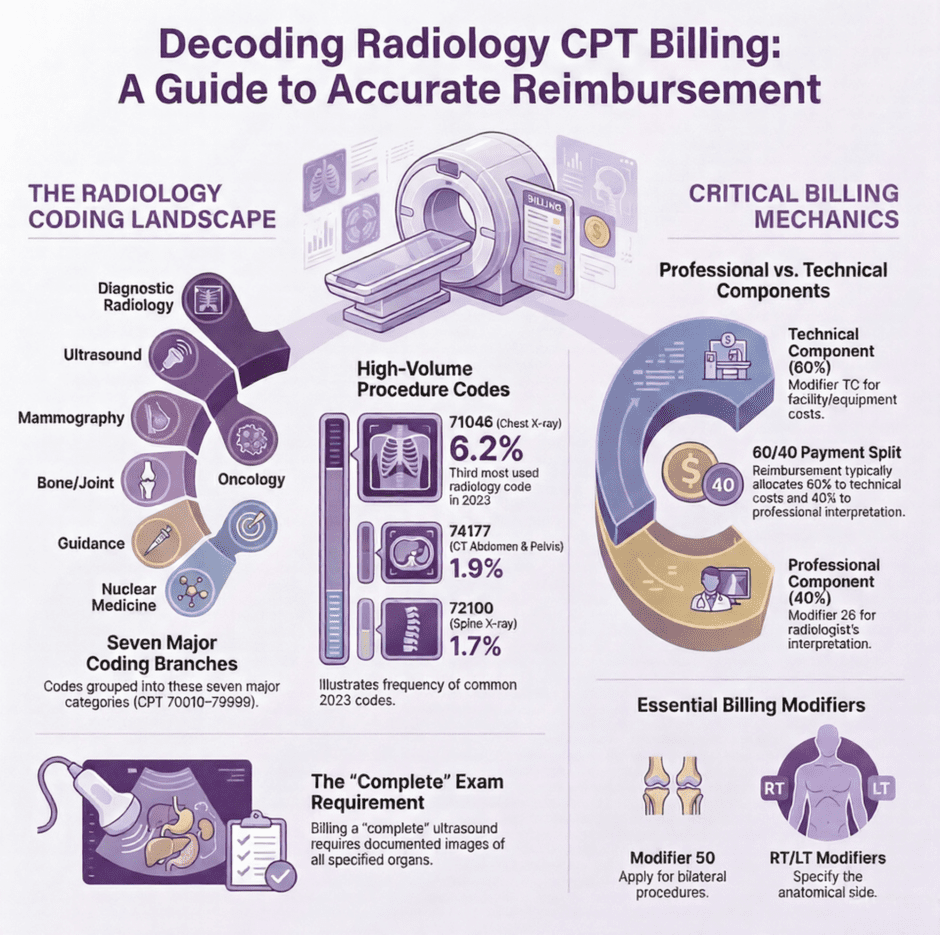
The radiology section breaks into seven subsections. Diagnostic radiology is by far the largest and holds the X-ray, CT, MRI and vascular imaging codes.
| Subsection | Code Range | What It Covers |
|---|---|---|
| Diagnostic Radiology (Diagnostic Imaging) | 70010-76499 | X-ray, CT, CTA, MRI, MRA and vascular imaging by body region |
| Diagnostic Ultrasound | 76506-76999 | Abdominal, pelvic, obstetric, breast and extremity ultrasound, plus ultrasound guidance |
| Radiologic Guidance | 77001-77022 | Fluoroscopic, CT and MR guidance for needle placement and other procedures |
| Breast, Mammography | 77046-77067 | Breast MRI, diagnostic and screening mammography, tomosynthesis add-on |
| Bone/Joint Studies | 77071-77086 | DXA bone density, skeletal surveys, vertebral fracture assessment |
| Radiation Oncology | 77261-77799 | Treatment planning, simulation, dosimetry, treatment delivery and management |
| Nuclear Medicine | 78012-79999 | Diagnostic nuclear imaging, SPECT, PET and therapeutic radiopharmaceuticals |
Inside those subsections, a relatively small group of codes makes up most imaging claims. The tables below list them by modality with shortened descriptions. Confirm the full descriptor in the current CPT book before billing.
X-ray codes are driven by body part and number of views.
| CPT Code | Description |
|---|---|
| 71045 | Chest X-ray, single view |
| 71046 | Chest X-ray, 2 views |
| 71047 | Chest X-ray, 3 views |
| 71048 | Chest X-ray, 4 or more views |
| 72040 | Cervical spine X-ray, 2 or 3 views |
| 72070 | Thoracic spine X-ray, 2 views |
| 72100 | Lumbosacral spine X-ray, 2 or 3 views |
| 72110 | Lumbosacral spine X-ray, minimum 4 views |
| 73030 | Shoulder X-ray, minimum 2 views |
| 73110 | Wrist X-ray, minimum 3 views |
| 73130 | Hand X-ray, minimum 3 views |
| 73502 | Hip X-ray, unilateral, with pelvis when performed, 2 or 3 views |
| 73560 | Knee X-ray, 1 or 2 views |
| 73562 | Knee X-ray, 3 views |
| 73564 | Knee X-ray, complete, 4 or more views |
| 73610 | Ankle X-ray, complete, minimum 3 views |
| 73630 | Foot X-ray, complete, minimum 3 views |
| 74018 | Abdomen X-ray, 1 view |
| 74019 | Abdomen X-ray, 2 views |
CT and CTA codes turn on anatomy and contrast status.
| CPT Code | Description |
|---|---|
| 70450 | CT head/brain, without contrast |
| 70486 | CT maxillofacial area, without contrast |
| 71250 | CT thorax, without contrast |
| 71260 | CT thorax, with contrast |
| 71271 | CT thorax, low dose, for lung cancer screening |
| 72125 | CT cervical spine, without contrast |
| 72131 | CT lumbar spine, without contrast |
| 74176 | CT abdomen and pelvis, without contrast |
| 74177 | CT abdomen and pelvis, with contrast |
| 74178 | CT abdomen and pelvis, without contrast followed by with contrast |
| 70471 | CTA head and neck (new for 2026) |
| 70496 | CTA head |
| 70498 | CTA neck |
| 71275 | CTA chest |
| 74174 | CTA abdomen and pelvis |
| 75571 | CT heart, without contrast, with coronary calcium scoring |
| 75574 | CTA heart, coronary arteries and bypass grafts |
MRI codes follow the same anatomy-plus-contrast logic.
| CPT Code | Description |
|---|---|
| 70551 | MRI brain, without contrast |
| 70553 | MRI brain, without contrast followed by with contrast |
| 72141 | MRI cervical spine, without contrast |
| 72146 | MRI thoracic spine, without contrast |
| 72148 | MRI lumbar spine, without contrast |
| 72158 | MRI lumbar spine, without contrast followed by with contrast |
| 72195 | MRI pelvis, without contrast |
| 72197 | MRI pelvis, without contrast followed by with contrast |
| 73221 | MRI upper extremity joint, without contrast |
| 73721 | MRI lower extremity joint, without contrast |
| 74181 | MRI abdomen, without contrast |
| 74183 | MRI abdomen, without contrast followed by with contrast |
Ultrasound codes split heavily on complete versus limited exams.
| CPT Code | Description |
|---|---|
| 76536 | Ultrasound, soft tissues of head and neck (including thyroid) |
| 76641 | Ultrasound, breast, unilateral, complete |
| 76642 | Ultrasound, breast, unilateral, limited |
| 76700 | Ultrasound, abdomen, complete |
| 76705 | Ultrasound, abdomen, limited |
| 76770 | Ultrasound, retroperitoneal, complete |
| 76801 | Obstetric ultrasound, under 14 weeks, single gestation |
| 76805 | Obstetric ultrasound, 14 weeks or more, single gestation |
| 76830 | Transvaginal ultrasound, non-obstetric |
| 76856 | Pelvic ultrasound, non-obstetric, complete |
| 76882 | Ultrasound, extremity, nonvascular, limited |
| 76942 | Ultrasound guidance for needle placement |
Vascular duplex studies such as carotid and venous scans are not in this range. They sit in the Medicine section at 93880-93990.
Breast imaging and bone density codes have their own subsections.
| CPT Code | Description |
|---|---|
| 77046 | MRI breast, unilateral, without contrast |
| 77047 | MRI breast, bilateral, without contrast |
| 77048 | MRI breast, unilateral, without and with contrast, including CAD |
| 77049 | MRI breast, bilateral, without and with contrast, including CAD |
| 77063 | Screening digital breast tomosynthesis, bilateral (add-on) |
| 77065 | Diagnostic mammography, unilateral, including CAD when performed |
| 77066 | Diagnostic mammography, bilateral, including CAD when performed |
| 77067 | Screening mammography, bilateral, including CAD when performed |
| 77075 | Radiologic skeletal survey, complete |
| 77080 | DXA bone density, axial skeleton |
| 77081 | DXA bone density, appendicular skeleton |
| 77085 | DXA bone density, axial skeleton, with vertebral fracture assessment |
Nuclear medicine and PET round out the range. Radiopharmaceuticals are billed separately with HCPCS A-codes or Q-codes, and the isotope on the claim has to match the study performed.
| CPT Code | Description |
|---|---|
| 78014 | Thyroid imaging with uptake |
| 78306 | Bone and/or joint imaging, whole body |
| 78452 | Myocardial perfusion imaging, SPECT, multiple studies |
| 78582 | Pulmonary ventilation and perfusion imaging |
| 78815 | PET with concurrent CT, skull base to mid-thigh |
| 78816 | PET with concurrent CT, whole body |
What Are the Most Common Radiology CPT Codes?
A handful of codes show up on imaging claims far more than the rest. These ten cover a large share of the X-ray, CT, MRI and ultrasound volume at imaging centers, hospital outpatient departments, and orthopedic and urgent care practices with in-house imaging. The American College of Radiology’s coding resources are the best place to check descriptor changes year to year.
CPT 71046
71046 is a chest X-ray with 2 views, the standard frontal and lateral study ordered for pneumonia, chest pain, shortness of breath and pre-operative clearance. A third view moves the claim to 71047.
CPT 71045
71045 is a chest X-ray with a single view. It is the code for most portable studies, line and tube placement checks, and quick follow-up imaging.
CPT 72100
72100 is a lumbosacral spine X-ray with 2 or 3 views, used for low back pain, trauma and degenerative disease. A study with 4 or more views is 72110, so the report needs to state the view count.
CPT 72148
72148 is an MRI of the lumbar spine without contrast, ordered for disc herniation, stenosis and radiculopathy. When a post-contrast series is added in the same session, the code becomes 72158. Most commercial plans require prior authorization for both.
CPT 74177
74177 is a CT of the abdomen and pelvis with contrast, one of the highest-volume CT codes in emergency and outpatient settings. The same study without contrast is 74176, and without followed by with contrast is 74178. These three get mixed up more than almost any other CT family.
CPT 74183
74183 is an MRI of the abdomen without contrast followed by with contrast, used for liver lesions, pancreatic evaluation and renal masses. It is an MRI code, not a CT code, and billing it for a CT study is a straight denial. The non-contrast version is 74181.
CPT 76700
76700 is a complete abdominal ultrasound. The record has to document the liver, gallbladder, common bile duct, pancreas, spleen, kidneys, upper abdominal aorta and inferior vena cava. If any element is missing without a documented reason, bill 76705 for a limited exam or expect one of the top reasons claims get denied.
CPT 73502
73502 is a unilateral hip X-ray with 2 or 3 views, including the pelvis when performed. It is the go-to study for hip fracture, arthritis and hip pain workups. Bilateral hips have their own codes (73521-73523), so do not bill 73502 twice with RT and LT.
CPT 73030
73030 is a shoulder X-ray with at least 2 views, one of the highest-volume extremity codes in orthopedic and urgent care imaging. It covers dislocations, fractures, rotator cuff evaluation and arthritis. A single-view shoulder study is 73020.
CPT 74018
74018 is a single-view abdominal X-ray, ordered to check for bowel obstruction, free air, kidney stones or foreign bodies. Two views is 74019, and 3 or more views is 74021.
How Do Professional and Technical Components Work?
 Most diagnostic imaging codes have two billable parts. The technical component covers the equipment, technologist, supplies and facility. The professional component covers the radiologist’s interpretation and written report.
Whoever owns the equipment bills the technical component with modifier TC. The reading radiologist bills the professional component with modifier 26. A chest X-ray done in a hospital and read by an outside group becomes two claims, 71046-TC from the hospital and 71046-26 from the radiology group.
When one entity owns the equipment and also interprets the images, it bills the global service with no modifier. An orthopedic practice that takes and reads its own knee films bills 73562 globally. Two parties both billing the global code for one study is one of the fastest routes to duplicate-claim denials, which is why radiology billing arrangements need the split agreed in writing.
The split between the two components varies by code. The technical share is usually larger for CT, MRI and PET because of equipment cost. Medicare also applies a multiple procedure payment reduction when advanced imaging of contiguous body areas happens in the same session. The highest-paid study pays in full, and each additional study is reduced 50 percent on the technical component and 5 percent on the professional component.
Which Modifiers Are Essential in Radiology Billing?
Beyond TC and 26, a short list of modifiers carries most radiology claims.
- Modifier 50 reports a bilateral procedure on codes whose descriptor is unilateral, such as bilateral knee X-rays. Some payers want RT and LT on two lines instead, so check the payer policy first.
- Modifiers RT and LT identify the side imaged on unilateral studies and keep a same-day study on the opposite side from looking like a duplicate.
- Modifier 76 marks a repeat procedure by the same physician on the same day, and modifier 77 marks a repeat by a different physician.
- Modifier 52 reports a reduced service, such as a study cut short of its full descriptor. Pair it with 26 when only the interpretation is billed.
- Modifier 53 reports a procedure discontinued after it started, usually for patient safety. It does not apply when the study never began.
- Modifier 59 and its X-modifier equivalents separate distinct procedures that would otherwise bundle under NCCI edits. Use them only when the documentation proves the services were independent.
Stacked modifiers are normal in radiology. A line like 73721-26-RT is routine. Every modifier on the line has to trace back to something in the report.
What Documentation Do You Need for Radiology Claims?
 Every radiology claim starts with a valid order. Medicare and most commercial payers expect the ordering provider’s name, NPI number and clinical reason on file, and the ordering provider has to be enrolled with the payer.
The diagnosis code has to support medical necessity for that specific study. Unspecified ICD-10 codes trigger a large share of imaging denials, and the 2026 ICD-10 update added specificity radiology uses daily. Flank pain now has its own codes (R10.A0-R10.A3), and pelvic pain gained laterality (R10.20-R10.24).
Contrast documentation decides the code. In CPT, “with contrast” means contrast given intravascularly, intra-articularly or intrathecally. Oral or rectal contrast alone does not count, so a CT abdomen with oral contrast only is still coded as without contrast. The “without followed by with” codes, such as 74178 and 70553, require two acquisitions in the same session, one before contrast and one after. The report should name the agent, route and dose.
The report itself should state the exam performed, the number of views or sequences, findings and impression. For complete studies, it should name every required structure. Clean medical billing for imaging depends on the report matching the code line for line, because auditors compare the two directly.
What Common Billing Errors Should You Avoid?
The same mistakes account for most radiology denials and recoupments.
- Billing the wrong contrast code, such as 74177 when the report documents a non-contrast scan, or billing with contrast when only oral contrast was given.
- Confusing CT and MRI codes in the same anatomy, such as billing 74183 (MRI) for a CT abdomen.
- Billing a complete ultrasound when the report supports only a limited exam.
- Missing TC or 26, or two parties both billing the global code for one study.
- Reporting 70496 and 70498 together when 70471 applies, or adding separate guidance codes to 2026 codes that now include guidance.
- Leaving deleted codes such as 0042T, 77385 or 77386 active in the chargemaster.
Place of service causes its own problems on professional component claims. The place of service should reflect where the patient was imaged, not where the radiologist read the study.
Most of these errors surface as edits or denials within days. A working denial management process catches the pattern before it repeats across hundreds of claims, and our list of coding and billing errors to avoid covers the versions that show up in every specialty.
How Do New Technology and AI Impact Radiology Billing?
 New imaging technology reaches billing through the annual CPT update. The 2026 update added 288 codes, revised 46 and deleted 84 across the full code set, and radiology took a meaningful share of the changes. For the cross-specialty summary, see what’s new in 2026 CPT coding.
CTA of the head and neck now reports with 70471, because the two exams were billed together the large majority of the time. According to Healthcare Administrative Partners’ 2026 review, the bundled code pays roughly a quarter less on the professional side than 70496 and 70498 did together. The separate codes remain valid when only one region is scanned.
CT cerebral perfusion left Category III code 0042T behind. Report add-on +70472 when perfusion runs with a concurrent head CT or CTA, and 70473 when it stands alone. Some Medicare contractors also require the KX modifier on 70472 to attest that the study was performed at a certified stroke center.
Radiation oncology delivery moved to three complexity levels, 77402, 77407 and 77412, with image guidance bundled into delivery. Codes 77385, 77386 and 77014 were deleted along with Medicare’s G6001-G6017 series, and image guidance consolidated under 77387. The ASTRO summary of the 2026 delivery codes details the new levels, and our guide to oncology billing codes covers the medical oncology side.
Interventional radiology saw the biggest overhaul. Lower extremity revascularization codes 37220-37235 were replaced by 46 territory-based codes (37254-37299). Prostate biopsy code 55700 gave way to imaging-guided codes 55707-55715 that already include the guidance, so billing a separate guidance code with them creates a bundling denial.
Artificial intelligence is also showing up in the code set itself. Code 75577 now covers AI-based coronary plaque analysis on CCTA, replacing Category III codes 0623T-0626T. On the billing side, coding tools that read imaging reports and suggest codes are common, but a coder still has to confirm the suggestion matches the documentation. Any deleted code left in a chargemaster or order set will reject at the clearinghouse, so audit those tables every January.
What Role Does Prior Authorization Play?
Advanced imaging carries more prior authorization requirements than almost any other service line. Most commercial and Medicare Advantage plans require approval for elective CT, MRI, PET and nuclear cardiology, often through a radiology benefit manager such as Evolent or Carelon rather than the plan itself.
An approval only protects the claim if the code billed matches the code authorized. A CT authorized as 74177 and performed as 74178 after the radiologist adds a pre-contrast series can still deny. That gap is covered in detail in why an approved authorization can still end in a denied claim.
Build the check into scheduling. Verify authorization before high-cost studies, update it when the protocol changes, and put the authorization number on every claim.
Radiology Billing CPT Codes FAQ
What are radiology CPT codes and what is their purpose?
Radiology CPT codes are five-digit codes maintained by the American Medical Association that identify imaging and radiation services on a claim. Each code tells the payer the modality, the anatomy imaged and usually the contrast status or number of views, which determines how the service is reimbursed.
What number range do radiology CPT codes cover?
Radiology CPT codes run from 70010 to 79999. The range covers everything from single-view X-rays to PET/CT and radiation treatment delivery. Most interventional radiology procedure codes are the exception and sit in the Surgery section.
What are the seven categories of radiology CPT codes?
The seven subsections are diagnostic radiology (70010-76499), diagnostic ultrasound (76506-76999), radiologic guidance (77001-77022), breast and mammography (77046-77067), bone and joint studies (77071-77086), radiation oncology (77261-77799) and nuclear medicine (78012-79999).
What is included in the diagnostic radiology code range?
Diagnostic radiology codes 70010-76499 cover X-ray, CT, CTA, MRI and MRA by body region, plus vascular imaging supervision and interpretation codes. For 2026, the range added 70471 for CTA of the head and neck and +70472 and 70473 for CT cerebral perfusion.
Why is choosing the correct technical or professional component important in radiology billing?
The technical component (modifier TC) pays whoever owns the equipment, and the professional component (modifier 26) pays the radiologist who reads the study. Billing the wrong component, or two parties both billing the global code, leads to underpayment or duplicate-claim denials.
What role does radiologic guidance play in CPT coding?
Radiologic guidance codes 77001-77022 report imaging used to guide another procedure, such as a biopsy or injection, and are billed alongside the procedure code. Many newer procedure codes include guidance in their descriptor, including the 2026 prostate biopsy and revascularization codes, and a separate guidance code should not be added to those.
How Can You Improve Your Radiology Billing Operations?
 Imaging practices lose money in small increments. It might be a wrong contrast code on one claim, a limited ultrasound billed as complete on another, or a deleted code still active in January. Each one is minor until it repeats across a few thousand studies a month.
Start with the chargemaster and the top twenty codes by volume. Confirm every descriptor against the 2026 CPT book, check that TC and 26 logic matches who owns the equipment, and pull a sample of denials to see which errors keep coming back.
Medwave handles medical billing, credentialing, and payer contracting for healthcare providers, including radiology groups, imaging centers and practices with in-house imaging. We have supported more than 15,000 providers, and our coders track component splits, modifier logic and annual code changes so your staff does not have to.
If radiology denials are climbing or the 2026 changes are still bouncing claims, send us a note below and we will review a sample of your recent radiology claims.

Co-Founder and COO of Medwave, bringing more than 30 years of hands-on experience in healthcare revenue cycle management, payer contracting, and medical credentialing.