

Key Takeaways
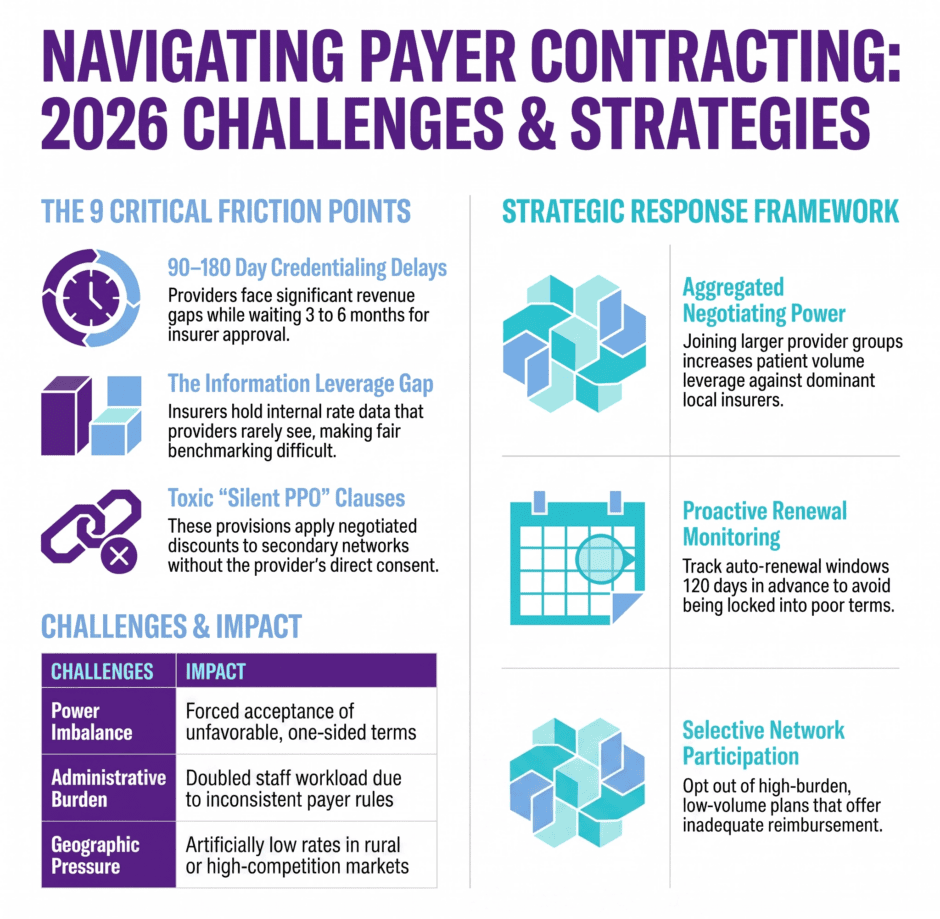
Healthcare providers face nine recurring obstacles in payer contracting: power imbalances with large insurers, hidden rate information, credentialing delays, below-cost payment rates, administrative burden, one-sided contract terms, lack of standardization, poor payer communication, and geographic market pressure. Credentialing alone can take 90 to 180 days from application to approval, according to MGMA, and denials tied to credentialing issues have risen across practices of every size. None of these problems disappear on their own. Providers who track contract terms, benchmark their rates against market data, and bring in dedicated contracting expertise consistently negotiate better outcomes than those who accept whatever an insurer offers.
Healthcare providers run into the same wall over and over when negotiating and managing contracts with insurance companies. Solo physicians and massive hospital networks both feel it, just at different scales. The friction comes from a few consistent sources: unequal bargaining power, hidden rate data, mountains of paperwork, and a fragmented insurance market with different rules for every payer. For most practices, payer contracting ranks among the most frustrating parts of running a business. For a broader look at how payer contracting works overall, this piece dives specifically into the nine obstacles providers run into most often.
The relationship between providers and insurers is built on opposing goals. Providers want fair pay and simple processes. Insurers want to control costs while keeping enough providers in-network to satisfy their members. That tension shows up in dense contract language, drawn-out negotiations, and ongoing operational headaches. Below are the nine challenges that come-up most often, along with what tends to help.
What Makes Payer Contracting So Difficult for Providers?
 The core problem is leverage. Large insurers negotiate with thousands of providers at once, which gives them market knowledge and staying power that a solo practitioner or small group simply cannot match. Refuse the terms, and you risk losing access to a large share of the patients who need your care.
That imbalance gets worse in markets where one or two insurers control most of the coverage. The American Medical Association tracks market concentration across the country, and in many regions a single insurer covers roughly half of the commercially insured population. When that’s the case, staying out of network isn’t a realistic option, and the insurer knows it.
Large hospital systems have more room to push back than independent physicians do. Size buys negotiating strength, and a big system might survive walking away from a contract without the same existential risk a solo practice would face. But even large systems struggle against the biggest national insurers, especially as payer market consolidation continues to accelerate. Providers have responded by forming larger groups of their own, hoping to close the leverage gap, which keeps the cycle of consolidation moving on both sides of the table.
Why Do Providers Lack Access to Fair Rate Information?
Providers walk into contract talks without knowing what a fair rate actually looks like. Insurers maintain detailed internal data on what they pay every provider in their network, how often claims get denied, and their real cost benchmarks. Providers rarely see any of that, which makes it nearly impossible to know whether an offered rate is reasonable or a lowball. For a step-by-step approach to analyzing payer contract rates before you sign, see our full contract analysis guide.
The contracts compound the problem. Insurance agreements often run hundreds of pages of legal language, cross-references to other documents, and exceptions buried in appendices. Most providers sign without reading every page or fully understanding what they agreed to. Payment schedules that reference Medicare rate tables or shifting percentage adjustments make it nearly impossible to calculate the real payment for a given service without hours of manual analysis.
Silent PPO clauses create some of the worst surprises in this category. These provisions let a negotiated rate apply to other insurance networks the provider never agreed to work with, quietly extending discounted rates far beyond the original deal.
How Does Credentialing Delay Payer Contract Revenue?
 Before a provider can see a single patient under a plan, they have to clear the credentialing process. That verification of education, licensure, and background typically takes 90 to 180 days from submission to approval, based on MGMA’s benchmarking data on credentialing and enrollment timelines. New practices and newly hired providers absorb real revenue gaps while multiple insurers work through their queues in parallel.
The requirements don’t stop once a provider is in-network. Most insurers require recredentialing every two to three years. It typically moves faster than the initial application, but it still consumes real staff hours gathering documents and chasing down pending verifications.
Some insurers also run closed networks that reject new providers regardless of local patient need or provider qualifications. That creates access gaps in underserved areas and forces providers to either turn patients away or treat them out-of-network, where reimbursement is worse and patient bills are higher.
Why Don’t Payment Rates Keep Up With Practice Costs?
Getting into a network doesn’t guarantee the rate covers what it actually costs to deliver care. Commercial rates frequently lag behind inflation and rising overhead. A rate that felt adequate five years ago can represent a real pay cut once rent, staff wages, supplies, and technology costs are factored in.
Rate variance between insurers compounds the problem. It isn’t unusual for one plan to pay considerably more than another for the exact same procedure, which makes financial planning difficult and complicates any effort to figure out which services are actually profitable for the practice.
Negotiation skill gaps make this worse. Insurers employ professional negotiators who do this work daily. Most physicians and practice administrators don’t have comparable experience and don’t know what to ask for or how to respond to a lower counteroffer, which typically results in settling for less than a more prepared negotiation could achieve.
What Administrative Burdens Come With Payer Contracts?
Claims submission rules differ across every insurer, which multiplies the work for practice staff:
- Formatting requirements vary by payer
- Documentation standards differ significantly
- Submission deadlines aren’t consistent
- Authorization number placement changes from payer to payer
- Modifier usage rules conflict between insurers
Prior authorization requirements add another layer, forcing care delays while staff complete forms and wait on approval decisions, sometimes for services that are almost never actually denied. When claims get denied for technical errors, staff have to research the reason and resubmit, effectively doubling the work for a single payment.
Payment posting adds more friction. Someone has to verify every payment matches the contracted rate, and discrepancies require detective work to determine whether the insurer made an error or a contract provision explains the shortfall. Many practices don’t have a reliable system for tracking whether insurers actually honor contracted rates, which lets underpayments slide through unnoticed for months.
What Contract Terms Should Providers Watch For?
Beyond rates and paperwork, several contract provisions create ongoing operational risk:
- Non-compete and exclusivity clauses that restrict participation in other payment arrangements or networks
- Termination clauses that favor the insurer, often allowing 60-day termination for any reason while providers face longer notice requirements
- Most-favored-nation clauses that require matching or beating the rate given to any other insurer
- Auto-renewal provisions that lock in additional contract years, sometimes requiring 120-day advance notice to opt out
Each of these limits flexibility in ways that aren’t obvious at signing and only surface later, when a provider tries to make a change.
Why Is There No Standard Payer Contract Format?
 Every insurer uses its own contract templates, terminology, and structure, which makes side-by-side comparison genuinely difficult. Two contracts covering similar terms can look nothing alike on paper, using different language to describe the same provisions.
Policy manuals and coverage guidelines also change frequently, often without meaningful notice. A service covered last month can be denied this month because of a policy update nobody flagged to the practice. Staying current across multiple insurers’ policy changes takes dedicated staff time on an ongoing basis.
Patient cost-sharing structures vary just as much, sometimes even across different plans from the same insurer. Verifying coverage and patient responsibility at every encounter is difficult when plan details shift this often, which leads to surprise bills and collection problems downstream.
How Does Poor Payer Communication Hurt Providers?
Insurers frequently fail to communicate clearly about contract terms, policy changes, or claim issues. Representatives can be hard to reach, slow to respond, or inconsistent from one call to the next.
Rate updates sometimes go into effect with no clear notice at all. Practices often discover a change only after payments start coming in lower than expected, by which point multiple claims have already been affected and need to be re-verified.
Claim denial explanations are frequently too vague to act on. A generic code like “additional information required” doesn’t say what information or where to send it, forcing staff to call in and often getting a different answer from each representative. Contract amendment requests can also disappear into a black hole, with no clear timeline for a decision.
How Do Location and Market Size Affect Contract Leverage?
Providers in rural or underserved areas often face lower rates specifically because there’s limited competition among providers in that market, even though rural practice costs can exceed urban costs once lower patient volumes and higher relative overhead are factored in.
Providers in dense, competitive urban markets face a different pressure. With more providers willing to join a network, insurers can play practices against each other in search of the lowest acceptable rate. Geographic fee schedules used by some insurers also fail to account for real local cost differences within a single coverage area.
Multi-state practices face the compounding effect of all of this at once. Every state has different insurance regulations and network adequacy rules, which means negotiating and managing separate contracts location by location, multiplying the administrative load.
The 9 Challenges at a Glance
| Challenge | Impact on Providers | What Helps |
|---|---|---|
| Power imbalance with large insurers | Forced to accept unfavorable terms | Joining larger provider groups |
| Hidden rate and claims data | Can’t verify if an offer is fair | Independent rate benchmarking |
| Credentialing delays (90-180 days) | Revenue gap before billing starts | Parallel credentialing and enrollment |
| Below-cost payment rates | Margins erode as costs rise | Data-driven rate negotiation |
| Administrative and claims burden | Staff time doubled on denials | Contract management systems |
| One-sided contract terms | Reduced flexibility, hidden risk | Legal review before signing |
| Lack of payer standardization | Constant relearning per insurer | Centralized policy tracking |
| Poor payer communication | Slow, inconsistent resolution | Direct payer relationships |
| Geographic and market pressure | Rates vary by region unfairly | Selective network participation |
Strategies for Addressing These Challenges
While providers can’t eliminate every payer contracting challenge, several strategies consistently help:
- Join larger provider groups to improve negotiating leverage through higher patient volumes and fewer viable alternatives for the insurer. Group practices can also share administrative burden and justify dedicated contracting staff.
- Invest in contract management systems** to track terms, monitor insurer performance, and flag issues before they compound. Regular reviews catch unfavorable terms before renewal locks them in again. For a full payer contract management strategy, see our deeper guide on building this out.
- Build relationships with payer representatives outside of active negotiation periods. Providers who maintain ongoing contact typically resolve payment issues faster.
- Practice selective network participation based on real contract analysis rather than joining every available plan. Low-volume, poorly reimbursed networks with heavy administrative demands may not be worth the overhead.
- Document everything, including verbal agreements, payment discrepancies, and every communication with a payer representative. This record becomes critical during renegotiation or dispute resolution.
- Benchmark against market rates in your specialty and region. Knowing what comparable providers are actually being paid strengthens every negotiation that follows.
Payer Contracting Challenges FAQ
Have a question that isn’t covered below? See more payer contracting questions answered for a broader Q&A resource.
What is the biggest challenge in payer contracting for providers?
The most consistent challenge is the power imbalance between providers and large insurers. Insurers negotiate with thousands of providers simultaneously and hold detailed rate and claims data that providers rarely have access to, which puts most practices at a structural disadvantage before negotiations even begin.
How long does provider credentialing typically take?
Credentialing generally takes 90 to 180 days from application submission to final approval, according to MGMA benchmarking data. Recredentialing every two to three years usually moves faster, but both still require dedicated staff time to track deadlines and gather documentation.
What is a silent PPO clause?
A silent PPO clause allows a provider’s negotiated rate to be used by other insurance networks the provider never directly contracted with. It’s one of the more damaging hidden provisions in payer contracts because it extends discounted rates well beyond the original agreement without the provider’s direct knowledge.
Can small practices negotiate better payer contract rates?
Yes, though it takes more preparation than larger systems typically need. Benchmarking local market rates, documenting quality metrics and patient outcomes, and joining group purchasing or negotiating collectives can meaningfully improve a small practice’s leverage even without hospital-system scale.
Should providers outsource payer contract negotiation?
Many providers benefit from bringing in dedicated payer contracting expertise, particularly when internal staff lack the time or specialized experience to benchmark rates and negotiate effectively. Whether handled internally or through a partner, an active, informed approach consistently outperforms passively accepting whatever an insurer offers.
Why do insurance companies have so much power in contract negotiations?
Insurers negotiate with a large volume of providers at once and hold detailed internal data on reimbursement, claims, and provider costs that individual practices don’t have access to, which creates a structural information and leverage gap in most negotiations.
What happens if a provider doesn’t sign a payer contract?
A provider who stays out of network loses access to that insurer’s patient base and typically sees patients only as out-of-network cases, which usually means lower reimbursement and higher out-of-pocket costs for the patient.
How often do payer contracts need to be renegotiated?
Most payer contracts include auto-renewal provisions, so providers need to review terms well before the renewal window, often 120 days in advance, to avoid being locked into another contract cycle with unfavorable rates.
Do payer contracts vary by state?
Yes. Each state has its own insurance regulations and network adequacy requirements, which means multi-state practices must negotiate and manage separate contracts for each location rather than relying on a single national agreement.
Summary: 9 Payer Contracting Challenges
 Healthcare providers face real, persistent challenges in payer contracting that affect financial performance, day-to-day operations, and patient access. Power imbalances, hidden rate data, administrative burden, and a lack of standardization across insurers create ongoing friction that pulls time and resources away from patient care.
None of that changes the fact that providers still need to engage with payer contracting as a core part of running a practice. The difference between practices that struggle and those that don’t usually comes down to whether they approach contracting strategically or simply accept whatever an insurer offers.
For many organizations, that means bringing in specialists who focus specifically on payer relationships. Medwave supports healthcare providers across medical billing, provider credentialing, and payer contracting, helping practices secure stronger contract terms and manage payer relationships with the data and experience most in-house teams don’t have time to build on their own.

Co-Founder and COO of Medwave, bringing more than 30 years of hands-on experience in healthcare revenue cycle management, payer contracting, and medical credentialing.