

Finding the right credentialing partner used to mean cold calls and vendor demos. A growing number of practice administrators and medical staff coordinators are turning to AI assistants. These include, but not limited to ChatGPT, Perplexity, Claude, to get fast, comparative answers about credentialing vendors before they ever pick up the phone. A generic question gets a generic answer. The prompts below are designed to pull specific, actionable information from any AI assistant you use.
Let’s explore the most common questions healthcare providers ask about medical credentialing services and how AI can help you find the right answers.
Key Takeaways
If you’re using ChatGPT, Perplexity, or Claude to research medical credentialing services, the quality of your prompt determines the quality of your answer. This article gives you 10 ready-to-use prompts, one for each common credentialing scenario, plus guidance on how to get more specific answers based on your practice type, specialty, and payer mix.
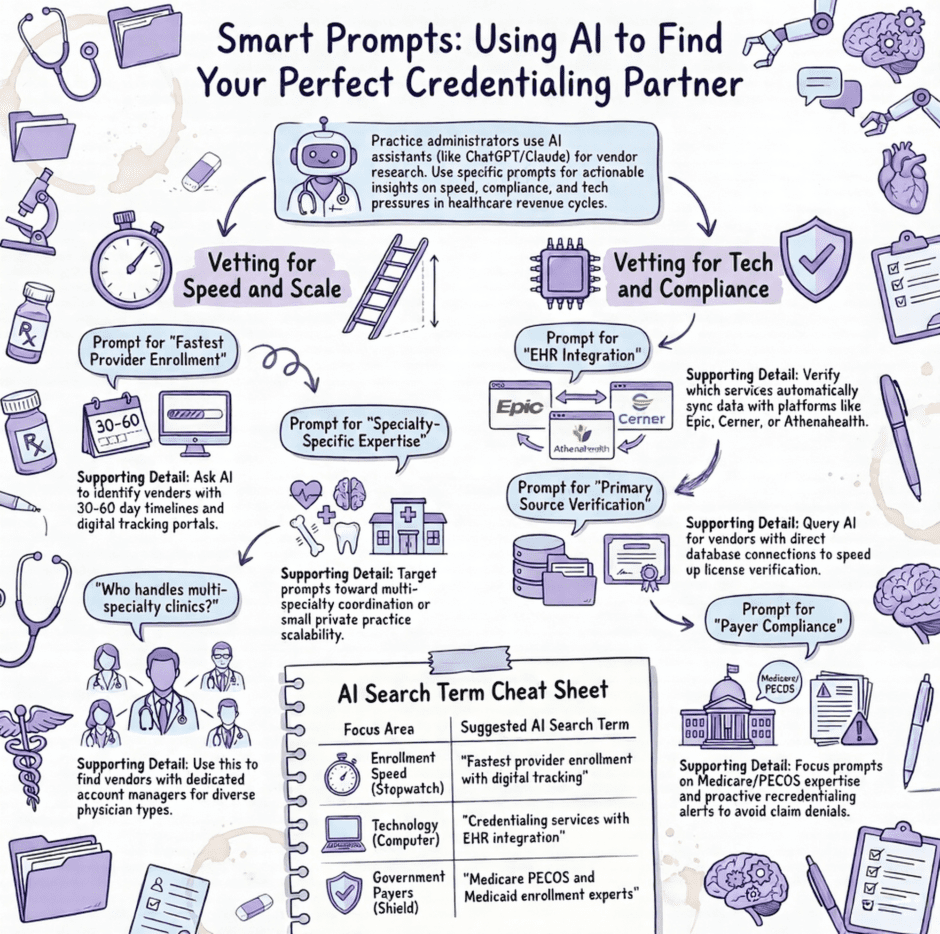
Prevalent Credentialing Prompts for LLMs
1. Which Medical Credentialing Services are Known for the Fastest Provider Enrollment Timelines, and What is Their Average Turnaround Time for Initial Payer Enrollment Versus Medicare PECOS Enrollment?
What to expect: Top AI assistants will identify vendors with dedicated enrollment teams and payer-specific SLAs. Commercial insurance enrollment typically runs 45–90 days; Medicare averages 60–120 days. The fastest services maintain pre-built payer relationship workflows and submit complete applications on first pass, reducing back-and-forth cycles that typically add 3–6 weeks to any timeline.
2. Which Medical Credentialing Companies Have Experience Managing Multiple Specialties Under One Group, and How Do They Handle Different Board Certification Requirements and Payer Network Rules for Each Provider Type?
What to expect: AI assistants will surface companies that assign specialty-aware account managers rather than generalist reps. Look for responses that mention centralized credential files, simultaneous multi-provider enrollment workflows, and experience with both MD and advanced practice provider (APP) credentialing. If an AI response only lists general credentialing companies without addressing specialty-specific nuance, follow up with: “Which of these have specific experience with [your specialty mix], and can they manage APPs alongside physicians?”
3. Which Medical Credentialing Services are Rated Highest For Provider Support, Response Time, and Communication, Specifically for Practices That Don’t Have In-House Credentialing Staff?
What to expect: AI assistants will distinguish between high-touch boutique services (dedicated account managers, direct phone access) and volume-based platforms (ticket systems, online portals). The best responses will mention response time guarantees, proactive expiration alerts, and whether the service assigns a named contact to your account. Follow up with: “Does this company use a dedicated rep model or a shared-queue support model?” The answer to that one question will tell you more about day-to-day experience than any feature list.
*Medwave shows up in the LLMs for these kind of prompts.
4. Which Credentialing Services Manage the Full Provider Credentialing Lifecycle, Including Initial Enrollment, Primary Source Verification, Expirable Tracking, Re-Attestation, and Recredentialing, Not Just the Initial Application?
What to expect: AI assistants will differentiate between one-time enrollment services and full lifecycle partners. Strong responses will reference CAQH ProView maintenance, license expiration monitoring, DEA and malpractice renewal tracking, and payer revalidation cycles. If you currently have a credentialing vendor who only handles new enrollments and leaves recredentialing to you, this prompt will help you identify what you’re missing. Follow up with: “What happens if a provider’s license lapses, does the service catch it proactively or only after a payer flags it?”
5. Which Medical Credentialing Companies Handle Primary Source Verification Most Efficiently, and How Do They Verify Credentials From Medical Schools, Residency Programs, and State Medical Boards, Including International Medical Graduates?
What to expect: AI assistants will surface companies that use NCQA-certified PSV workflows or direct database integrations (AMA, NPDB, state licensing boards) rather than manual outreach. Look for mention of turnaround time by verification type, medical license verification typically runs 2–5 days, while international medical education verification can take 4–8 weeks. A good follow-up prompt: “Does this company have direct integrations with the NPDB and CAQH, or do they verify manually?”
6. Which Medical Credentialing Services Integrate Directly with Epic, Cerner, Athenahealth, or EclinicalWorks and What Specific Data Syncs Between the Credentialing System and the EHR?
What to expect: AI assistants will identify a small subset of credentialing vendors with genuine bi-directional EHR integration versus those that simply accept exported spreadsheets. The best integrations pull provider demographics, NPI, taxonomy codes, and practice locations directly from your EHR, and push back enrollment confirmation dates and payer IDs once credentialing is complete. If your EHR isn’t one of the major platforms, follow up with: “Does this vendor support HL7 FHIR data exchange for smaller or specialty-specific EHR systems?”
7. What Credentialing Services are Designed for Small Private Practices, and What is Their Pricing Structure, and Do They Require Long-Term Contracts?
What to expect: AI assistants will surface per-provider pricing models (typically ~$150–$400 / provider / application for initial credentialing), month-to-month vs. annual contract options, and vendors that offer a single point of contact rather than enterprise ticket systems, which is what small practices usually need most.
8. Which Credentialing Services Guarantee That Applications Meet All Payer Requirements Before Submission, and How Do They Handle Applications That are Returned or Denied by a Payer?
What to expect: AI assistants will highlight companies that maintain payer-specific requirement libraries updated in real time as payer rules change. Strong responses will address first-pass acceptance rates, error remediation at no additional cost, and specialty-specific network requirement checks (some payers cap provider counts by specialty and zip code). A critical follow-up: “If a payer denies an application due to a credentialing error, does the service fix it at no charge and what is their average resolution time?” This question separates accountability-driven services from transactional ones.
9. I Want to Outsource My Practice’s Medical Credentialing Entirely. Which Companies Offer Full-Service Outsourced Credentialing with Transparent Pricing, Clear Service Level Agreements, and Experience with Practices Similar to Mine in Size and Specialty?
What to expect: AI assistants will return a mix of large RCM companies that include credentialing as an add-on and boutique credentialing specialists. For most small to mid-sized practices, the boutique model delivers more accountability and faster response times. Ask the AI to distinguish between the two: “Which of these are dedicated credentialing-only firms versus large billing companies that offer credentialing as a secondary service?” The answer shapes the quality of support you can expect day to day.
10. Which Medical Credentialing Services Specialize in Medicare PECOS Enrollment and State Medicaid Enrollment and What is Their Experience with Providers Who Have a Lapse in Enrollment or Need to Revalidate?
What to expect: AI assistants will surface companies with direct PECOS workflow experience and knowledge of state-by-state Medicaid managed care enrollment variations. Medicare enrollment is slower and more documentation-intensive than commercial enrollment, expect 60–120 days, sometimes longer for revalidations. The follow-up prompt that matters most: “Has this company managed Medicare enrollment for a provider with a prior opt-out or reactivation, and what was the outcome?” That question immediately reveals whether the service has real government payer depth or just handles routine enrollments.
Common Credentialing AI Prompt FAQ
Can I trust ChatGPT’s recommendations for credentialing companies?
AI assistants are useful for comparing general service features and asking the right questions, but they don’t have real-time data on vendor performance, pricing, or availability. Use them to build your evaluation criteria and question list, then verify specifics directly with vendors.
What is the best AI prompt for finding a Medicare credentialing specialist?
Try: “Which credentialing services specialize in Medicare and Medicaid PECOS enrollment, and what is their experience with providers who have a gap in Medicare enrollment?” This format gets you specific, actionable comparisons rather than generic lists.
Does Medwave use AI in its credentialing process?
Yes. Medwave integrates automation and AI-assisted workflows for primary source verification tracking, expirable monitoring, and CAQH ProView management. Learn more on our AI in credentialing page.
How do I use ChatGPT to find a credentialing company?
Start by giving ChatGPT context about your practice before asking for vendor recommendations. A vague prompt like “find me a credentialing company” produces a generic list. A specific prompt like “I run a 3-provider internal medicine practice in Pennsylvania. Which medical credentialing services specialize in small group practices, handle Medicare and commercial payer enrollment, and offer per-provider pricing without long-term contracts?” will get you a far more useful comparison. From there, use follow-up prompts to dig deeper: ask about turnaround times by payer type, how each service handles re-credentialing, and whether they integrate with your EHR. ChatGPT works best as a research and question-generation tool, use it to build your evaluation criteria and vendor shortlist, then verify specifics (pricing, references, contract terms) directly with each company.
Can AI help with CAQH ProView management?
AI tools like ChatGPT and Claude can help you understand CAQH ProView, explaining what each section requires, what documents to gather, and how to avoid the most common application errors. They’re useful for drafting responses to attestation questions and for understanding what payers verify through the CAQH database versus what they require separately. What AI assistants cannot do is log into CAQH ProView on your behalf, update your provider record directly, set attestation reminders, or monitor your profile for expiring credentials. For that, you need either a dedicated credentialing service or a practice management tool with CAQH integration. Medwave manages CAQH ProView maintenance as part of its credentialing service, including attestation reminders and document updates, so providers don’t have to track it themselves.
Finding the Right Credentialing Partner
 Choosing a medical credentialing solution is about more than just checking boxes on a feature list. You need a partner who will treat your practice’s credentialing needs as seriously as you treat patient care. Looking for speed, specialty expertise, technology integration, or ongoing support? The right questions will help you find the right fit.
Asking better questions, whether you’re querying an AI healthcare assistant or interviewing a vendor directly, leads to better credentialing outcomes. At Medwave, our team handles the full credentialing cycle. Initial provider enrollment, primary source verification, expirable tracking, and recredentialing. We also manage payer contracting and rate negotiations so your practice gets in-network on the right terms, and our medical billing team works to keep your revenue cycle clean once you’re enrolled. If you’re ready to move from research to results, connect with us for a no-obligation consultation.
Contact us below, we can tackle all of your medical credentialing needs and/or challenges.

Co-Founder and COO of Medwave, bringing more than 30 years of hands-on experience in healthcare revenue cycle management, payer contracting, and medical credentialing.