
Medical equipment providers play a crucial role in our healthcare system, but getting properly credentialed to provide Durable Medical Equipment (DME) can feel like navigating a maze. Let’s break down everything you need to know about DME credentialing in plain English, from the basics to the nitty-gritty details.
What is DME Credentialing; Why Does it Matter?
 Think of DME credentialing as your golden ticket to legally providing medical equipment and getting paid for it. It’s essentially a verification process that ensures you meet all the necessary standards and requirements to provide durable medical equipment to patients.
Without proper credentialing, you can’t bill insurance companies or Medicare for the equipment you provide, and that’s a big deal!
The process might seem overwhelming at first, but it’s designed to protect patients and ensure they receive quality equipment from qualified providers. Plus, once you’re properly credentialed, you’ve opened the door to a world of opportunities in the healthcare market.
The Basics: Types of DME Credentials
Before diving into the how-to, let’s look at the different types of credentials you might need:
Medicare DME Supplier Number
This is your bread and butter if you want to work with Medicare patients. It’s issued by the National Supplier Clearinghouse (NSC) and is absolutely essential for Medicare billing. Think of it as your Medicare ID card, you can’t play the game without it.
State-Specific Licenses
Each state has its own rules about DME licensing. Some states require specific DME licenses, while others might require a general business license. It’s like having different driver’s licenses for different types of vehicles, you need the right one for what you’re doing.
Insurance Provider Credentialing
Different insurance companies have their own credentialing processes. It’s similar to being approved for different credit cards, each company has its own requirements and processes.
The Step-by-Step Credentialing Process
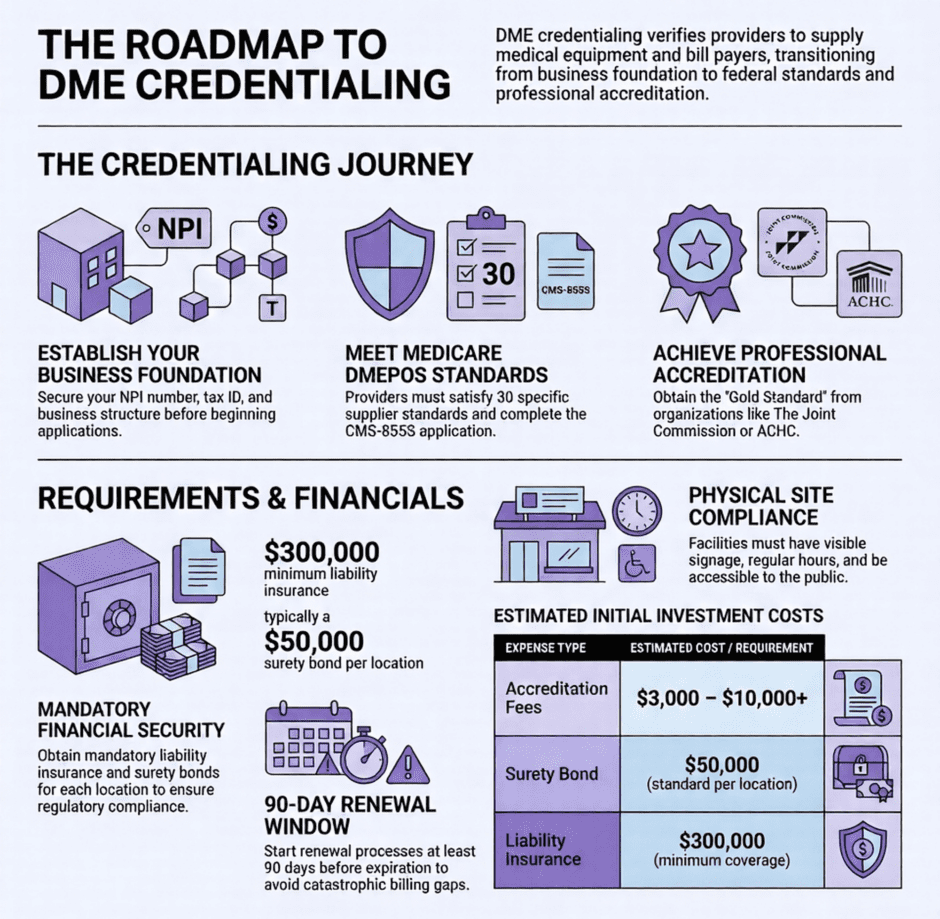
1. Setting Up Your Business Foundation
Before you even think about credentialing, you need to have your business ducks in a row:
- Get your business structure sorted (LLC, corporation, etc.)
- Obtain your tax ID number
- Set up your business bank account
- Get your NPI (National Provider Identifier) number
- Secure proper liability insurance
Think of this as building the foundation of a house, everything else sits on top of these basics.
2. Meeting Medicare Requirements
Medicare’s requirements are typically the most comprehensive, so let’s focus on those.
You’ll need to:
- Complete the CMS-855S application
- Meet all 30 DMEPOS Supplier Standards
- Maintain appropriate liability insurance ($300,000 minimum)
- Set up a physical location that meets all requirements
- Pass site inspections
- Obtain surety bonds (typically $50,000 per location)
The process is like applying for a mortgage, there’s a lot of paperwork, and they’re going to verify everything!
3. Accreditation: The Gold Standard
Accreditation is crucial for Medicare billing and is often required by private insurers too.
The main accrediting organizations include:
- The Joint Commission
- Accreditation Commission for Health Care (ACHC)
- Community Health Accreditation Partner (CHAP)
- Healthcare Quality Association on Accreditation (HQAA)
Getting accredited is like getting a college degree, it takes time, effort, and money, but it proves you meet high standards of quality and service.
Common Challenges and How to Overcome Them
1. Documentation Overload
The sheer amount of paperwork required can be overwhelming. The solution?
Create a systematic approach:
- Use a checklist system
- Keep digital copies of everything
- Set up a filing system that makes sense
- Use credential management software if possible
2. Keeping Track of Deadlines
Different credentials expire at different times, and missing a renewal can be catastrophic.
To stay on top of it:
- Create a master calendar of all expiration dates
- Set up multiple reminders
- Assign specific staff members to monitor renewals
- Start renewal processes early, at least 90 days before expiration
3. Meeting Physical Location Requirements
Medicare’s requirements for physical locations are specific and non-negotiable.
Your location must:
- Be accessible to the public
- Have visible signage
- Maintain regular business hours
- Be staffed during business hours
- Have a proper inventory storage system
Best Practices for Successful Credentialing
1. Stay Organized from Day One
Create a credentialing folder (physical and digital) that includes:
- Copies of all licenses and certifications
- Insurance documentation
- Business formation documents
- Tax documents
- NPI information
- Staff credentials and training records
- Policies and procedures documentation
2. Invest in Compliance
Compliance isn’t just about getting credentialed, it’s about staying credentialed:
- Regular staff training
- Written policies and procedures
- Quality assurance programs
- Regular internal audits
- Documentation of all patient interactions
3. Build Strong Relationships
Network with:
- Other DME providers
- Healthcare facilities
- Insurance provider representatives
- Accreditation organizations
- State licensing boards
These relationships can be invaluable when you need guidance or face challenges.
The Financial Side of Credentialing
Let’s talk money, because credentialing isn’t cheap:
Initial Costs
- Application fees
- Accreditation fees (can range from $3,000 to $10,000+)
- Surety bond premiums
- Liability insurance premiums
- Business license fees
- State-specific licensing fees
Ongoing Costs
- Renewal fees
- Continuing education
- Maintenance of insurance and bonds
- Compliance program costs
- Staff training
Maintaining Your Credentials
Getting credentialed is just the beginning.
Maintaining your credentials requires:
Regular Monitoring
- Track expiration dates
- Monitor regulatory changes
- Keep up with industry standards
- Document everything
Quality Assurance
- Regular internal audits
- Patient satisfaction surveys
- Equipment maintenance logs
- Staff training records
Compliance Updates
- Stay current with Medicare rules
- Monitor state regulation changes
- Update policies and procedures as needed
- Regular staff compliance training
DME Credentialing FAQ
What is DME credentialing?
DME credentialing is a verification process that confirms a durable medical equipment provider meets the standards required to supply equipment to patients and bill for it. It covers things like Medicare supplier numbers, state licenses, and insurance company approvals. Without it, a provider cannot bill Medicare or insurance companies for the equipment they provide.
Why does a DME provider need to get credentialed?
Credentialing allows a provider to legally supply medical equipment and receive payment from Medicare and insurance companies. It also confirms to patients that the provider meets quality and safety standards. Skipping this step means a business cannot bill for the equipment it distributes.
What types of DME credentials might a provider need?
A provider may need a Medicare DME Supplier Number issued by the National Supplier Clearinghouse, state-specific licenses that vary by location, and separate credentialing from each insurance company they work with. Each credential has its own application and approval steps, similar to applying for different credit cards or driver’s licenses.
What business steps come before applying for DME credentials?
Before starting the credentialing process, a business should set up its legal structure such as an LLC or corporation, obtain a tax ID number, open a business bank account, get an NPI number, and secure liability insurance. These steps form the foundation that later credentialing applications rely on.
What does Medicare require for DME supplier approval?
Medicare requires providers to complete the CMS-855S application, meet all 30 DMEPOS Supplier Standards, and carry liability insurance of at least $300,000. Providers also need a physical location that passes site inspections and a surety bond of about $50,000 per location. The process involves detailed paperwork and verification, similar to applying for a mortgage.
Which organizations provide DME accreditation?
Accreditation for DME providers can come from organizations such as The Joint Commission, the Accreditation Commission for Health Care, the Community Health Accreditation Partner, and the Healthcare Quality Association on Accreditation. This accreditation is required for Medicare billing and is often requested by private insurers as well. Earning it takes time and money but confirms a provider meets recognized quality standards.
Summary: Credentialing for DME is Crucial
DME credentialing might seem like a mountain to climb, but it’s manageable with the right approach and systems in place.
Remember:
- Take it step by step
- Stay organized
- Keep detailed records
- Build strong relationships
- Stay current with requirements
- Invest in compliance
- Plan for the future
Think of credentialing as building and maintaining a professional reputation. It takes work, but it’s worth it for the opportunity to serve patients and build a successful business in the healthcare industry.
Contact us below, we can tackle your DME credentialing needs and/or challenges.

Co-Founder and COO of Medwave, bringing more than 30 years of hands-on experience in healthcare revenue cycle management, payer contracting, and medical credentialing.