

HL7 integration is how an EHR, a practice management system, a lab, and a billing platform pass the same patient, order, and charge data back and forth without anyone typing it in twice. When those connections fail or were never built, the gap gets filled by staff who re-key demographics, chase mismatched patient records, and fix rejected transactions by hand.
 HL7 message types such as ADT, ORM, and ORU exist to solve that problem, but vendors implement them differently. Two systems can both claim HL7 compliance and still fail to exchange data cleanly because of differences in segment structure, custom Z-segments, or how each vendor reads the standard. Making them work together takes hands-on configuration and testing, not a line on a spec sheet.
Medwave builds and supports HL7 interfaces between the systems healthcare organizations already run. We handle the interface build, testing, and ongoing support, so your team can trust the data moving between systems instead of double-checking it.
Key Takeaways
- HL7 v2 is still the most common way clinical and billing systems exchange data, but every vendor’s version varies, so each interface needs its own mapping and testing.
- A working interface removes duplicate data entry between the EHR, practice management, labs, and billing, which cuts registration errors that later turn into denied claims.
- FHIR APIs add real-time, web-based access on top of HL7 v2, and most organizations will run both for years.
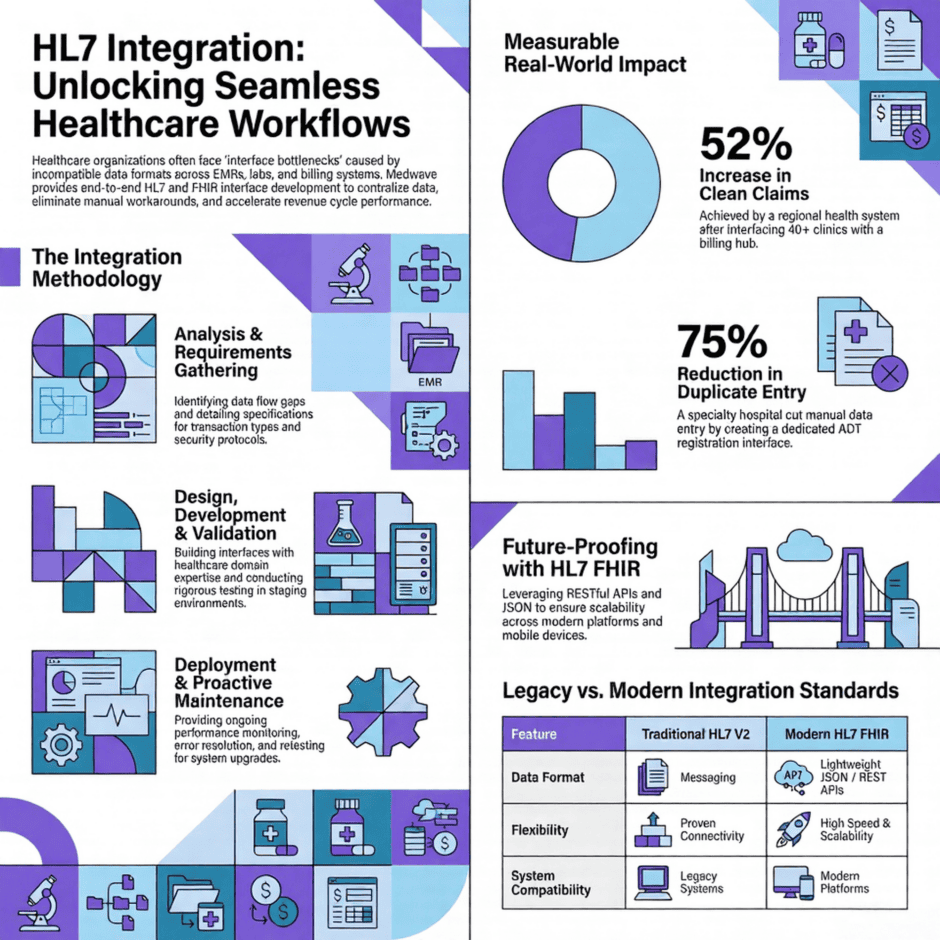
Why Healthcare Systems Struggle to Share Data
How many hours does your staff spend each week resolving mismatches between billing and the EHR? How often does a nurse call the pharmacy to confirm a medication list that already exists in another system? Gaps like these force manual workarounds that eat time every day.
The pain points tend to look the same from one organization to the next.
- Clinical teams can’t see orders and results captured in another system in real time.
- Revenue cycle staff reconcile claim data from several sources by hand.
- The same demographics and insurance details get entered in two or three places.
- Reporting is slow because there is no central, structured copy of the data.
- Pulling data out of siloed systems for quality reporting takes custom work every time.
- One-way notifications arrive without context, which adds to alert fatigue.
Purpose-built HL7 interfaces close those gaps by defining exactly which data moves, in what format, and when.
How We Build an HL7 Interface
 Every project follows the same five steps, whether it is a single lab feed or a multi-system build.
- We map your current systems and data flows to find the connections that will save the most manual work.
- We meet with the people who use each system and document message types, data fields, exception handling, timing, and security requirements.
- Our team builds the interface to that specification, including the segment mapping and translation rules each vendor needs.
- We test against real-world message samples in development and staging before anything touches production.
- After go-live, we monitor performance, resolve errors, and retest whenever a connected system is upgraded.
HL7 Message Types We Work With
Most of our work centers on a handful of basic HL7 interfaces that carry the bulk of clinical and financial data.
- ADT messages for patient registration, admissions, transfers, and demographic updates
- ORM and ORU messages for lab and imaging orders and their results
- DFT messages that send charges from the clinical system to billing
- SIU messages for scheduling between practice management and the EHR
- MDM messages for transcribed notes and clinical documents
DFT feeds matter most to the revenue cycle, because a charge that drops between the EHR and billing never becomes a claim. For practices sending claims out through a clearinghouse, our guide on connecting an EHR to a clearinghouse covers the next link in that chain.
HL7 Interface Use Cases
Each interface serves a specific need, and the most common requests include the following.
- Linking practice management and the EHR to share scheduling, registration, coding, billing, and collections data
- Sending medication lists and e-prescriptions between the EHR, pharmacies, and e-prescribing hubs
- Pushing encounters, orders, and results to patient portals and health information exchanges
- Importing payer eligibility data into EHR encounter screens
- Combining patient records from affiliated facilities into one enterprise data repository
- Placing clinical decision support prompts inside EHR workflows
- Connecting inventory management and billing systems to automate supply reordering
Many providers are only using a fraction of what their systems can already exchange, and the use cases above are usually the first place that unused capacity shows up.
Where FHIR Fits Alongside HL7 v2
Traditional HL7 v2 messaging is proven and widely supported. HL7 FHIR (Fast Healthcare Interoperability Resources) takes a different approach, using RESTful APIs and JSON to exchange data on request rather than in batches of messages. Our breakdown of HL7 vs FHIR covers the technical differences in detail.
FHIR brings several advantages over older HL7 versions.
- Faster, real-time data access
- Better interoperability between modern systems
- Less work for developers to implement
- Stricter data schemas and terminology bindings
- Support across platforms, from mobile apps to full EHRs
- New resources added as the standard grows
That is why we build support for FHIR APIs into our interfaces alongside v2 messaging. Older systems keep working over v2, and the newer connections are ready as more vendors adopt FHIR. We follow the published HL7 standards as they change so interfaces don’t need to be rebuilt every time a version moves.
Medwave Builds Interfaces With the Revenue Cycle in Mind
Many HL7 vendors stop at the technical connection. Medwave also runs billing and credentialing, and has supported 15,000+ providers, so we design each interface around what happens to the data after it moves. A registration field that maps wrong is a coding problem today and a denied claim next month, and our team knows both sides of that chain.
Each engagement includes direct access to the people building your interface, clear project tracking from scoping through go-live, and ongoing updates as your systems and the standards change. When an interface project uncovers larger workflow problems, our revenue cycle consulting team can take those on as well.
Tell us which systems aren’t talking to each other, and we’ll map out the interfaces it would take to connect them.