

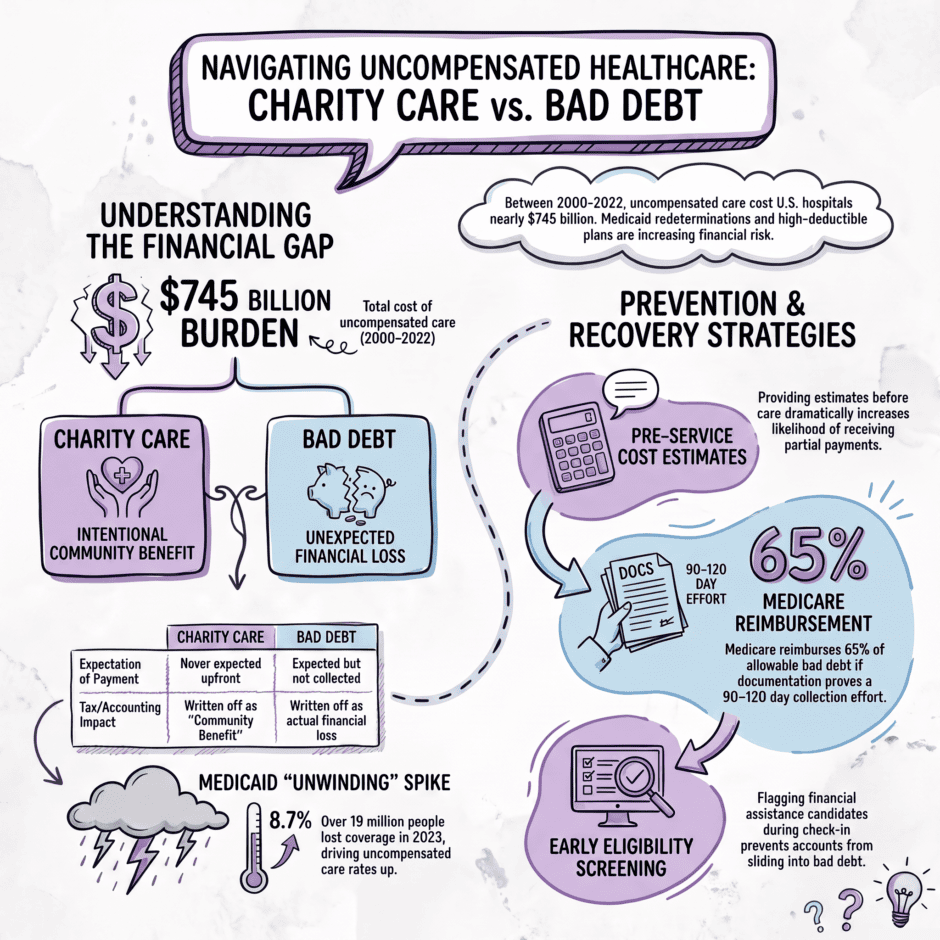
Uncompensated care cost U.S. hospitals close to $745 billion between 2000 and 2022, and the number keeps climbing. Some of that spike traces back to Medicaid redeterminations that resumed in 2023, when states rechecked eligibility for the first time since the pandemic and more than 19 million people lost coverage. A patient who had Medicaid on Monday and loses it on Tuesday still shows up for care, and the bill still has to go somewhere.
Key Takeaways
Uncompensated care splits into two categories: charity care, where a provider never expected payment, and bad debt, where payment was expected but never collected.
Medicaid redeterminations pushed millions of patients out of coverage starting in 2023, and uncompensated care rates rose from 6.4% to 8.7% of gross revenue at many hospitals that year alone. Medicare reimburses eligible providers for 65% of allowable bad debt tied to Medicare patients specifically, but only with documentation that meets CMS requirements. Collecting an upfront cost estimate before service dramatically increases the odds a patient pays something, even a partial amount.Practices that treat bad debt prevention as a workflow, not an afterthought, recover more of what they’re owed without writing off nearly as much.
What’s the Difference Between Charity Care and Bad Debt?
 Both categories describe care a provider delivered but never got paid for, but the distinction matters for accounting, for tax reporting, and for which recovery options are even available.
Charity care happens when a provider decides upfront, or close to it, that a patient can’t pay and never bills them for the full cost. This usually follows a written financial assistance policy with income thresholds and an application process. Because the provider never expected payment, charity care gets written off as a community benefit rather than a loss, and it can count toward the community benefit reporting that nonprofit hospitals use to justify their tax-exempt status.
Bad debt is different. The provider expected to get paid, sent a bill, and never collected. Maybe the patient had insurance that denied the claim. Maybe they simply didn’t pay. Either way, bad debt gets written off as an actual financial loss, not a charitable contribution, and it hits the bottom line differently on a hospital’s books.
The two categories can blur together in practice. A patient who doesn’t know financial assistance exists, or who doesn’t apply in time, often ends up in bad debt when they might have qualified for charity care. That’s a meaningful gap, because bad debt is close to unrecoverable while charity care at least gets accounted for as an intentional decision rather than a collections failure.
Why Are Uncompensated Care Costs Rising?
The short answer is coverage instability. When people lose insurance, whether through a job change, a Medicaid redetermination, or a marketplace plan lapsing, the care they need doesn’t stop. It just moves into the uncompensated category.
The Medicaid unwinding that started in 2023 is the clearest recent example. States had paused eligibility checks during the COVID-19 public health emergency, so enrollment grew substantially. When normal redeterminations resumed, states worked through a backlog of cases, and a large share of people lost coverage for procedural reasons (missing paperwork, an address that wasn’t updated, a form that didn’t get processed in time) rather than because they actually became ineligible. Many of those people were still eligible and simply fell through administrative cracks, but the coverage gap and the uncompensated care that follows it are real either way.
High-deductible health plans compound the problem even for insured patients. A patient with a $6,000 deductible and a real emergency has coverage on paper, but the provider often collects little to nothing from that patient directly. Genuine inability to pay and insured-but-underfunded patients now show up in the same bad debt bucket.
Safety net hospitals feel this hardest. Essential Hospitals, the association representing safety net systems, reported its members provided $11 billion in uncompensated care in 2023 alone, plus another $11 billion in care reimbursed at a loss. Those hospitals serve a patient population where coverage gaps are already more common, so policy shifts that increase the uninsured rate hit them first and hardest.
How Does Medicare Bad Debt Reimbursement Work?
 Medicare is the one payer that offers structured relief for bad debt, but only under specific conditions, and only for the Medicare-covered portion of a patient’s bill.
To qualify, a provider generally has to show the debt is related to Medicare-covered services, that reasonable collection efforts were made and documented, that the debt was actually uncollectible, and that sound business judgment supported writing it off rather than continuing collection attempts. CMS reimburses providers for a portion of that documented bad debt, currently around 65% for most eligible providers, though the exact rate and rules can vary based on provider type and dual-eligible status.
The documentation requirement trips up a lot of practices. CMS wants to see an actual collection effort, not just a bill that went unanswered. A provider that sends one statement and writes off the balance a month later usually won’t meet the bar. A provider that follows a documented 90 to 120 day collection process, with statements, calls, and a formal determination that the balance is uncollectible, has a much stronger case for reimbursement.
This is also where working with a billing partner tends to pay for itself. The collection effort has to be consistent and well documented across every account, not just the ones a staff member remembers to follow up on, and that kind of consistency is hard to maintain with a small internal team juggling other priorities.
The stakes are real money, not a rounding error. A practice writing off $200,000 a year in Medicare-related bad debt without proper documentation is walking away from roughly $130,000 in potential reimbursement, assuming the standard 65% rate applies and the debt would otherwise qualify. Multiply that across a full patient population and the gap between a documented process and an informal one gets expensive fast.
Five Ways to Reduce Bad Debt Before It Happens
Bad debt is much cheaper to prevent than to collect. Once a balance ages past 90 or 120 days, the odds of recovering anything drop fast, so the highest-value work happens before the balance ever becomes a write-off.
- Give patients a real cost estimate before service. Patients who see an estimate before care is delivered are far more likely to make at least a partial payment than patients who get surprised by a bill weeks later. A simple online estimator tool, even a rough one, changes the conversation from “why is this so expensive” to “how do we handle this.”
- Screen for financial assistance eligibility early, not after the account is already in collections. A patient who qualifies for charity care but never gets the application in front of them becomes a bad debt write-off instead of a documented community benefit. Front desk staff and financial counselors should know the income thresholds well enough to flag likely candidates during scheduling or check-in.
- Watch for red flags on insurance that suggest a coverage gap is coming. A high-deductible plan, a marketplace plan close to its renewal date, or a patient who mentions a recent job change are all signals worth a proactive conversation about payment options before the balance grows.
- Make it easy for patients to actually pay. Confusing, separate bills from the facility and the physician, unclear itemization, and no digital payment option all suppress collections, even from patients who are willing and able to pay. A consolidated statement with a clear breakdown and multiple payment channels removes friction that otherwise turns into unpaid balances.
- Use data to catch bad debt risk earlier in the cycle. Practices that track which accounts are aging without payment, and why, can intervene while there’s still a real chance of collecting something, instead of discovering the problem only when the balance gets written off months later.
How Should a Practice Handle the Accounts That Still Go Bad?
 Even with strong prevention, some accounts will still end up as bad debt. At that point, the goal shifts from prevention to recovery and clean documentation, since undocumented write-offs get treated as pure loss with no chance at Medicare reimbursement or accurate community benefit reporting.
A clear internal policy helps here more than any single tactic. That means a defined number of collection attempts, a documented timeline before an account moves to write-off, and a clear record of why each account was ultimately deemed uncollectible. Practices that formalize this process recover more through Medicare bad debt reimbursement, because the documentation already exists instead of getting reconstructed after the fact.
The timeline matters as much as the steps themselves. CMS doesn’t specify an exact number of days, but auditors generally expect to see multiple documented attempts spread across a reasonable window, not a single statement followed by an immediate write-off. A workflow built around 30, 60, and 90 day touchpoints, each logged with the date and method of contact, gives a practice something concrete to point to if a reimbursement claim gets questioned later.
Third-party partners, including Medwave, often step in at exactly this point. Not to replace a practice’s financial policies, but to make sure the collection effort is consistent, the documentation holds up, and every dollar that’s actually recoverable gets pursued before it’s written off for good.
Uncompensated Care FAQ
What’s the difference between charity care and bad debt?
Charity care is care a provider never expected to be paid for, usually decided in advance through a financial assistance policy. Bad debt is care the provider expected to collect on but couldn’t, whether from an unpaid patient balance or a denied claim.
Does Medicare reimburse hospitals for bad debt?
Yes, but only for the Medicare-covered portion of a patient’s bill, and only with documentation showing a genuine collection effort was made and the debt is truly uncollectible. The reimbursement rate is currently around 65% for most eligible providers.
Why did uncompensated care costs rise so much starting in 2023?
Mostly due to Medicaid redeterminations. States resumed eligibility checks that had been paused during the pandemic, and more than 19 million people lost Medicaid coverage, many for procedural reasons rather than actual ineligibility. That coverage gap shows up as uncompensated care.
Can a patient with insurance still end up as bad debt?
Yes. High-deductible health plans mean an insured patient can still owe thousands out of pocket, and providers often collect little of that directly. That balance gets treated the same as an uninsured patient’s unpaid bill.
What’s the fastest way to reduce bad debt?
Prevention beats collection every time. Giving patients a cost estimate before service, screening for financial assistance eligibility early, and making payment easy all reduce how much ends up as bad debt in the first place, rather than trying to collect on an aged account later.
Does uncompensated care affect a hospital’s tax status?
For nonprofit hospitals, yes, indirectly. Charity care counts toward the community benefit reporting that supports their tax-exempt status, so accurately screening and documenting charity care eligibility matters for compliance, not just for revenue.
Summary: How to Handle Uncompensated Healthcare
 Uncompensated care isn’t going away, and the coverage instability driving it doesn’t look like it’s easing up any time soon. What’s within a practice’s control is how much of that exposure turns into a clean, documented write-off versus an unrecovered loss with no paper trail to show for it.
That distinction is where Medwave’s billing team earns its keep, building the documented collection workflows that support Medicare bad debt reimbursement instead of leaving money on the table. Getting a patient’s coverage right in the first place also starts upstream, which is why our credentialing team keeps provider enrollment current so claims don’t deny for a preventable reason. And when a practice’s payer mix shifts because of coverage changes in its patient population, our payer contracting team can help evaluate whether current contracts still reflect that reality.

Co-Founder and COO of Medwave, bringing more than 30 years of hands-on experience in healthcare revenue cycle management, payer contracting, and medical credentialing.