

Since January 2023, any clinician with a standard DEA registration that includes Schedule III can prescribe buprenorphine for opioid use disorder. The X-waiver is gone, and more primary care, psychiatry, and emergency practices now treat addiction alongside dedicated programs. The billing didn’t get simpler. It depends on where treatment happens. Office-based treatment bills one way, opioid treatment programs another, and residential, partial hospitalization, and intensive outpatient programs a third, often with H-codes, revenue codes, and payer rules that don’t appear anywhere else in medicine.
Key Takeaways
- Office-based buprenorphine treatment bills with standard E/M codes, or with the monthly office-based OUD bundles (G2086 to G2088) for Medicare.
- Medicare pays opioid treatment programs a weekly bundle (G2067 to G2080) that covers medication, counseling, and drug testing.
- Many commercial and Medicaid plans pay residential, PHP, IOP, and detox services under HCPCS H-codes or facility revenue codes, set by contract.
- The X-waiver ended in 2023, but prescribers still need a DEA registration with Schedule III in every state where they prescribe.
- Substance use disorder treatment records fall under 42 CFR Part 2, which limits how they can be disclosed, including to payers.
Office-Based Treatment and MAT
 Practices that prescribe buprenorphine or naltrexone in the office bill the visit with standard office E/M codes, leveled by medical decision-making or total time. Under the current rules, 99202 to 99205 cover new patients and 99212 to 99215 cover established patients. A new patient visit of 60 minutes or more supports 99205, and an established visit of 40 minutes or more supports 99215. Induction visits often qualify for higher levels because of the time and risk involved, but the note has to support it.
For Medicare patients, practices can bill a monthly bundle instead. G2086 covers the first month of office-based OUD treatment, G2087 covers later months, and G2088 adds time beyond the base amount. The bundles include care management, care planning, and counseling, but not the drug. Billing a bundle and separate E/M codes for the same OUD services in the same month is duplicate billing.
Long-acting injections bill as the drug plus an administration code. Extended-release naltrexone (Vivitrol) bills as J2315 per milligram with 96372. Extended-release buprenorphine injections have their own HCPCS codes by product and dose, and many plans require them through a specialty pharmacy rather than buy-and-bill.
Screening and brief intervention for alcohol or drug use bills as 99408 or 99409 for commercial plans and G0396 or G0397 for Medicare, depending on time. Our post on which CPT codes are used in substance abuse billing lists more of the codes these practices use.
Opioid Treatment Programs
Opioid treatment programs that dispense methadone or buprenorphine bill Medicare through weekly bundles. G2067 covers a week of methadone treatment, G2068 a week of oral buprenorphine, and additional codes cover injectable buprenorphine, naltrexone, and weeks without medication. Add-on codes cover intake, periodic assessments, take-home supplies, and extra counseling. Each bundle includes the medication, dispensing, counseling, and drug testing, so those aren’t billed separately.
Commercial plans and Medicaid programs often pay OTPs differently. Some use H0020 for methadone administration and H0004 or H0005 for counseling, and others use a daily or weekly rate set by contract. The billing system has to follow each payer’s method, since a claim built for Medicare’s weekly bundle won’t process under a plan that pays daily.
Residential, PHP, IOP, and Detox
 Facility-based programs bill by level of care. Many commercial and Medicaid plans use HCPCS codes such as H0015 for intensive outpatient treatment, H0035 for partial hospitalization, H0010 to H0014 for withdrawal management by setting, and H0018 or H0019 for residential treatment, often on a UB-04 with revenue codes for the program type. The contract decides which codes and forms apply, and the codes vary by state Medicaid program.
Medicare covers partial hospitalization and, since 2024, intensive outpatient services when they’re delivered by an eligible hospital outpatient department, community mental health center, or other qualifying site. Medicare doesn’t cover residential addiction treatment in a freestanding facility.
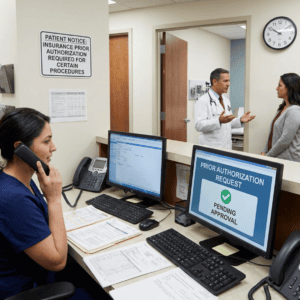
Almost every level of care above routine outpatient needs prior authorization and continued-stay reviews. Payers judge medical necessity against ASAM criteria, so the assessment has to document all six ASAM dimensions and explain why the patient needs that level of care. When an authorization covers fewer days than the patient stayed, the extra days deny, which is why authorizations have to be tracked against the census every day.
Drug Testing
Urine drug testing is part of nearly every treatment program. Presumptive screens bill as 80305 to 80307. Definitive testing bills as G0480 to G0483 for Medicare and 80320 to 80377 for many commercial plans. Payers limit how often definitive testing is covered and expect each test to be ordered for a specific clinical reason. Standing orders that test every patient for every drug at every visit are a frequent audit target. In an OTP’s Medicare bundle, drug testing is included and not billed separately. Our toxicology page covers lab-side billing.
42 CFR Part 2 and Confidentiality
Records from federally assisted substance use disorder programs are protected under 42 CFR Part 2, which is stricter than HIPAA. Updated rules now let patients sign a single consent covering treatment, payment, and health care operations, and they bring breach notification in line with HIPAA. Programs still need valid patient consent before disclosing records to a payer, and billing staff need to know which records fall under Part 2 before sending documentation for an appeal or audit.
Substance Abuse Treatment Credentialing

Prescribers
Physicians, NPs, and PAs who prescribe buprenorphine need a DEA registration that includes Schedule III in each state where they prescribe. The X-waiver ended in 2023, and DEA now requires a one-time eight hours of training on substance use disorders for new or renewing registrations. Payers verify licensure, DEA registration, board certification such as addiction medicine, and malpractice history.
Counselors and therapists
Since 2024, Medicare enrolls licensed marriage and family therapists and mental health counselors, including many licensed addiction counselors who meet the mental health counselor requirements. Counselors who don’t meet them can’t bill Medicare directly, though many Medicaid programs and commercial plans credential certified and licensed addiction counselors. Each counselor needs their own enrollment with each plan they bill. Our behavioral health page covers therapist credentialing in more detail.
Programs and facilities
Opioid treatment programs need SAMHSA certification, a DEA narcotic treatment program registration, state licensure, and accreditation from an approved body such as CARF or The Joint Commission, and they enroll with Medicare through the CMS-855B. Residential, PHP, and IOP programs need state licensure for each level of care, and many payers require accreditation before they’ll contract. Until each provider and program is approved, its services can’t be billed, which is why you can’t bill what you can’t credential.
Substance Abuse Billing FAQs
Do prescribers still need an X-waiver to prescribe buprenorphine?
No. The X-waiver was eliminated in January 2023. Any prescriber with a current DEA registration that includes Schedule III can prescribe buprenorphine for opioid use disorder, subject to state law.
How is office-based buprenorphine treatment billed?
With standard office E/M codes leveled by medical decision-making or time. For Medicare patients, practices can instead bill the monthly office-based OUD bundles G2086 to G2088.
How do opioid treatment programs bill Medicare?
Through weekly bundles, G2067 to G2080, which include the medication, dispensing, counseling, and drug testing. Add-on codes cover intake, assessments, and take-home supplies.
Does Medicare cover intensive outpatient treatment for substance use disorders?
Yes, since 2024, when delivered by an eligible hospital outpatient department, community mental health center, or other qualifying site. Medicare doesn’t cover freestanding residential treatment.
How is Vivitrol billed?
The drug bills as J2315 per milligram, and the injection bills separately as 96372.
What is 42 CFR Part 2?
The federal rule that protects records from federally assisted substance use disorder programs. Programs need patient consent before disclosing those records, including to payers for billing, audits, or appeals.
Medwave for Addiction Treatment Programs
 Addiction treatment claims depend on level of care, and payers check that the documentation supports it. Medwave bills residential, PHP, IOP, and outpatient services with the right revenue and HCPCS codes, tracks authorizations and concurrent reviews, and handles Medicare OTP bundles for methadone and buprenorphine programs. Our billing team holds addiction treatment claims to a 98% clean rate.
Facilities need state licensure, often accreditation, and enrollment for both the facility and its clinicians. Our credentialing team handles all of it, averaging 85 days for payer enrollment, and our payer contracting work targets per diem rates for each level of care.
Tell us which levels of care you offer.