

A closed panel notice usually arrives as a form letter. No explanation beyond “this network is currently closed,” no timeline, no named contact. For a lot of practices, that’s where the process ends. The application sits in a drawer, and the provider stays out of network with a payer that controls real patient volume in the area.
It doesn’t have to end there. Panels close for identifiable reasons, and most of those reasons leave real room to make a case.
Key Takeaways
Closed panels close for specific, identifiable reasons. These include mergers, budget cycles, and network saturation. Not every closed panel is worth fighting; check the fee schedule and patient volume math first. A strong appeal names the payer’s stated reason and answers it directly with data. Persistence, without pressure, keeps a practice first in line when a panel reopens.
Why Payers Close Panels
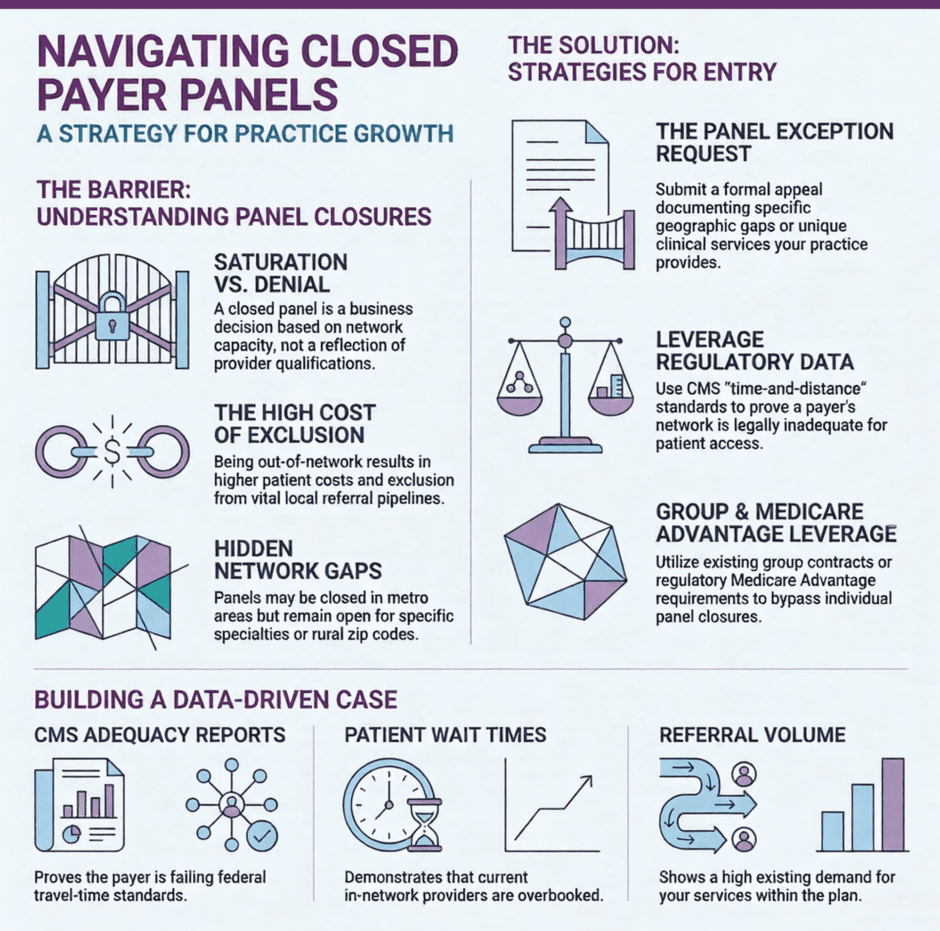
 Panel closures are rarely arbitrary. The most common drivers are network mergers, budget cycles, and network saturation. A payer merges two networks and ends up with overlapping coverage in a specialty. A budget cycle tightens and new contracts get frozen for a quarter or a year. Maybe the payer believes it already has enough providers in a specialty and zip code? This is common, we see it constantly.
Each of these opens a different door. A saturation claim can be challenged with patient demand data. A budget freeze is often temporary and worth revisiting on a set schedule. A merger-driven closure sometimes resolves on its own as the combined network settles.
Deciding Whether the Fight Is Worth It
Before committing weeks to an appeal, it’s worth running the math. Compare the payer’s fee schedule for the specialty against what the practice already collects from other contracts. Look at how much of the existing patient base is already covered, or trying to be covered, by this specific payer. A panel worth fighting for is one where the numbers justify the effort, not one that simply feels unfair to be excluded from.
Building an Appeal That Gets a Response
 A strong appeal names the specific reason the payer gave for closing the panel and answers it directly. If the stated reason was saturation, the appeal should include patient demand numbers, documented wait times, or referral volume from other in-network providers who can’t place patients elsewhere. If the reason was a network freeze, the appeal should ask directly when reviews resume and request notification.
Addressing a named decision-maker by title matters more than most practices assume. Generic submissions to a general inbox rarely get a second look, while an appeal routed to the right person at the payer has a real chance of moving.
Staying Visible After a Denial
A closed-panel denial is rarely permanent. Payer networks reopen, budgets refresh, and provider needs shift over time. Practices that stay professionally persistent, a brief check-in each quarter, an updated data point as patient volume grows, tend to be the ones contacted first when a panel does reopen. The goal isn’t pressure. It’s staying visible without becoming a nuisance.
Closed Insurance Panels FAQ
Why do insurance payers close provider panels?
Panels usually close for one of three reasons: a network merger that creates overlapping coverage, a budget cycle that freezes new contracts, or a belief that the payer already has enough providers in that specialty and zip code. Each reason points to a different path forward. A saturation claim can be challenged with demand data, a budget freeze often lifts on a schedule, and a merger-driven closure sometimes resolves once the combined network settles.
How does a practice know if fighting a closed panel is worth the effort?
Compare the payer’s fee schedule for the specialty against what the practice already collects under other contracts. Then look at how much of the current patient base is tied to or seeking coverage from that specific payer. If the numbers support it, the appeal is worth pursuing; if not, the time is better spent elsewhere.
What makes an appeal to a closed panel actually get a response?
A strong appeal names the exact reason the payer gave for closing the panel and answers it point by point. For a saturation claim, that means including patient demand numbers, wait times, or referral volume from in-network providers who can’t place patients. For a budget freeze, the appeal should directly ask when reviews resume and request notification.
Does it matter who at the payer receives the appeal?
Yes, routing the appeal to a named decision-maker by title matters far more than most practices expect. Submissions sent to a general inbox rarely get reviewed, while an appeal addressed to the right person has a real chance of being acted on.
What should a practice do after a closed-panel denial?
Closed-panel denials are rarely final, since payer networks reopen and budgets refresh over time. Practices that check in briefly each quarter and share updated data, such as growing patient volume, tend to be contacted first when a spot opens. The aim is steady visibility, not pressure.
Are all closed panel notices final decisions with no room to respond?
No, closed panel notices are typically form letters with no explanation, timeline, or named contact, but that does not mean the decision is locked in. Panels close for identifiable reasons like mergers, budget cycles, or saturation claims, and each of those reasons leaves room for a data-backed appeal.
Summary: Breaking Down Closed Insurance Panel Walls
 At Medwave, we help practices work through exactly this kind of situation every day. Closed panels aren’t rare, and they aren’t random, payers close them for reasons that are usually traceable, whether that’s a recent merger absorbing overlapping coverage, a budget cycle that’s frozen new contracts for the quarter, or a genuine belief that the network already has enough coverage in a given specialty and region. Knowing which of those applies changes the entire approach, and it’s the first thing our team works through with a practice before deciding whether an appeal is worth pursuing at all. When it is worth pursuing, we don’t submit a generic reapplication and hope for a different outcome the second time around. We start by running the actual numbers on the payer’s fee schedule and the practice’s existing patient volume, then research the payer’s internal structure to find the right decision-maker rather than routing another submission into a general inbox that may never get read. From there, we build the appeal around the payer’s stated reason for closing the panel, because an appeal that directly answers the actual objection is the one that gets a response.
When a first appeal doesn’t land, that’s rarely the end of the conversation. Payer networks shift constantly, budgets refresh, mergers settle, and provider needs change, so part of what we do is keep a practice visible to the right contact over time with periodic updates and new data points, rather than letting the application sit forgotten in a drawer.
Between our payer contracting work, medical billing, and credentialing services, we handle the full arc of what it takes to get a practice properly connected to the payers it needs, not just the initial contract, but the ongoing relationship that keeps reimbursement, network status, and revenue moving in the right direction. If a closed panel is costing your practice patients or revenue right now, we’d be glad to look at your specific situation and tell you honestly whether it’s worth fighting and what that fight would actually look like.
We have a lot of payer representative relationships and have for over 25 years. Reach out to our team below to get started.