

Physicians face mounting administrative burdens that contribute significantly to burnout and diminished well-being. Among these burdens, the repetitive process of medical credentialing stands out as a particular pain point. The current credentialing system is fragmented and time-intensive, and it takes physicians away from patient care while adding unnecessary stress to their professional lives. Rebuilding credentialing applications and processes is a tangible opportunity to reduce administrative burden and support physician well-being while maintaining the safeguards quality care requires.
Key Takeaway
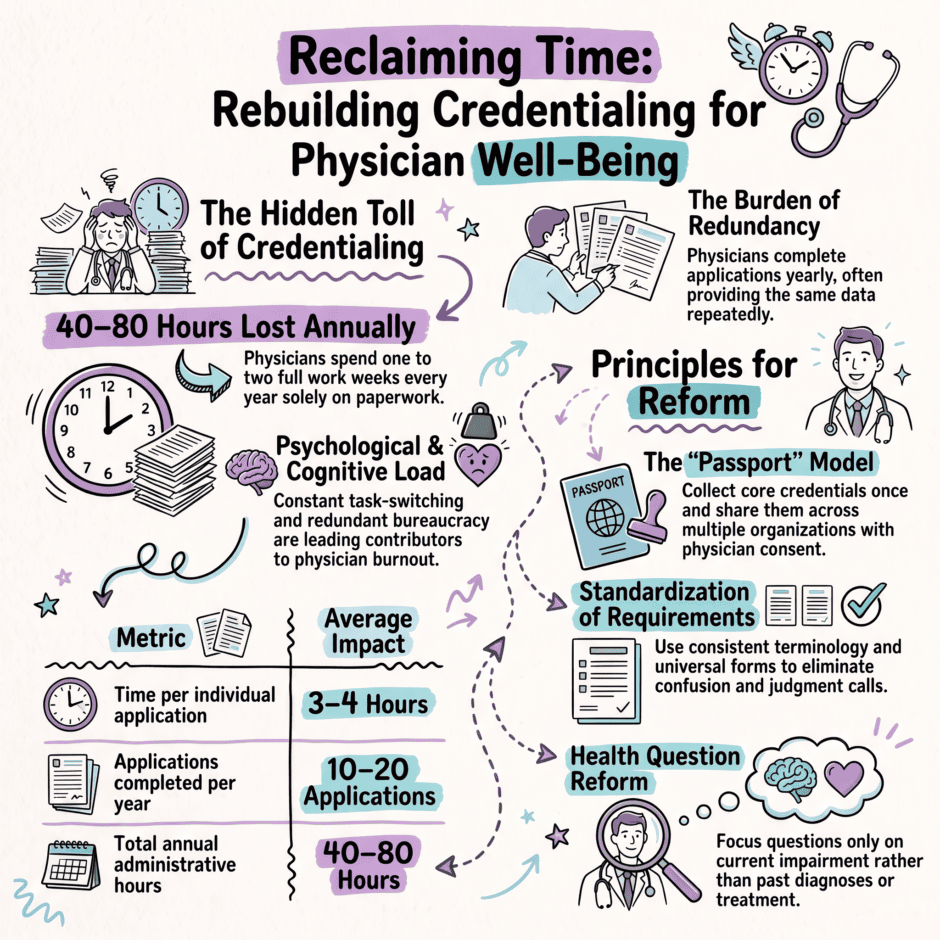
Credentialing applications are one of the most fixable sources of physician administrative burden. The average physician completes 10 or more separate applications a year, most of them asking for the same information in different formats. Well-being-conscious redesign means collecting information once, standardizing terminology, asking only clinically relevant health questions, and giving physicians visibility into where their application stands. Models like CAQH DataSpring, FCVS, and regional credentialing verification organizations already show this is possible at scale.
Why Does Credentialing Create So Much Administrative Burden for Physicians?
Medical credentialing exists to verify that healthcare providers have the qualifications, training, and clean record necessary to deliver safe care. That function is essential. The problem is how it has been implemented. A difficult process that places heavy demands on physicians’ time and mental bandwidth.
A typical physician holds privileges at multiple healthcare facilities and participates in numerous insurance networks, each with its own credentialing application and renewal timeline. These entities collect largely identical information but rarely coordinate their processes, so physicians repeatedly provide the same education history, training details, work experience, and licensing data in slightly different formats for each organization.
Beyond the paperwork itself, credentialing creates cognitive load through tracking multiple deadlines and renewal cycles, keeping current copies of licenses and CME records, recalling details from training programs completed years earlier, moving between unfamiliar online portals, and responding to repetitive verification and follow-up requests. The persistent demand to document and re-document qualifications can feel undermining to physicians who have already spent years earning their professional standing.
How Much Time Do Credentialing Applications Actually Cost Physicians?
Industry estimates place the time cost of a single credentialing application in the range of several hours, and physicians in active practice typically complete more than a dozen applications across facilities and payers each year. For a physician already working long clinical weeks, that additional load lands squarely on evenings, weekends, or time that would otherwise go to patient care or personal recovery.
The task-switching between clinical work and administrative paperwork creates its own kind of fatigue, separate from the hours themselves. Anxiety about missing a deadline or submitting incomplete information adds another layer of stress, and physicians who practice across state lines or multiple facilities feel this multiplied several times over.
What Well-Being Impacts Come From Redundant Credentialing Paperwork?
Burdensome credentialing processes affect physician well-being in ways that go beyond simple frustration. Administrative burden is a well-documented contributor to physician burnout, and credentialing represents a substantial share of that burden industry-wide.
Time spent on paperwork during evenings and weekends comes directly out of time that would otherwise support rest, family, or recovery. The demoralizing effect of redundant bureaucracy compounds this: physicians enter medicine to help patients, and being pulled away from that purpose to complete forms disconnected from patient care reinforces cynicism rather than professional satisfaction.
These impacts extend past the individual physician. Burned-out physicians are more likely to cut clinical hours, leave practice, or make errors, which means inefficient credentialing processes work against the very quality and safety standards credentialing exists to protect.
What Are the Specific Pain Points in Today’s Credentialing Applications?
Before a credentialing application can be rebuilt, the specific sources of friction need to be named clearly.
Redundant Information Collection
The most visible issue is redundancy. Physicians repeatedly provide basic information, name, demographics, education, and training history, that rarely changes. Verification processes run in parallel across organizations, each independently contacting the same primary sources for the same facts.
Intrusive Health Questions
Many applications include health history questions that are overly broad and legally risky to ask in that form. A question like “have you ever been treated for a mental health condition” discourages physicians from seeking care they need, out of fear it will show up on a future application.
Inconsistent Terminology and Requirements
Different organizations define terms like “disciplinary action,” “investigation,” or “impairment” differently. A disclosure that one application requires might not be required on another, forcing physicians into judgment calls with real consequences attached.
Opaque Processes and Timelines
Many credentialing systems give little visibility into application status, expected processing time, or the reason for a delay. That uncertainty is its own source of stress, especially when a physician’s ability to bill depends on the outcome.
Technological Barriers
Despite available digital tools, many credentialing systems still run on outdated interfaces or non-interoperable electronic forms, forcing physicians to manually re-enter the same data across platforms that could otherwise talk to each other.
Excessive Documentation Requirements
Requirements to document activities from years in the past, detailed residency case logs or exact locum tenens dates from a decade earlier, create difficulty that is out of proportion to their value in assessing current competence.
What Does a Well-Being-Conscious Credentialing Process Look Like?
Rebuilding credentialing with physician well-being in mind does not mean lowering the bar on verification. It means designing systems that verify qualifications while cutting unnecessary friction.
Collect once, use many times. Information that rarely changes, education history, training details, past employment, should be collected once and shared across organizations with the physician’s consent. This “passport model” lets organizations focus verification effort on new information instead of re-checking the same credentials repeatedly.
Standardize requirements and terminology. Consistent definitions and formats across credentialing bodies would let physicians maintain a single set of responses usable across multiple organizations.
Focus on relevant information. Credentialing should weigh information that actually relates to a physician’s ability to provide safe care in their specific practice setting, and de-emphasize historical detail with little bearing on current competence.
Ask appropriate health questions. Health questions should focus narrowly on current impairment affecting the ability to practice safely, not on diagnoses or past treatment history. This aligns with ADA guidance and removes a disincentive to seeking care.
Use technology as a simplifier, not a barrier. Digital systems should offer intuitive interfaces, pre-population of known information, interoperability between platforms, and secure data sharing.
Provide transparency and support. Clear timelines, status updates, and access to knowledgeable staff who can answer process questions all reduce the uncertainty that drives stress.
What Credentialing Models and Innovations Are Already Reducing Burden?
Several existing models show that a lower-burden credentialing system is achievable at scale, each with a different scope.
| Model | What It Solves | Where It Falls Short |
|---|---|---|
| Federation Credentials Verification Service (FCVS) | Lifetime credential repository shareable with state licensing boards | Limited to state licensing, not facility credentialing or payer enrollment |
| CAQH DataSpring (formerly CAQH ProView) | Single-entry provider data form shared across participating health plans | Not universally adopted by every payer or facility |
| State "clean credentialing application" laws | Standardized information requirements and maximum processing timelines | Varies significantly by state |
| Regional Credentials Verification Organizations (CVOs) | Primary source verification shared across multiple facilities in one market | Regional in scope, not national |
| Blockchain-based digital credentials | Tamper-proof, portable verification records | Still early-stage; interoperability standards still forming |
The DataSpring CAQH system lets physicians enter their information once into a standard form shared with multiple health plans. Medwave built a CAQH DataSpring intake form specifically to capture the variables providers and groups need for that process.
Regional Credentials Verification Organizations (CVOs) perform primary source verification for multiple facilities within a geographic market, reducing duplicated effort while keeping oversight in place. Meanwhile, digital verification technology is beginning to offer secure, portable digital credentials that could reduce the need for repeated primary source checks altogether.
How Can Healthcare Organizations, Payers, and Physicians Fix This Together?
Rebuilding credentialing around well-being takes coordinated action across every stakeholder in the process, not a single fix from any one party.
Healthcare organizations can run time-motion studies to find specific pain points, cut requirements that exceed regulatory minimums, adopt technology that reduces manual entry, build fast-track paths for recredentialing providers already in good standing, and coordinate credentialing across affiliated facilities.
Health plans and payers can participate in standardized provider data systems like CAQH DataSpring, accept hospital verification for shared data elements, use delegated credentialing arrangements with trusted provider organizations, and give physicians transparent timelines and status updates.
Medical associations can keep pushing for legislative reform, build consensus standards for appropriate health questions, create resources that help physicians move through credentialing efficiently, and partner with technology vendors on physician-friendly system design.
Regulatory bodies and accreditors, including state licensing boards and national accrediting organizations, can harmonize requirements across jurisdictions, focus on outcomes rather than process documentation, and weigh administrative burden explicitly when writing new standards.
Physicians can document specific pain points as they encounter them, take part in pilot programs testing new approaches, advocate through professional societies, and keep personal systems organized so credentialing information is ready when the next application arrives.
What’s the Business Case for Fixing Credentialing Applications?
Beyond the well-being argument, there’s a straightforward business case for reform. Physicians lose productive time that could go toward patient care. Healthcare organizations maintain credentialing departments and absorb delays getting new providers onto staff. Health plans carry the administrative cost of running separate verification processes instead of sharing one standardized system. And the healthcare system as a whole absorbs the downstream cost of burnout, turnover, and reduced provider capacity.
Streamlining credentialing does not require a full system overhaul to produce results. Practical, incremental changes, standardizing terminology, adopting shared data systems, cutting redundant documentation, produce measurable time savings without asking any organization to lower its verification standards.
How Medwave Helps Reduce Credentialing Burden
Medwave’s medical credentialing team manages the application and renewal process directly with facilities and payers, so physicians aren’t the ones re-entering the same information across a dozen portals. That includes CAQH DataSpring maintenance, primary source verification coordination, and tracking deadlines before they become urgent.
Credentialing rarely happens in isolation from the rest of a practice’s revenue cycle. Timely credentialing affects when a provider can start billing, which connects directly to payer contracting timelines and the accuracy of ongoing medical billing once the provider is in-network.
Credentialing Application Rebuilds FAQ
What is the biggest source of credentialing-related burnout for physicians?
Redundancy is the biggest driver. Physicians provide largely identical information, education, training, licensing, work history, to multiple organizations that don’t coordinate, so the same data gets re-entered in slightly different formats over and over.
How long does credentialing typically take per application?
Timelines vary by facility and payer, but most credentialing applications take several hours of physician time to complete, plus additional weeks for primary source verification and payer review before the process is finalized.
What is CAQH DataSpring?
CAQH DataSpring (formerly CAQH ProView) is a provider data system that lets physicians enter their information once and share it with multiple participating health plans, reducing the need to fill out separate forms for each payer.
Are health history questions on credentialing applications legal?
Health questions must be narrowly tied to current ability to practice safely under the Americans with Disabilities Act. Broad questions about past diagnoses or treatment history, rather than current impairment, raise legal and well-being concerns.
Can outsourcing credentialing reduce physician administrative burden?
Yes. Outsourcing the application, tracking, and renewal process to a credentialing team removes the redundant data entry and deadline tracking from the physician’s plate while keeping the verification standards intact.
Why is medical credentialing so time-consuming?
Because each facility and payer runs its own verification process against the same primary sources, with little coordination or data sharing between them, physicians end up repeating the same steps multiple times per year.
What is the passport model in credentialing?
It’s an approach where a physician’s core credentials are verified once and then shared, with consent, across multiple organizations, rather than each organization independently re-verifying the same information.
Does credentialing burden affect patient care?
Indirectly, yes. Time and stress spent on credentialing paperwork is time and energy not available for patient care or physician recovery, and it contributes to the kind of burnout linked to reduced clinical hours and higher error rates.
 Summary: Redesigning Credentialing Applications to Protect Physician Well-Being
 Summary: Redesigning Credentialing Applications to Protect Physician Well-Being
Rebuilding credentialing applications is one of the more practical fixes available for physician administrative burden. It does not require reinventing verification standards, only removing the redundancy, inconsistent terminology, and outdated technology that make the process harder than it needs to be.
For practices working through this directly, Medwave’s medical credentialing services, payer contracting support, and medical billing management work together to keep providers credentialed, contracted, and paid without the paperwork bottleneck landing back on the physician.
Contact us below, we can assist your medical practice in designing smarter applications.

Co-Founder and COO of Medwave, bringing more than 25 years of hands-on experience in healthcare revenue cycle management, payer contracting, and medical credentialing.